PopUpAdventurePlay are organising their annual Campference (online) on 15th Oct from 7am to 11am, co-hosted by the Black River Innovation Campus in Vermont, USA with multi-lingual presentations from Costa Rica, Turkey, Hong Kong and more. There will be a pre-campference get together tomorrow (15th Oct at 7am)
Tag: playwork
Play in Hospitals webinars
https://www.starlight.org.uk/play-in-hospital-week-webinars/
Anyone with an interest in Play and Playwork in hospitals might be interested in this series of 4 webinars:
13th Oct 12.30 to 1.30: Working for change in hospitals
18th Oct 2 to 3: Prioritising play after lockdown
26th Oct 12 to 1: Playing with virtual reality
2nd Nov: Play for mental health and resilience
The webinars are being organised by Starlight in partnership with the National Association of Health Play Specialists to celebrate
Playwork Foundation Open Meeting
Will Cardiff Bay speak up for play after election day?

Tomorrow is set to be a bumper election day in Great Britain!
In England alone, there will be local council elections, mayoral elections, Mayor of London elections, London Assembly elections and Police & Crime Commissioner* elections. Some of these are elections that were postponed in 2020 due to the outbreak of COVID-19.
*Police & Crime Commissioner elections will also be taking place in Wales. Did you know that Wales and England share a single jurisdiction but have two legislatures? Something unique in the world.
As if that wasn’t enough elections for one day, there will also be a Senedd Cymru/Welsh Parliament election and a Scottish Parliamentary election. This article will look at the Senedd elections – fellow Trustee, Ann-marie, has written a piece on the Scottish Parliamentary election which you can read here. If you’re unfamiliar, this short video explains the powers of the Senedd.
This year’s Senedd election is nothing short of historic! Thanks to the ‘Senedd Election Act 2020’, 16 and 17 year-olds will be able to vote for the first time as well as an estimated 33,000 foreign nationals gaining the right to vote – this represents the biggest expansion of the franchise since 1969, when suffrage was extended to 18 to 21 year-olds, and will undoubtedly impact on the results of the election.
So, what do the parties say about play and playwork for #Senedd2021?
Whilst a number of parties have progressive manifesto promises for children and young people, only the Wales Green Party and Welsh Liberal Democrats specifically reference “play”, albeit in the context of early years education in both cases. Questions to Plaid Cymru leader, Adam Price, on play, also returned responses linking to education and early years. Despite no mention of it in their manifesto, it could be argued that, as it was a Welsh Labour Government that produced The Children and Families (Wales) Measure 2010, that gave us the Play Sufficiency Duty, and their record in supporting play in recent years, that Labour will likely continue this commitment.
Whatever the party-political make-up of the new Welsh parliament and government next week, a number of organisations have made it clear to all of them what they believe should be done to protect the rights of children in Wales, including their right to play.
First, we look at our national play board, Play Wales, and their manifesto “Wales – a play friendly place”. The headline asks are for the continuation of the Play Sufficiency Duty and for the opportunities for children to play to “increase and improve”. The dominance of the motor vehicle is addressed, with recommendations for default 20mph speed limits in built-up areas and government-mandated guidance for street play projects. Looking at schools, Play Wales propose a mandatory minimum time for “play breaks” within the school day and also ask for consideration, wherever practical, to making outdoor school grounds available for play after school and at weekends. Play Wales also call for a public campaign that not only explains what play is but also communicates the health and wellbeing benefits for children and wider society.
The Children’s Commissioner for Wales’s Manifesto briefly mentions play, asking for “more youth and play services that anyone can use, for free”. However it does go a little further by giving a vision of the future with “free adventure playgrounds all over the country”! This year will see the end of the current Commissioner’s tenure – we hope that the next Commissioner will be just as welcoming to play and playwork as Sally has been.
Clybiau Plant Cymru Kids’ Club appear to be the only organisation making very specific representations on behalf of playworkers. Specifically, they call for: the “continued investment in professionalisation of the sector” via funding, CPD and access to training and qualifications; recognition of playworkers’ influence on children’s lives and the Welsh economy to be “recognised in all government communications and policy decisions”; parity with Early Years workers through an “active and effective sector skills council”; and a call for more initiatives that support fair remuneration for playworkers (e.g. tax-free childcare, the childcare offer and 100% rates relief).
The Play Sufficiency Duty and legislation like the world-first Well-being of Future Generations Act, are indicative of how progressive governments can make a real difference to children and young people’s lives in a meaningful and sustainable way and on a national scale. However, any incoming Welsh Government will still be restricted by the allocation of funding set by the UK Government and by the reservation of powers over aspects of media, health and safety legislation, employment and regulation of charities.
In the coming months, The Playwork Foundation will be revisiting ‘A Manifesto for Play: Policy proposals for children’s play in England’ that was written in partnership with Play England and IPA England ahead of the 2019 UK General Election. Taking into consideration the composition of the new parliaments and governments in Wales and Scotland following national elections, and the shifting of the political map in England as a result of local elections, we hope to present a vision for the future of playwork that can influence and encourage each nation of the UK to not only recognise the profession but utilise our expertise and practice to the benefit of children and young people in every corner of Great Britain and Northern Ireland.
If you’re living in Wales and wondering who to vote for, the BBC have put together this guide, or, for those in Scotland and England voting this Thursday, you can find out about all the elections, candidates and parties by visiting https://whocanivotefor.co.uk/
Siôn Edwards
All-Wales Playworkers Forum, 2020
by Simon Bazley
The All Wales Playworkers Forum has been running since 2007. Orginally established by Play Wales to provide a forum for those working in adventure playgrounds it has evolved to meet the needs of the sector. The Playworkers Forum is run by a dedicated steering group of playworkers, for playworkers. In the past a number of regional play associations took it in turns to administer the event with our collective aim being to keep the costs as low as possible, whilst bringing as many playworkers as possible together to share information, network and recharge our batteries. More recently, with the sad closure of the vast majority of the regional associations, Play Wales have taken over administration of the event on behalf of the sector, with the steering group working hard to keep things fresh and exciting for all participants from year to year.
Over the years we have toured around Wales, from as far south as the Gower Peninsula to as far north as Hawarden. We’ve made temporary homes in orchards, willow globes and big tops and generally we have almost always had the weather on our side. Anyone who’s ever attended will be fully aware of how much of a special event it has become in the playwork calendar. As our infrastructure has changed here in Wales, the forum has also been opened up to anyone from across the UK and it has brought playworkers together to share their unique experiences and support each other. The event has always been an overnighter, with participants camping out under the stars and often sat up into the small hours gazing at the glowing embers of our fire and putting the world to rights.
Over the years we’ve been lucky to attract some of the best playwork trainers, speakers and academics and they have all really helped to make the event what it is. We tend to have a blend of theoretical and practical sessions, normally focussed around an emerging or current hot topic. One of the annual highlights is without a doubt the ‘Annual Playwork Games’ hosted by Martin King-Sheard. Two teams of goblins and elves compete in a head to head to find out who will be crowned champions for the year ahead.
This years event was somewhat different from previous years, due to the lockdowns that sadly made meeting in person impossible. Instead, to ensure that we maintained continuity we all came together on 24th June 2020 for an online book club that was organised and facilitated by Play Wales. It was so much of a success that they are now continuing these for free as a monthly professional development opportunity for play and playwork professionals in Wales. Each month they select a freely available online paper, article or other publication relating to play and playwork for you to read and then you can join an hour’s discussion and reflection on the content. All Book Club meetings are held on the Zoom online meeting platform. More information is available here.
In the first book club, participants discussed the Play Wales guidance paper ‘dynamic risk management of common but potentially hazardous play behaviours’. This paper was written by Mike Barclay, Dave Bullough and Simon Bazley. The paper is available for free download here.
The event was facilitated by Martin King-Sheard and Marianne Mannello from Play Wales, who also ran a ‘Q and A’ session with one of the papers authors, Simon Bazley. The successful event was then followed by an online version of the playworker games where contestants competed to find out who would be crowned champions for 2020. It was a close call with competitors racing around their houses to undertake a series of challenges and games. In the end the mighty elves came through victorious once again, just beating the goblins in the last game.
Anyone interested in attending future events should keep an eye out on the Play Wales website as we hope to be back to meeting in person once again in 2021 if local and national restrictions allow.
Simon Bazley
Questions to a playworker…
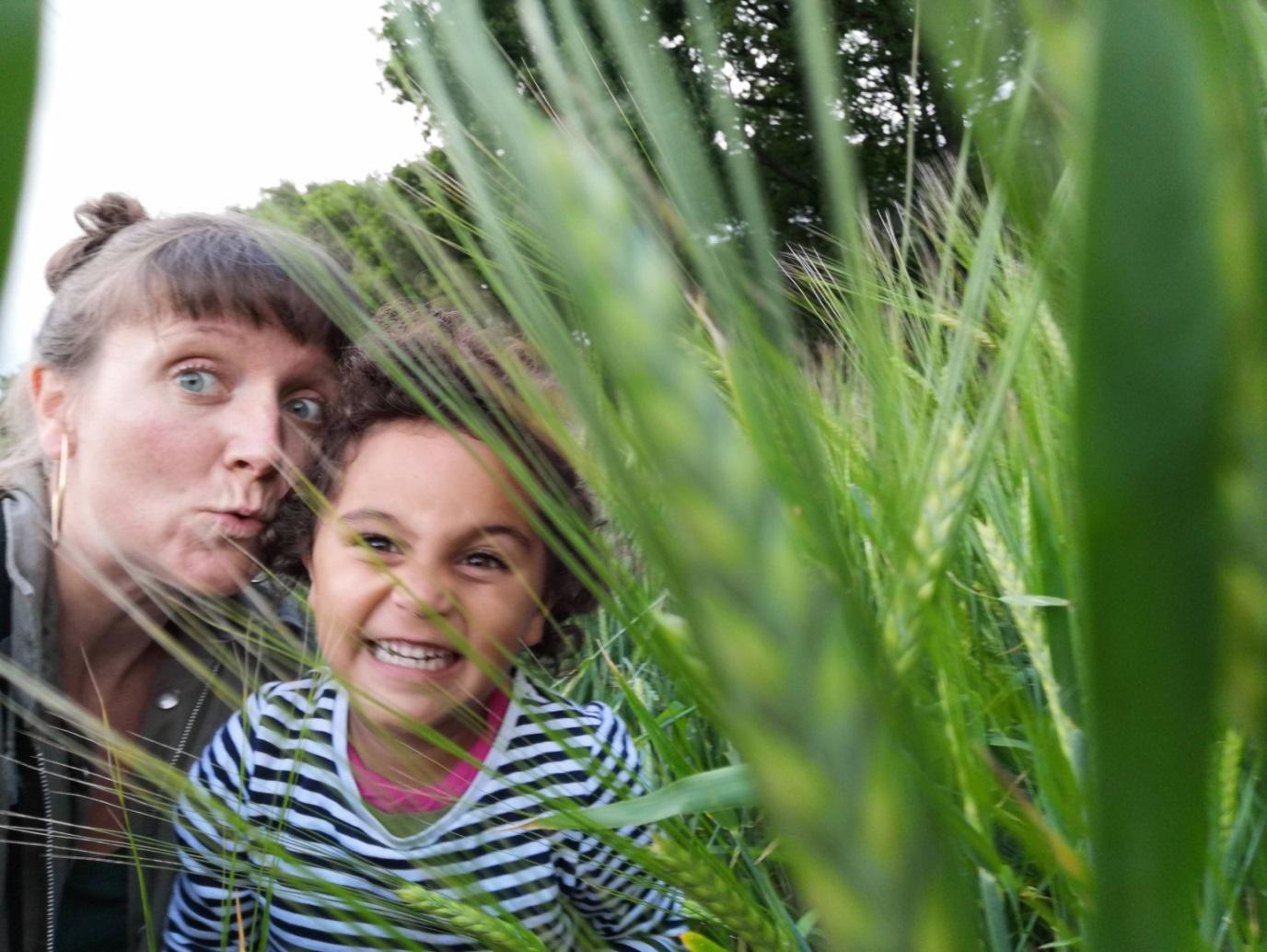
Adele Cleaver trained as a playworker in Birmingham back in 2010. She calls herself “a nomadic Brummie” who after dabbling in playful adventures and community work in Leeds, London and Birmingham and Ghana, Portugal, Brazil, Uganda and Kenya now resides in Bournemouth on the south coast of England with her 4-year-old daughter and husband.
In November 2019 she started writing her first book which she describes as a part-memoir, part-manifesto on living a life full of play. She writes “accidentally stumbling into playwork was going to be the best voyage I was ever going to embark on”. We asked her a few questions about her playwork journey.
How did you become a playworker?
I think I was born a playworker. It just took me a long time to realise my way of being could also be a profession. My home was like a free play environment; a laidback pair of almost hippies for parents with 4 children, over 12-year age gap each with their respective friends over to play, and a multicultural backdrop beyond our doorstep. My mom was a teacher though openly criticised “the system” and longed for the 6 weeks holidays and my dad worked in Social Inclusion for the NHS so I was brought up to live inclusively, be weary of hierarchy and play freely. I went to the University of Leeds to study International Development because when I was 18 I naively thought I could save the world. I moved back to Birmingham and worked at a local youth project as a Youth Worker where I bumped into Laura Watts one of the radical women who founded Dens of Equality. She worked in the building next door, and took me under her wing because the youth project just wasn’t rebellious enough for me. After a few months of bid-writing and setting up family-led play projects around Birmingham, Laura sent me off to play with Ali Wood and Sue Smith and they turned me into a proper playworker with a capital P and a certificate to prove it.
Are you working on a play project in Bournemouth?
Yes, currently myself; I am my own play priority! The first few years of motherhood and juggling the chaos that a tiny new life brings reminded me that I needed to play more. Playful parents breed playful children so I’ve been prioritising us at home.
But even before motherhood, I took a rest from play when we moved out of London in 2014; not intentionally but because playworker jobs didn’t seem to exist down here. I needed work, couldn’t afford to be fussy so without giving it much thought ditched the play. I was an Autism Support Worker for a few years before I had my daughter and always tried to work more playfully, but there was no real understanding of play in the organisations I worked for. I felt I had become very institutionalised so I contacted The Prince’s Trust and set up a greetings card business with their support to learn new skills and feed my own creativity.

When I was pregnant we very almost moved to Bristol because I knew we could live more playfully there as a new family but I had fallen in love swimming in sea at the end of our road. So we stayed put and have started rooting here. I often described Dorset as a “play desert”. Apart from Fernheath Play as the little oasis, there isn’t much opportunity for playwork here. After I had my daughter I did Admin at a creative youth project locally in Bournemouth. I could see the glaringly obvious gap in the service provision; these young people weren’t accessing community play as children so they were being referred to us through CAMHS because there are no early intervention projects. I couldn’t handle office work so I left and decided to focus on building up Play here.
So now I am setting up, very slowly, a Community Interest Company called Real Playful. I am running a series of Family Nature Play sessions in collaboration with a local community garden this winter. I am super excited that so many families local to Boscombe are interested; all the workshops were fully booked within days. Then my next big job is to source playful people and train them up as playworkers so I am currently completing a very tedious application for employability funding. I’m really just relying on my book to become an international bestseller (any agents reading, please call me!!), I’ll be made a millionaire overnight and voila! I can fund all sorts of magical community play projects here, there and everywhere.
Where is your favourite place to play?
Hmmm, it varies. This year I have really genuinely loved being at home, playing in my PJs, all day with my daughter. Lockdown was good for us in that sense because I am a sociable being, and I like to be out and about, but the unstructured, timeless play got priority over my need to be with people. I thoroughly enjoyed being locked away in our own little adventure playground; it was necessary escapism! But if you’d asked me last year I would have said outdoors in the community. Big outdoor community play, mixed ages, multigenerational, loads of loose parts, street closures of festivals of play, neighbours laughing together, cups of tea being brought out onto the doorstep. I love the big colourful pop up play sessions I used to create with Parks 4 Play in Birmingham. It was physically demanding work, lugging tonnes of resources around Kings Heath park but it was so magical. That’s the sort of play I want to bring to Boscombe.
Where do you play outdoors?
Well we don’t have much of a garden except a little front hedge area which is big enough for a mud kitchen and my bicycle. I am not complaining, we live opposite a small charismatic Victorian park and 800m from the beach! 9 miles of glorious sand and a view over to the Purbeck Hills. I’ve always lived in cities and this is the closest I have ever lived to nature; life is good here even though I can only experience vibrant community play in my imagination…. I must remind myself that good things come to those who experience vibrant community play in their imagination!
I still really love going back to Brum and playing in my parent’s overgrown garden when I played as a child. I’m a proper city kid through and through, in terms of my exposure to diversity, multiculturalism and the arts, but I played and played and played in that garden and have a lot of happy memories. For as long as I remember my parents have fixed everything, and kept things ‘just in case they will be useful to fix other things….’ so their garden has always been full of loose parts. It is great, but also kind of a strange time-warp-come-parallel-universe to see my daughter explore freely with all the random stuff I did thirty years earlier.
If you could live in any era, when would you choose?
When people could play and cycle out on the roads without it being dangerous. I joined the Playing Out Activator group at the start of the year, just before lockdown and was so excited to hear of all these communities regularly playing out. And then through lockdown I was campaigning for “Quiet Streets” to be our “legacy of lockdown” in Bournemouth, Christchurch and Poole (BCP Council) but Highways wouldn’t give us permission. It is so frustrating; without much publicity over 30 residents had expressed an interest, around 10 streets had self-organised stewards, signs and safety kits, but the powers-at-be just wouldn’t give the green light. It is so obvious to me that community playfulness is good for everyone; my council don’t use the same glasses I do.
What is your favourite word?
I am a linguist so I have 3! In English “Chaos”. Quelquefois (French for “sometimes”) and Bochechas (“cheeks” in Portuguese).
What did you want to be when you were growing up?
Ohhh good question! An author, an artist and an architect. I think I’m almost there. I have just finished my first book, just need to get it published to make me a “real author”. Everyone is an artist, and those with confidence capitalise the A to make them official Artists and I build splendid dens so I guess that makes me an Architect. If I could go back to university I would definitely study urban design, architecture or planning; something to build more community play spaces in cities. Maybe I will go back to university…. Who knows?!
Finally, tell us a little bit about your book.
It is a part-memoir, part-manifesto about prioritising playtime for new parents and gifting our children unstructured family time. I write from my heart about inclusion, playful encounters in playwork settings, my own childhood play, playful parenting in Cuba and Montreal, miscarriage and multiculturalism.
Connect with Adele
therealplayfulmama@gmail.com
Facebook – Real Playful – Pop Up Community Play
Instagram the_real_playful_mama
Twitter @Adeleplayworker
And if you have any connections to the literary world please help her to circulate her proposal!
Playwork in the North East steps up to the Covid challenge

Jackie Boldon, a new trustee of the Playwork Foundation, describes some of the different ways that organisations in the North East have responded to children’s need and right to play in Newcastle and North Tyneside:
Elswick Lamp Post Play Project
Playworkers from Play in Newcastle ran multiple projects across Newcastle in different school and community venues this summer, funded by the Department of Education’s Fit and Fed initiative through Street Games. In Elswick, the Play in Newcastle playworkers ran an estate based “Lamp Post Play Project”, with games, creative activities, dance and challenges over 7 Wednesdays of the summer holidays. On week one, the playworkers were shocked by the huge amounts of litter and fly-tipping which was seen as a barrier to children’s outdoor play. With a bit of pressure, the Council carried out a “clean up”, which was greatly appreciated by all residents and enabled children living on the estate to play safely outdoors every day. All the children who engaged with the Lamp Post Play project received a backpack with activity cards and play resources to provide them with new play ideas over the summer. (These can be found here)
The children had great fun and parents and grandparents were very appreciative of the Lamp Post Play Project. The playworkers have been asked to set up a year-round kids club. The project was supported by Hawthorn School, West End Schools Trust, Sussed and Able and the West End Children’s Community.
YMCA Lamp Post Play Project
A second Lamp Post Play Project was run by the YMCA in North Tyneside. With BBC Children in Need funding, children who would have attended a school-based after school and holiday club were offered creative play activities on their doorstep. Children were desperate for someone new to talk to and to support their play and parents were very grateful for the respite. The scheme ran for 4 weeks.
As soon as World War Two broke out, YMCAs developed mobile canteens to bring refreshments to the troops. In the same spirit, YMCA North Tyneside is now doing its bit to help bring a little joy to children’s lives during the Covid 19 crisis. During the lockdown, many children have been confined to their homes and denied access to their friends. Even now, it is still difficult for many organisations to open their doors to children to enable them to meet and play. So, in order to combat this, YMCA North Tyneside, funded by Children in Need and inspired by Jackie Bolden has decided to take their play provision to the children’s door steps. Adhering to social distancing requirements, YMCAs play workers, armed with their box of tricks, present themselves at door steps. They then engage children in a range of fun and creative activities. After an hour or so, they then move on to another door step and so on.
‘The response has been fantastic. The children have loved the activities on their doorsteps and it has been heartening to hear them talk about their lock down experiences. Equally, parents have welcomed the play workers presence and have urged them to return’
— Don Irving, Youth and Play Manager YMCA North Tyneside.
‘The doorstep sessions that the YMCA have been running are amazing. The children always look forward to Carlie and Demi from the YMCA arriving. My children are so proud of the various things they make and cant wait to the next time the workers come back. (Mr Roy Oliver…parent)
A comment from one of the children from another family referring to the YMCA workers: –
‘We have interesting chats and they listen to my feelings. They make us laugh and cheer us up…its great
(Sophie aged 10)
Another parent;- Leigh Johnson says ‘ My children really looked forward to the YMCA workers coming to see the girls. They sit at the bottom of the front garden and take part in the activities. As well as the company, they chat about the lockdown period and what it has meant to them’
Benwell Playful Lives Project – Newcastle
Children in the Benwell area of Newcastle have been supported by a team of playworkers from the regional charity – Children North East to play outside their own homes over the summer, in family bubbles for 45 minute long free play session. Some children benefitted from as many as 6 sessions over 4 weeks of the school holidays. The children and parents had great fun inventing imaginary games and engaging in all types of play. This pilot project was supported by the Extended Schools Officer from Bridgewater School who coordinated the referral process and was funded through Street Games by the Department of Education. Jackie Boldon from Sussed and Able provided playwork training and advice. See the full story here
The Power of Playful Lives
Three-year-old Lyla is waiting in anticipation for our Playful Lives project workers, Lorna and Paula and student social worker, Lauren, to turn up.
It’s an overcast day but this hasn’t dampened anyone’s enthusiasm. As soon as the team walk through the garden gate, Lyla and her two brothers, Joseph, six and Thomas, five, run up to them shouting suggestions of what to play first.
The boys can’t wait to play tag whilst Lyla, full of bounce, heads for the trampoline with Lauren, It’s a welcome break for their mam, Lisa, who admits she finds keeping three children under six entertained 24/7 a bit of a stretch.
“Playful Lives has been great because the children have had no interaction with anyone other than me,” says Lisa, who is a teaching assistant at a local school.
I love them and they love me but they must be sick of me by now! Just the fact that there’s three extra pairs of hands here today – even for just half an hour to an hour – it’s brilliant.
The family has been shielding since March and the start of the Coronavirus lockdown due to Joseph’s asthma. “We’ve actually only been out three times since the 17 March,” Lisa says.
The last time the Playful Lives team was here, they used old cardboard boxes to make a pirate ship with the children. This session has a loose theme of ‘physical play’ so it’s running round the garden playing tag and hide and seek.
Playful Lives is a new Children North East project and part of Newcastle City Council’s Best Summer Ever, a holiday activity scheme aimed at supporting the city’s five to 18-year-olds during the school holidays.
Our charity is working closely with the West End Schools Trust, a charitable educational trust formed by eight primary schools, and other partners to create a multi-agency Children’s Community in this part of the city. There’ll also be an ongoing research element to the work overseen by Newcastle University. Schools like Bridgewater Primary have recommended families who feel they could benefit from the Playful Lives project to engage with our team.
Andrew and Shirley’s family have also enjoyed the project. They have two daughters, Maddison, who’s nine and Tamzin, ten. “This has kept the kids really entertained and they look forward to them coming,” Shirley says.
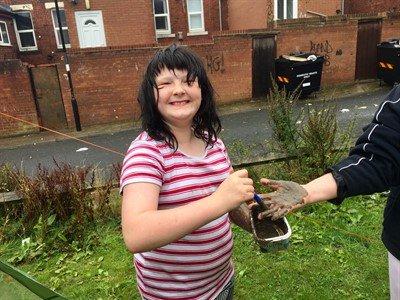
On the day we visit, it’s tanking down with rain so Andrew has put up a big family tent on ground next to their house. Tamzin, who is being assessed for an attention deficit disorder, loves messy play so Lorna suggests making ‘mud paint’ and Tamzin gets set digging a hole. “We like to demonstrate that it doesn’t have to cost lots of money to keep children occupied and engaged,” Lorna explains.
Whilst Maddison experiments with coloured painting inside the tent, Tamzin makes mud handprints before persuading mam to have her hands and face painted – with mud!
Andrew stands by enjoying the spectacle. “I was into everything like this when I was young – mud fights and making dens with cut grass. The street was full of kids. I don’t think kids get the chance to use their imagination so much any more because they’re so used to the electronic age. So things like Playful Lives is great with people like yourselves coming out and showing that they can get involved.”
Playful Lives worker, Paula, who, along with other Playful Lives staff, benefited from training with a freelance playwork specialist, Jackie Boldon, says the project has been a big hit with families this summer.
Playful Lives has given children the opportunity to engage in different activities together as a family whilst having fun in a safe environment. The interaction with different people – our team members – has had a positive effect on helping the children with their transition back to school and it has decreased isolation for the families by giving them something to look forward to outside of the family home.
Jackie Boldon
* For more information about Playful Lives please contact the team by email: lorna.nicoll@children-ne.org.uk
Playwork in Progress – new session announced
Online: 31 August, 2 – 3 pm
Following the success of the first Playwork in Progress online reflective practice session, we’re back with the 2nd session on Monday 31st August, 2 – 3pm.
This is a chance for playworkers from across the UK (and, who knows, beyond!) to come together and share their experiences of playwork in this “new normal”, the barriers you face, and your plans for the future.
To secure your place, book your free ticket now.
(Spaces are limited so please make sure you let us know if you book a place and are subsequently unable to attend).
We recognise that this may not be the most convenient day and time for everyone so we’re planning for future sessions already. To have your say, please complete one of the following surveys:
- If you attended the first session please complete this survey.
- If you’ve not been able to join us but would like to in the future, please complete this survey.
To keep up with the conversation, please like the public Facebook Page (and follow ‘Playwork in Progress’ on Instagram and Twitter.
This is open to both members and non-members of The Playwork Foundation, so please feel free to share this post with any of your playwork colleagues who may be interested in taking part.
Thank you!
As lockdown eases, what children, families, AND teachers now desperately need is a great Summer of Play – but who will provide it?

The cautious optimism among play advocates in recent weeks, that the Covid-19 pandemic may lead to a fundamental re-evaluation of what is most important for children, their families, and communities, was given a cold reality check on Sunday, when the UK’s most progressive mainstream newspaper, the Guardian/Observer, dedicated its entire editorial to an 8-point ‘manifesto for children’ without once mentioning their need to play. It is an illustration (again) of how lowly children’s own priorities are within the national debate about what is best for them.
At the start of the lockdown nobody was too surprised, in the circumstances, that the government’s response to an open letter from more than 40 play researchers, practitioners, and advocates asking for ‘clear advice’ about outdoor play, merely reiterated that we all must ‘focus on preventing the spread of Covid-19 (and) protecting the most vulnerable in society’. When the government’s only other stated priority was ‘offering support to those impacted by social-distancing, including companies and employees’, it was clear that the sudden constraints on space and opportunity for children to play was not going to be even a secondary issue for ministers.
‘There is little evidence that children’s profound need to play has received any more consideration. How lowly their own priorities are within the national debate about what is best for them’.
Now, as we move towards a substantial easing of the lockdown, these fears are born out. Children’s profound need to play has received little or no consideration from the government.
Researchers concerned
Some eminent researchers, including the ‘Play First’ alliance, have expressed serious concerns about the effect that a lack of play opportunities is having on children’s mental health, and called on the government to ease lockdown ‘in a way that provides all children with the time and opportunity to play with peers, in and outside of school … even while social distancing measures remain in place’. Others have specifically called for a nationwide plan to repurpose residential streets for play during lockdown and beyond.
The four national UK play organisations have endorsed a report from the Play Safety Forum calling for the government’s approach to be ‘urgently reviewed’ on the basis that the current policy ‘completely ignores’ the benefits of outdoor play to children (especially at a time of stress and uncertainty), while the risks of infection are ‘very low’.
Strong words
These are strong words, and necessarily so. The government in Westminster has indeed ignored children’s play as a policy issue ever since it first came to power on 2010, in spite of long recognising it as such. Having abandoned the Play Strategy for England, it believes local authorities should make their own policies for play, but has starved them of the cash that most of them would need to do anything meaningful, at the same time as deregulating both planning and childcare in ways that relegate children’s play to the status of an optional extra.
‘For children the overwhelming priority is playing with their friends’.
Now, however, would be the moment to think again. Millions of parents, teachers and children are stressed, tired and seriously unhappy after a full term-and-a-half trying to keep up with the curriculum via variable on-line platforms and ad hoc home-schooling, without receiving any of the ‘softer’ benefits of being part of the school community. For children this overwhelmingly means playing with their friends.
The government has announced a ‘Covid catch-up’ package for primary and secondary schools to support children returning to school in September to recover lost ground, and has also said that providers running holiday clubs and activities for children over the summer holiday will be able to open ‘if the science allows’ (although the guidance on this seems to be delayed). The relative importance attached to these two measures? £1 billion is allocated to the former, zero to the latter, which is conceived primarily as a service to parents – who will no doubt have to cover the cost themselves. For many, many children – the same children for whom the £1b catch-up fund is designed – this will mean summer play schemes are unaffordable. In turn, many independent providers will be unable to operate – which puts an additional pressure on schools, just as they need the mother of all breaks.
A play recovery fund
The answer is obvious. A discreet ‘play recovery’ fund should be established, in consultation with the play and playwork sectors, to enable non-school based holiday play schemes to be offered free of charge in the areas that will need them most. And the government should also talk to Playing Out, its network of street play activators, and the growing number of local authorities who now support temporary street closures for play, to consider an expanded national programme of street play sessions over the summer.
Some will think such an idea cavalier: that children’s outdoor play is simply too random and chaotic to observe any kind of public health protocols, even with the distancing requirements relaxed. But even if the Play Safety Forum’s persuasive risk-benefit assessment is disregarded, the government should know that the playwork field is highly professional, and always resourceful. Whatever the safety measures might need to be, no one will be better at engaging with children to follow them than playworkers.
Playwork responds to the crisis
For a field seriously depleted after 10 years of austerity, deregulation, and (in England) policy neglect, the field rallied well to respond to the crisis – in spite of some of its fundamental tenets seeming completely untenable in a public health emergency that demands distance, isolation, and regimentation. Playwork practitioners and advocates have offered timely guidance on how to sustain play opportunities through the lockdown, including playing at home. Adventure playgrounds have reached out to offer relational space and support to communities whose physical playgrounds were closed, and some practitioners have given new meaning to the term face-to-face playwork by taking it to the online platforms with which we are all now so familiar.
Play England and the great playwork theorist, Bob Hughes, have set out some wise words and good practical advice on ‘Play after Lockdown’. But first, in this time of national crisis, with families desperately needing a break before a return to the new normal – many of them unable to go away because of increased job insecurity or unemployment – the country needs the play sector to step up and do what it does best: give our kids space and support to have a good time. From within the billions that this terrible pandemic has cost the economy, is a few million for a well-deserved and badly needed Summer of Play, too much to expect? At the very least, the Observer should include it in its manifesto.
Adrian Voce
This blog was first published on policyforplay.com
Birmingham adventure playgrounds featured in oral history project
General Public’s Oral Histories has launched part one of it’s Let Us Play project, an investigation of the ‘state of play’ today. Initially this involves the collation of an archive of material to capture the Birmingham adventure playground movement of the 1960-1980’s (funded by The National Lottery Heritage Fund).
This will be followed by a wider ‘live period’ of events and exhibitions in 2021/22. This has been initiated through an Arts Council R&D grant. This has seen the development of a new piece of moving image work, a Sparkbrook adventure playground digital trail/app, mapping of play in the city from the 1960’s through to the present day, collaborations with academics at UoB and developing a series of creative play weeks/exhibitions in close proximity to the old playground sites.
Photo: Meriden Adventure Playground
Visit the Let Us Play project here

