Playworkers for Peace

Today, on the International Day of Play, we are reminded that play is not an optional extra but a fundamental right. Today is a global moment to insist that children everywhere should have safe, inclusive places to play. This year’s theme – Protect play, protect childhood – asks us to centre play as a public good and to use the language of safety and belonging when talking about the right to play.
However, on this, the third International Day of Play, it is impossible not to reflect on the many acts and circumstances around the world that undermine any sense of safety and belonging – not just for children, but entire communities or even countries. In pondering what I might write today, I found myself referring to an unexpected document.

The International Play Association’s Play in Crisis guidance was written for parents and carers in a pandemic, but reading it afresh today, I wonder if it might also guide playworkers too, in these turbulent times. The booklet states plainly that “Playing helps children stay physically and mental well. It is an everyday part of a healthy and happy childhood”. It also reminds us that “Playing is one way children deal with stress and cope with the situation they’re in” – the professional reasons we protect play when the world around us feels fractured.

The IPA document asks adults to give children space and time, to observe before intervening, to accept difficult themes in play, and to use play as a way of making sense of frightening events. In our practice, we’re reminded to: protect uninterrupted playtime; offer materials that invite all types of symbolic and messy play; listen and reflect before intervening if necessary; and hold children’s enactments or expressions of fear, loss or anger as meaningful work rather than behaviour to be suppressed or corrected.
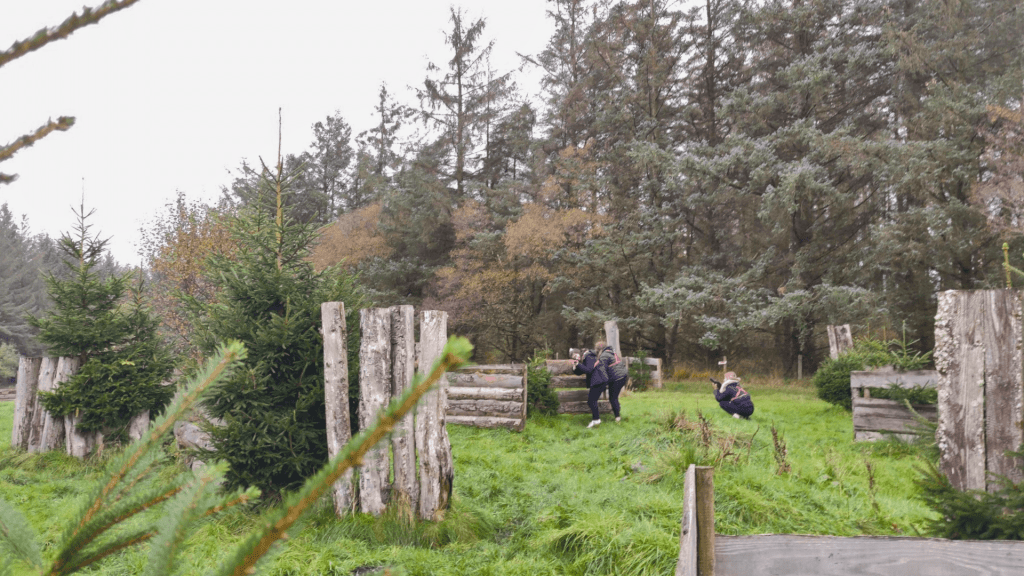
We know that when children stage battles, build barricades, or create worlds divided into “us” and “them”, they are not being deliberately provocative, necessarily. They may be trying to understand what they cannot yet name. The IPA guidance normalises this: it tells us that acting out themes of loss, illness, loneliness or conflict is part of how children process upheaval. In practice, our response must be to hold that play with curiosity and steadiness – to protect the conditions in which it can be explored safely, and to use it as a bridge to reassurance and repair.

This year, the play we see in our settings will carry the marks of local and global pressures: the violence in Belfast; the tensions stirred by the ‘Raise the Flags’ movement; the war in Gaza; a rise in antisemitism; the far-right mobilisation following the tragic death of Henry Nowak; and the increase in anti-LGBTQ+ hostility during Pride Month. These are all different in scale and history, but they share an effect: they make children feel less secure in their communities and more anxious about their future and where they belong.
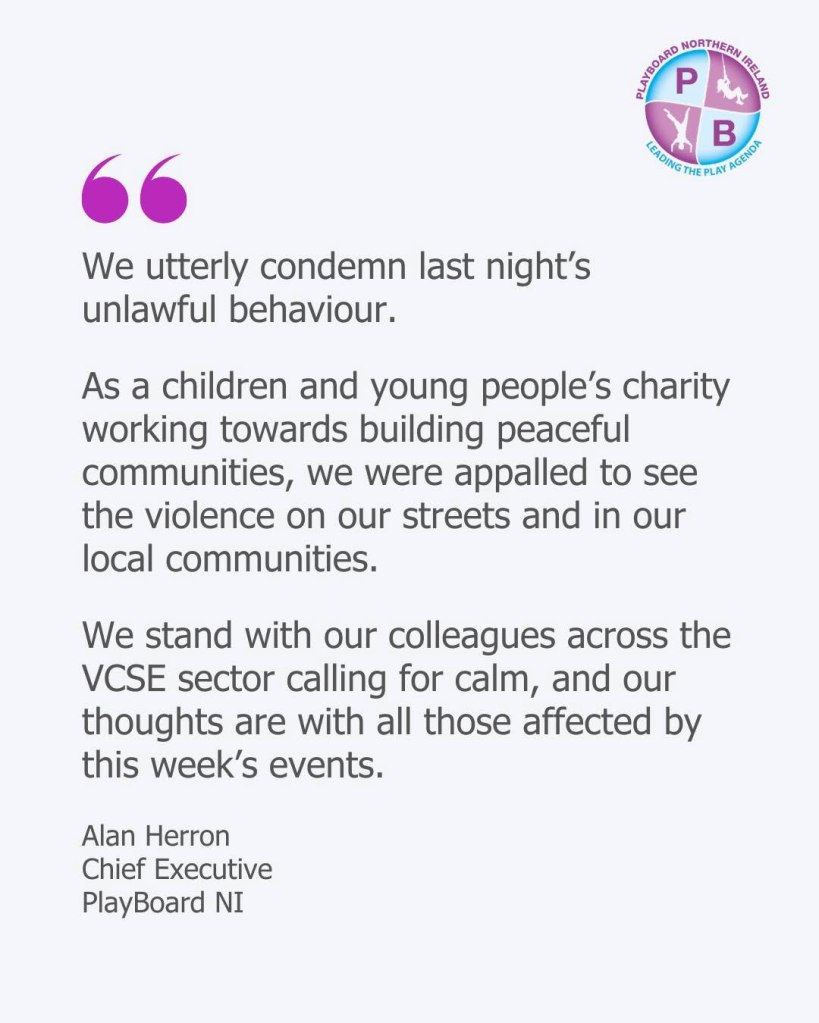
10/06/26: PlayBoard Northern Ireland post to Facebook

Playworkers are not outside this. We are part of the same communities; we carry the same histories and the same wounds. The IPA booklet’s honesty about adults – that our feelings influence how we respond to children’s play – is a timely reminder of the Playwork Principles:

7.  Playworkers recognise their own impact on the play space and also the impact of children and young people’s play on the playworker.

We must acknowledge our own fatigue, fear and anger, because only by recognising them can we prevent those feelings from adulterating children’s play or from colouring our interventions in ways that curtail the therapeutic nature of play.

I’m sure many of you, like me, feel quite helpless in knowing what “to do”. I have heard wonderful accounts of playwork colleagues right on the frontline, helping families in crisis in real practical ways. But that is not always possible. So, what can we do today just through our practice?

If we take the IPA toolkit as our frame, the work of playworkers becomes a set of everyday acts of peace. These acts are practical and small, but they are cumulative and powerful. They include keeping routines where possible; protecting time and space for play; offering materials that invite repair and transformation; listening to children’s stories and questions; modelling inclusive language and behaviour; and intervening to stop harassment or exclusion when it appears.

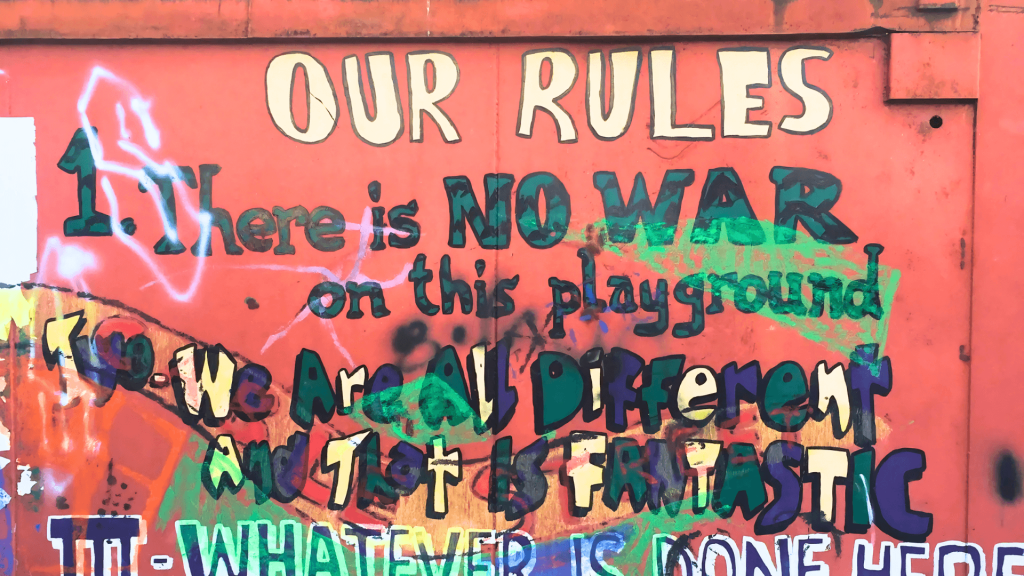
There is a line painted on a shipping container at Glamis Adventure Playground that reads, “These are our Rules. There is no war here. We are all different, and that is fantastic”. We create micro-worlds where difference is welcomed and where children can practise being together without the hierarchies and hostilities they may see elsewhere. That is peace-building in the most literal sense.
International Day of Play gives us a public opportunity to amplify these practices. Use today to share simple, rights-based messages with families: explain why play matters in crisis, offer a few practical tips from the IPA toolkit about observing before intervening, and signpost resources for families who need extra support. Share images and short reflections that show play as a place of belonging rather than a place of division.

To pick my Top 3 messages for today: play is a right; play helps children make sense of fear; playwork is a practice of inclusion.

Penny Wilson’s original call for Playworkers for Peace asked for a banner under which playworkers could gather – not to solve geopolitics, but to declare a shared commitment. Today, on International Day of Play, that call feels urgent again. We cannot resolve every conflict, nor should we pretend that play alone will heal structural injustice. But we can do what we do best: create spaces where children can be children, where difference is treated as a resource, and where safety and dignity are non-negotiable.

Let us protect play, protect childhood, and in doing so practise peace in the places where it matters most.

Playworkers for Peace. Anyone in?
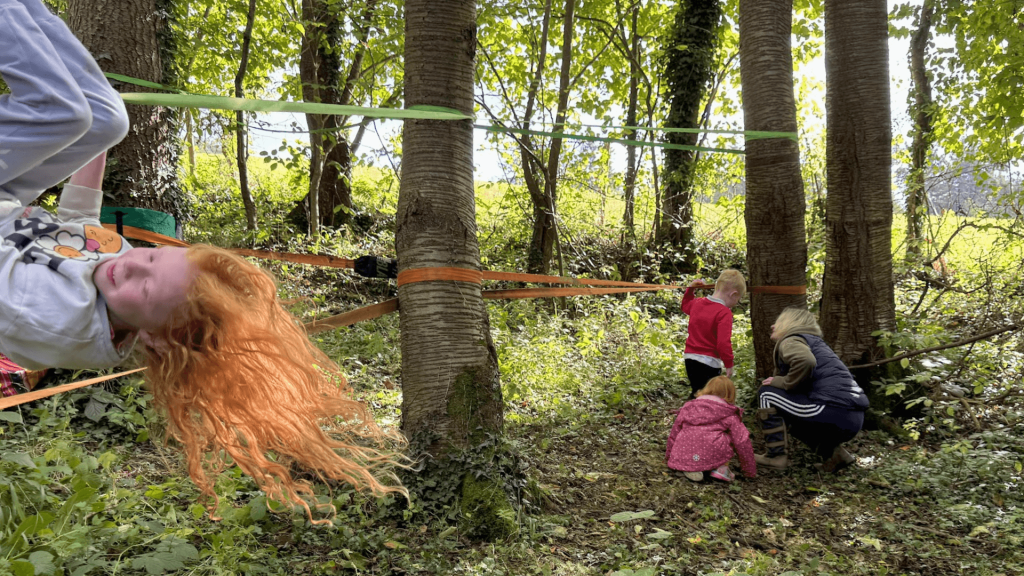
Time for a new adventure?

This month we’re sharing not one but two opportunities on adventure playgrounds in Hackney and Portsmouth.

Senior Playworker – Hackney Marsh Adventure Playground (12‑month FTC)

Young Hackney is recruiting for a Senior Playworker to join the team at Hackney Marsh Adventure Playground on a 12-month fixed-term contract / secondment, covering maternity leave.

About the role

The Senior Playworker will support the planning, delivery and evaluation of high‑quality adventure play provision, including:

  • Developing term-time and holiday provision
  • Supporting the day-to-day running of the playground, including staff oversight, site safety, safeguarding and resource management
  • Deputising for the Play Manager when required
  • Helping maintain a safe, creative and continually evolving play environment
  • Carrying out structure inspections, repairs and maintenance
  • Championing anti‑oppressive, anti‑racist and inclusive practice

This is a hands-on, outdoor role, involving fire and water play, structure building, arts and crafts, sports, gardening, trips and residentials. Unsurprisingly, the postholder will work outdoors all year round and in all weather conditions.

Hours and contract

36 hours per week, including evenings and weekends during term time.

Winter term time: Tue – Fri 10:45-19:30, Sat 10:45-16:15

Summer term time: Tue-Fri 11:00-19:45, Sat 10:45-16:15

School holidays: Mon-Fri 09:30-17:45

Closing date: 31 May 2026

Ways to apply

Hackney Council website

LinkedIn

Guardian Jobs

For an informal conversation about the role, contact simeon.marriottdixon@hackney.gov.uk.

Deputy Playground Manager – Portsmouth City Council

Earlier this month we also shared that Portsmouth City Council is recruiting a full-time Deputy Playground Manager to work across its six adventure playgrounds.

Each playground team includes four playworkers, one of whom is the Playground Manager. In the Manager’s absence, the Deputy Playground Managers share responsibility for the site, staff, safeguarding and the day‑to‑day running of the playground.

Outside of opening hours, teams spend time:

  • maintaining and developing the site
  • planning and reflecting on delivery
  • responding to safeguarding needs
  • completing training
  • engaging with other agencies and the community
  • supporting other playgrounds across the city

It’s a substantial, hands-on role within a long-established adventure playground service.

For more information visit the Portsmouth City Council website: https://searchjobs.portsmouth.gov.uk/jobs/job/Deputy-Playground-Manager/1421.

Playwork NOS Consultation Now Open

The UK Playwork National Occupational Standards (NOS) Consortium has opened the sector‑wide consultation on the draft Playwork NOS. This consultation marks a major milestone in the long‑term effort to strengthen and modernise the standards that underpin playwork qualifications, training and professional expectations across Great Britain and Northern Ireland.

As a member of the Consortium, The Playwork Foundation strongly encourages practitioners, managers, trainers, organisations and partners to take part. See the latest information sheet below:

The review is being carried out by the UK Playwork NOS Consortium – consisting of Play Wales, Play Scotland, PlayBoard Northern Ireland, Play England and The Playwork Foundation – working closely with the four Playwork Education and Training Councils (PETCs). The Consortium has been meeting since 2021 to plan strategically for the future of workforce development and sector skills.

The formal review process began in early 2025. Since then, the Consortium has:

  • RAG‑rated all existing NOS
  • Identified standards requiring revision or replacement
  • Drafted new standards across three job roles
  • Developed a new Functional Map
  • Produced a comprehensive Glossary to support clarity and consistency

This work has been shaped by research, scoping exercises and conversations with playworkers and playwork organisations. Key themes emerging from this engagement include:

  • a focus on playwork as an approach – playworking
  • recognition that playwork happens in many places and spaces
  • the need for streamlined, clearer standards
  • reaffirmation that the Playwork Principles remain intrinsic to all NOS

The draft suite includes standards for:

  • Support Playworker
  • Playworker
  • Playwork Manager

Additional optional units include:

  • food and drink provision
  • travel outside the setting
  • playwork constructions
  • additional support needs
  • leadership preparation
  • community development
  • quality assurance
  • financial management
  • recruitment

Alongside the draft NOS, the Consortium has produced a glossary to support shared understanding across Great Britain and Northern Ireland. It includes definitions for key concepts like:

  • Accessible play spaces“barrier‑free… offering participation opportunities for a range of differing abilities”
  • Additional support needs – recognising that needs may be short-term, long-term or intermittent, and do not require a diagnosis.
  • Inclusive playwork practice – removing physical, social, cultural and organisational barriers so all children can shape their own play.
  • Playwork approach“supporting and facilitating play as described by the Playwork Principles”
  • Observation, reflection and reflective practice – central processes for understanding and supporting children’s play.

The Glossary also acknowledges variations in terminology across Great Britain and Northern Ireland and provides clarity where multiple terms are in use.

How to Take Part

Complete the consultation response form.

Open from 9 March to 1 May 2026.

You can access the draft NOS, Functional Map and Glossary via:

Consultation Webinars

The Consortium is hosting webinars across the four nations to:

  • explain the review process
  • explore the Functional Map
  • discuss the draft standards
  • gather early feedback

If you cannot attend your respecgtive session, you are welcome to join any of the others.

Webinar dates:

NationDateTime
Scotland18/03/2610:00–12:00
Wales18/02/2613:00–15:00
England24/03/2618:30–20:30
Northern Ireland27/03/2610:00–12:00

The Playwork Foundation will host a catch-all session in April based on the feedback and participation at each of the national play organisations’ events, and to take a multi-national perspective.

Then what?

After the consultation closes, the Consortium and Writing Group will:

  • review all feedback
  • refine and finalise the NOS
  • publish a consultation report
  • release the final NOS in June 2026, in Welsh and English

Awarding Bodies and Awarding Organisations will then begin re‑mapping or redeveloping playwork qualifications.

Why Your Voice Matters

National Occupational Standards shape:

  • qualification frameworks
  • training and CPD
  • job descriptions
  • organisational policies
  • workforce development strategies

This review is a rare opportunity for the sector to shape the standards that will define playwork practice across Great Britain and Northern Ireland. The Playwork Foundation encourages all practitioners, organisations and partners to take part.

Your insight, experience and expertise are essential.

For questions about the consultation or webinars, contact: nosreview@play.wales

New £500,000 Adventure Playground Fund Announced

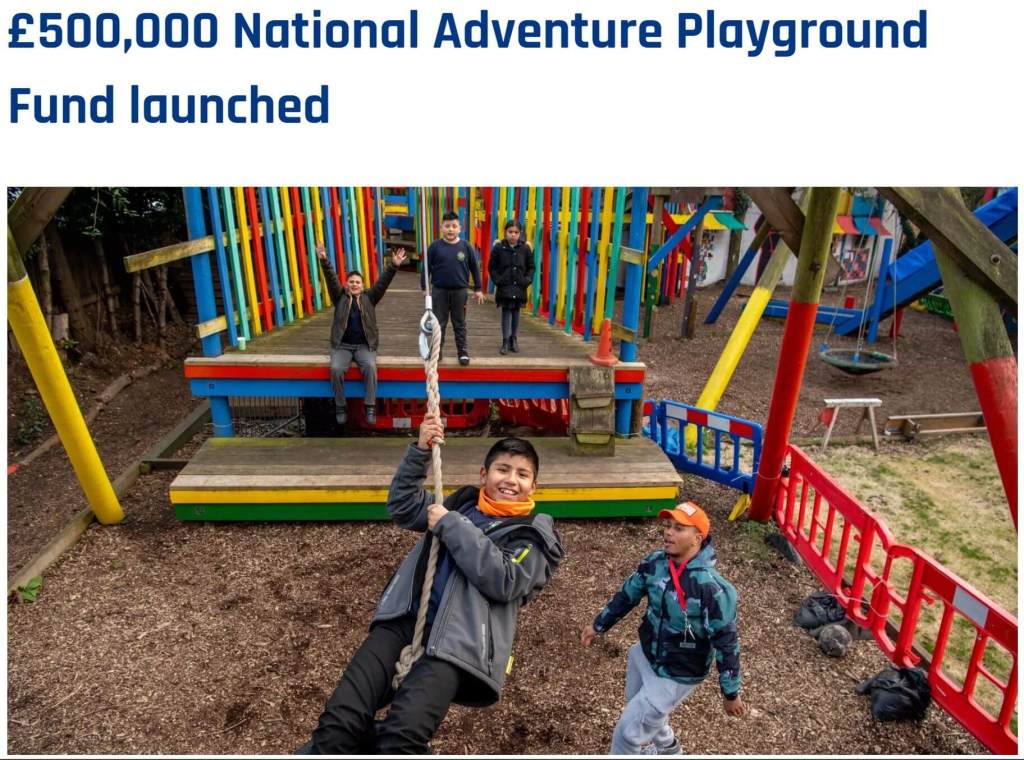
A new £500,000 fund has been established to support staffed adventure playgrounds in England, offering grants of £20,000 – £50,000 to enhance child-led play in low-income communities. Applications close 20/03/26.

A new £500,000 philanthropic fund has been announced to support staffed adventure playgrounds in England. The fund is made possible through a personal donation from philanthropist Alex Gerko, founder of XTX Markets, whose charitable work spans education, science, and community initiatives.

The focus on staffed adventure playgrounds reflects a growing recognition of the unique role these spaces play in children’s lives.

What the fund offers

The fund provides unrestricted grants of £20,000–£50,000, alongside sustainability support for successful applicants. To be eligible, playgrounds must be:

  • staffed by skilled playworkers
  • free‑of‑charge
  • places where children can come and go as they wish
  • committed to child‑led play

Successful applicants will also take part in four one‑hour sessions designed to strengthen long‑term resilience.

The application asks for information about opening hours, attendance, land or site arrangements, reserves, and the main challenges they face.

Applications close at 12 noon on Friday 20/03/26 – full details on the Adventure Playground Fund website.

Play England announced the fund as a national programme aimed at protecting, restoring and growing staffed adventure playgrounds – highlighting that the fund will prioritise playgrounds in low-income communities and those experiencing financial pressure.

They emphasised that staffed adventure playgrounds are not discretionary amenities but distinct, staffed spaces where children shape their own play with the support of skilled playworkers. They highlighted the contribution these spaces make to independence, inclusion and year-round community connection.

At the same time, Play England noted that many adventure playgrounds have faced sustained financial pressure as local authority budgets have tightened. Provision has reduced in some areas, and several sites remain at risk.

Play England framed the fund as a welcome step within a broader picture: a contribution toward restoring and protecting staffed adventure playgrounds, and a sign that national recognition and investment may be beginning to align with long-standing sector advocacy.

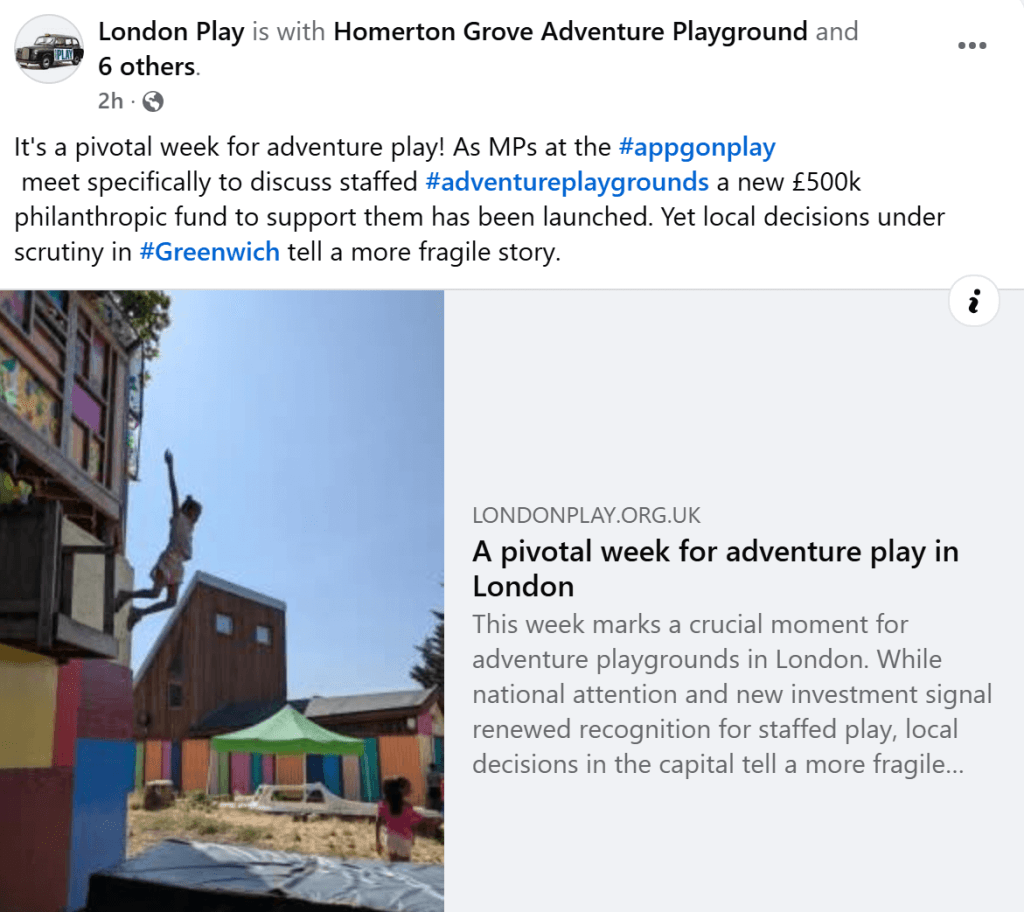
“A Pivotal Week for Adventure Play…”

London Play also welcomed the national attention and investment while similarly highlighting the fragility of local provision in the English capital – in particular the recent proposals to close or downgrade several staffed playgrounds in Greenwich.

This cautious optimism is echoed in the comments sections, with some expressing appreciation for the fund whilst also stating that £500,000 wouldn’t solve the long‑term structural pressures facing the sector.

Nevertheless, the hope is that this donation – in tandem with the parliamentary attention at this week’s All-Party Parliamentary Group on Play meeting on adventure playgrounds and playwork – will help build a broader recognition and attract future investment.

Any funding directed specifically toward staffed provision is a positive development, particularly at a time when many adventure playgrounds and other community-based playwork providers face uncertainty.

As ever, we will continue to support where we can by sharing information and evidence, and helping ensure that the value of staffed playwork provision – guided by the Playwork Principles – remains visible in national, inter-national and local decision-making.

This post was written by Siôn Edwards – current Chair of The Playwork Foundation – and represents his personal views and not necessarily those of The Playwork Foundation itself, or its Board of Trustees.

Cool Enough to Care – A Playworker’s Guide to Extreme Heat & Hot Weather

Playworkers across these islands are in the thrust of arguably the busiest times of the year, and usually the warmest.

Whether you chalk it up to global warming or chalkier theories, hotter summers are no longer anomalies – they’re becoming part of the seasonal rhythm. As heat becomes less exceptional and more expected, the clickbait tips will fade – but the need for thoughtful, place-based guidance will only grow.

So, with the help of Stockholm-based playworker Suzanne Axelsson, we’ve compiled some facts, figures, and field-tested strategies to help you not only respond to high temperatures, but anticipate them – in your budgets, your resources, and your site design.

Too Hot to Play – The facts at a glance

Children are at risk of burns when surface temperatures exceed 50℃, or when skin is exposed to 45℃ for long periods. Surface temperatures above 50℃ can cause severe burns in seconds – especially on young skin.

Playground surfaces and equipment (particularly plastic) can reach these high temperatures on bright, dry days in the high twenties. Slides, poles, guardrails, swing seats, barriers, tabletops, decking and slabs are just some examples of the surfaces that can pose a burn risk when exposed to direct sunlight in these temperatures.

Top tips:

  • Test surface temperatures before each play session, including flooring.
  • If you don’t have a thermometer, use a hand test: if you can’t keep your hand comfortably on the surface for 5 seconds, it’s too hot for play!
  • Recheck temperatures throughout the day. Using a timed checklist can help monitoring during hot spells.

Prevention

  • Avoid south-facing equipment (especially slides) to limit sun exposure during peak heat.
  • Offer natural shade – trees can cool surrounding areas by up to 8℃ – and consider cooling surfaces down with water.
  • Use natural materials. Synthetic grass and rubber surfacing can burn children’s feet, especially darker colours.
  • On hot days, encourage children to keep shoes on and avoid prolonged contact with hot surfaces, including when kneeling or sitting.

Heat hacks

Keep hydrated:
  • Make sure there is access to drinking water.
  • Sweating is the body’s way of keeping cool (and it’s pretty effective), but water lost through sweating needs to be replaced, which is why keeping hydrated is so important.
  • Some children won’t realise they’re dehydrated, so reminders will help.
  • Add a little fruit juice or cordial to encourage those who “don’t like” water to stay hydrated.
  • Cucumbers, tomatoes, oranges and watermelon are all good ways to keep hydrated.
  • Electrolytes help to stay hydrated – these are found naturally in coconut water, milk, fruit juices, and smoothies.
  • Ice-lollies are better than ice-cream for cooling off – the milk and creamy fats of the ice cream use energy to digest, increasing your body temperature.
Keep cool:
  • If you have a choice, play outside early in the day and late in the afternoon to avoid the worst UV radiation at midday.
  • Lots of locomotor play going on? It’s not the playworker way, but try encouraging breaks in the shade to bring down core temperature and rehydrate.
  • Fans can bring immediate relief to sweaty faces, but they also speed-up dehydration(!), so make sure there’s plenty of drinking water. Misting sprays are a good choice.
  • Water fight! Nothing cools better than water, but do consider the environmental impact of excessive water use (and your water bill!).
  • Cool-rags (wet cloth), wet towels and bandannas help cool hot bodies down.
  • Create foot baths to cool warm feet. Do check if you need to consider extra infection-control measures based on where you are: UKHSA (England); Public Health Agency (Northern Ireland); Public Health Scotland; Public Health Wales).
  • Encourage children to wear loose, light-weight, light-coloured clothes. Caps and hats can protect from harmful UV rays, but they can also increase body temperature, so encourage time in the shade to take them off.
  • Encourage everyone to sun cream for UV protection.

Heat, humidity & health

Humidity is how much water vapour in the air.

Low humidity means surfaces will feel hotter. But high humidity makes it harder to regulate body heat increasing the risk of heat-related illnesses, like heat exhaustion and heat stroke.

These heat-related illnesses can be serious and potentially life-threatening. They can also be brought on or intensified by physical activity.

Hydration and cooling down the body are the key to treatment and recovery from such illnesses. Recognising the signs and symptoms early will help avoid serious illness.

Below is a unified checklist drawing on NHS (England), nidirect (Northern Ireland), NHS Inform (Scotland) and Public Health Wales guidance:

Heat Exhaustion (early stage)
  • Excessive sweating
  • Pale, clammy skin or development of heat rash
  • Muscle cramps in arms, legs or abdomen
  • Intense thirst and dry mouth
  • Weakness or fatigue
  • Headache or throbbing headache
  • Nausea, vomiting or feeling sick
  • Dizziness or light-headedness
  • Rapid heartbeat (tachycardia) and fast breathing (tachypnea)
  • Dark or reduced urine output (sign of dehydration)
Heatstroke (advanced stage; medical emergency)
  • Core body temperature above 40 ℃ (104 ℉)
  • Skin that may feel hot and dry—or paradoxically cold/clammy—despite high temperature
  • Altered mental state: confusion, irritability, aggressive behaviour, hallucinations
  • Slurred speech or gross lack of coordination
  • Seizures or convulsions
  • Fainting, loss of consciousness or collapse
  • Extreme lethargy or sudden sleepiness
  • Loss of balance or falling down
  • Feeling chills or rigors
  • Absence of sweating despite feeling overheated

Children will react to heat in different ways. Some are more susceptible to heat than others.

Children with excess body weight, who have congenital conditions, or who are taking medication could be at increased risk of negative effects.

Even age can have an impact. For example, children under four years of age are at an increased risk because younger children produce more metabolic heat, are less able to sweat, and have core temperatures that rise faster during dehydration.

Disabilities and health needs may also play a role in the impact of heat extremes.

Having Fun in the Heat

  • Instead of gathering around the campfire, congregate around the camp-pool – find some shade and have a shared pamper-sesh with you feet in soothing, cooling waters. Maybe offer some slower activities to encourage rest (e.g., art & craft, finger string games or board games) or set-up some hammocks.
  • Murder She Soaked – swap chalk and crime scene tape for the cooling spray of a hose-pipe. Lie on the floor or sit against a wall, and use your body create a dry silhouette. Wet clothes will help cool off.
  • Jur-ICE-ic Park – submerge dinosaurs or other “artifacts” in water and place in the freezer overnight. Once frozen, give your budding paleontologists toffee hammers or other suitable utensils to slowly chip away at these cold (and cooling) time capsules – watch out for ice burn by holding for too long.
  • Curate a cool art exhibit – add non-toxic paint to water and freeze overnight Now you’ve got a frozen paintbrush! Again, watch out for ice burns.
  • Put your cooking on ice, and make home-made ice-lollies with fresh fruit and juices.
  • Don’t wait for Halloween – cool down by bobbing for apples!
  • Run a car wash! Or bike wash, minibus wash…

Thinking About the Future

To create cooler outdoor spaces for play during hot days, prioritise shade, utilise water features, and select appropriate materials.

Shade

  • Natural Shade: Plant shade trees to strategically to block direct sunlight and create cool microclimates. Deciduous trees allow sunlight to filter through during winter when it is needed.
  • Shade Structures: Install pergolas, gazebos, or shade sails to offer focused areas of shade over seating or play areas.
  • Adjustable Shade: Consider using umbrellas or retractable canopies on pergolas for flexibility in adjusting to the sun’s position.

Water Features

  • Misting Systems: Misting systems can create a refreshing cool mist, especially effective in warmer climates.
  • Water Play: Incorporate features like water tables, sprinklers, or even a small splash pad/paddling pool to offer cooling and fun.

Materials

  • Light-Coloured Surfaces: Use lighter-coloured surfacing materials (e.g., light-coloured concrete, pavers, or mulch) as they reflect more sunlight and absorb less heat than dark surfaces.
  • Reflective Materials: Consider using materials with solar reflective properties for roofs to deflect solar radiation.
  • Natural Materials: Choose materials like wood or bamboo, which tend to absorb less heat than synthetic materials.
  • Ground Cover: Use materials like sand or bark for soft fall areas, which can reduce surface temperatures.

Other Considerations

  • Ventilation: Ensure good airflow through the space by incorporating design elements that allow for natural ventilation.
  • Hydration: Provide access to cool drinking water and encourage frequent hydration, as sweating is the body’s natural cooling mechanism.
  • Time of Day: Schedule outdoor activities during cooler parts of the day, like early mornings or evenings when possible.
  • Strategy: Create an extreme heat and hot weather strategy, so that everyone is aware of measuring temperature routines, when to limit high intensity play and games, when and where to create cool-down and hydration areas, what symptoms to keep an eye out for etc.

Sources and Resources

  1. https://www.unicef.org/parenting/emergencies/heat-wave-safety-tips
  2. https://www.epa.gov/children/protecting-children-and-maternal-health-extreme-heat
  3. https://www.unicef.org/documents/protecting-children-heat-stress-technical-note
  4. https://www.preventionweb.net/files/36380%2036380children.pdf
  5. https://www.healthychildren.org/English/safety-prevention/at-home/Pages/Protecting-Children-from-Extreme-Heat-Information-for-Parents.aspx
  6. https://www.npr.org/2025/06/24/nx-s1-5442382/heat-dome-kids-safety
  7. https://www.epa.gov/perspectives/protecting-children-extreme-heat
  8. https://education.nsw.gov.au/early-childhood-education/ecec-resource-library/hot-weather-risks-for-children
  9. https://www.kidsafensw.org/imagesDB/wysiwyg/PlaygroundNewsIssue392012EmbeddedFonts%202.pdf
  10. https://playwork.foundation/wp-content/uploads/2025/08/493aa-1609024heatguidelines.pdf
  11. https://www.washingtonpost.com/weather/2021/07/24/wet-bulb-temperature-extreme-heat/
  12. https://www.abc.net.au/news/2018-11-09/toddler-burns-feet-standing-on-metal-plate-ipswich-park/10477340?future=true&
  13. https://pmc.ncbi.nlm.nih.gov/articles/PMC8225778/

Checklist

  • Check air and WBGT temperatures. If too hot consider play limits or cancelling/postponing.
  • Check surface temperatures of ground and equipment (regularly throughout the day). If too hot cordon off the area/equipment that is too hot to be safe. If the entire area is too hot for play – cancel/postpone or offer a small area with calm activities where children can hang out and keep cool.
  • Check accessibility to shade and the ability to cool down. If there is nowhere to cool down then play sessions in weather of 26℃ and over should be evaluated from a safety aspect. Invest in flexible shade if you can, so that it makes it possible for children to hang out together.
  • Create a cool down area.
  • Encourage children engaging in high intensity physical play to take breaks and cool down regularly.
  • Ensure there is easy access to drinking water or other sources of rehydration.
  • Stock your first aid kit with electrolytes suitable for children, as well as burns treatment. Medicinal manuka honey is an excellent way to naturally treat minor burns.
  • Ensure you have a plan to support staff, children and parents in case of a medical emergency concerning heat stroke and serious burns.

London Adventure Playground Meet-up this week

London playworkers and play advocates are invited to gather at Martin Luther King Adventure Playground this Friday 14th March, from 11:30am, for the next London Adventure Playground meet-up organised by London Play.

The event aims to foster collaboration and offer an opportunity to share stories in a friendly setting. Located at 3 Sheringham Rd, London N7 8PF, MLK adventure playground has recently reopened, so this will also be an opportunity to have a look around.

The event is free to attend and offers a valuable opportunity for those interested in the future of play in London.

Agenda:

  • 11:30 AM: Arrival and hellos (Tea/coffee available)
  • 11:40 AM: Welcome by Fiona Sutherland, London Play
  • 11:45 AM: Swings and roundabouts (Group speed networking session)
  • 12:15 PM: MLK and play in Islington by Simon Rix, Islington Play/MLK
  • 12:45 PM: 2025: A pivotal year for play? by Fiona Sutherland, London Play, and Sereena Keymatlian, Haringey Play
  • 1:05 PM: AOB (Wrap up, next steps)
  • 1:15 PM: Light lunch/networking and playground tour
  • 2:00 PM: Close

To reserve your space, #email info@londonplay.org.uk.

This event promises to be an enriching experience for anyone passionate about play and its future in London. Don’t miss out on this opportunity to connect with like-minded individuals and explore new ideas for enhancing play in England’s capital.

For this and more London Play news, check out the Spring edition of London Playwire.

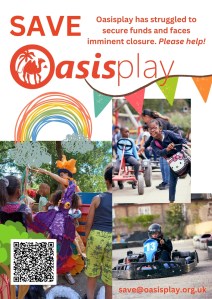
Call to SAVE Oasisplay

According to a post on Instagram, a community meeting is being held tonight at Stockwell Adventure Playground to discuss the future of Oasisplay.

On the Oasisplay website, it explains how, due to the closure of funding bodies and diminishing donations, Oasisplay is facing “a huge deficit” this financial year – going so far as to say that, without substantial fundraising, they will be forced to “close with immediate effect”.

Copyright © 2024 Oasis Children’s Venture

In addition to attending the meeting tonight, Oasisplay have suggested other ways you can support their cause:

  1. Spread the word – share this post or write your own on your social media or websites
  2. Display a poster in your window – printed copes are available at any Oasisplay site

Oasisplay have also launched a JustGiving fundraising page where people can donate to their cause.

“We feel confident that with the support of the community Oasisplay will survive the current situation. Please help by spreading the word and link to our fundraising page”

Further information from the JustGiving fundraising page:

Oasisplay describes its four sites as “a Nature Garden, a youth led Go Kart Track and two amazing Adventure Playgrounds, catering for children from birth to 18 years of age, or 25 years for disabled people” and how the organisation has been a part of the local community for 50 years.

According to the JustGiving page, each year they provide over 2000 hours of free and inclusive environmental play sessions, playwork provision on their adventure playgrounds, karting and mechanics sessions, holiday playschemes, day trips, community events, educational sessions and youth leadership opportunities.

In addition to these core provisions, Oasisplay also host a weekly food hub at each of their sites, distribute free tickets to local attractions and events to support local families, offer volunteering opportunities, and host activity sessions for schools.

At the time of publishing, £38,200 had been raised equating to 25% of their £150,000 goal

Like most open-access playwork provision, their services are open to all those who wish to use them. However, many referrals come from local authority and other multi-agency groups such as social services, youth offending teams, schools and other community organisations. This may be part of the reason why their services are in higher demand than ever.

Whilst many similar organisations and provisions have been lost in recent years, the impacts of the COVID-19 pandemic and cost-of-living crisis continue to significantly affect the both the financial and health status of their community. .

Unfortunately Oasisplay has not been immune to the tough economic climate and we too have had to scale back significantly in the last 2 months, despite intense need. We are determined that this is a temporary measure and with your support we will not only be able to save Oasis from complete closure, but also bring back all of the services that we have recently cut.

How might your donation help?

Their JustGiving page describes how:

  • £10 will pay for 1 child to attend an After School Club at the playground
  • £50 will pay for 3 children to attend a Saturday Club at the playground
  • £100 will pay for petrol and spare parts for 2 weeks of Karting sessions at the Kart Track
  • £150 will pay for an under-5’s Forest School Foragers session at the Nature Garden
  • £250 will pay for a kart maintenance and mechanics session for young people at the Kart Track

With their goal set at £150,000, what exactly will that funding be put towards?

  • £60,000 will fill their shortfall for the current financial year, keeping their gates open until April 2025.
  • £100,000 will keep sites open until August 2025 for the paying groups and projects for which additional funding can be secured.
  • £150,000 would allow Oasisplay to reinstate some of their free services until August 2025 and provide time to find further funding.

We are making a robust financial plan for the future, including significant cost cutting measures. We continue to explore all possible funding options and are in talks with Lambeth Council about how they may be able to help us to keep this vital service open.

For further information or to get involved, contact save@oasisplay.org.uk.

Adventure Playground Network announcement

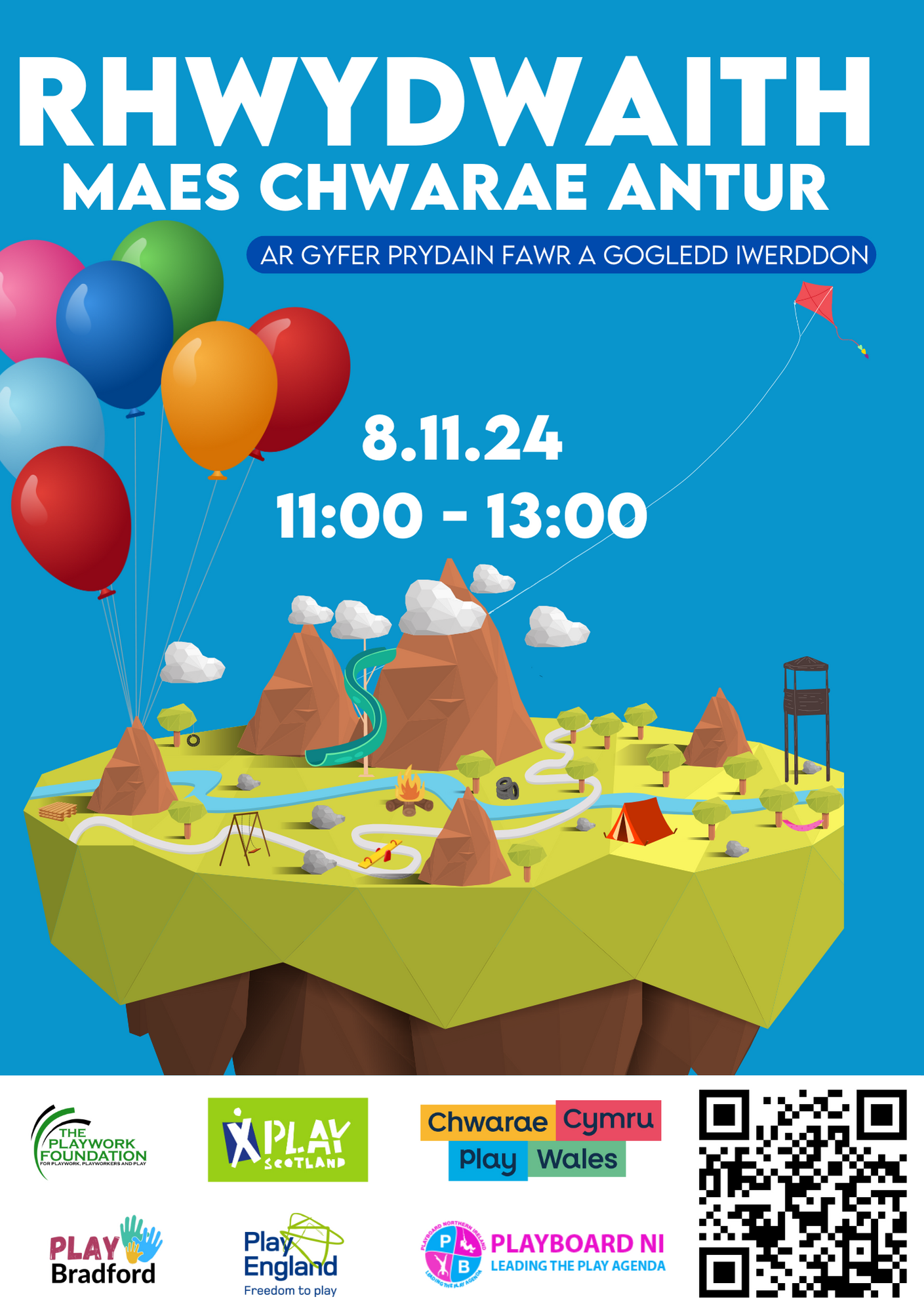
After an (unintentionally) extended period of quiet, the Adventure Playground Network is pleased to announce Friday 8th November, 11am – 1pm, as the next meeting date. To ensure you receive the most up-to-date information, including the link to the meeting, please ensure you sign up.

The Network has also been liaising with the Raising The Nation Play Commission to ensure that adventure playgrounds have an opportunity to contribute to the call for evidence. Please see the open letter to Adventure Playgrounds below:

Dear Playworkers,

Last week, Sereena, from Haringey Play Association and Mike from Play Bradford met with Policy Researchers from the Centre for Young Lives / Raising The Nation Play Commission.

Read our article on the commission here.

The aim of the meeting was to amplify the voice of England’s adventure playgrounds in the Centre for Young Lives’ and Raising the Nation Play Commission’s ‘ENQUIRY INTO WHY PLAY IS SO CRITICAL TO CHILDREN’S WELLBEING AND HOW A NATIONAL PLAY STRATEGY CAN BE ESTABLISHED.’

The aim of the meeting was threefold:

  1. Ensure that the crucial role of adventure playgrounds is not overlooked in the course of the Enquiry
  2. Maximise the time available for contributions from adventure playgrounds to be made to the Enquiry
  3. Offer the assistance of the adventure playground sector’s collective wealth of knowledge and experience to the development of a national play strategy for England.

The Centre for Young Lives has received evidence from all sectors including Health, Sport, Education, Early Years etc. Some adventure playgrounds have already submitted evidence, but the closing date is October 31st.

HOWEVER, the Adventure Playground Network has negotiated a rolling deadline, which means that the Centre will continue to welcome contributions from adventure playgrounds – via the Network – on an ongoing basis.

If you have any evidence of the wonderful work that you do, which you’d like to inform the enquiry, please consider sending it to Mike at m.wragg@leedsbeckett.ac.uk and we will ensure that your adventure playground is represented in this national enquiry into why play is so critical to children’s wellbeing and how a national play strategy can be established.

Evidence may consist of anything at all from data concerning numbers and backgrounds of beneficiaries, through to case-studies, presentations, testimonies, reflective diaries and films or video.

The Centre for Young Lives is also keen to visit adventure playgrounds across the country, so if you would be willing to show someone round your site, please let us know and we’ll pass on your details.

And if you have any questions, please let us know at m.wragg@leedsbeckett.ac.uk

Dr Mike Wragg

Senior Lecturer, Childhood Development & Playwork

The School of Health, Leeds Beckett University.

Time up on vaping?

Photo by Rainier Ridao on Unsplash
Click play to listen to this article being read by the author

Jump to the latest information and resources

There is an interesting history to vapes, with the first modern e-cigarette invented for good reasons and appearing to be a timely saviour to a deadly addiction.

But in the 18 years since they were first introduced in the UK, rather than coming of age, the dark side of vaping is beginning to become more apparent. What was once an innovative smoking cessation tool, is increasingly ensnaring children and young people in a nicotine seine net.

Image by Peter H from Pixabay

When I was at school in the 00’s, smoking had mostly fallen out of fashion, so the 80s stereotype of big-haired girls sneaking a ciggie in the toilets was a thing of the past. You only hung-out in there if you wanted the best gossip (yes, I used to sneak into the girls) or you were escaping Mrs Davies’ Welsh Class.

Today, we’ve gone back to the 80s but with a modern twist. Stories are emerging of schools removing the main doors of toilet blocks, employing CCTV cameras to monitor the entrances, and installing “vape detectors” above cubicles to provide the tell-tale timestamp to track down vagrant vapers.

Over-kill? Or saving lives?

Last month, the story of Sarah Griffin came to light after an appearance on This Morning and numerous articles from the BBC and other legacy media outlets. Having first tried a vape at the age of 9, this 12 year-old girl in Northern Ireland wound-up in intensive care and was placed into an induced coma for four days to bring an infection affecting her lungs under control.

Though they were ultimately able to save her life, doctors pointed the finger of blame directly at vaping, which had exacerbated her asthma and put her life at risk.

Sarah’s story is being shared as part of an anti-vaping campaign from the charity Northern Ireland Chest Heart and Stroke. As their campaign page describes:

Many people may think there is little, or no risk of personal harm associated with regular vaping. The biggest misunderstanding about vapes is that they are harmless compared to cigarettes.

This is not true. The long term health implications are unknown – just as they once were with tobacco.

https://nichs.org.uk/vaping

As I’m sure is the case at many adventure playgrounds, we have watched at The Venture as vaping has become more-and-more prevalent as time marches on, and even more concerning as their use is discovered amongst children of younger-and-younger ages. Discarded disposable vapes, too, are now a common visual of the crisp packet and pop bottle litter landscape.

With the general positive perception of vapes as a way to help people stop smoking tobacco, without a clear catalogue of evidence demonstrating the dangers of vaping, calls to curtail their use will struggle to break through – particularly to children and young people.

Moves are, nonetheless, underway to try to tackle youth vaping. In September, Public Health Wales released new guidance on vaping for secondary schools. And in October, Rishi Sunak announced a public consultation on plans, backed by all the devolved nations and administrations, to create a “Smokefree Generation” – this includes the intention to clampdown on access to vapes by children.

…the health advice is clear – if you don’t smoke, don’t vape and children should never vape.

https://www.gov.uk/government/news/government-sets-out-next-steps-to-create-smokefree-generation

The consultation is open until 6th December. Please take part if you can. [THIS CONSULTATION HAS NOW CLOSED]

You can view the full online advice session delivered by Northern Ireland Chest Heart and Stroke on YouTube, and below that we’ve included some useful links from the presentation. We will also continue to compile useful links and resources at the bottom of this page which may be of use to playworkers and youth workers.

https://teen.smokefree.gov/quit-vaping/how-to-quit-vaping – A guide from The National Cancer Institute (NCI) in the United States aimed at teenagers

https://truthinitiative.org/ – A United States campaign tackling tobacco use and nicotine addiction

https://noifs-nobutts.co.uk/ – Welsh campaign to report illegal tobacco (and e-cigarette sales)

National Register of Tobacco Retailers – Home (tobaccoregister.ie) – Practice and legislation from the Republic of Ireland to limit the sale of tobacco

ARTICLE: How can we stop children vaping? [28/11/23, BBC]

BRIEFING PAPER: ‘Addressing common myths about vaping‘ from ASH (Action on Smoking and Health)

LEAFLET: ‘Know It Before You Blow It

Time running out to recognise great playwork

It’s the final push for nominations to the 14th Annual Playwork Awards

Arguably the highlight of the playwork year, the Annual Playwork Awards mark the pinnacle point of the National Playwork Conference held in Eastbourne, England, each year (except when there’s a pandemic, of course).

Now in their 14th year, it’s easier than ever to nominate who you think are the GOAT of playwork. Nominations can be in writing (as before) and can also be made by audio and video! And all you need is to answer 3 questions:

  1. Who are you nominating?
  2. Which award are you nominating them for?
  3. Why are you nominating them?

But you will have to be quick, as time is running out with the deadline for submissions this Friday, 17th November 2023.

Here are the different awards you can nominate under:

The Play and Community Development Award 2024

This Award recognises an organisation or individual who has engaged with and involved the local community to increase children’s opportunities to play.

The recipient of this award will be able to demonstrate:

  • Engagement with the local community through auditing play, gathering children’s views, hyperlocal research, fundraising, access to play and/or spaces of play
  • Commitment to the playwork principles, diversity, equity and inclusion
  • Appropriate collaboration with children to ensure their voices are heard

Click here to nominate

The Paul Bonel Special Mention Award 2024

Paul Bonel, who died in January 2011, was always striving to make the world a better place for children and was at the forefront of the development of playwork as a recognised profession. We are looking to celebrate a living individual who has made a difference to children’s lives through their contribution to playwork.

This award will go to an individual:

  • Who has made a significant contribution to the development and understanding of playwork practice at a local or national level
  • Whose contribution is respected and acknowledged by their peers

Click here to nominate

The Frontline Playwork Award 2024

This award is for an organisation whose work, practice and ethos is underpinned by the playwork principles.

The recipient of the award will be able to evidence/demonstrate:

  • How they underpin all of the playwork principles
  • How children have ownership and a voice over the organisation
  • How the organisation promotes play and playwork to others in the community

Click here to nominate

The Professional Development Award 2024

This award is for an organisation or individual who has really made a difference through their training, mentoring practice, and approach to professional development. This can be for either internal workplace or external training and mentoring

The recipient of the award must be able to evidence/demonstrate:

  • How they promote playwork and the playwork principles in their training, mentoring and professional development work with individuals and organisations
  • How they work so that the individual needs of staff, learners or mentees are met as much as possible to enable inclusive practice
  • How their work results in demonstrably innovative and sustainable playwork practice from those they train, support or mentor

Click here to nominate

The Altogether Different Award 2024

The recipient of this award is recognised for their flexibility and openness to others – specifically around issues of diversity, equity and inclusion – as they make the celebratory and transformative potential of playwork theory and practice real.

The award goes to the individual or organisation that best meets the following criteria:

  • Have a diverse and inclusive reach professionally and with the wider community
  • Constantly working to improve or upskill themselves and/or their team about other cultures, beliefs, abilities and preferences
  • Show responsiveness within their practice to support the diverse needs of others

Click here to nominate

DON’T DELAY: Deadline this Friday 17th November!