Sunrise over Warwick University, the venue of the Playwork Summit
Playworkers across England are being invited to take part in a national, sector-led Playwork Summit on Thursday 8th October 2026, hosted by Play England and held at University of Warwick (Scarman Space 11, Scarman Road, Coventry CV4 7AL). The event will run from 3 – 5pm and is in-person only, with places limited to 50.
This gathering comes at a pivotal moment for playwork. With the new National Occupational Standards (NOS) for playwork reaching adoption, and major work underway on workforce development, qualifications, training pathways, and professional standards, the Summit offers a space for practitioners and sector partners to understand what is changing – and to help shape what happens next.
The discussion will explore:
the future professional recognition of playwork
the development and implementation of professional standards
the emerging relationship between playwork and CIMSPA
how we protect and strengthen the distinctive principles, ethos, and practice of playwork as new structures take shape
This will be an open, practical conversation led by the sector itself – a chance for playworkers, employers, educators, and partners to come together and consider how playwork can evolve while staying rooted in its core values.
The Summit sits alongside the Play England AGM, and precedes both the inaugural National Play Awards (Thursday 8th October) and the National Play Conference (Friday 9th October), creating a two-day focus on the future of play, practice, and professional identity.
Breaktimes and lunchtimes make up around one-fifth of every primary school day. For many children – especially those with limited access to safe outdoor spaces, rising screen time, or reduced opportunities for neighbourhood play – school playtime is their only daily chance for outdoor play.
A new petition, created by Michael Follett, calls on the Westminster Government to require every primary school in England to publish a plan for outdoor free play, and for the Department for Education (DfE) to produce statutory guidance defining what quality provision looks like, with Ofsted required to inspect against it. This recommendation comes directly from the 2025 Play Commission report, which identified playtime as one of the most overlooked elements of school life.
Outdoor free play is not a luxury – it is a foundation of children’s physical health, emotional regulation, social development and resilience.
Recent work from Play England and the Youth Sport Trust reinforces this point. Their new summary report, More Play. Better Learning, alongside a rapid evidence review by Dr Wendy Russell and Ludicology, sets out a clear and compelling case: children’s opportunities to play have been squeezed out of everyday life – including in schools.
Breaktimes have shortened. Outdoor spaces are colonised. Teachers face intense curriculum demands. Many children lack the time, space and permission they need to play freely. At the same time, schools are grappling with rising anxiety, poor attention and engagement, persistent absence, widening inequalities, and growing pressure on staff.
The evidence is unambiguous: play is part of the solution.
What a Published Play Plan Could Achieve
A national requirement for every primary school in England to publish an outdoor free play plan would:
Make play visible in school leadership and governance
Ensure accountability for the quality of children’s play experiences
Support staff training in playwork principles and inclusive practice
Encourage investment in outdoor environments and loose parts
Promote consistency across England while allowing local flexibility
Give parents clarity about how their children’s play needs are being met
The Play Commission’s landmark 2025 report highlighted a stark truth: play is essential, but structurally neglected. Among its recommendations, the call for statutory play plans was one of the most urgent. The Commission argued that without formal recognition, play will continue to be squeezed by curriculum pressures, behaviour policies, and risk-averse cultures.
The petition now brings that recommendation directly to Government.
✊ How You Can Support the Call for Change
The petition closes on 5th December 2026. If you believe that every child in England deserves high-quality outdoor free play at school, you can:
Sign the petition
Share it with colleagues, parents, and community groups
Discuss play plans within your own school or organisation
Advocate for playwork training and inclusive practice
Play is represented very differently in school policy across Great Bitain and Northern Ireland:
Scotland’s national guidance emphasises outdoor learning and play‑based pedagogy in the early years, but there is no requirement for schools to plan for or report on playtime, and no inspection framework relating to play.
Northern Ireland is similar: there is no statutory school policy on play, though government‑endorsed strategies and PlayBoard NI guidance encourage schools to value play as part of wellbeing and early learning.
And, finally, in Wales, the Ministerial Review of Play states that schools have a central role in protecting children’s time, space and permission to play. It highlights that the structure of the school day often restricts children’s opportunities for self‑directed play, and recommends that schools provide predictable, protected time for play alongside accessible, stimulating outdoor environments that support exploration and appropriate risk. The Review frames play as integral to pedagogy and wellbeing, and calls for school policy and everyday practice to more explicitly recognise and uphold children’s right to play – something we hope the new Welsh Government will address.
The Playwork Principles remind us that, for playworkers at least, play is important for play’s sake. The instrumental outcomes of play are secondary. But that doesn’t mean that we can’t advocate for more play in realms where play’s functional value might make it sound more attractive or politically viable. And what other place do most children spend a majority of their time?
The prime focus and essence of playwork is to support and facilitate the play process and this should inform the development of play policy, strategy, training and education.
– Playwork Principle 3
This week, Play England and the Youth Sport Trust released More Play. Better Learning, a new summary report calling for Play Sufficiency to be embedded across England’s primary, secondary and special schools, as well as Alternative Provision. Alongside a rapid evidence review by Dr Wendy Russell and Ludicology, the report sets out a clear, urgent message: children need more time, space and acceptance to play – and schools have a vital role to play in making that possible.
Children’s opportunities to play have been steadily squeezed out of everyday school life. Breaktimes have shortened, outdoor spaces are increasingly colonised, and curriculum demands have intensified. It’s therefore no surprise that children lack the time, space and permission they need to play.
The report highlights the consequences: rising anxiety, poor attention, persistent absence, widening inequalities, increasing SEND need and growing pressure on teaching staff. Play, it argues, is not a distraction from learning – play is learning. Through play, children regulate emotions, build relationships, develop confidence, explore risk, solve problems and experience joy. When children have the conditions to play in ways they value, they actively generate wellbeing.
A Practical Route Forward
The report introduces a framework that will feel familiar: Play Sufficiency. It asks a simple but transformative question: Does every child have enough time, space, acceptance and rights protection to play in ways that matter to them?
The framework focuses on four structural conditions:
Space: Accessible, inclusive, stimulating environments that are safe enough for exploration and appropriate risk.
Time: Predictable, protected, uninterrupted opportunities for self-directed play every day.
Acceptance: A school culture that values and actively supports children’s play.
Rights-informed practice: Alignment with Article 31, General Comment 17 and the wider UNCRC
“If we are serious about giving children their childhood back, then more play must become a normal, accepted and valued part of every school day.”
– Eugene Minogue, Executive Director, Play England
Tom Hayes MP, Chair of the APPG (All-Party Parliamentary Group) on Play, welcomes the report as a practical framework for policymakers and school leaders. The message is simple: protecting children’s opportunities to play is not at odds with raising standards. It supports them.
Play England and the Youth Sport Trust will now work with schools to develop practical tools to embed Play Sufficiency within everyday school life. These tools will help schools understand what children do, how they experience their environments, and how structural changes can support wellbeing, engagement, learning and inclusion.
Not from scratch
Fortunately, this work will not need to start from scratch. Here we share some of the existing information and resources from some of the other national play organisations:
Play Wales’ long-standing work with schools offers a rich set of insights and resources. Their guidance emphasises that children have a right to time and space to play during the school day, and that playtimes are not a luxury but a vital part of school life.
From the Wales Children’s Omnibus Survey (2022):
“98% of children said they look forward to playtime at school… 82% said they especially like playtime as it allows them to spend time with their friends.”
Play Wales highlights that richer play environments – including loose parts, green spaces, and staff who understand play – lead to improvements in academic performance, attention, behaviour, social skills and relationships between groups of children.
Crucially, they also warn against removing playtime as punishment, noting that the Welsh Government’s whole-school wellbeing framework states this “denies children their right to play and can cause stigmatisation and anxiety.”
PlayBoard NI’s publication Why Play Matters in Primary Schools reinforces the same core message: high-quality play within school environments strengthens children’s cognitive, social and emotional development.
From their evidence:
“Play is a primary driver of children’s learning, development and well-being”
PlayBoard’s school programmes, developed since 2005, are built around two complementary pillars designed to embed play as a sustainable part of school culture – not a one-off intervention. Their work demonstrates improvements in play environments, improved mental health outcomes, and increased staff confidence to use play-based approaches across the school day.
Play Scotland’s schools guidance positions play as central to learning, wellbeing and inclusion.
Their message is clear:
“There is no better activity for learning and development than play”
Play Scotland highlights how play enhances learning and creativity, supports mental health and emotional regulation, fosters collaboration and communication, and helps build inclusive, supportive school communities. This aligns closely with Scotland’s wider educational vision, reflected in Realising the Ambition, which emphasises that children learn best in environments rich in quality interactions, interesting spaces and meaningful contexts.
They also provide a suite of school-focused resources, including:
The Playwork Foundation welcomes this growing momentum. The evidence from across Great Britain and Northern Ireland reinforces what playworkers have long understood: children need time, space, and permission to play in ways that matter to them. Schools cannot solve the wider decline in children’s opportunities to play alone – but they can become places where play is recognised as fundamental wellbeing and childhood itself, if also to learning as the pull.
Whilst most references to “the north” of England today will be focussed on the likely-soon-to-be coronated next Prime Minister, don’t let that distract from this exciting webinar coming up!
Developed in partnership with Child of the North and the Centre for Young Lives, the project aims to bring together grounded, real-world stories from people who support children’s play every day – playworkers, youth workers, community organisers, educators, volunteers, and anyone who champions children’s right to play.
This webinar is an invitation to help shape a report that will speak directly to national conversations about childhood, wellbeing, and spatial justice. It is also a chance to ensure that the voices of playworkers and community practitioners are heard within that momentum.
What to expect
Christina and the co‑editors will walk participants through:
How the report came about The call emerges from growing national attention on children’s right to play in England, the inequalities that shape access to play, and the need for grounded evidence from the North of England.
Why this report matters Play is increasingly recognised as a foundation for learning, wellbeing, social connection, and recovery. Yet access to play remains uneven. This report aims to highlight what is working, where barriers remain, and how communities are responding creatively.
What will happen to the report once completed The final publication will contribute to ongoing policy discussions, advocacy efforts, and sector-wide work to re-establish play as a universal right. It will also help strengthen the case for investment in community-based playwork provision.
How to submit your case study The webinar will outline the submission process, what the editors are looking for, and how practitioners can share their experiences in ways that feel authentic and manageable.
There will also be time for questions, reflections, and discussion.
Case Study areas
The editors are seeking contributions across six interconnected themes:
Play in children and young people’s lives and learning Everyday play as a driver of curiosity, capability, and informal learning.
Space/s to play Adventure playgrounds, parks, streets, green spaces, community buildings, and the politics of access.
Time and the right to play How routines, responsibilities, school structures, and family life shape children’s opportunities.
Play, wellbeing and health Play as a protective factor for mental health, recovery, belonging, and resilience.
Digital play Online worlds, gaming, creativity, connection – and the tensions and opportunities they bring.
Parents and play Family cultures, expectations, pressures, and the role of adults in enabling or restricting play.
These themes reflect the breadth of children’s lived experience and the many ways practitioners support play in complex, changing environments.
Why get involved?
Playworkers understand the conditions that help play flourish, the barriers children face, and the ways communities respond. Your stories – whether from adventure playgrounds, youth clubs, community centres, streets, estates, or green space – are an important part of a bigger picture of what equitable access to play really looks like in the north of England.
This call is an opportunity to:
Influence national conversations about children’s rights in England
Highlight the value and impact of playwork
Share practice that is often overlooked or misunderstood
Strengthen the case for investment in play-friendly communities
Connect with others working towards the same goals
Can’t attend?
A recording will be available. Simply contact Christina Tatham at c.h.tatham@sheffield.ac.uk for access.
Today, on the International Day of Play, we are reminded that play is not an optional extra but a fundamental right. Today is a global moment to insist that children everywhere should have safe, inclusive places to play. This year’s theme – Protect play, protect childhood – asks us to centre play as a public good and to use the language of safety and belonging when talking about the right to play.
However, on this, the third International Day of Play, it is impossible not to reflect on the many acts and circumstances around the world that undermine any sense of safety and belonging – not just for children, but entire communities or even countries. In pondering what I might write today, I found myself referring to an unexpected document.
The International Play Association’s Play in Crisis guidance was written for parents and carers in a pandemic, but reading it afresh today, I wonder if it might also guide playworkers too, in these turbulent times. The booklet states plainly that “Playing helps children stay physically and mental well. It is an everyday part of a healthy and happy childhood”. It also reminds us that “Playing is one way children deal with stress and cope with the situation they’re in” – the professional reasons we protect play when the world around us feels fractured.
The IPA document asks adults to give children space and time, to observe before intervening, to accept difficult themes in play, and to use play as a way of making sense of frightening events. In our practice, we’re reminded to: protect uninterrupted playtime; offer materials that invite all types of symbolic and messy play; listen and reflect before intervening if necessary; and hold children’s enactments or expressions of fear, loss or anger as meaningful work rather than behaviour to be suppressed or corrected.
We know that when children stage battles, build barricades, or create worlds divided into “us” and “them”, they are not being deliberately provocative, necessarily. They may be trying to understand what they cannot yet name. The IPA guidance normalises this: it tells us that acting out themes of loss, illness, loneliness or conflict is part of how children process upheaval. In practice, our response must be to hold that play with curiosity and steadiness – to protect the conditions in which it can be explored safely, and to use it as a bridge to reassurance and repair.
Playworkers are not outside this. We are part of the same communities; we carry the same histories and the same wounds. The IPA booklet’s honesty about adults – that our feelings influence how we respond to children’s play – is a timely reminder of the Playwork Principles:
7. Playworkers recognise their own impact on the play space and also the impact of children and young people’s play on the playworker.
We must acknowledge our own fatigue, fear and anger, because only by recognising them can we prevent those feelings from adulterating children’s play or from colouring our interventions in ways that curtail the therapeutic nature of play.
I’m sure many of you, like me, feel quite helpless in knowing what “to do”. I have heard wonderful accounts of playwork colleagues right on the frontline, helping families in crisis in real practical ways. But that is not always possible. So, what can we do today just through our practice?
If we take the IPA toolkit as our frame, the work of playworkers becomes a set of everyday acts of peace. These acts are practical and small, but they are cumulative and powerful. They include keeping routines where possible; protecting time and space for play; offering materials that invite repair and transformation; listening to children’s stories and questions; modelling inclusive language and behaviour; and intervening to stop harassment or exclusion when it appears.
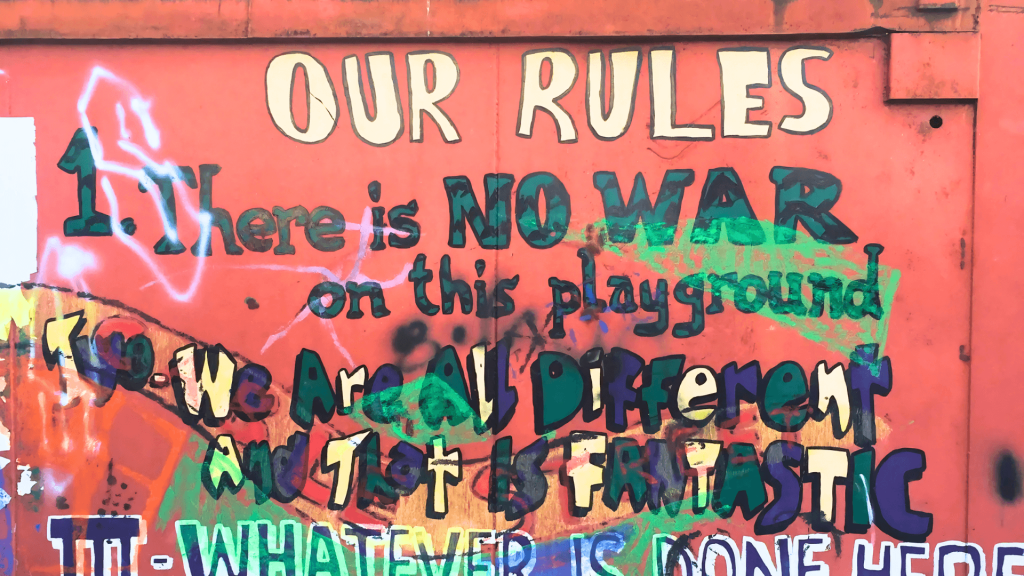
There is a line painted on a shipping container at Glamis Adventure Playground that reads, “These are our Rules. There is no war here. We are all different, and that is fantastic”. We create micro-worlds where difference is welcomed and where children can practise being together without the hierarchies and hostilities they may see elsewhere. That is peace-building in the most literal sense.
International Day of Play gives us a public opportunity to amplify these practices. Use today to share simple, rights-based messages with families: explain why play matters in crisis, offer a few practical tips from the IPA toolkit about observing before intervening, and signpost resources for families who need extra support. Share images and short reflections that show play as a place of belonging rather than a place of division.
To pick my Top 3 messages for today: play is a right; play helps children make sense of fear; playwork is a practice of inclusion.
Penny Wilson’s original call for Playworkers for Peace asked for a banner under which playworkers could gather – not to solve geopolitics, but to declare a shared commitment. Today, on International Day of Play, that call feels urgent again. We cannot resolve every conflict, nor should we pretend that play alone will heal structural injustice. But we can do what we do best: create spaces where children can be children, where difference is treated as a resource, and where safety and dignity are non-negotiable.
Let us protect play, protect childhood, and in doing so practise peace in the places where it matters most.
Young Hackney is recruiting for a Senior Playworker to join the team at Hackney Marsh Adventure Playground on a 12-month fixed-term contract / secondment, covering maternity leave.
About the role
The Senior Playworker will support the planning, delivery and evaluation of high‑quality adventure play provision, including:
Developing term-time and holiday provision
Supporting the day-to-day running of the playground, including staff oversight, site safety, safeguarding and resource management
Deputising for the Play Manager when required
Helping maintain a safe, creative and continually evolving play environment
Carrying out structure inspections, repairs and maintenance
Championing anti‑oppressive, anti‑racist and inclusive practice
This is a hands-on, outdoor role, involving fire and water play, structure building, arts and crafts, sports, gardening, trips and residentials. Unsurprisingly, the postholder will work outdoors all year round and in all weather conditions.
Hours and contract
36 hours per week, including evenings and weekends during term time.
Winter term time: Tue – Fri 10:45-19:30, Sat 10:45-16:15
Summer term time: Tue-Fri 11:00-19:45, Sat 10:45-16:15
Deputy Playground Manager – Portsmouth City Council
Earlier this month we also shared that Portsmouth City Council is recruiting a full-time Deputy Playground Manager to work across its six adventure playgrounds.
Each playground team includes four playworkers, one of whom is the Playground Manager. In the Manager’s absence, the Deputy Playground Managers share responsibility for the site, staff, safeguarding and the day‑to‑day running of the playground.
Outside of opening hours, teams spend time:
maintaining and developing the site
planning and reflecting on delivery
responding to safeguarding needs
completing training
engaging with other agencies and the community
supporting other playgrounds across the city
It’s a substantial, hands-on role within a long-established adventure playground service.
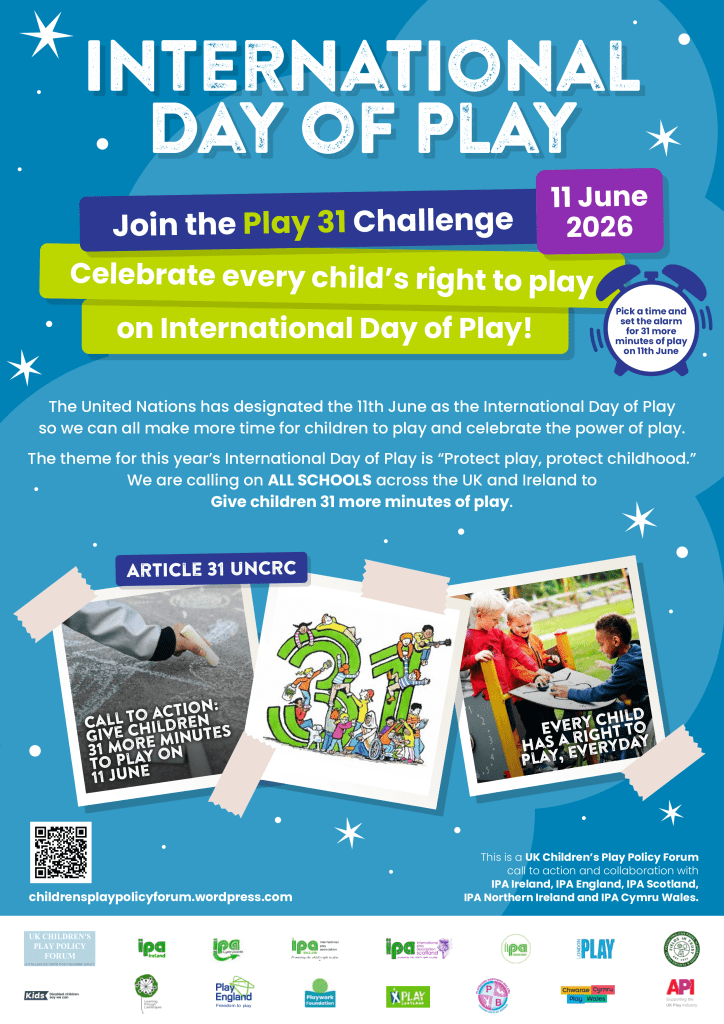
On 11 June 2026, schools across our islands are being invited to do something beautifully simple and profoundly important: give children 31 more minutes of play.
This year’s theme – Protect play, protect childhood – speaks to the heart of what playworkers, researchers, advocates, and communities have been saying for decades: play is not an optional extra in childhood; it is a right, a need, and a foundation for wellbeing.
Why 31 Minutes?
The Play 31 Challenge is inspired by Article 31 of the UN Convention on the Rights of the Child (UNCRC), which enshrines every child’s right to play, rest, leisure, and participation in cultural life.
1. States Parties recognize the right of the child to rest and leisure, to engage in play and recreational activities appropriate to the age of the child and to participate freely in cultural life and the arts.
2. States Parties shall respect and promote the right of the child to participate fully in cultural and artistic life and shall encourage the provision of appropriate and equal opportunities for cultural, artistic, recreational and leisure activity.
The ask is purposefully simple:
31 minutes
No cost
No equipment required
No special programme needed
Just time, space and permission.
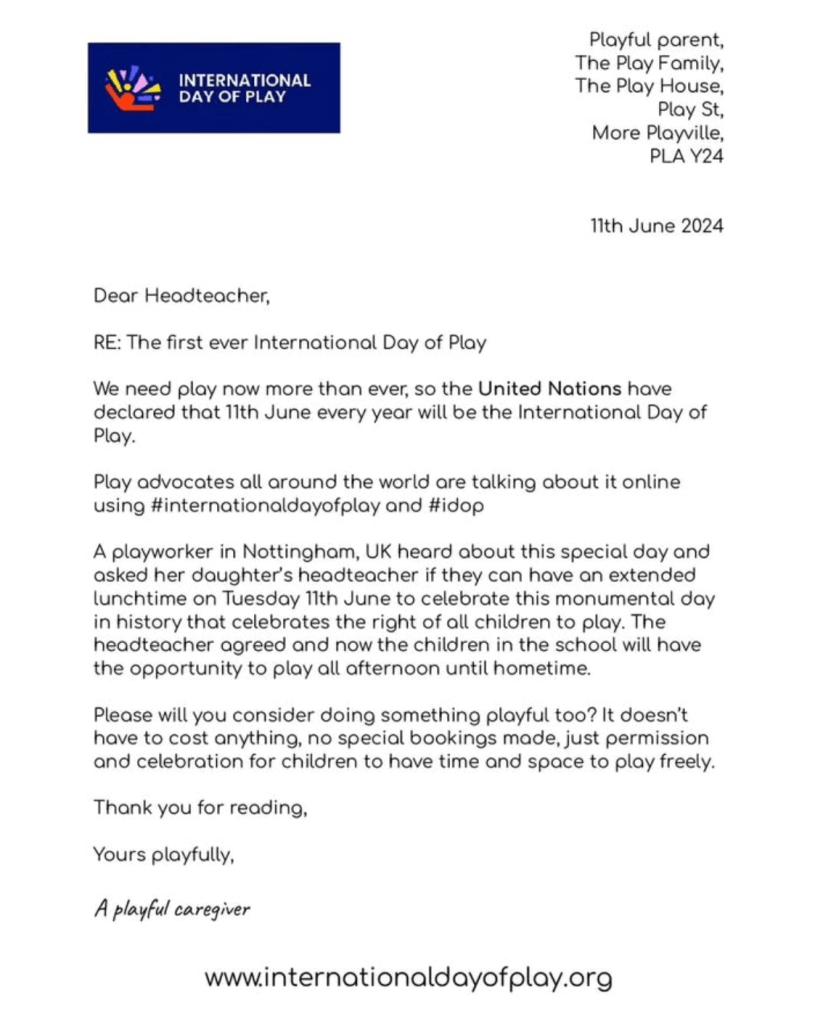
Not sure how to ask? In 2024, Adele (@adeleplayworker), posted the above template letter to headteachers for parents / carers to use. At the time of the post, she said “I volunteer in [a] school so it hadn’t occurred to me that parents wouldn’t know how to approach their headteacher, or even feel confident doing so” – and sometimes that can be the hardest part: knowing where to start.
So, inspired by Adele’s original letter, The Playwork Foundation has drafted an updated version that parents, carers, and community members can use to contact their Headteacher / Principal or Board of Governors / Board of Management.
We encourage anyone who wants to support the Play 31 Challenge to use the letter, share it, or adapt it for their own school community. Small acts – a conversation, a request, a letter handed in at the office – can be just the little ripple that starts a wave of cultural change towards more play-friendly schools.
The consultation on the draft National Occupational Standards (NOS) for Playwork is now open – and with the deadline approaching, The Playwork Foundation will be hosting a final “catch‑all” webinar on 1st May, 10am – 12pm, to support a final surge of responses from across the sector.
Whether you’ve already skimmed the documents, haven’t yet had time to engage, or simply want clarity before submitting your response, this webinar is your opportunity to get up to speed before the consultation closes.
If you would like to submit feedback in some other way (e.g., audio, video) contact nosreview@play.wales let us know and we’ll do what we can to help.
The Consortium is encouraging responses from across the sector, including practitioners, managers, trainers, employers, awarding bodies, local authorities and community organisations.
What Happens Next…
After the consultation closes:
The UK Playwork NOS Consortium and Writing Group will review all feedback
A consultation report will be drafted and published
The final NOS will be released around June 2026, in both Welsh and English
Awarding Bodies and Awarding Organisations will begin re‑mapping or re‑developing their playwork qualifications
This marks the beginning of a new phase for the playwork workforce, with updated standards that reflect contemporary practice, international alignment and the core principles of a playwork approach.
A significant milestone for the play sector in Yorkshire has just been announced: the inaugural Sheffield Play Conference will take place on Tuesday 19th May 2026 at the Adventures Hub (formerly known as Highfields Adventure Playground) in Sharrow.
The organisers describe it as “a vibrant celebration of all things play” bringing together volunteers, students, professionals, decision-makers and community members for a full day dedicated to strengthening play across the city and region.
The conference is a welcome and timely development, as Sheffield has been steadily building a movement for child-friendly neighbourhoods, and this event marks the first formal gathering of that growing community.
The Conference is broad in scope – designed to bring together people working across:
Students in child development, youth work, teaching and social care
Anyone responsible for children’s play spaces, from parks to housing
The event has emerged from the work of the Sheffield Play Partnership, a collaboration focused on reversing the decline in community play provision and strengthening the city’s capacity to deliver high‑quality, inclusive play opportunities.
Their work includes:
Mapping citywide play provision
Identifying gaps and inequalities
Developing new community-led play projects
Supporting collaborative models that connect voluntary groups, families and local authorities
A Vision for a Regional Play Movement
The organisers are clear that this is not a one‑off event. They describe the conference as “the first step in an ambition to gather the region’s play community in one place”, with the hope that it will become an annual fixture and eventually a truly regional gathering.
Playing Out CIC formally closed on 31 March 2026, bringing seventeen years of activism, community organising and policy influence to a dignified close.
In their final message to supporters, the team wrote that they were contacting “one last time to say thank you and goodbye” while emphasising that “the movement for children’s freedom and right to play out is alive, well and growing.”
Co-founders Alice Ferguson and Ingrid Skeels offered a powerful reflection as they “prepare to turn out the lights at Playing Out CIC”, expressing gratitude for the activism, collaboration and policy change driven by thousands of residents, practitioners and allies.
One of Playing Out’s final major contributions is the publication of Streets for Play, Streets for Freedom, authored by Alice Ferguson and Tim Gill. The report argues for a radical reframing of transport and street policy in England through a “child lens”, prioritising those most affected yet least considered in planning.
The email summarises the case succinctly: creating streets safe for children to “play, walk and wheel would save children’s lives, restore children’s freedom and transform children’s wellbeing”.
The report includes Ten Good Reasons for adopting this approach and is intended as a tool for influencing local and national decision-makers.
A Refreshed Website for the Future
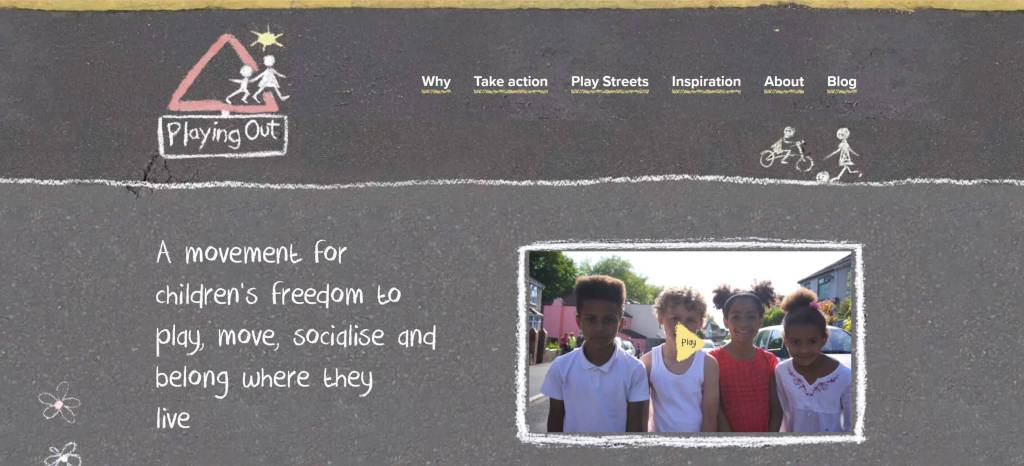
Although the CIC has closed, the Playing Out website has been rebuilt to serve as a long-term resource hub. The team describe the original site as “aged about 100 in website years” and note that the new platform is designed to support the next generation of change-makers.
The site remains familiar but clearer, more navigable and future-proofed.
The refreshed Playing Out homepage
Beyond the CIC
Two important networks will continue independently:
1. The Play Streets Network
Hosted by Lucy Colbeck and Alison Stenning, this network offers:
A long-standing, friendly space for parents and residents to connect around play streets and playing out.
You can find the group on Facebook by clicking here.
Not The End
The email closes with a reminder from international allies: “We’re just at the beginning – things will grow and grow – as a system, we all have a role to support children’s right to get outside and play”.