A response to the review of the National Occupational Standards for Playwork
Shelly Newstead
In October 2015, Shelly Newstead posted her response to a review of the National Occupational Standards, raising some fundamental questions about how playwork is defined and described. With kind permission, we are making her response available here, believing these questions to be as relevant as ever
Having been away from the hurly-burly of playwork training and National Occupational Standards for the last few years (doing a PhD takes up inordinate amounts of time and energy – who knew?), I attended the London consultation meeting, organised by Skillsactive, to review the Playwork National Occupational Standards. I didn’t look at the draft Standards before I went, so was interested to hear at the meeting, from SkillsActive, how things had changed, and to look at the proposed new playwork NOS with fresh eyes.
I want to say loud and clear that I believe that playwork should have its own set of National Occupational Standards. Right now they are the only thing keeping us out of what Bob Hughes (2012) called the “primeval learning soup” of the wider children’s workforce. What playwork needs, now more than ever, is a distinct identity with which to distinguish itself from other forms of working with children; to prevent us from tipping over the edge of that bubbling cauldron and becoming another unit in somebody else’s NOS (with a title something like ‘Looking after school-aged children in supervised indoor settings’ or ‘Providing play for school-aged children to support their development and self-esteem’).
Open secret
However it is an open secret, and has been since the Playwork NOS were first created in the 1990s, that some playwork people don’t think they should exist at all, and that several more don’t think they are fit for purpose (see Davy, 2007, Wilson 2008). The Playwork NOS have been criticised for being too technical, too functional and for not including what has often been referred to as the “essence” of playwork (see PlayEducation, 1983; PLAYLINK, 1997, p.2). The generic nature of the so-called ‘playwork’ NOS, which now are set to include providing food and drink and intimate care, lend themselves to the idea that anybody can do playwork, and (far more worryingly) that anybody can interpret (and reinterpret) playwork in the light of whatever job role and physical setting they find themselves in. We have developed the suicidal habit of writing specific units of the playwork NOS for specific types of spaces (which begs the question – why is what is done in the name of playwork in a prison different to what is done in the name of playwork in a park?), and are also apparently now writing special units for people who ask for them, on the grounds that there are no other qualifications available to them (see the unit on ‘leisure and entertainment’).
‘playwork has become ‘all things to all people’ (Hughes, 2006) and that is a huge problem for the continued existence of playwork as a discrete identity’.
As a result, playwork has become ‘all things to all people’ (Hughes, 2006) and that is a huge problem for the continued existence of playwork as a discrete identity. If we want to stay out of that bubbling cauldron and prevent playwork – a profession which has had children’s interests at its core for the last sixty years – from turning into another form of the institutionalisation of children, then it seems to me that the revision of the playwork NOS presents an ideal opportunity for us to do some good hard thinking.
At the London meeting several things that needed thinking about occurred to me, many of which I tried to articulate on the day, and many of which I wished I’d said better. It seems to me that if we feel passionately about playwork, then there is a responsibility to try to articulate what it is that we are passionate about. This is a bullet we’ve been dodging for the last sixty years and my fear is that if we stick to our tried-and-tested habits then playwork will not be around to see its telegram from the Queen.
So this is an attempt to capture some of the thoughts that popped into my head during the meeting, and since, as a result of the stimulating discussions held on the day. It was written in six hours straight, is certainly not a finished product, it hasn’t been proof-read for typos and it does not purport to be ‘the answer’. The best I can hope for is to provide those at the London meeting who wanted to understand more about ‘where I was at’ (to quote Meynell) with a better explanation than I did on the day, and also to get a lot of stuff that’s been buzzing around in my head since then, out of my head so that I can think about something else! If it also generates some thinking and discussion in the wider field, then great – it’s about time we had a good debate.
If what follows does generate ideas on any aspect of the playwork National Occupational Standards, whether you agree with me or not, then I encourage you to send your thoughts to SkillsActive.
The problem of ‘playwork as space’
I fully understand (thanks to SkillsActive’s very clear and helpful explanation) that the NOS are designed for the purpose of describing a JOB ROLE in order to assess whether somebody is performing that job role adequately. This shouldn’t present a problem for playwork – we’ve got other frameworks, which describe other aspects of playwork, such as quality assurance systems for playwork settings. We’ve always had difficulty in pinning down job descriptions (see Conway, 2008), so the playwork NOS should, in theory, prove helpful in setting out what it means to do playwork as a distinct role (as opposed to what it means to do early years work, residential care or operate bouncy castles.
The problem we do have at the moment, however, is that there is very little that is ‘playwork’ about the playwork NOS, apart from providing for/supporting the self-directed play of children. And even that white elephant gets us into more trouble than it’s worth, because there is, in fact, nothing playwork about providing for/supporting the self-directed play of children. Parents who have never heard of playwork do it on playgrounds all over the world at weekends, Guiders do it in their un-programmed time at camps, adults do it in woods with hacksaws and call it ‘Forest School’. All of which are great, but to describe these valuable experiences for children as ‘playwork’, as described by the NOS, is a stretch to say the least. To get the adults involved in them to call them playwork is a Herculean task.
The problem with the playwork NOS is that they attempt to construct playwork as a job role based on the concept of ‘playwork as space’. Presumably this original conceptualisation of ‘playwork as space’ goes back literally to the first playwork spaces – adventure playgrounds, which were very much defined as children’s spaces by their fences. It also echoes the whole reason for the creation of the playwork NOS in the first place: to qualify a newly expanded school-aged childcare workforce to work in after-school clubs. After-school clubs were created as new spaces within other spaces for the purpose of providing childcare, and the people who ran those spaces were qualified as playworkers mainly because there wasn’t anything else to qualify them as.
Out-dated
However, this concept of playwork as space is out-dated by about forty years. Playwork (as it was to become known) moved out of the adventure playgrounds in the 1960s and 70s (JNCTP, 1979) into schools, play schemes and hospitals, and has continued to expand into a myriad of differently organised and purposed spaces ever since. The problem is that the underpinning concept on which articulations of playwork have been constructed (not only the playwork NOS, but also our quality assurance systems and the Playwork Principles) haven’t kept up with how playwork is being used in practice.
Playwork hasn’t been about ‘providing space’ for nearly as long as I’ve been alive, but when the after-school club workforce came along in the 1990s we still qualified people in terms of the spaces they were in, instead of what they do, or should be doing, in the name of playwork, thanks to our pernicious collective consciousness of ‘playwork as space’. (Interestingly, this has resulted in the farcical situation for the last twenty five years of playwork trainers trying to teach adults to ‘do playwork’, whilst the qualifications system has been qualifying the same adults to run playwork settings – although perhaps that’s something that needs more thinking about another time.)
In discussion at the NOS review meeting, it appeared that a working definition of ‘playwork space’ was ‘anywhere playwork takes place’, which poses something of an existential dilemma. If the NOS don’t describe what it means to ‘do playwork’ (see above), then how does anybody know how to recognise when playwork is taking place in a space in order to define that space as a ‘playwork space’? Just because somebody calls himself or herself a playworker doesn’t mean they are doing playwork (because the NOS don’t tell us what that is), and neither does it mean that park/bit of desert/school playground is automatically transformed into a ‘playwork space’, just because somebody who calls her or himself a playworker is standing in it.
‘when is a playwork space not a playwork space?’
Furthermore, when is a playwork space not a playwork space? Perhaps, for example, when it’s a school hall with a headteacher insistent on enforcing the school rules about ‘no shouting’ and ‘no running’, and a grumpy caretaker who will not under any circumstances entertain the idea of sand/glitter/mud/chalk anywhere near his beautifully polished floor. Just because we say it’s a playwork space doesn’t mean it’s a space where playwork takes place, and until the playwork NOS clearly define and describe what that is (over and above ‘providing/supporting play’, which anybody can do on any terms), then trying to define and defend the existence of ‘playwork’ based on the concept of playwork as space just causes practitioners more problems than they had to start with.
On a related note, the NOS keep referring to ‘play environments’ and ‘play spaces’. At the risk of repeating myself, anybody can ‘provide’ these, and it still doesn’t make them playwork. A bouncy castle is a ‘play space’, and a swing/slide/roundabout playground is a ‘play environment’. I would defy anybody to define what is ‘playwork’ about such spaces. Furthermore, it should be children who decide what constitutes a ‘play space’ or ‘play environment’ – and they do of course, using all sorts of non-designated spaces for their play.
There is certainly still a case to be made for the provision of play spaces by adults in certain environments and in certain situations (any space designated for children’s play in the middle of Manila has to be better than the alternatives, swing/slide/roundabout to boot), but if we are going to provide adult-defined and designed alternatives to children playing in spaces they have chosen themselves, then we playwork people should stick to providing playwork spaces. As professionals with a specific and unique approach to looking at space, we should provide playwork spaces which are distinct from play spaces – and be prepared to articulate what that means (see Sutton, 2014). Otherwise we run the risk of being seen as some sort of professional child-catchers, whose nice shiny/grubby play spaces are somehow ‘better’ than other sorts of play spaces.
Playwork as practice
There is an alternative to ‘playwork as space’, which is ‘playwork as practice’. At the moment the job role called playwork, as described by the NOS, varies depending on the space a ‘playworker’ finds him or herself in. The space defines the playwork, which in turn defines the playwork job role, which ultimately defines the practice carried out in the name of ‘playwork’. So playwork in a prison becomes the art and craft of entertaining children with practically no resources whatsoever; playwork in a residential home for children with complex care needs turns into a whole package of units including intimate care; and playwork in an ‘entertainment organisation’ (whatever that might be) becomes running birthday parties. Again, playwork becomes all things to all people, and what is playwork in one space looks completely different to playwork in another – because it is. There is no essence of playwork, there is no core to playwork as a unique and recognisable profession, and ultimately therefore there is no discipline in our discipline.
Now let’s turn that all on its head, and replace ‘playwork as space’ as the underlying concept of the playwork NOS with ‘playwork as practice’. Playwork as practice means ‘the things that we do in the name of playwork which are solely and uniquely playwork’. Playwork practice transcends space. It is something that can be done at any time and in any place: it can be done without having to make special preparations in special places. It is a way of working with children that any adult can adopt within their existing relationships with children, including parents and volunteers.
Playwork practice is something I use as a volunteer on an adventure playground; it is something that I use with children of all ages in my family, and it is something that I can (and do!) use in airports with children I have just met. Playwork practice is – or could be – ubiquitous and universal. Instead of continuously segmenting and dividing the playwork field up into their own little silos of what ‘playwork’ means in their own spaces, all we have to do is find a way of describing playwork practice in NOS shaped- parcels. That isn’t a ‘today job’, (and maybe not a ‘tomorrow job’ either!) but here’s a few ‘fantasy NOS playwork-as-practice units’ off the top of my head and in no particular order, despite the cod- NOS numbering system which I’ve just made up (see also the section below on Values, Behaviours and Skills to get the background thinking on these):
PW1 – Provide resources to use for children to use for their own purpose
PW2 – Use risk-benefit assessment to determine appropriate adult intervention
PW3 – Contribute to professional discussions and evaluations of playwork practice
PW4 – Articulate intervention decisions using playwork and other relevant theory
PW5 – Demonstrate inclusive and anti-discriminatory practice
PW6 – Advocate for children’s interests when they conflict with adult led-agendas
PW7 – Evaluate current relevant legislative and policy requirements in the light of current playwork theory to arrive at playwork practice decisions
PW8 – Make informed decisions about which methods of supervision to use
PW9 – Communicate with children on an individual level: PW10 Provide and initiate activities for children when appropriate (and explain why and how this was achieved).
…and so on.
Of course none of those would probably meet the criteria for NOS unit titles and the language would need tinkering with in playwork terms (e.g. I don’t like PW5 as it smacks of early years and an interventionist approach – we need new playwork-appropriate wording), but the aim of the exercise was to provide an example of how playwork practice could be described in terms of a job role, and specifically a job role which is different to other ways of working with children. It is simply a matter of breaking down what we do in the name of ‘playwork’, and turning this into operationalized statements (or ‘performance criteria’ in NOS-speak); then building up those statements into units, etc.
In this way ‘playwork’ is liberated from the shackles of what has to be done in a specific setting (provide food, do the paperwork, dispose of hazardous materials and anything else that isn’t playwork). Instead the playwork practitioner can do their playwork as part of their broader job title, call it playwork (practice) when it is playwork practice that they are using, and perform the rest of their job role according to whatever standards need to be achieved. Thus the job role for NOS purposes becomes ‘playwork practitioner’ and anybody can be qualified as a playwork practitioner (bouncy castles and all), provided that they can actually demonstrate that they can ‘do playwork’ as described by the NOS (as opposed to running birthday parties).
A couple of additional notes are needed here. First of all, there is a proposal in the NOS review to change the title of the Level 3 in Scotland to ‘Playwork Practitioner’. I got really excited about that when I first saw it at the meeting, as I thought that maybe the tide was finally turning from space to practice. However, if my understanding is correct, it is intended to describe somebody who is ‘in charge’ of a playwork setting, which I feel is a missed opportunity. For me, a playwork practitioner is somebody who ‘does playwork’ in whatever capacity and at whatever level of responsibility, from part-time volunteer to managers with hands-on experience – or, to put it another way, a playwork practitioner is a job role, rather than a job title.
Secondly, there is provision for ‘bolt on’ units from other NOS which might be useful to describe parts of the job role of the playwork practitioner which are not playwork practice, but do involve working with children, such as organising trips, health and safety, safeguarding etc. These may be useful in defining the wider job role of the playwork practitioner within the context of current legislation, and therefore could provide useful adjunct material to the core units that describe the business of doing playwork. However, specific units for specific settings and specific ‘types’ of children (since when did playworkers start labelling children and writing special instructions for them?) would be redundant, with a universal description of playwork as practice as the core of the playwork NOS.
Core functions
In placing the core functions of what it means to do playwork, rather than what it means to run a playwork space, at the heart of the playwork NOS, it becomes the decision of the playwork practitioner how far and to what extent to apply playwork practice. We can’t – and shouldn’t, as Penny Wilson (2008) has observed – tell practitioners exactly how to practice in any given situation: all of the decisions we make on a day-to-day basis in playwork are made by weighing up the variables in front of us on a ‘here and now’ basis. Playwork practitioners apply their judgement to the situation in front of them. In other words, just because something looks like a loose part (Nicholson 1972) doesn’t mean that children can use it for their own purposes (dog muck and syringes spring to mind).
These variables include those presented by the space we find ourselves in: playwork practitioners can decide which loose parts are suitable for working in prisons, and whether to let children with complex needs in residential homes play with clay, and whether the risks outweigh the benefits of allowing children on an adventure playground into the desert in the middle of the day. These practitioners, all working in very different physical settings, don’t need separate units written for them, they simply need to know what the parameters of playwork are within which they should practice, and then apply their judgements according to the challenges presented by the variables in front of them at any given time, or by any given space. Or, if an example might help here: to use playwork practice in an airport lounge I don’t need to set up a dedicated playwork space (although I could if the will and resources were available). However, I can:
PW1 – Provide resources to use for children to use for their own purposes. I always carry the fold-up frisbee from the Cardiff IPA conference in my handbag, plus pens, pencils, paper, a Tangle and various other bits and pieces that children can use.
PW2 – Use risk-benefit assessment to determine appropriate adult intervention. I don’t get out the Frisbee if I’m in a crowded lounge, only when there’s space to use it.
PW4 – Articulate intervention decisions using playwork and other relevant theory. I’ve often found myself having some very interesting discussions about loose parts (Nicholson 1972) and neophilic appeal (Morris 1967) with random parents in airports!
PW5 – Demonstrate inclusive and anti-discriminatory practice. I engage with whatever child is sending me play cues (Else and Sturrock 2007), not the ones who look most interesting/most like me/most articulate etc.
PW6 – Advocate for children’s interests when they conflict with adult led-agendas. I spend a lot of time reassuring adults that I don’t mind talking to children/answering their nosy questions/playing noughts and crosses/doing monkey impressions – and that it helps to alleviate my boredom too, thus (hopefully) getting the point across to frustrated adult travellers that one of the possible reasons for their little darling screaming the place down is that they are in a sterile adult-designed environment and thus bored witless.
And so on..
I could go through all of my ‘fantasy playwork-as-practice NOS’ from above, but hopefully the example serves. Clearly nobody is going to employ me as a playwork practitioner in an airport lounge (although wouldn’t it be lovely if they did – maybe one day…), but the point here is that, if we constructed the playwork NOS on the basis of playwork as a practice, then playwork practitioners would be able to articulate and describe their practice as something uniquely ‘playwork’, no matter what physical setting they work in. Or to put that another way, if I can describe how I do playwork practice in an airport lounge using my fantasy playwork NOS, which isn’t (as far as I know) even on the radar for a special ‘playwork’ unit of its own, then we should be able to articulate playwork practice anywhere – no walls or fences required.
Playwork as practice’ as the underpinning concept for the playwork NOS would have four main advantages. Firstly, it would finally distinguish playwork from other forms of working with children, something that has vexed the playwork field since the days of the early adventure playgrounds (Mays 1957, Abernethy 1975). Secondly, it would dramatically increase the size of the workforce, as anybody working with children could (in theory) demonstrate their competence in playwork practice, once we have those competencies clearly defined. This would be a significant advantage for a field that has constantly lamented the lack of status and recognition (see PlayEducation 1983; Martin 2014), as the more of us there are, the more likely it is that our voice is heard. Thirdly, it would narrow the gap between playwork theory and playwork practice, enabling practitioners to apply playwork theory according to specific situations, instead of grappling wholesale with theories that simply do not fit certain spaces (e.g., if you can’t provide ‘deep play’ (Hughes 2002) in a prison, does that mean that you’re not doing playwork?). And, finally, it would achieve a consistency and stability for playwork which has been missing for the last sixty years – or to put it another way, when playwork people all get together in a room the size of an aircraft hangar, we would be able to work out that we are in the right aircraft hangar as we would all be talking about the same practices in the name of ‘playwork’, albeit set in a diversity of different contexts.
The Playwork Principles
I’ll finish with a brief word on the Playwork Principles (PPSG 2005). There is some controversy at the moment about the omission of the Playwork Principles in the re-drafting of the playwork NOS and their possible replacement by statements of ‘Values, Behaviours and Skills’ (VBS). The bone of contention seems to be whether the new NOS can include reference to external documents. SkillsActive said at the meeting that it was not possible to include external documents, but it was permissible to describe the VBS that underpin the job role. SkillsActive produced a draft of the VBS statements, partially based on the Playwork Principles. These referenced the Playwork Principles in the draft NOS, and where I have left some of the original Playwork Principle statements in my revised VBS below, they should also be properly referenced.
However this is a complicated exercise and would take some time (for example, the original definition of play goes back to 1984), so I hope for now that it will be obvious to most readers which statements originally belonged in the Playwork Principles, and if not then the VBS statements below can easily be crossed referenced with the original SkillsActive version via the link above.
As they stand, the VBS written by SkillsActive do not reflect playwork as I understand it, nor as it is reflected in much of the contemporary and historical playwork literature. If it is the case that the new NOS cannot include external documents, it is possible simply to delete the VBS completely and have no Values, Behaviours and Skills underpinning the playwork NOS at all. However in my view that would be a huge mistake, particularly if we have to stick with the ‘playwork as space’ construct of playwork for the sake of expediency this time round. In the absence of anything particularly ‘playwork’ about the NOS in their draft revised form, the VBS statements are the only chance we have of injecting some idea of what is unique and distinct about playwork into the playwork NOS. For me it’s imperative that we make the most of this opportunity, before somebody somewhere decides to make childcare soup out of us to save the expense of supporting a separate sector.
Broader concept
It was made clear at the meeting that it would be possible for playwork people to re-write the VBS if they were to be included in the new NOS. So what follows below is an off-the-top-of-my-head outline of how I think the Values, Behaviours and Skills for playwork could sound, with the specific aim of providing a unique playwork perspective for working with children. The Playwork Principles aim to do this, but they are in fact more narrowly focussed on providing play, and therefore offer no clues on the many other non-play situations involved in daily practice which call for a playwork response (which may differ from an early years/youthwork/teacher response). I have therefore shifted the focus of the role of the playwork practitioner to the broader concept of playwork as providing children with the time and space “to follow their own instincts, ideas and interests, in their own way for their own reasons” – which of course is in the Playwork Principles but is framed solely in terms of children’s play, which I think is a missed opportunity. Although it still doesn’t provide the whole story and needs further development, this broader conceptualisation of playwork is much closer to the founding aims of the adventure playground pioneers, and thus roots contemporary playwork practice firmly within its own unique tradition and paradigm.
A couple of other things to note. I have deliberately only referred to legislation, rather than ‘organisational policies’ as per the original VBS, as organisational policies often conflict with playwork understandings and practices. Far better to tell practitioners to weigh up legislation, policy and playwork (see PW7 above!) in my view, than make a virtue out of following organisational policies which state that everybody must line up for face-painting, as the thing that is supposed to set us apart from other approaches to working with children. And whilst the statements below are numbered, they are not ranked – this has been thrown together in half a day and would need to be much more developed before any sort of ranking could take place. In an ideal world I would have matched up my PWs (above) with my VBS statements below – but this is as far as I got within the time available, and doubtless there are more Values, Behaviours and Skills that we could come up with between us!
AN ALTERNATIVE (AND VERY PRELIMINARY) DRAFT RENDITION OF THE VALUES, BEHAVIOURS AND SKILLS FOR PLAYWORK
Playwork began in the adventure playgrounds set up in the UK after the Second World War, and playwork practice is now used in a wide variety of settings throughout the world, from prisons to parks, and deserts to school playgrounds. Founded on the premise that children need some time and space to do the things that matter to them, rather than to the adults around them, playwork takes a unique approach to working with children and young people within the wider children’s workforce. These Playwork Values, Behaviours and Skills provide an overview of what distinguishes playwork practice from other approaches to working with children, and describe the qualities that playwork practitioners working in any setting must demonstrate in order to distinguish their professional playwork practice from other forms of professional training and experience.
VALUES
- Be committed to children’s rights to make their own choices, discover their own solutions and to develop at their own pace and in their own way
- Be committed to engaging with adult-led agendas where they conflict with children’s ability to follow their own instincts, ideas and interests, in their own way for their own reasons, both inside and outside the playwork setting.
- Be committed to diversity and equal of opportunity for all children.
- Be committed to the process of play as a child-led behaviour, which is freely chosen, personally directed and intrinsically motivated and carried out for its own sake.
BEHAVIOURS
- Demonstrate a flexible working attitude, adapting his or her level of intervention, if any, to each child and young person on an ever-changing basis
- Communicate with each child and young person at a level that suits the individual, using appropriate communication techniques and appropriate responses
- Value each child according to their individual personality and talents, regardless of labels applied to individual children outside the playwork setting.
- Take part constructively in team discussions based on reflective practice to evaluate the effectiveness of the playwork setting in terms of children’s ability to follow their own instincts, ideas and interests, in their own way for their own reasons, current playwork theory and legislative requirements.
SKILLS
- Make well-defined decisions about when adult intervention in children’s activities is necessary and when it is not.
- Articulate those decisions in terms of current playwork theory and current relevant legislation.
- Provide resources which encourage children to use them for their own purposes, including scrounged materials
- Provide supervision in a way which balances children’s ability to follow their own instincts, ideas and interests, in their own way for their own reasons, with current legal requirements
- Carry out reflective practice before, during and after hands-on work with children to evaluate the impact of one’s own practice on children’s ability to enjoy their own time and space
- Engage constructively with conflicting adult agendas as an advocate for children’s right to have some time and space to do what matters to them.
Shelly Newstead
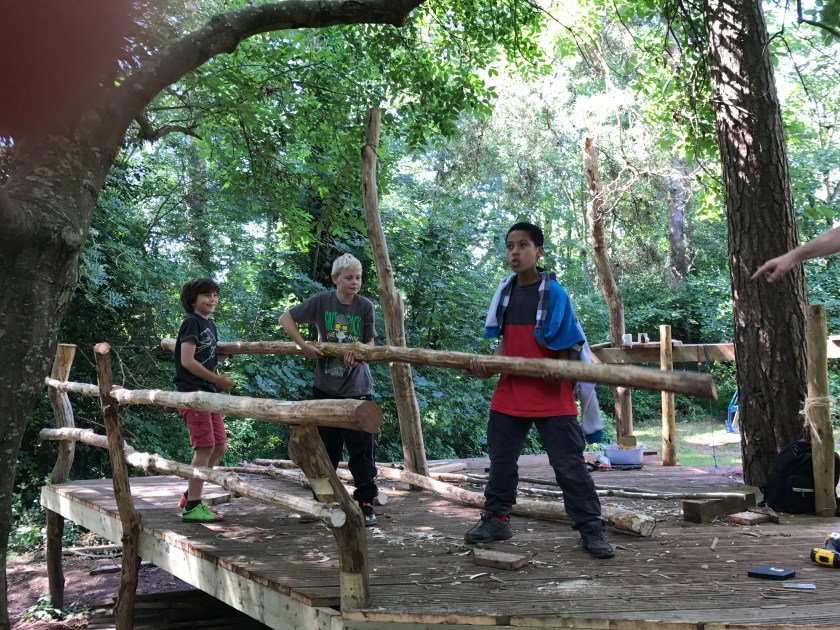
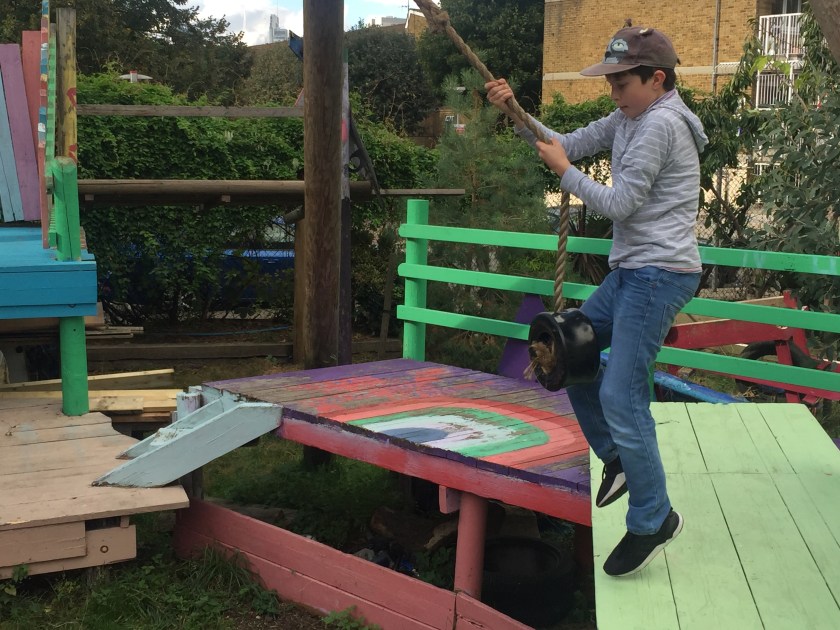
Photo: Adrian Voce (Glamis adventure playground, East London).
References
Abernethy, W. D. (1975). Training of Workers for Adventure Play. Paper presented at the Adventure Playground in Theory and Practice conference. Adventure Playgrounds and Children’s Playgrounds; Report of the Sixth International Conference. University Bucconi, Milan, Italy. 31st August to 6th September 1975
Conway, M. (2008). Do our playwork job descriptions describe the job? – Ideas Paper 5 [Report]. London: Play England
Davy, A. (2007). ‘Playwork: Art, Science, Political Movement or Religion?’. In W. Russell, B. Handscomb and J. Fitzpatrick (Eds), Playwork Voices: In Celebration of Bob Hughes and Gordon Sturrock (pp. 41-46). London: London Centre for Playwork Education and Training
Else, P. and Sturrock, G. (2007). Therapeutic Playwork Reader one 1995-2000. Eastleigh: Common Threads Publications
Hughes, B. (2002b). A Playworker’s Taxonomy of Play Types. (2nd Ed.). London: PlayEducation
Hughes, B. (2006). Play Types Speculations and Possibilities. London: London Centre for Playwork Education and Training
Hughes, B. (2012). Evolutionary Playwork. (2nd Ed.). London: Routledge.
JNCTP[a] Joint National Committee on Training for Playleadership. (1979)
Recommendations on Training (also known as the Black Book) Saltney, Chester: Grosvenor Printing Co Ltd.
Martin, C. (2014). ‘Playwork cuts: the effect of austerity on playwork practitioners, playgrounds and play services’. Journal of Playwork Practice, 1 (1), 74-81.
Mays, J. (1957). Adventure in Play. 2nd Edition. Eastleigh: Common Threads Publications. Morris, D. (1967). The Naked Ape London: Jonathan Cape.
Nicholson, S. (1972). ‘The Theory of Loose Parts, An important principle for design methodology’. Studies in Design Education Craft & Technology, 4 (2).
PlayEducation. (1983). PlayEd 1983 – Play and Playwork: Developments and Definitions. Bolton.
Sutton, L. (2014). ‘Adventure Playgrounds and environmental modification: a beginner’s guide’. Journal of Playwork Practice, 1 (2), 211-217.
Wilson, P. (2008). Passion, recalcitrance, sound management and confident applications of the craft – Ideas Paper 15a [Report]. London: Play England
© Shelly Newstead, October 2015