First published in Picture Post on 16 November 1946, Lady Allen of Hurtwood’s Why Not Use Our Bomb Sites Like This? introduced readers across Britain to the pioneering junk playground at Emdrup, Copenhagen.
To mark the article’s 80th anniversary, we have reproduced its original text below. It offers a fascinating glimpse of an idea that helped inspire the development of adventure playgrounds and, in time, the playwork profession.
The language and attitudes are those of 1946 and should be read in their historical context.
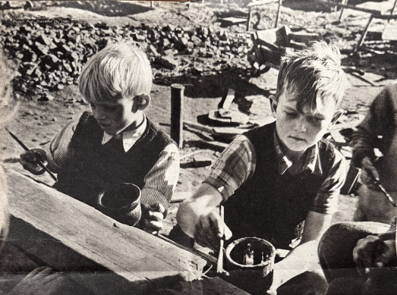
They might have been larking in busy streets, or squabbling in formal, unimaginative playgrounds. Instead they are happily absorbed. In the new-style playground at Emdrup, in Copenhagen, they are free to play with waste material – bricks, old wood, loose sheets of metal – everything we have on our own bomb sites.
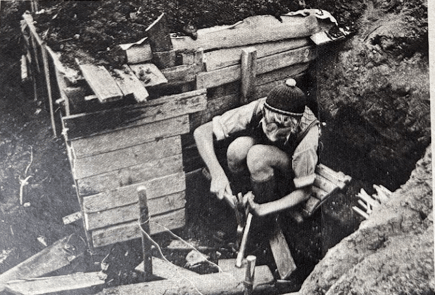
And it’s education in responsibility and self-help too, because the money he gets for his firewood will buy the building materials he covets for new adventures in his ‘waste material’ playground.
WHY NOT USE OUR BOMB SITES LIKE THIS?
Lady Allen of Hurtwood describes how an experiment with a piece of waste land in Denmark gives children just the playground they’ve been looking for. Similar use of bomb sites in our cities could reduce road deaths and juvenile delinquency.
JUVENILE delinquency and the death of young people in road accidents both arise, in part at least, from the inadequate and unimaginative manner in which local authorities try to meet the need for creative play.
Modern conditions, especially in towns, tend to deprive children of places in which to play. The desire for adventure and to explore should be encouraged, but almost all adventure becomes wrong and dangerous in towns, because roads and pavements are the only places where the majority of children can play. Much has been written about children’s play by psychologists and educationalists, but very few of their ideas have been put into practice. The best the Borough Engineer can do is to level the ground, surface it with asphalt, and equip it with expensive mechanical swings and slides. His paradise is a place of utter boredom for the children, and it is little wonder that they prefer the dumps of rough wood and piles of bricks and rubbish of the bomb sites, or the dangers and excitements of the traffic.
Denmark has realised that if children are to be kept off the roads and saved from delinquency, they must be given the opportunity to extend themselves to the full in a playground designed to meet their needs. An experimental playground of a revolutionary nature was started at Emdrup in Copenhagen in 1943. It is a rectangular piece of ground sunk beneath the level of the surrounding land, in the middle of a workers’ housing estate. It is financed by the State, which contributes 70 per cent. of the cost, and by the Workers’ Co-operative Building Society. Its total cost was £2,000. From the beginning, the playground was formed by the children and their play. The materials provided are stone, earth, bricks, wood, iron, clay, water, planks, empty petrol casks, wheelbarrows and derelict motor cars. The children at first had to learn to use tools, and materials, and the work began slowly, but at the end of six months the ‘waste material playground’ was made.
Before houses and caves are built, there is a ‘building meeting’ to decide how best to make their houses without risk of collapse, and when they are finished, the playground leader examines each and passes it before the children play in it. The bricks are cemented together with clay and made rainproof with grass. The older children make fine houses with doors, complete with hinges and locks, and girls decorate the houses inside and out, make tables and chairs, and kitchen utensils.
Indian wigwams of laths of wood and branches of spruce are sometimes 20 feet high. Some caves are built 12 feet down into the earth, and towers are built 45 feet high. The playground is an educational factor of the greatest importance, but there must be a skilled leader, an older companion in whom the children have confidence. He must be willing to make each project a joint effort between himself and the children. For instance, three of the older boys came to the leader in Emdrup, Mr. John Bertelsen, an ex-seaman and trained nursery-school teacher, wanting to build a 50-foot tower. The children first told him their plans and then, in discussion, they discovered the weakness of their suggestions, and it was decided to seek further help from books, and from practical people in the town.
The aim of the leader, of course, is to get all the children to work together by indirect suggestion. They must be secure in the knowledge that the place is their own, that the materials, tools and play equipment belong to them. They have to look after them themselves. If, for instance, a hammer is lost, then they must do without it, or find it.
The playground is a democratic community. The leader never organises groups or play. The children’s freedom is limited only by their feeling of responsibility, by the atmosphere of the playground, and by the care they take of other children, which is necessary if they are to remain part of the companionship of the playground. Frictions are always present when large numbers of children are together, but when they resolve these conflicts themselves—they have their own ‘courts’—they educate each other. The leader has, of course, sometimes to help unravel difficulties, but the conflicts at Emdrup are in reality very few compared with those in other playgrounds. The playing is so intense that the noise, screams and fights found in dull playgrounds are absent, for the play opportunities are so rich that the children do not need to fight. The leader tries not to forbid the children anything, but if action has to be taken, a reason is always given.
The playground is mostly visited by ‘difficult’ children, and by children from large families and overcrowded homes. It is intended for school-age children, but there are children from infancy to eighteen. Many between the ages of five and fourteen, in order to play at all, have to bring their smaller brothers and sisters. All children work together to make the playground a success. They help in a hundred ways and are always eager to undertake a job that is necessary. The playground could not actively exist without this co-operation and help. There are about 200 children always present, and they are coming and going the whole day. It is open from 10 a.m. until 6 p.m., and during this time it may be visited by up to 400 children.
It is a great pity this pioneer playground will shortly be closed because the owner wants the ground to build on. The children do not hide their sorrow. But Emdrup has shown the way. Copenhagen hopes to find another ‘waste material’ playground, and educationists from other countries who have visited Emdrup may start similar playgrounds at home. The facts give them every encouragement. This unorthodox playground has already had a great and powerful influence in preventing juvenile delinquency. Here children have opportunities for attractive free-time activities, and co-operative, creative work with adults, so that they may find their own balance, and a balanced relationship to the community.
NB: A full facsimile with all photos will be uploaded in due course.

