2nd ‘Playwork Campference’ announced for Houston, Texas, February 2019

A Second “Playwork Campference” has been announced for 15th-18th February 2019 in Houston. The organisers, Pop-Up Adventure Play, say it will  bring together “international experts on children’s play to discuss unconventional approaches to risk and inclusion”

Full details here

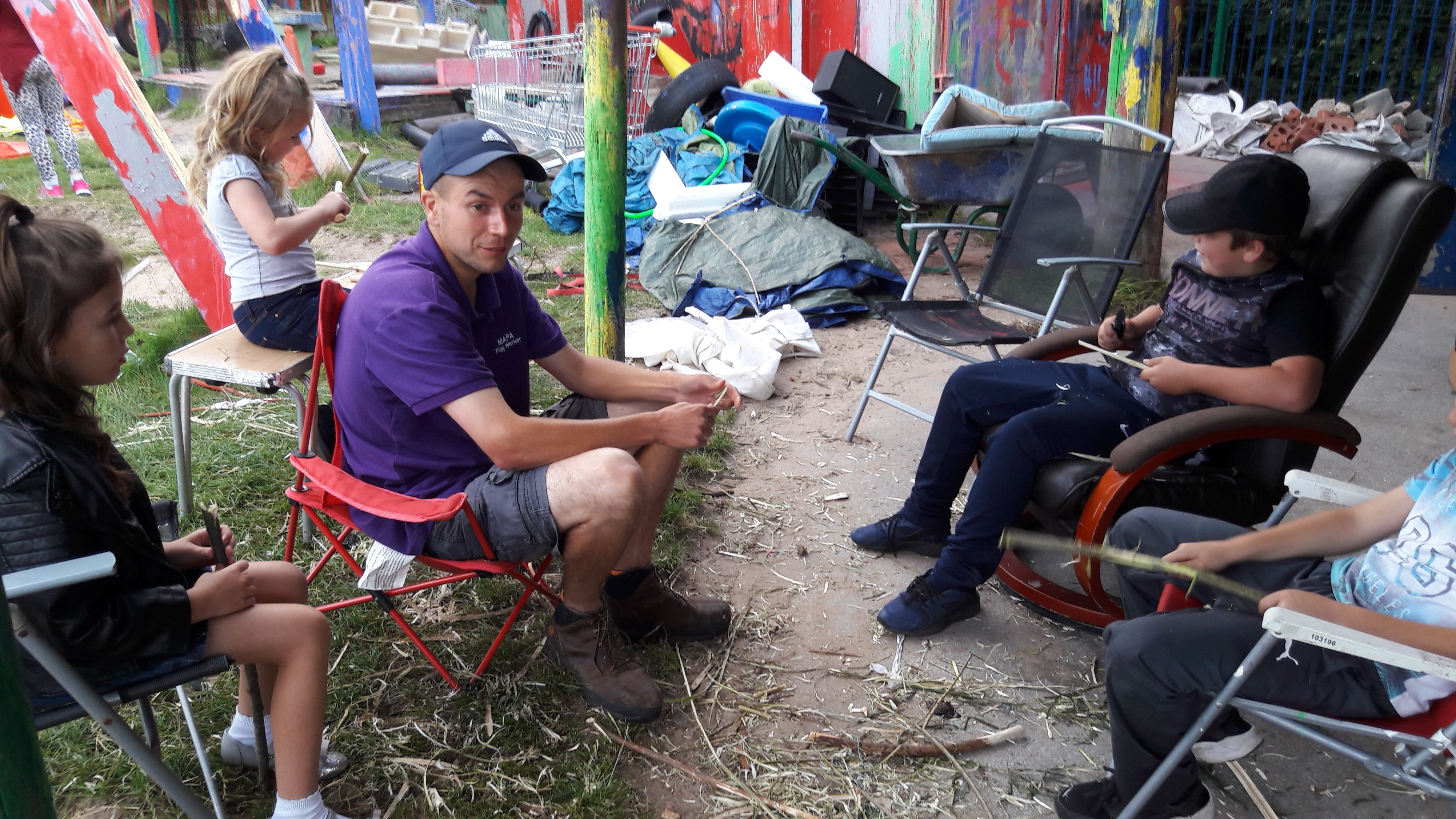
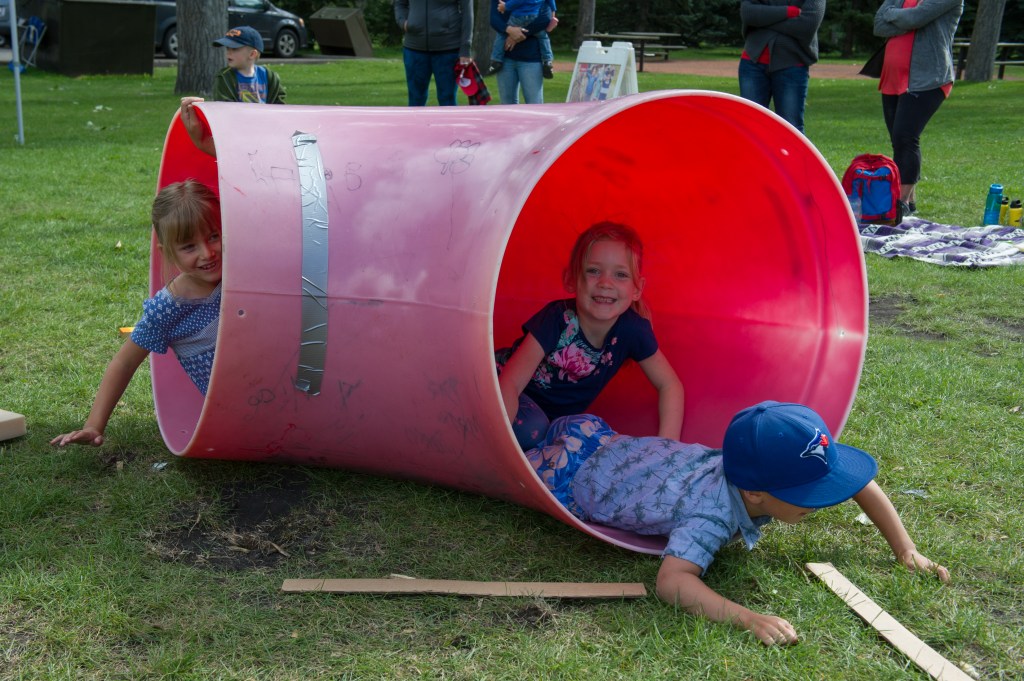
Photo: Calgary Community Services


Symbiotic homeostatic disequilibrium in playworking interaction

A new paper by Joel Seath and Gordon Sturrock, derived from and following communications at the PlayEd conference in Cambridge, May 2018.

Abstract

Playwork’s key claim is its unique manner of working for and with children. It currently suffers, however, from a lack of consensus regarding the benefits of its application. This paper challenges the dilution of playwork practice in acknowledging the art, grace and wisdom in connectivity of playworking. Drawing primarily on Antonio Damasio’s neurobiological analysis, the homeostatic disequilibrium operation at the core of body/neural intra-action is detected as reflected in the interaction of organisms.

In consideration of some key concepts of social ecology – consociation, mutual aid, co-operativity rather than competition, rhizomatic rather than hierarchical structures – and  the neurobiological study of individuals’ feelings, emotive responses, affect and culture, this paper discusses the evolving phenomenon of the playworking adult and child at play in terms of a symbiotic being and becoming.

Joel Seath and Gordon Sturrock

Download the full paper here

Image: ‘Rhizomatic tree of life’ by jef Safi

The Play Cycle 20 Years On

In 1998, Gordon Sturrock and the late Perry Else presented a paper at the IPA International Play Conference in Colorado, USA.  The paper was titled ‘The playground as therapeutic space: playwork as healing’, later referred to as The Colorado Paper and introduced the Play Cycle to play  theory.

In the last twenty years, elements of the Play Cycle (such as ‘play cues’, ‘play return’, ‘play frame’ and ‘annihilation’’) have entered into common use within the childcare sector.  The aim of this exploratory study is to investigate understandings and applications of the Play Cycle within childcare over the last 20 years.

This study is open to anybody who is currently involved in childcare but must be aged 18 years or over.  The research will be undertaken by Dr Pete King from Swansea University and Dr Shelly Newstead.  For more details about the study, please contact Pete at p.f.king@swansea.ac.uk or 01792 602 314.

To take part in this study please click on the link here

The questionnaire can be completed online using a computer, tablet or phone.

The study is open to Friday 21 December 2018.

Thanks

Dr Pete King

Colleagues, community and commons – our vital triumverate

In this critique of Voce and Sturrock’s A Situated Ethos of Playwork, Simon Rix suggests that community should be integral to playwork practice, and the central focus of the field’s fightback.

Thanks are due to Gordon Sturrock and and Adrian Voce for their recent paper, A Situated Ethos of Playwork. It rightly acknowledges that the internal debate, about what playwork is, should at present be laid aside in the face of the urgent issue of what playwork should do. This is not to say that what playwork is is not important; it is to say that what playwork may be is being shaped, and in such circumstances, to do is to be. Doo-be-doo-be-doo!

In this response, I will first discuss some of the paper’s main points; then I will add some comments that I think are relevant. I won’t comment on the preliminary descriptions of playwork in the first section, because I cannot argue with what’s written there. Nor do I dispute the principle that playwork is, at present, a necessary part of the ludic ecology – an ecology that is inevitably linked with, overlapped by and overlapping into other parts of the totality. Currently, this is dominated by an economic hegemony under the control of very narrow interests, only aware of their own needs and assumptions. This can be described as both the ‘integrated spectacle’, and the ‘no alternative’ dialogue, favoured by crisis capitalism.

A story of recuperation?

The historical section of the paper reads as both a story of development, response and endorsement; and a story of recuperation. As Voce and Sturrock rightly point out, the elements with the greatest capacity (wealth) and / or affinity with the current hegemony, tend to have the greatest sway; and also tend to harvest those elements of and from playwork that suit their agenda. So, we find landscape architects presenting projects designed by playworkers as their own, and bit players from our field taking selected elements of the playwork approach into other, more lucrative fields.

Mutual aid and class

So, to resist recuperation and to develop itself as a discreet discipline, it is proposed that playwork should return to the totality, which was at its genesis (in a critique of the totality). The paper pronounces: “where the subordination of children is no longer accepted, everything can change”, The critique of social Darwinism, rightly identified as a way of justifying and promoting practices of domination – from race to class to gender – in fact goes back to 1902 and the publication of ‘Mutual Aid’ by Kropotkin. It’s not new; it is a longstanding heresy, which playwork has been allied to explicitly and implicitly, to varying degrees, forever.

I feel that here is a call for a period of more explicit aligning with that critique, an alignment which, in my opinion, is long overdue. Playwork has been cowed since the beginning of the neo-liberal assault on the critics of social Darwinism, an assault which has had the effect of altering the totality for most, even playwork, into the ‘no alternative’ narrative – of placing all value into the market and so forcing participation in the market at the expense of everything the critique stands for.

Marxian critique still holds sway

In support of that call, we are introduced to the precariat class as an ally. In the context of the critique of the totality, the Marxian critique based on class division still holds sway and hasn’t been superseded; but this critique is also of the totality. While the emergence, (or discovery) of the precariat class is appropriate in the face of the effects of the current neo-liberal crisis, in terms of the totality, how different is being a member of the precariat class any different from any other way of being a landless peasant?

I also wonder how different the discovery of the precariat is to the discovery of the ‘underclass’ in the 1980’s, and how successful any hopes pinned on this section of landless peasantry will be? The pinning of hopes on the underclass – which, for similar reasons, was forced to make a life outside the norms of capitalism and develop ‘post-work’ social structures – didn’t produce change. It didn’t make a significant contribution to playwork, other than providing playwork with a number of volunteers from ‘outside the system’ (a significant number of whom then dropped out of playwork too!).

This is not to denigrate those who find themselves identifying with the precariat as a class, and share playwork’s analysis. I would caution, however, that a significant part of the gig economy is made up of aspirant, slightly arty entrepreneurs whose wish is to find fame, be discovered and float on the stock market. The role of playwork is not to develop class consciousness among the precariat, nor to facilitate the advancement its aspirant element, nor to develop class consciousness among children.

‘The dialectic process demands the negation of oppositions, the creation of something new, not a mere realignment of the forces it contains’.

As Anslem Jappe points out in his recent book of essays, capitalism, class structure and its ideology – currently called neo-liberalism – reproduces itself as a social relationship, as well as reproducing countless throwaway consumer items. It’s the social relationship which is at the hub of the arrangement. How far, then, Jappe asks, is basing change, as well as our critique, on this social relationship, likely to be successful? Is not change, as a departure, dependent on the formation of new social relationships, yet to be decided, but based in other qualities: human ones. This echoes the paper’s point “The struggle we need to commit to, then, is not between different alignments of people, but between people and non-human entities”, but I wish to escape from relying on the existing social relationship as a basis for that. The dialectic process demands the negation of oppositions, the creation of something new, not a mere realignment of the forces it contains.

This is alluded to in discussion of a situated practice. I can’t disagree with the utopian picture painted. I can’t fault the likelihood that a playful approach seems a route towards it, and that playful environments will be a contributing crucible.

New organisations and methods

In pursuit of the establishment and maintenance of crucibles, the paper seems to go into two points. The first is the unification of playwork and the escape of its story from the recuperated, possibly watered down alliances that it’s had. I am a trustee of the Playwork Foundation along with Adrian (declared, though as a burden, not an interest: trusteeship has no personal benefit) and I do see this as a developing vehicle for a playworker controlled, and owned, narrative and solidarity.

There are a number of other, more local, initiatives developing as well – a coping mechanism in the face of neo-liberal denial of any but its own social system. These initiatives are about delivery through new sororal groupings, and new relationships with the state and other funders. There is an opportunity there to develop solidarity and mutual aid among playworkers and our organisations. There is opportunity through this to build local, regional and national networks of playwork delivery. Whether this is additional to, affiliated with, supported by, or any other relationship with the Foundation remains to be seen, as appropriate, but whichever route is taken, care must be taken at this development stage to have due regard to maximising direct democracy in the structure which is set up.

In both cases, Foundation and delivery, the membership is the critical mass, and the source of strength. There has been much written on organisational structure, group dynamics, meetings, consultation and decision-making. In this case, I think the choice to be be made is one which emphasises the human relationship, and tries as hard as possible to enshrine that in the structure. That means a principle of grass roots localism and autonomy, under the auspice of the agreed narrative and structure, which will, as far as possible reflect those principles and narrative. At all costs, the fallacy of democratic centralism must be avoided; as must elitism (another class issue), a tendency which the precariat seems to be susceptible to.

Policy of relationships

Secondly, we have a discussion on rights and policy. I have the greatest admiration for those who are able to sit down with the suits, jackals and other creatures that inhabit the corridors of power; and are able to both endure it, and be understood. I’m certainly not that person, but I have seen the impact it can make, and I appreciate it. The paper goes into, as I have above, the dangers of recuperation, and that any honey pot attracts flies. But, in addition to the corporate squatters and ideological heathens who gathered around the Play Strategy, I feel that the social relationship I criticised above also raised its head here. This was in the decision that the roll out should be by a managerial, and not a playwork organisation.

The idea that management is a generic skillset, and that managers need not know anything about what they are managing was a problem, both for the strategy and for playwork. Skilled and experienced playworkers found themselves leading astonished managers around events and projects; managers who in some cases had no idea of the magic that playwork can unleash. Some playworkers, whose influence had apparently been crucial, didn’t even find out their influence had been there until years after the strategy had been rolled out, never mind have a conscious input.

This is a caution to the Foundation, to the imagined delivery federation and to the field. If it is to be the Foundation that makes the policy approach to Government, if it is to be a delivery federation, if either have a role in a new phase of growth, then the medium is the message. The human relationships, enshrined by the principles of localism, autonomy and direct democracy, must be held dear by these organisations, and their structures must reflect that.

It’s the community, innit?

This leads me on to the glaring omission, the third point.

The paper contains several mentions of the word ‘community’, it talks of a community of practice, and it makes mention of the communities playworkers serve. But, in human terms, I consider community to be the most important constituency in every way. The paper speaks of a national campaign that will “listen to the voices of those on the front line, and in their communities.” Although this speaks of consultation, it doesn’t speak so strongly of participation. It speaks of building support, as traditional politics does, towards a particular goal, which can and may be forgotten as the campaigning mode subsides and the programme lost in recuperation, but it doesn’t speak of love. Love is what sustains the communities that gather around good playwork provision, retains them and facilitates their participation. Playworkers have a service role in this community, but they are not its leaders or its voice. If anything, playworkers should be a conduit based on shared skills, given freely.

‘to build a community around provision and to mobilise that community in times of threat, means everyday playworking in campaign mode’.

This is both relevant to campaigning and to everyday playwork, because to build a community around provision and to mobilise that community in times of threat, means everyday playworking in campaign mode. This shouldn’t sound extraordinary. Observation, knowledge, response, relationships, attention to detail and sometimes individuals, large affective interventions, and small effective facilitations – these should be common to both.

Everyday playworking should be able to concern itself with issues that impact on children’s lives, and affect their ability to play, just as much as it should be able to concern itself with the play environment. It should be able to make a connection with the totality of the community and respond to that, both as an acknowledgement that these issues have an impact on children’s ability to play, and because the play environment has a place in that totality. To attempt to campaign in the face of threat without having the groundwork of a position in the totality of the community renders the community an afterthought, a position nobody will respond to.

I consider this to be a more valuable mode, in the local context, than playwork organisations regarding themselves as managerial and relying on relationships with power, which have already proved fickle. I consider that mode to be as much to do with playworkers positioning themselves in the redundant social relationship that is class society, a symptom of the aspirant precariat, and we will see them by the number and strength of the communities around them and how quickly they accept their recuperation, or die.

Colleagues, community and commons – a vital triumverate

The question of how to develop this element of the triumvirate of playwork defence and development is a little more problematic, given that playwork is about relationships. If I may quote myself, “The adventure playground is not a physical thing. It’s a community. The physical appearance of the site is the hook, if you like, but it’s the social and emotional that gets people to remain”. Community should come as second nature to playworkers, but evidence shows that this is not always the case. Why? Are some tired, some resting on their laurels, some not recognising the connection, some subsumed in the status that policy mistakes of the past have dubbed them with?

Should playwork training have more emphasis on community and relationships, should it contain a unit on campaigning? Should emergent playwork organisations take it upon themselves to take this training out, as a separate piece of work? Who should it be delivered to? Should a model be devised on the hoof, as organisations develop, with due regard to the principles of localism, autonomy and direct democracy at its core? Who is going to join in?

These are questions for debate, and prompt the prequel question of, how and by whom is this debate to be organised? In that spirit, I call upon the field to engage with the Foundation and with the policy roadshows currently underway; and I call upon the roadshows and those debating at them to consider the triumvirate of colleagues, community and commons as an adage:

Colleagues – a unified workforce, building solidarity among us;
Community -meaning both those we serve, whose totality we are a part of, ­­and a community of practice; and
Commons – meaning the wider social and political environment and institutions that we need to have an oversight of, and facilitate in that environment.

If we lose sight of any part of this triumvirate, we will miss the mark.

Simon Rix

Image: Jacqueliine Pallesen

Simon Rix is a practising playworker and a trustee of The Playwork Foundation
 

A situated ethos of playwork

Turning the playwork story into a narrative for change.

In this new collaboration, Adrian Voce and Gordon Sturrock cast their collective eye over the recent history of playwork in the UK to draw out some lessons for the field on how it might regroup and take a leading role in making the case for a comprehensive national play policy: one consistent with its distinct ethos and approach. 

Abstract

Playwork is a distinct approach to working with children, and a particular set of perspectives on the nature of children’s play in a broader context. We concur with others (e.g. Brown, 2017) that its theory and practice – on play and development, constructs of childhood, the role of adults with children, the allocation and use of space, and children’s rights – are unique among the children’s professions.

This paper attempts to describe some of these perspectives, the practice tenets that arise from them, and the distinct ethos we suggest they comprise. We then propose a broad rationale for playwork advocacy, ­congruent with this ethos and its political dimension.

Vision

We also attempt to set out a long-term vision for the place of playwork practice within a renewed, reimagined public realm; and we suggest some specific shorter-term, more tangible objectives, towards the aim of formulating a sustained government policy framework that recognises and supports playwork without compromising it: achievable milestones on a roadmap to the longer-term vision.

Through a critical appraisal of the field’s recent history, the paper considers how organisational structures for playwork advocacy and professional development have, until now, with the odd exception, been ultimately run not by practitioners but by various branches of government, its agents, employer bodies or established children’s charities – generally more aligned with the current hegemony than with anything approximating to the playwork ethos. We argue that, in the absence of a cohesive and authoritative playwork representative body, this has led to near fatal compromises in the development and dissemination of the playwork approach.

Conundrum

The paper addresses the perennial conundrum of a community of practice that profoundly challenges the status quo; yet which, nevertheless, needs to find sufficient leverage in the mainstream policy discourse to secure the resources it needs to sustain its work. As the professional playwork fraternity attempts to regroup after eight years of austerity and UK government policy reversals, we suggest there is an urgent need for the field to coalesce around a binding narrative – accommodating the plurality of perspectives and approaches that have evolved – to explicitly articulate its ethos in a way that can both speak to a wide public audience and impact on the policymaking process.

The paper concludes that the framework for this narrative should be children’s rights, refracted through the prism of the playwork ethos, which is a bulwark against instrumentalist agendas. We suggest that the playwork field, though greatly incapacitated by the dismantling of its infrastructure and the closure of many of its services and courses, has a legitimate claim to be the practice community best qualified to interpret General Comment 17 of the UNCRC (CRC, 2013) for the UK context. We propose that fully engaging with the rights discourse is the logical strategy for playwork advocates; aligning our ethos to an authoritative, coherent policy case that also resonates with a wider political narrative of social and spatial justice, universal human rights and full citizenship for all.

Adrian Voce and Gordon Sturrock
June 2018

Download the full paper here

Adrian Voce is a founding trustee of the Playwork Foundation. His contribution to this paper is in his personal capacity and does not represent the collective view of the charity.

Photo: Adrian Voce (Tiverton adventure playground, Devon).

What is unique about playwork?

eran-marshmallow-e1513346778660.jpg

At the launch of the Playwork Foundation in November 2017, Professor Fraser Brown described the elements of playwork practice that he identifies as unique within the children’s workforce, using playwork stories to illustrate each point.

He has now followed up his presentation with an expanded paper, which can be downloaded below, while the list of unique elements is set out here:

The Unique Elements of Playwork

A conceptualisation of the child that actively resists dominant and subordinating narratives and practices.

A belief that, while playing, the ‘being’ child is far more important than the ‘becoming’ child.

An adherence to the principle that the vital outcomes of playing are derived by children in inverse proportion to the degree of adult involvement in the process.

A non-judgemental acceptance of the children as they really are, running hand in hand with an attitude, when relating to the children, of ‘unconditional positive regard’.

An approach to practice that involves a willingness to relinquish adult power, suspend any preconceptions, and work to the children’s agenda.

The provision of environments that are characterised by flexibility, so that the children are able to create (and possibly destroy and recreate) their own play environments according to their own needs.

A general acceptance that risky play can be beneficial, and that intervention is not necessary unless a safety or safeguarding issue arises.

A continuous commitment to deep personal reflection that manages the internal relationship between the playworker’s present and former child-self, and the effects of that relationship on their current practice.

Fraser Brown

Read Professor Brown’s full paper: What Is Unique About Playwork

Photo: Adrian Voce


fraser-brown Inaugural

Fraser Brown is the world’s first Professor of Playwork and the author of numerous papers, chapters and books on play and playwork.

He and the playwork team at Leeds Beckett University have contributed a chapter to the forthcoming Cambridge Handbook of Play (Roopnarine & Smith 2018), which will include  a discussion of these unique elements of playwork.


Playwork foundation launches at London event

The Playwork Foundation was launched as a membership organisation at a special event in London last week.

The Playwork Foundation finally opened for business last week at a special launch event in London.

Board members Ali Wood and Karen Benjamin, experienced playwork trainers, writers and consultants, introduced the event with a review of the foundation’s development, which began at a meeting called by Bob Hughes and the late Professor Perry Else at the University of Sheffield Hallam, in 2013.

Wood and Benjamin said that an extensive consultation with the field had found overwhelming support for a new vehicle for playwork and had established some clear aims and principles.

Development

They said that, although slow because of the lack of resources, the development work had been proceeding steadily to this point. The new body has a charitable constitution, adopted by a board of trustees, and is awaiting registration. It has a website, a list of potential members and has developed a dialogue with national bodies in each of the four UK nations. The time was ripe, they said, to launch a membership scheme as the next significant milestone.

UNIQUE

Among the guest speakers at the launch event, held at Goldsmiths University of London, was Professor Fraser Brown of Leeds Becket University, who welcomed the launch and spoke about what makes playwork unique, illustrating each quality with a story in his inimitable style. Professor Brown said the playwork approach ‘actively resists dominant and subordinating narratives and practices’. Playworkers, he said, practice non-judgmental acceptance of children, holding them in ‘unconditional positive regard’, akin to the approach of person-centred counselling as developed by Carl Rogers. He said playwork offers children flexible environments, in which to afford them opportunities for the fullest possible range of play types.

entreaty

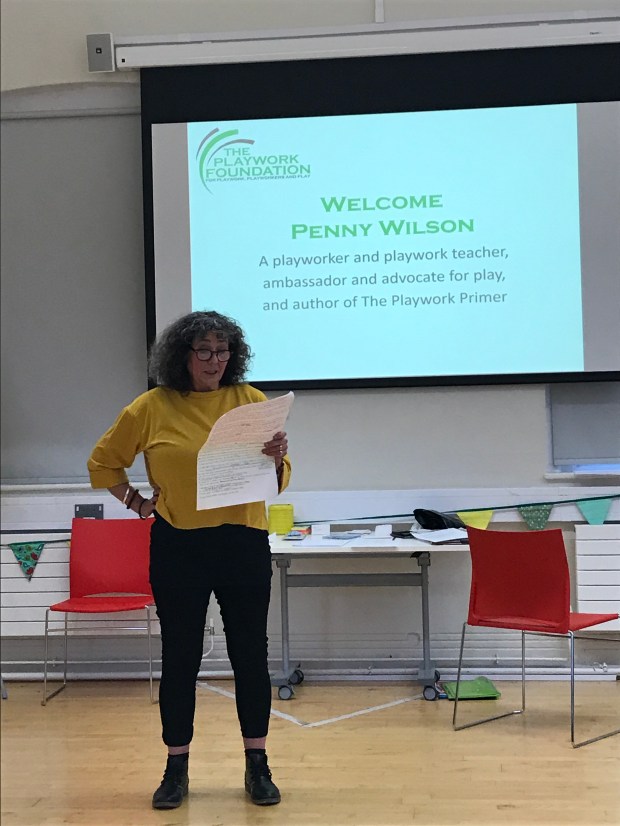
Penny Wilson, the London-based playworker and author of The Playwork Primer greeted the launch of the new body with a lyrical and impassioned entreaty from the field, reflecting the discourse at the recent adventure playground conference in Bristol.  Wilson said the field wants ‘an organisation that is tailor made – like playwork is  – a bespoke design with enough strength in its warp and weft to be responsive and resilient, to be able to meet and greet the unpredicted; an organisation that is play literate and promotes play literacy’.

INDEPENDENT

Adrian Voce, author of Policy for Play, and a member of the foundation’s board, spoke about the need for the playwork field to create its own vehicle, after previously seeing its support structures hosted or controlled by organisations with wider remits – and for whom play would only ever be a priority when it was in favour with government or brought in extra funding.

Quoting Labour Party leader Jeremy Corbyn, Voce said it was a mistake to believe that the decline in playwork opportunities was long-term. He said the period of austerity should be seen as an opportunity to re-group, stronger and wiser than before, ready to take the case for play and playwork into the next election campaign. He suggested that we need to now move quickly given the volatility of the political situation.

Meynell spoke about the longer-term history of playwork development, and previous incarnations of the national movement. He hoped the new organisation would help to revive the field after the decline of the austerity years.

Although modest in scale, many of those attending said the event – and the new body – felt like something they could identify with and belong to. Others said it was a significant moment in playwork’s history.

Time will tell.

More details of the different presentations, including a full transcript of Penny Wilson’s speech, will be made available soon.

WITH THANKS TO GOLDSMITHS UNIVERSITY OF LONDON, WHO HOSTED THE EVENT FREE OF CHARGE

JOIN THE PLAYWORK FOUNDATION HERE

The Playwork Foundation Board is

Simon Bazley (pictured, top)
Karen Benjamin (inset, right)
Barbara McIlwrath
Tanny Stobart
Debbie Willett
Ali Wood (pictured, top and inset left)
Adrian Voce

Withdrawing qualifications is another blow to playwork

Play England has reported that CACHE (Council for Awards in Care, Health and Education) has closed its Level 2 Award and Certificate, Level 3 Award and Level 4 Award and Certificate qualifications to new registrations. The other main awarding organisation, City and Guilds are also now only open for registrations of full Diplomas at levels 2, 3, and 5, although they are still offering the Level 4 Award. All of these qualifications, for both awarding organisations, are only available for registration until November 2017.

According to Play England, these qualifications, vital to the growth of a professional playwork sector for two decades, no longer fit within the Regulated Qualifications Framework (RQF) that replaced the former Qualifications and Credit Framework (QCF) under the Coalition Government.

Under the RQF, the ‘stepping stone’ awards and certificates, which could previously lead incrementally to full diplomas via the credit system, is being phased out. Thus, when existing qualifications come up for renewal, unless they are suitable for conversion to the new framework they are being withdraw, in spite of many playworkers and their employers preferring the modular approach.

Prospects

But the prospects of playwork in England adapting to this new context are affected by a funding squeeze. With registrations for playwork qualifications declining because of a dearth of available finance, awarding organisations are finding it harder to make the business case for the development of new ones. At a roundtable meeting at the National Playwork Conference in Eastbourne last week, co-hosted by Play England and the Playwork Foundation, it was agreed to lobby CACHE and City and Guilds, to extend registration of the level 2, 3 and 5 qualifications beyond the end of the current year. The two organisations have written to the awarding bodies and are encouraging playwork trainers and employers to do the same.

Nicola Butler, chair of Play England, says: ‘Playwork is a highly skilled job. Parents, playworkers and employers all want the playwork profession to have the training that is needed for the job, but while most playwork employers would like to be able to invest more in professional development of their workforce but are prevented from doing so by the lack of public funding’.

So what are the reasons for this decline in the playwork sector after so many years of growth? One factor is the partial de-regulation of the school-age play and childcare sector. Since September 2014, there has been no statutory requirement for out-of-school clubs and holiday play-schemes to employ staff with ‘full and relevant’ childcare or playwork qualifications. (Over-8s and open-access providers have never been required to register).

Cuts

At least as significant as the change in regulatory requirements has been the effect of cuts to local authority play services, which in many places have been withdrawn altogether.  A 2014 report showed that capital and revenue spending on children’s play by England’s local authorities from 2010-13 fell by 50% and 61% respectively and it is clear that deep cuts have continued.

Many believe that playwork is now in something of an existential crisis, certainly in England. 10 years ago, the first phase of a 10-year national play strategy included funding to qualify 4,000 playworkers and a new graduate level qualification for playwork managers. Since then, the government has, according to the Children’s Rights Alliance for England, ‘undermined’ children’s right to play by abandoning the play strategy and not having a minister with responsibility for play policy for the first time since the 1980s; a situation that remains, in spite of the calls for a wide ranging national play policy by an All Party Parliamentary Group on children’s health in 2015.

What does all this mean for children? Most obviously, vital play services such as staffed adventure playgrounds (where playwork originated) are being closed. In some places these are being replaced with fixed equipment play areas, as in Watford; in others, such as Battersea Park, children can now indulge in ‘tree-top adventures’ for between £20 – £38 a session, where they used to play for free on structures that they had helped to build. Wendy Russell of the University of Gloucestershire estimates there only 150 traditional adventure playgrounds remaining in Britain, compared to around 500 at their peak; and with the erosion of playwork training and the on-gong pressures on funding, she has called those that remain an ‘endangered species’.

Extended schools

Less apparently, but perhaps even more significantly (certainly for larger numbers of children) the removal of a requirement for qualified staff means that children attending after-school and holiday play services – not voluntarily, let’s remember, but because their parents need to work – are now much more likely to be supervised either by classroom assistants or staff with no training at all; often on school premises.

When Labour introduced the concept of ‘wrap-around’ services as a key development of its ‘childcare revolution’, it was quick to distance itself from the term ‘extended schools’; but what the abandonment of playwork practice as the benchmark for quality in out-of-school provision means for many children, is that they are now effectively in school for up to 10 hours a day.


 A New Playwork Apprenticeship

The one area of potential growth for the playwork training sector is apprenticeships. The government is introducing an Apprenticeship Levy, although most small centres are not eligible for this funding unless subcontracted by larger providers. On this point, the Playwork Foundation is concerned that a high proportion of the few larger centres offering playwork apprenticeships employ trainers and assessors who are ‘not occupationally competent’.

A group of playwork employers has submitted an expression of interest to develop a new Playwork Trailblazer apprenticeship, which aims to: enable employers to access playwork apprenticeships; clarify what they should cover; develop the skills needed for quality playwork provision; and reinforce that they need to be delivered by trainers and assessors fully competent in playwork.

Adrian Voce

An edited version of this article was published in Children and Young People Now on 14 March 2017

This article is about playwork qualifications in England. For an overview of the situation in Northern Ireland, Scotland and Wales read this

Thousands of children expected for Playday 2016

Tomorrow, 3 August, tens of thousands of children and young people from across the United Kingdom will be out playing, celebrating Playday – the national day for play, when hundreds of local and regional play events are taking place to promote the importance of children’s right to play.

This year’s Playday theme, ‘Play Matters…’ celebrates the many benefits of outdoor play: climbing trees, making dens, jumping in puddles, making mud pies, rolling down hills, playing with water, chasing, hide and seek, climbing.

Playday national coordinators, Play England, Play Scotland, Play Wales and PlayBoard Northern Ireland issued a statement, saying:

“It will be no surprise to learn that when children talk about their preferred play experiences, they more often than not cite outdoor play as their favourite activity. This makes sense; the outdoors is the very best place for children to practice and master emerging physical skills. Frequent and regular opportunities to explore and play in the outdoor environment are essential for children’s … well-being, health, happiness, learning and development”.

To mark this year’s Playday, publishers Routledge, part of the Taylor and Francis Group, have made a selection of play-related academic papers and articles available free of charge for the duration of August. Visit their site here to view the selection.

sticker

About Playday

Playday was originated by a small group of playworkers in London in 1986 as a response to threatened cuts and closures to adventure playgrounds and play schemes (Plus ca change!)

It has become the national day to celebrate children’s play in the UK, traditionally held on the first Wednesday of August. As well as a coordinated annual event, Playday continues to be part of the campaign to highlight the importance of play in children’s lives and their right for this to be provided for within the public realm.

For more information see www.playday.org.uk

Follow #Playday2016 on Twitter

or visit the Playday Facebook page

Steering group plans take shape

The steering group for the new Playwork Foundation has met for a two-day residential workshop to develop its plans and resolve outstanding administrative issues associated with the organisation’s imminent launch.

The meeting, on 5-6 July, made substantial progress towards establishing the body as a new charitable organisation, and on its first programme of work. The steering group also reaffirmed its commitment to engage with other national play organisations to explore potential collaborations, ensure the foundation’s work is complementary to existing activity and avoid possible duplication.

More details of the Foundation’s plans will be published soon on this site.