Play Wales has released the first of a series of guides exploring some of the theories that influence the way adults understand children, the role of play and childhood, as well as the ethics of working with playing children.
The first guide:
Explores some of the ideas, concepts and theories of child development and childhood that have influenced and continue to influence understandings of children and their play and as a result are important to those practicing playwork.
Looks at the playwork role and how it both affects and is affected by the environment and the children. It considers how the play process is given precedence and how playworkers balance the developmental benefits of play with children’s well-being.
Play Wales worked with Ludicology to produce this and three further guides to be published over the coming weeks.
You can download the first volume in Welsh or English or view online, in Welsh here or English here.
As practitioner-led structure building declines, Rob Wheway of the Children’s Play Advisory Service explains how inspection training is part of a renaisance of this quintessential feature of the traditional adventure playground.
Over the course of its history, adventure play has had a variety of attributes promulgated as its defining practice ethos, with different aspects taking prominence at different times, as fashion – both in playwork and in the wider zeitgeist – fluctuates. First ‘risky play’ takes the limelight, then ‘creative play’, before ‘natural play’ wrestles it away for a while … and so it goes on.
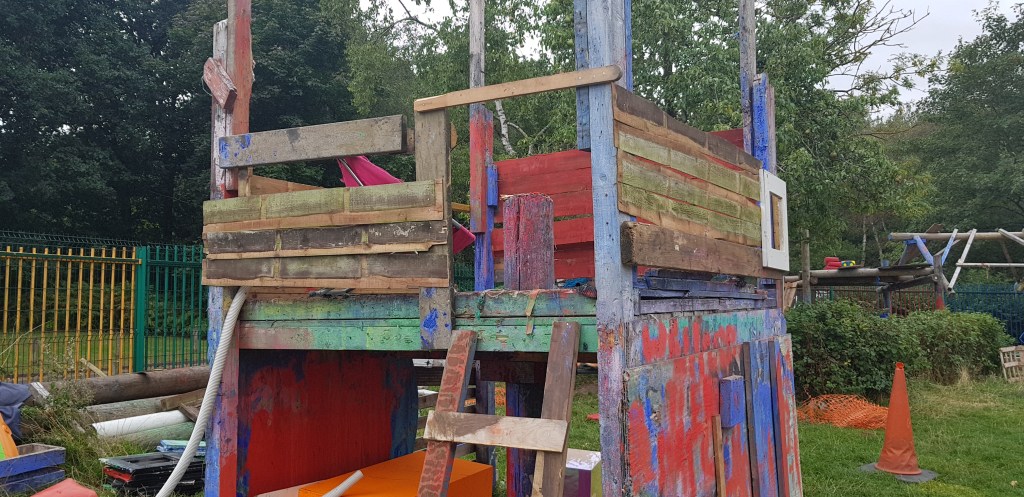
Whichever way the zeitgeist goes, though, it is an abiding characteristic of adventure playgrounds that they are made and built by playworkers. The ethos of adventure play is self-build: playworkers build them, and playworkers are responsible for them.
However, many playworkers are currently employed on adventure playgrounds that have either not been rebuilt for some years, or where contractors have been used in preference to training the workforce in the relevant skills.
Such practitioners, having had no role in the building of their playgrounds, are in a difficult position. This was highlighted of the recent case involving the failure of a piece of ‘self-build’ equipment (which had, in fact, been placed by a contractor) and which had not been adequately inspected. It was this case which probably propelled the furore with an insurance company a couple of years ago, and led to headlines that adventure play is too dangerous to insure.
Upskilling the workforce
The response to this turn of events could be to further deskill the workforce and deaden the adventure playground with rigidity – no more self-build, no more flexibility, no more children ‘spoiling’ bought equipment with hammers and nails … Or, it could be to develop further methodologies to overcome insurers’ fears and to upskill the workforce’s competence in caring for and developing the play environments they provide.
In pursuance of the latter, the short course ‘Inspecting your Adventure Playground’ has been developed by the Children’s Play Advisory Service, which is recognised as one of the foremost resources for health and safety expertise in both the fixed-equipment and adventure play fields.
This course is designed to provide a framework for playworkers to both perform operational inspections of their playsites, and keep an ongoing paper trail as evidence that due care has been taken to repair and maintain the attendant structures. This both ensures that the site remains in an acceptable state between annual inspections, and covers the organisation and workforce against claims of negligence in the event of unexpected and unforeseeable catastrophe.
Piloted with playworkers
The course has been piloted with playworkers running adventure playgrounds, mostly to a good reception. Participants have commented, “I thought the information given on this course was relevant in order for playworkers to have a better understanding of how to keep a playground safe” and, “Very informative… all adventure playground staff need this training.” However, there remains some confusion over operational inspection, dynamic risk assessment and annual, independent inspection.
The course is not a substitute for annual, independent, inspection by a competent and qualified person. Its methodology works in tandem with independent inspection and is intended to overcome the tendency, which overworked playworkers may have, to put the independent inspection, once completed, aside until the following year, in order to avoid the onerous and laborious tick-box sheets which can become robotic, not really checks at all; or the tendency to do the checks, but not to record them. Neither does its methodology work the same as dynamic risk assessment, which is a process for judging actions in the provision, rather than a system for recording the physical safety of the provision itself.
As there is currently no accrediting body for courses in playwork (which the Playwork Foundation and others are working to remedy) the current ‘Inspecting your Playground’ course does not carry a qualification. It does, however, both equip playworkers with the tools to prove competence should the need arise and, more importantly, mitigate against such eventualities by enabling them to be more fully responsible for their own sites.
Rob Wheway Children’s Play Advisory Service (CPAS)
For more information contact Rob Wheway, Director of CPAS. on whewayr@gmail.com or 024 7650 3540
Ali Wood of the Playwork Foundation adds…
The Playwork Foundation has heard from a number of playworkers in adventure playgrounds with self-build structures about how best to inspect and maintain these to ensure they remain safe. We, therefore, want to promote the course run by the Children’s Play Advisory Service, ‘Inspecting Adventure Playgrounds’ that enables playworkers to do just that.
At Meriden AP, for example (where I am a trustee), we are currently having to deal with a personal injury claim regarding a child who came on her first visit and broke her leg at the bottom of a slide constructed from large tunnel piping several years earlier. Had our staff not done this course with Rob Wheway and Simon Rix, we may well have had difficulty providing the necessary evidence for both the solicitor and the insurance company, to show we were not negligent in both checking and maintaining this slide and all our other structures in a meaningful way.
We were also able to call on Rob Wheway for the extra information we needed regarding what the law does and doesn’t require of us regarding self-build structures and his help was invaluable. I would really urge AP playworkers to do this course so you really know the ongoing condition of your structures both above and below ground and can be sure they are therefore safe.
Ali Wood
Ali Wood is a playwork trainer and writer who is a trustee both of the Playwork Foundation and Meriden Adventure Playground.
A message from The All-Party Parliamentary Group on a Fit and Healthy Childhood
Zoom Meeting open to all – Monday 8th February 2021 at 4.30 pm
The APPG is inviting you to an open meeting with the aim of encouraging and co-ordinating sector-wide activity to press for improved mental health support for children and young people.
It is not the intention of the APPG or of the meeting to define precisely what organisations or individuals might wish to say. Each will have their own perspectives, and variety in approach will be an important factor in distinguishing the campaign from a standardised template letter-writing campaign.
Hopes raised Even before the pandemic, there was overwhelming evidence of a significant and growing decline in the mental health of our children and young people. Much of this evidence was set out in APPG reports 10, 12 and 14. Some of the evidence available since the pandemic is attached to this email, courtesy of The Children First Alliance.
The APPG is currently preparing a further relevant report scheduled for March publication entitled: ‘The Covid Generation: A Mental Health Pandemic in the Making’.
Government seemed to accept that ‘something must be done’ and on 9th January 2017, former Prime Minister Theresa May announced the publication of a Green Paper: ‘Transforming children and young people’s mental health provision.’
In a press release, heralding the Green Paper and captioned ‘Prime Minister unveils plans to transform mental health support,’ Mrs. May said:
‘What I am announcing are the first steps in our plan to transform the way we deal with mental illness in this country at every stage of a person’s life: not in our hospitals, but in our classrooms, at work and in our communities. This starts with ensuring that children and young people get the help and support they need and deserve – because we know that mental illness too often starts in childhood and that when left untreated, can blight lives, and become entrenched.’
In July 2018, the Government published its response to the public consultation on the Green Paper with a joint Ministerial foreword by the Rt Hon Matt Hancock MP, then as now, Secretary of State for Health and Social Care, and former Secretary of State for Education, the Rt Hon Damian Hinds MP.
They said:
‘The government is delivering on manifesto commitments, taking focused action to provide the support needed by children and young people…Our aim is for the proposals we set out in our Green Paper in December 2017 to transform support for children and young people’s mental health, linked to and building upon what is already done by schools and colleges. We want to make sure that young people have access to the services they need, whilst teachers and schools – who are often on the front line of recognising and supporting a young person’s mental health problems – have access to the training they need…. we are determined to drive this programme forward as quickly as possible with the ultimate ambition for national rollout.’
Hopes that the Green Paper reforms would not be blown off course under the new Prime Minister were high when in the Queen’s Speech of 19th December 2019 Boris Johnson announced his intention to reform the 1983 Mental Health Act ‘during the course of this Parliament’.
It was therefore reasonable to expect that the first comprehensive mental health legislative reform since 1983 would enshrine the principles and major proposals of the Green Paper.
Hopes dashed There was concern that the Government-commissioned Wessely Review of the Act was strongly focussed on detention issues nevertheless the sector remained hopeful that the Green Paper reforms would not be lost. However, when the White Paper was published on Wednesday 13th January 2021, it became clear that there was little intention to roll out those Green Paper reforms.
The White Paper was laid before Parliament by the Rt Hon Matt Hancock MP, then as now, Secretary of State for Health and Social Care, the same Minister quoted above saying in July 2018 of the Green Paper proposals that he was ‘determined to drive this programme forward as quickly as possible with the ultimate ambition for national roll out’.
Insofar as children and young people feature in this White Paper, it is largely in respect to the law on detention and inpatient care.
Undoubtedly, detention issues required addressing and those proposals have been well received but this impacts only on a minuscule number of people compared to the widespread and growing mental health challenges affecting so many children, young people and adults.
The White Paper as it stands represents a sad scaling down from the Green Paper vision of widespread reform to stem the tide of large-scale and growing mental health deterioration especially amongst children and young people, part of the trajectory, further fuelled by reducing levels of physical activity and health, towards the next generation becoming the least healthy adult population in the UK in living memory.
The narrow perspective of the 2021 Johnson White Paper may be best described as polishing the edges of continuity.
Parliamentary support for the Green Paper approach It is to be assumed that if the recommendations of the Green Paper are intended to persist at all, this will be via the familiar limited trialling of strategies or in the form of ambitions in the NHS Long Term Plan.
At Westminster, however, Parliamentarians have continued to press for the adoption of ‘Green Paper-style’ approaches. Some examples:
It was left to the now Backbench Theresa May MP, responding to the Statement of the Secretary of State, to introduce a dissonant note on the White Paper: ‘I fear though, that the legislation might not be on the statute book until 2023. Meanwhile, GPs and hospitals caring for my constituents tell me that there is an increasing problem of mental health and increasing numbers of people with mental health problems, particularly young people,’ https://www.theyworkforyou.com/debates/?id=2021-01-13a.329.0
Robert Halfon (Harlow, Con, Chair of the Education Select Committee) to the Secretary of State for Education the Rt Hon Gavin Williamson MP, 18th January 2021:
‘…While schools are closed and children are remote learning, mental health worries for millions of children have rocketed, as highlighted by the Royal College of Paediatrics and Child Health and others. Will my right hon friend work with charities such as Place2Be to put mental health counsellors in all schools now, so that children can access support whenever they need it and their attainment levels will not suffer even further?’ Munira Wilson (Twickenham, Liberal Democrat) writing in ‘Politics Home’
‘The availability and access to counselling in schools would be a lifeline to many young people, allowing them to get the support they need before they reach crisis point…….The Liberal Democrats are calling on the Government to invest in the future by prioritising access to counselling to children and young people who are already dealing with so much…
Baroness Fall (Con): Questions for Written Answer, tabled on 12th January and due for answer by 26th January:
To ask her Majesty’s Government what percentage of referrals of children with mental health issues referred for treatment from (1) GPs and (2) other health professionals, have been treated through child and adolescent mental health services since 23 March 2020; and what was the percentage of such referrals from 23 March 2019 to 22 March 2020.’
Queries and discussion points that stem from the omission of the 2017 Green Paper ethos and content in the January 2021 White Paper might include the following:
What help will the new legislation afford a child or young person before they are in crisis? The White Paper leaps straight to emergency inpatient treatment and misses all the steps beforehand that could have prevented the emergency from happening. Also absent is the great swathe of professionals in the community such as play therapists and counsellors prior to detainment in a hospital or secure setting
The Green Paper of 2017 commits resources to the recruitment of therapists, supervisors, training teachers in mental health awareness and ‘puts schools and colleges at the heart of (our) efforts to intervene early and prevent problems escalating.’
The Green Paper system to facilitate Mental Health Leads in schools with links to parents and carers with promised Mental Health Support Teams to be supervised in cross-departmental spirit by NHS Children and Young People NHS staff is missing
The Green Paper focused on the ‘right help in the right setting’ on early intervention and school-based therapy and support. This differs sharply from the White Paper concentration on ‘invasive’ or ‘other medical treatment’ in an inpatient surroundings
There is no recognition of the value and existence of the current workforce in schools to include clinically trained therapists and professional counsellors
There is no reflection of the plans in the Green Paper for teacher training and support when dealing with emergent mental health problems in schools
If there is little support available for children and young people experiencing mental health problems before they enter crisis, what therefore is proposed for ‘afterwards’ when a young mental health inpatient is discharged? Therapists and counsellors are needed in schools as a matter of statute (not option) both for early intervention, prevention and recuperation after a crisis to help a child to regain health and resilience and go on to thrive in school as is their right
A gap is perpetuated between the initial worries of a concerned parent, carer or teacher and a full-blown CAMHS referral. What about the crucial ‘in-between’ stage where the services of trained teaching staff, on-site play therapists and counsellors can make the difference and avert a full-scale inpatient stay?
The call for mass urgent action Without a determined and concerted effort, there is a real risk that the Green Paper proposals will be ‘sometime, never’ and now is the time for action.
The aim of the action is to press for ‘Green Paper’ inclusions into the current White Paper and to build a concerted, determined campaign for the Green Paper proposals to be enacted, either through the White Paper or otherwise.
It is not the intention of the APPG or of the meeting to define precisely what organisations or individuals might wish to say. Each will have their own perspectives, and variety in approach will be an important factor in distinguishing the campaign from a standardised template letter-writing campaign.
It is however important to act swiftly.
Key links The White Paper is available here The Green Paper is available here. APPG reports 10, 12 and 14 available here.
Who to approach In essence, write to Rt. Hon. Matt Hancock MP (Secretary of State for Health and Social Care) at mb-sofs@dhsc.gov.uk and copy in every political contact you have including:
Constituency MPs where relevant.
The email address for submissions to the White Paper is mhaconsultation2021@dhsc.gov.uk (don’t be guided by the set questions unless you have a particular interest in any question, simply write with your views on what is needed to help children and young people)
Rt. Hon. Jeremy Hunt MP (Chair of the Health Select Committee) huntj@parliament.uk
The Playwork Foundation is attempting to compile a current database of adventure playgrounds, knowing that there have sadly been many closures in recent years. We also want to extend the scope of the data to cover the whole of the UK.
We are asking members and supporters to help us to review the attached spreadsheet – compiled by Mick Conway when he was at Play England, and last updated in 2017.
If you have up-to-date, accurate information on adventure playgrounds in your UK region that differs from the information on the spreadsheet, please contact Ali Wood: aliwood@blueyonder.co.uk
The All Wales Playworkers Forum has been running since 2007. Orginally established by Play Wales to provide a forum for those working in adventure playgrounds it has evolved to meet the needs of the sector. The Playworkers Forum is run by a dedicated steering group of playworkers, for playworkers. In the past a number of regional play associations took it in turns to administer the event with our collective aim being to keep the costs as low as possible, whilst bringing as many playworkers as possible together to share information, network and recharge our batteries. More recently, with the sad closure of the vast majority of the regional associations, Play Wales have taken over administration of the event on behalf of the sector, with the steering group working hard to keep things fresh and exciting for all participants from year to year.
Over the years we have toured around Wales, from as far south as the Gower Peninsula to as far north as Hawarden. We’ve made temporary homes in orchards, willow globes and big tops and generally we have almost always had the weather on our side. Anyone who’s ever attended will be fully aware of how much of a special event it has become in the playwork calendar. As our infrastructure has changed here in Wales, the forum has also been opened up to anyone from across the UK and it has brought playworkers together to share their unique experiences and support each other. The event has always been an overnighter, with participants camping out under the stars and often sat up into the small hours gazing at the glowing embers of our fire and putting the world to rights.
Over the years we’ve been lucky to attract some of the best playwork trainers, speakers and academics and they have all really helped to make the event what it is. We tend to have a blend of theoretical and practical sessions, normally focussed around an emerging or current hot topic. One of the annual highlights is without a doubt the ‘Annual Playwork Games’ hosted by Martin King-Sheard. Two teams of goblins and elves compete in a head to head to find out who will be crowned champions for the year ahead.
This years event was somewhat different from previous years, due to the lockdowns that sadly made meeting in person impossible. Instead, to ensure that we maintained continuity we all came together on 24th June 2020 for an online book club that was organised and facilitated by Play Wales. It was so much of a success that they are now continuing these for free as a monthly professional development opportunity for play and playwork professionals in Wales. Each month they select a freely available online paper, article or other publication relating to play and playwork for you to read and then you can join an hour’s discussion and reflection on the content. All Book Club meetings are held on the Zoom online meeting platform. More information is available here.
In the first book club, participants discussed the Play Wales guidance paper ‘dynamic risk management of common but potentially hazardous play behaviours’. This paper was written by Mike Barclay, Dave Bullough and Simon Bazley. The paper is available for free download here.
The event was facilitated by Martin King-Sheard and Marianne Mannello from Play Wales, who also ran a ‘Q and A’ session with one of the papers authors, Simon Bazley. The successful event was then followed by an online version of the playworker games where contestants competed to find out who would be crowned champions for 2020. It was a close call with competitors racing around their houses to undertake a series of challenges and games. In the end the mighty elves came through victorious once again, just beating the goblins in the last game.
Anyone interested in attending future events should keep an eye out on the Play Wales website as we hope to be back to meeting in person once again in 2021 if local and national restrictions allow.
Dr Pete King of Swansea University is researching the playwork field’s response to the pandemic and has two opportunities to get involved.
Adventure Playgrounds
Dr. King is looking for anyone involved in adventure playground to take part in a study on how adventure playgrounds have been adapted since post-lockdown measures were put in place in July 2020. The research study will involve a short 20-30 minutes interview using Zoom. If you would like to take part, please contact Pete at p.f.king@swansea.ac.uk where you can be sent more information about the study. The research study has ethical approval from the College of Human and Health Science at Swansea University.
After-school clubs or holiday playschemes
Dr. King is also looking for anyone involved in afterschool clubs or holiday playschemes to take part in a study on how you have adapted since post-lockdown measures were put in place in July 2020. The research study will involve you to take part and complete a short survey which can be accessed here.
Adele Cleaver trained as a playworker in Birmingham back in 2010. She calls herself “a nomadic Brummie” who after dabbling in playful adventures and community work in Leeds, London and Birmingham and Ghana, Portugal, Brazil, Uganda and Kenya now resides in Bournemouth on the south coast of England with her 4-year-old daughter and husband.
In November 2019 she started writing her first book which she describes as a part-memoir, part-manifesto on living a life full of play. She writes “accidentally stumbling into playwork was going to be the best voyage I was ever going to embark on”. We asked her a few questions about her playwork journey.
How did you become a playworker?
I think I was born a playworker. It just took me a long time to realise my way of being could also be a profession. My home was like a free play environment; a laidback pair of almost hippies for parents with 4 children, over 12-year age gap each with their respective friends over to play, and a multicultural backdrop beyond our doorstep. My mom was a teacher though openly criticised “the system” and longed for the 6 weeks holidays and my dad worked in Social Inclusion for the NHS so I was brought up to live inclusively, be weary of hierarchy and play freely. I went to the University of Leeds to study International Development because when I was 18 I naively thought I could save the world. I moved back to Birmingham and worked at a local youth project as a Youth Worker where I bumped into Laura Watts one of the radical women who founded Dens of Equality. She worked in the building next door, and took me under her wing because the youth project just wasn’t rebellious enough for me. After a few months of bid-writing and setting up family-led play projects around Birmingham, Laura sent me off to play with Ali Wood and Sue Smith and they turned me into a proper playworker with a capital P and a certificate to prove it.
Are you working on a play project in Bournemouth?
Yes, currently myself; I am my own play priority! The first few years of motherhood and juggling the chaos that a tiny new life brings reminded me that I needed to play more. Playful parents breed playful children so I’ve been prioritising us at home.
But even before motherhood, I took a rest from play when we moved out of London in 2014; not intentionally but because playworker jobs didn’t seem to exist down here. I needed work, couldn’t afford to be fussy so without giving it much thought ditched the play. I was an Autism Support Worker for a few years before I had my daughter and always tried to work more playfully, but there was no real understanding of play in the organisations I worked for. I felt I had become very institutionalised so I contacted The Prince’s Trust and set up a greetings card business with their support to learn new skills and feed my own creativity.
When I was pregnant we very almost moved to Bristol because I knew we could live more playfully there as a new family but I had fallen in love swimming in sea at the end of our road. So we stayed put and have started rooting here. I often described Dorset as a “play desert”. Apart from Fernheath Play as the little oasis, there isn’t much opportunity for playwork here. After I had my daughter I did Admin at a creative youth project locally in Bournemouth. I could see the glaringly obvious gap in the service provision; these young people weren’t accessing community play as children so they were being referred to us through CAMHS because there are no early intervention projects. I couldn’t handle office work so I left and decided to focus on building up Play here.
So now I am setting up, very slowly, a Community Interest Company called Real Playful. I am running a series of Family Nature Play sessions in collaboration with a local community garden this winter. I am super excited that so many families local to Boscombe are interested; all the workshops were fully booked within days. Then my next big job is to source playful people and train them up as playworkers so I am currently completing a very tedious application for employability funding. I’m really just relying on my book to become an international bestseller (any agents reading, please call me!!), I’ll be made a millionaire overnight and voila! I can fund all sorts of magical community play projects here, there and everywhere.
Where is your favourite place to play?
Hmmm, it varies. This year I have really genuinely loved being at home, playing in my PJs, all day with my daughter. Lockdown was good for us in that sense because I am a sociable being, and I like to be out and about, but the unstructured, timeless play got priority over my need to be with people. I thoroughly enjoyed being locked away in our own little adventure playground; it was necessary escapism! But if you’d asked me last year I would have said outdoors in the community. Big outdoor community play, mixed ages, multigenerational, loads of loose parts, street closures of festivals of play, neighbours laughing together, cups of tea being brought out onto the doorstep. I love the big colourful pop up play sessions I used to create with Parks 4 Play in Birmingham. It was physically demanding work, lugging tonnes of resources around Kings Heath park but it was so magical. That’s the sort of play I want to bring to Boscombe.
Where do you play outdoors?
Well we don’t have much of a garden except a little front hedge area which is big enough for a mud kitchen and my bicycle. I am not complaining, we live opposite a small charismatic Victorian park and 800m from the beach! 9 miles of glorious sand and a view over to the Purbeck Hills. I’ve always lived in cities and this is the closest I have ever lived to nature; life is good here even though I can only experience vibrant community play in my imagination…. I must remind myself that good things come to those who experience vibrant community play in their imagination!
I still really love going back to Brum and playing in my parent’s overgrown garden when I played as a child. I’m a proper city kid through and through, in terms of my exposure to diversity, multiculturalism and the arts, but I played and played and played in that garden and have a lot of happy memories. For as long as I remember my parents have fixed everything, and kept things ‘just in case they will be useful to fix other things….’ so their garden has always been full of loose parts. It is great, but also kind of a strange time-warp-come-parallel-universe to see my daughter explore freely with all the random stuff I did thirty years earlier.
If you could live in any era, when would you choose?
When people could play and cycle out on the roads without it being dangerous. I joined the Playing Out Activator group at the start of the year, just before lockdown and was so excited to hear of all these communities regularly playing out. And then through lockdown I was campaigning for “Quiet Streets” to be our “legacy of lockdown” in Bournemouth, Christchurch and Poole (BCP Council) but Highways wouldn’t give us permission. It is so frustrating; without much publicity over 30 residents had expressed an interest, around 10 streets had self-organised stewards, signs and safety kits, but the powers-at-be just wouldn’t give the green light. It is so obvious to me that community playfulness is good for everyone; my council don’t use the same glasses I do.
What is your favourite word?
I am a linguist so I have 3! In English “Chaos”. Quelquefois (French for “sometimes”) and Bochechas (“cheeks” in Portuguese).
What did you want to be when you were growing up?
Ohhh good question! An author, an artist and an architect. I think I’m almost there. I have just finished my first book, just need to get it published to make me a “real author”. Everyone is an artist, and those with confidence capitalise the A to make them official Artists and I build splendid dens so I guess that makes me an Architect. If I could go back to university I would definitely study urban design, architecture or planning; something to build more community play spaces in cities. Maybe I will go back to university…. Who knows?!
Finally, tell us a little bit about your book.
It is a part-memoir, part-manifesto about prioritising playtime for new parents and gifting our children unstructured family time. I write from my heart about inclusion, playful encounters in playwork settings, my own childhood play, playful parenting in Cuba and Montreal, miscarriage and multiculturalism.
Connect with Adele
therealplayfulmama@gmail.com
Facebook – Real Playful – Pop Up Community Play
Instagram the_real_playful_mama
Twitter @Adeleplayworker
And if you have any connections to the literary world please help her to circulate her proposal!
Trustee Ali Wood describes how Meriden Adventure Playground, in Chelmsley Wood in the West Midlands, is managing to continue its vital work through the Covid crisis
Like all other playgrounds, we had to close during the lockdown. We furloughed most of the staff but kept two on to stay in touch with the community and to help set up a new food bank and make deliveries – along with made-up play packs – to local families. We opened up again at the beginning of July, having spent weeks working out to how to do this safely without losing the power and fun of playing – we eventually set up an online booking system (which has been a nightmare to administrate) so that we could open to groups of 20 three times a day. We required adults to socially distance, but not the children and we also encouraged both children and parents to complete a questionnaire about how they had been feeling and playing during the lockdown.
A SPECTRUM OF EXPERIENCES
These have yielded some really interesting responses showing a whole spectrum of experiences – ranging from those who had a really tough tine and were still very worried right through to those who had loved being off school and having more time to play. It was interesting to see the correlation that matched up the most anxious children with the most fearful and stressed out parents… We also noticed initially that most of the children were more reticent than usual and it took a few sessions for them to get back to their gung-ho selves.
Being an outdoors only site did make things easier and by August we had nearly all the staff back and were up to 40 children a session and we had also formed a partnership with SOLAR – our local Mental Health NHS Foundation Trust – who have been paying for the exclusive use of the site twice a week with groups of children on their caseloads. It has been wonderful to see these isolated children particularly, forming friendships with others like them and building up confidence and competence and starting to open up and talk. This is a partnership we shall definitely be building on – the psychologists have a passion for free play and we are learning from each other and sharing good practice. Youth nights also started up halfway through July and moved up to 30 per session and attracting new young people we didn’t know.
A BUSY SUMMER
So it was a very busy summer interspersed with cameos of spraying disinfectant and dishing out hand sanitiser together with constantly explaining the ‘rules’ for limited numbers to parents who kept turning up at the gate. There has been a lot of ‘can we – can’t we?’ reflections along the way but confidence has grown all-round and despite things not being as they were, the magic and power of playing has definitely returned and feels great. We looked forward to the school term starting so we could build back up our unaccompanied regulars after-school – many of whom had not returned because they would normally have turned up here in the holidays all day and every day which has not been possible due to online booking. Many of them did return and we soon went back to offering food again as many of them were hungry.
We are now into the second national lockdown but have managed to stay open. After many conversations with both the police and with public health officials about the need to continue supporting kids, we have been allowed to open as long as there is a maximum of 15 ‘children or young people most in need’ present. That left us with a real conundrum – how could we decide who was most needy. We managed to structure things so that we have at least two sessions five days a week and are working on trying as far as possible to get the same kids at the same sessions so there is less ‘mingling’ (despite the fact that all these are kids are mingling on the streets after school and in the park). Despite the agreement we had forged, the local police force still came to disperse everyone at the first youth session last Thursday, but fortunately they listened and drove off and we are hoping that doesn’t keep happening.
We are also spending time having strategic discussions and planning for the future in response to the pandemic – we are exploring offering alternative education placements and more therapeutic play sessions as a means of reaching those children most in need, whilst earning extra much-needed income. These are not easy times for playwork!
Ali Wood Trustee, Meriden Adventure Playground
If anyone would like to buy our 2021 calendar for a fiver plus postage, that would be great as we are having to do this more by post this year! Email aliwood@meridenadventureplayground.com for one or more copies – all proceeds go towards feeding kids!
by Gill Games Chair of the Playwork Trailblazer Apprenticeship Group
Over three years ago now, a group of playwork employers began the journey to build a new Trailblazer Apprenticeship for Playworkers. Probably if those involved had realised the size of the mountain (actually that should be mountains) in front of them, this journey might never have started, as it has been a whole series of challenges.
Our first challenge was the discovery that the Institute of Apprenticeships questioned that Playwork was actually an occupation. There followed several frustrating months where we were pushed towards Early Years to be a module on their apprenticeship and then over to Youth Work and then back again. After much production of evidence and many meetings, employers working on those two Apprenticeships stated clearly that Playwork was a different discipline; and finally Playwork was recognised as having occupational status in its own right.
Another important moment followed very quickly when it was realised that the Apprenticeship was required to train Playworkers from every aspect of the Playwork Industry. The scope of the Apprenticeship was clear; a Playworker who trained while working as a Park Ranger must be able to move to employment in a closed access after school club without any further training. The steering group finally involved employers from every aspect of Playwork creating lengthy but enlightening discussions all helping to create an exciting and broad Apprenticeship relevant for everyone.
Many challenges followed from the changing of the forms to be used; to the terminology; to gaining understanding of what was expected at each stage. Lots of frustrations, lots of laughing and lots of building of new relationships and often a wider understanding of the amazing industry we all work in.
Information and overview of the Apprenticeship in Playwork
The Standard for the Apprenticeship has been designed by employers of playworkers. It gives a clear description of the occupation describing the responsibilities and tasks involved and the skills, knowledge and behaviours that will need to be attained to show competence. It is totally based on the duties a Level 2 Playworker is required to undertake.
It is approved by the Institute of Apprenticeships
The Employer is required to release the Apprentice for 20% of their employed time for off-the-job training
The Government pay for a substantial amount of the cost of training, up to 95%, but this varies from employer to employer
An Apprenticeship in Playwork will take 18 months to complete due to the system of hours worked by an Apprentices
A Certificate is issued by the Institute of Apprenticeships after successful completion noting either a Pass or a Distinction
Training
A playwork training provider (who must be on the Register of Apprenticeship Training Providers) delivers the training
The course – entitled Level 2 Playwork Practitioner – attached to the apprenticeship is bespoke to Playwork and to the skills and knowledge the Apprentice will need to attain in the Standard
A learner’s handbook has also been designed to support the delivered training. It has been created specifically for Playworkers and is easily accessible to all learners.
Assessment
Assessment is at the end of the Apprenticeship – known as the End Point Assessment.
The End Point Assessment has three assessment methods
A multiple-choice questionnaire
A Professional Discussion based on a portfolio compiled by the apprentice – many of the formatted items for inclusion in this Portfolio will be contained with the Learner’s Handbook for the apprentice to complete
An Observation of playwork practice with questions afterwards.
Further Information
The Apprenticeship is overseen by the Institute and part of the responsibilities of the steering group is to give clear instructions as to the background, qualifications and experience in Playwork that a Trainer and Independent Assessor should have in order to play their part in the Apprenticeship. We have made it clear in all the documentation that only suitably qualified, experienced and occupationally competent Playworkers will be undertaking these roles.
The End Point Assessment is required to be undertaken by an appointed independent organisation employing occupationally competent playwork assessors who must be independent from the Apprentice, Employer and Training Provider.
We are almost at the end of our journey now. Things have been delayed due to the Covid19 pandemic as in all other areas of our lives, but the Standard is now working its way through the various stages of approval at the Institute and if all goes to plan the Apprenticeship should be ready to go during the early part of next year. We look forward to seeing it roll out and supporting our sector to grow.
Gill James Chair, Playwork Trailblazer Apprenticeship Group
This research is part of a larger project that Alison was working on, funded by a Leverhulme Research Fellowship, focused on how organised street play sessions using the Playing Out model were remaking relationships between people and places on the street. Fieldwork on this project was just about to begin as Covid-19 emerged and as the first lockdown was announced in the UK, meaning playing out sessions swiftly vanished as did Alison’s fieldwork sites.
Yet just as swiftly, we witnessed the flourishing of all kinds of other activities that connected play, neighbours and streets: mutual support networks emerged; traffic levels dropped; residents took to the streets. We saw the emergence of all sorts of playful acts – rainbows in windows and Thursday night claps to thank NHS and key workers, teddy bear trails, and the proliferation of pavement chalking. These emergent spaces seemed all the more important in the face of the closure of other public spaces of play and connection, including playgrounds.
With the restrictions on movement, debates emerged around access to public space, especially for children, and particularly for those without private gardens. Pressure on public parks led to threats of closure and the media reverberated with testy discussions about what were legitimate reasons to be outside. Within these debates, children’s right to play outdoors was challenged at times by police and by vigilant neighbours, and families expressed anxieties about the safety of outdoor play.
The research study
In this context, together we worked with other play activists and researchers to present a case for outdoor play on streets, arguing that this was a space which needed protection and advocacy. But we also wanted to do some research to get a better sense of what was going on in terms of play and playfulness on streets. We wanted detail: to get at the ‘granular’ connections people were making with their streets in lockdown.
We developed a qualitative survey to gather data about playful activities, and changes in the material environment and feel of the street. The survey was circulated through social media and networks of community groups, play organisations and beyond. We received 78 responses from across England, Scotland and Wales. Reflecting the limits of online research and of our own networks, the majority of respondents were White, well-educated owner-occupiers. More than three-quarters of the respondents were women and two-thirds were aged 35-54, but more than a quarter of respondents did not have children under 18 living with them. We followed up the survey with 13 online video interviews. In these interviews, we explored participants’ survey responses in more detail but also explored the sites of play through drawing maps, using Google Maps on-screen, and sharing photos and videos. We also invited respondents’ children to participate and in 5 of the interviews a total of 12 children aged between 4 and 11 years joined for all or part of the conversation.
It is relevant to note that playworkers and community activists were disproportionately represented amongst our respondents; in part, this reflects our recruitment strategy but also, we feel, reflects the desire and willingness of such people to recognise and engage in playful acts in their communities.
What we present here in terms of ‘findings’ are very much preliminary, as we are still analysing the detail of the rich data we gathered, and we have focused on what might be of particular interest to a playwork readership.
Time, space and permission to play
We know that if conditions are right, children will play; these interdependent conditions have been categorised as time, space and permission, and as a matter of spatial justice. One thing that most children did have during lockdown was time, given that most stopped attending schools and other organised activities. Nationally, although time spent outdoors did not appear to change significantly for primary aged children, socialising was of course greatly reduced. In our research, not all parents had extra time, but several respondents did comment on the time available to spend chatting, at a distance, with neighbours. Many talked of spending more time with their children, and of children spending more time playing with their siblings if they had them, more time exploring and playing in local streets and green spaces, more time inventing their own ways to play.
Time, space and permission to play intermingled in various and sometimes contradictory ways. All had witnessed a number of changes on their streets, the most common being less traffic and more people walking in the road, reflecting widespread narratives of street life during lockdown. More people were using their street for walking, running or cycling, or to linger in front gardens, yards and pavements. This suggests a real shift in the presence of people on streets, with a sense of much more connecting with neighbours.
Just over half felt their streets were quieter during lockdown, both in terms of activity on the street (particularly traffic) and noise. Only 12% reported that traffic was slower whereas over a quarter reported seeing speeding vehicles, reflecting what has been reported elsewhere. Many also noted that the reduced traffic levels were short-lived, lasting only until lockdown started to be relaxed.
Although 60% reported that they had seen chalking on roads and pavements, a clear sign of the presence of children on streets (even if at times it was adults chalking), just 35% saw more children playing on the street. Additional responses suggested a mixed picture: on streets where children ordinarily played out, some reported that there was a reduction when lockdown started, as families followed government guidance to “stay at home”:
“I have really missed the sound of children playing … during lockdown. At first I found this eerie and sad.”
Others suggested that children were playing out more of the time as they weren’t at school. On streets where children ordinarily rarely played out, some saw no change, but some did witness a significant increase:
“For the first couple of weeks, there was no traffic at all and we could see children playing on the street corners – this has never happened before”.
There was a temporality to all these patterns – as there was for much of what was reported – with a peak lockdown period (from 23 March to 13 May) marked generally by higher levels of street activity, but in some instances lower levels of children’s presence as parental anxieties and unclear rules restricted children’s access to outdoor space.
The kinds of activities respondents reported, in addition to simply seeing and talking to more neighbours more of the time (something significant in itself), included bingo, doorstep discos, music (live and recorded), dancing, singing, sports (including street marathons for charity), cycling and scooting, chalking, nerf wars, chalk trails and hopscotch, nature trails and bug hunts, rock snakes, rainbow trails, teddy bear trails and tea parties, toy and book swaps, football, kerby, hula-hooping, and more.
In some instances, play was animated or curated by activists, working from home or furloughed, and shifting their professional playful and community practices to their streets. In each of these instances, these playworkers and community workers opened up spaces for other neighbours, of all ages, to engage in a process of play, stepping back, in the tradition of playworking, to enable children and their families to occupy the playful environments created, but often linking this to other forms of support for those who needed it.
These diverse forms of play were experienced in all sorts of ways but a few common themes emerged. Some talked of a simple joy in seeing children playing:
“the sound of laughter and general buzz really does lift the spirits … It has been nice to see the street come alive again.”
This seemed to resonate with hope in the context of the pandemic and also the opening up more spaces for neighbours to connect:
“Seeing kids playing with each other, despite the situation, brings a smile to my face. The children may be aware of what’s going on, but being able to play without any inhibitions brings back memories of playing when I was young too. It makes the street inviting for families and brings more children out to play.”
This sense of playfulness creating a space for connection appeared in a number of responses:
“I love it. We can connect. I love the creativity, the generosity, the community spirit that it engenders. The opportunity it offers for us as older neighbours to be playful with the children/families nearby.”
For some, especially those more vulnerable and shielding, this was translated into an increased sense of security and comfort:
“They mean so much to me. I feel safer knowing my neighbours.”
“Being creative and playful felt comforting”
Much of this was connected directly to changes in the materialities and atmospheres of the street itself, created by these playful acts, such as chalking and planting, which shifted not only these respondents’ relationships to their street, but more broadly.
“Planting in the street makes me feel hopeful. And I felt really proud, sharing footage with friends and family to show them what a great street I live in! And how a sense of community can be fostered.”
Of course, these experiences were not all joyful; the pandemic and the rules of lockdown encroached on street life and on playfulness in sometimes difficult and painful ways. Respondents were aware of diverse attitudes to the rules, sometimes unsure of what was and wasn’t permitted, wary of upsetting their neighbours but also anxious that their own attempts to be playful might be watched and shamed from a neighbouring window or doorstep. Others, including those shielding or with vulnerable family members, oscillated between the comfort and security offered by seeing their neighbours animating the street and the fear that too many connections might exacerbate the pandemic and extend the lockdown. One interviewee noted how, as time went on, the rainbow pictures were still up in windows, but they had faded: she felt this was a kind of dystopian image and that the NHS, where she worked, had been forgotten, adding “they all clapped, but they broke the rules”.
Maps and materialities
A changed relationship with their most local environments was a recurring theme in our follow-up interviews where respondents described and mapped in different ways their playful practices through lockdown. Through this process, the very detailed material geography of streets – and its remaking during the weeks of lockdown – came to the fore, showing how differently streetscapes are experienced by children, and the ways they perceive the possibilities for playing.
One 8-year-old talked about how all the parked cars meant she couldn’t balance along the kerb; her 11-year-old brother marked his map with the section of the street where the kerb was particularly high, making it good to jump off on bikes and scooters. A 7-year-old talked about there being lots of rocks in the street – there was brick paving and many of the bricks were loose. A 9-year old recalled dancing across the street with her friend, from facing pavements that allowed them keep a two-metre distance.
Many people talked about staying hyperlocal. The maps reflected this, for example, showing the small spaces of the local park, discovered and explored during lockdown, and the route there through snickets, alleyways and side roads, peopled by neighbours with rainbows in their windows, hammocks in their front gardens, and chalk on their pavements. Others talked of playing in the nearby woods because they felt less watched over. One mother of a 4-year-old talked about how, because the playground was closed, her daughter “learned how to be in the woods. Now she will make up her own games, do more self-directed play”. “Sticks,” the daughter informed us, “are not toys, they’re animals”.
The importance of play and street geography
In many ways, lockdown opened up spaces for play and connection for our respondents and remade streets and neighbourhoods in multiple and positive ways, but these playful transformations took place in the shadow of Covid-19. This meant that play on streets was also at times restrained and restricted, conditions potentially antithetical to play. As official guidance on outdoor play and children socialising remains opaque and contradictory and as we face more lockdowns over the autumn and winter, the need to advocate for and make space for play on our streets and in our communities continues.
This is especially the case for those children for whom conditions for play are more restricted than for our comparatively privileged and fortunate respondents, including those in overcrowded, temporary or sub-standard accommodation and those whose access to outdoor space is limited. These are perhaps the children more likely to be those that use open access playwork services, suggesting there is a need for further research in this area and perhaps for a broader think about playwork in the community.







 The Playwork Foundation