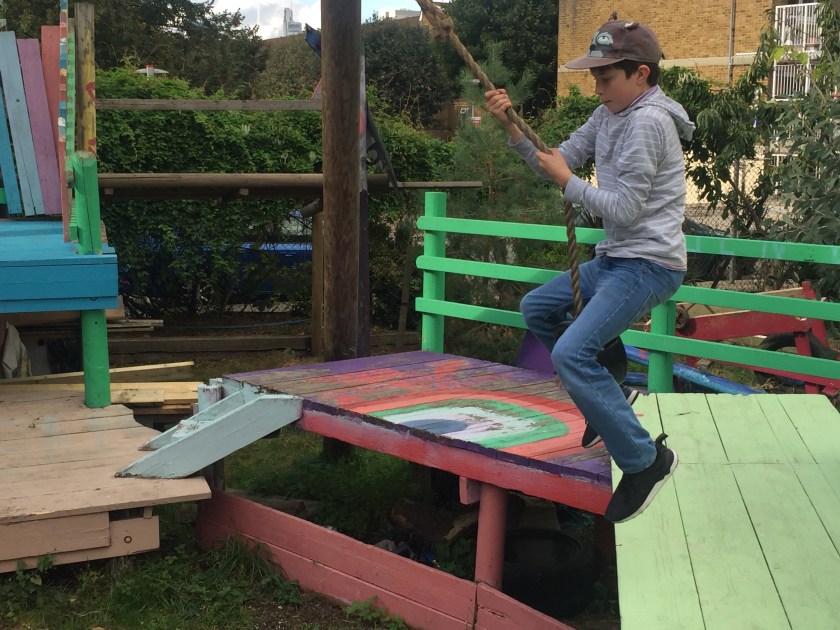
Sharing memories of ‘endangered’ adventure playgrounds

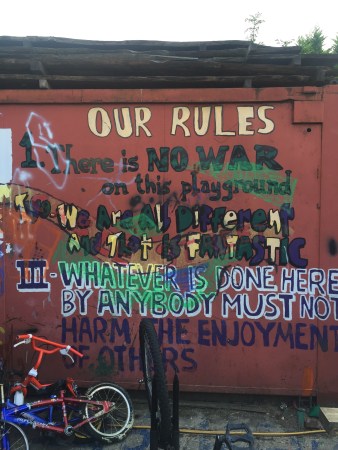
The University of Gloucestershire has launched the report, and a short film, of its Sharing Memories of Adventure Playgrounds (SMAP) research project. The project worked with adventure playgrounds in the cities of Bristol and Gloucester to gather memories of those involved – as children, staff, families and communities – over their history, in order to explore their value; but the project also shines a spotlight on the decline in the number of UK adventure playgrounds, and their ongoing insecurity.

Adventure playgrounds are a specific form of play provision generally catering for children aged 5-15 years of age, with local variations. Their received history tells how they were first introduced into the UK in the late 1940s by Lady Allen of Hurtwood after her visit to the junk playground in Emdrup, Copenhagen. These facilities sprung up in urban spaces left by wartime bombs, using waste materials, tools and the permissive supervision of a playworker to create spaces where children could build play structures, make dens, use tools, have fires and generally engage in outdoor play. Largely developed and run by voluntary organisations, such seemingly anarchic and chaotic spaces were welcomed by the authorities as an effective response to the rise in delinquency amongst working-class boys.

Over the last 70 or so years, these playgrounds have had a chequered history. At times adventure playgrounds have been well funded because of their perceived social and economic benefits (instrumental value), at others less so. Alongside this, the ethos and practices of adventure playgrounds in the UK have both affected and been affected by the zeitgeist, theory and social policy paradigms. From an estimated 500 in operation across the UK in the 1970s, their decline to less than 150 today (many of which no longer operate wholeheartedly according to the original principles) has been attributed to a number of socio-legal changes, including the Health and Safety at Work Act 1975, the Children Act 1989, the introduction of out of school childcare and now unprecedented public expenditure cuts.

‘Critical cartography’

This trans-disciplinary project held events at each of the playgrounds and recorded these using video, audio and the work of artists. It was funded by both the Being Human and Sport, Exercise, Health and Wellbeing Research Priority Areas at the University of Gloucestershire. It drew on concepts from post-qualitative research methodologies, memory studies, geography, philosophy and policy. It aimed to develop a ‘critical cartography’ as a different way of articulating the value of adventure playgrounds that can be used to inform future policy.

There is plenty of evidence showing the benefits of play for children, but less showing the benefits of play provision. What does exist tends to show the instrumental value of adventure playgrounds and playwork in terms of its capacity to address social policy concerns such as reducing physical inactivity and obesity, crime reduction, or community cohesion. These are important, and at the same time the desire to show measurable benefits in this way obscures other ways of expressing value. The creative methods we used looked to show how much these spaces mattered to those involved.

“Adventure playgrounds are an endangered species”

Dr. Wendy Russell

At the launch of the SMAP project, with an exhibition at the University’s Oxstalls campus on 27 January, the Mayor of Gloucester, Councillor Neil Hampson highlighted the huge value of the city’s adventure playgrounds to successive generations of local communities and decried the austerity policies that was placing them at risk. Dr. Wendy Russell, for the research team, said they were an ‘endangered species’, which needed to be documented while they were still in existence.

Adrian Voce

Illustration: Mick Conway (from original artwork produced for the project)
Photo: Bristol Daily News

As well as the exhibition, the project has produced a film, which can be viewed here and a short report, available here. If you would like to host the exhibition, please contact the research team at smap@glos.ac.uk.


Tags: 

Back to the (possible) Futures of Playwork

In 2007-8 there was an ambitious project to engage the playwork field in a dialogue about its possible future, and the structures it might need to get there. Here, Adrian Voce, who, as Play England’s director, initiated the project, and Dr. Pete King, who has researched it, introduce Dr. King’s 2015 paper about the initiative, which we are making available free of charge for the first time today[1].

The idea of a practitioner body for playwork is not a new one. After its origins in the adventure playground movement of the 60s, 70s and 80s, playwork during the 1990s and especially the 2000s saw some significant developments towards what might be called professionalisation.

The growth of out-of-school childcare in the 90s had led to increased numbers entering the field, and increasing interest from government. The establishment of national occupational standards, training and qualifications frameworks and workforce development strategies – all underpinned by specific definitions, assumptions and values (now articulated in the Playwork Principles) – were a response in part to a government challenge, famously laid down by culture secretary Chris Smith; but they were also indicative of the growing need for playwork to adopt the kind of structures that would enable it to become a recognised profession. How to manage this growth – in numbers and recognition – whilst protecting the integrity of the field and its practice within a world dominated by measurable (primarily educational) outcomes, was the big question.

‘How to manage growth, whilst protecting the integrity of the field and its practice within a world dominated by measurable (primarily educational) outcomes, was the big question’.

Aiming for the voice of the playworker to be central to these developments, the Association of Playworkers (England), formed in the early 00s, was short-lived. With terms and conditions for a perennially undervalued workforce proving to be the top priority, the association closed around 2004, recommending that its members join the Community and Youth Workers Union[2].

Without its own practitioner organisation, the role of advocating for and representing playwork beyond union activity fell largely[3] to organisations with broader agendas. Thus, in England, the Children’s Play Council, and then (after 2006) Play England, was a champion for playwork services, but only as part of its wider remit to campaign for children’s right to play in general. Even this was subject to the constraints of being dependent upon a larger ‘umbrella’ charity, the National Children’s Bureau (NCB), with its primary interest in the more established children’s services. Similarly, the sector skills council, SkillsActive’s remit was for a much wider sector than playwork, representing employers from the outdoor sports and leisure industries.

‘The idea was to provide a number of platforms for the field to explore questions of its own identity, purpose, values and aspirations; providing a framework … for the field to conceive its own model for a professional body’.

Perceiving professionalisation in general, and the question of a potential independent practitioner body in particular, to be crucial issues for the field at a time when public investment in it was on the rise, Play England, with the support of SkillsActive and the JNCTP (Joint National Council for Training in Playwork) initiated the ‘The Possible Futures for Playwork’ project and asked the late Professor Perry Else to lead it for us. The idea was to provide a number of platforms, beginning with a large ‘world café’ event, for the field to explore questions of its own identity, purpose, values and aspirations; providing a framework, or so we thought, for the field to conceive its own model for a professional body.

Pete King takes up the story….

In 2007, like many others, I was combining play and playwork practice with my own academic interests. At that time I was developing play both operationally and strategically in a West Wales Local Authority and, having finished a Research Masters in Play and Playwork, was developing a PhD proposal. So when Perry Else sent out a call for some ‘ideas papers’ to contribute to the ‘The Possible Futures for Playwork’ project, it seemed like a good opportunity. A total of 23 papers were submitted and made available to a dedicated on-line discussion forum. My own paper (no. 2) did contribute to my PhD, but, as with most research studies, by the time my thesis was completed in 2013, my interests had developed into new areas.

The original Possible Future project had included plans for at least one more World Café event but for a number of reasons (Voce, 2015) this did not take place. I had always wondered what happened to the 23 ‘ideas papers’ and had a niggling sense of incompletion about the project, which had seemed to finish without closure. As I started to re-read them, along with the work that Perry had done to introduce the project, I wondered whether or not the kinds of futures we imagined for playwork in 2007 and 2008 would still be relevant. As I read them, It dawned on me that I was engaged in research. Although they were only 8 years old, I decided to treat the papers as historical texts, representing contemporary perspectives of playwork at that time. I began to undertake a thematic analysis of the papers, considering the contextual factors pertaining when they were written.

The result was a paper published in the Journal of Playwork Practice in November 2015. The Possible Futures for Playwork project: a thematic analysis, concluded with some provocations aimed at stimulating a new discussion about playwork’s future.

A free version of the paper is available here. The discussion is over to you.

Adrian Voce and Dr. Pete King

With thanks to Eddie Nuttall, for keeping the idea alive and showing us where the original papers were to be found, and to Shelly Newstead, for agreeing to make Pete King’s paper available here.

[1] With thanks to the Journal of Playwork Practice, who first published the paper.

[2] There were exceptions, such as the Joint National Council for Training in Playwork and Bob Hughes’ Play Education, for example, who each in their different way had important roles in advancing the playwork approach.

[3] This move led to playwork becoming a distinct part of the union’s membership, with its own convenor. CYPW, as it became known, is now part of Unite, the Union.

References

Voce, A (2015) Policy for play: responding to children’s forgotten right, Bristol: Policy Press.

How to start an adventure playground

(Reblogged from https://playeverything.wordpress.com)


playeverything's avatarPlay Everything

There are some questions about adventure playgrounds that we at Pop-Up Adventure Play get asked a lot.

“What about liability insurance?”

“Who pays for these places?”

“Are they really safe?”

And, our favorite:

“How do I open one??”

When people ask this, flushed with new excitement, it’s worth taking a moment to step back and rethink the question.  On the one hand, we want to see as many adventure playgrounds as possible.  We’re thrilled to be part of this new wave of interest in adventure playgrounds, and to be helping those new sites with their staff training.  But more importantly, we want all adventure playgrounds to be great adventure playgrounds.

And that comes down to staffing.

Great playworkers can make the most of a site that is frankly crap, while uptight or apathetic playworkers can ruin the richest of environments.  We all share a burden of anti-child, anti-play education…

View original post 423 more words

Playwork ‘Campference’ announced in California for Feb. 2017

(Reblogged from Pop-Up Adventure Play)

The UK based Pop-up Adventure Play is teaming up with Santa Clarita Valley Adventure Play to host a first time Playwork Campference in Val Verde, CA 16-19 February 2017.

The Campference will headline Professor Fraser Brown, Head of Playwork at Leeds Beckett University’s School of Health & Community Studies, Erin Davis, Director of the documentary “The Land”, and Jill Wood, founder of “AP” adventure playground in Houston, TX.  Campference programming will also include a variety of hands on workshops, keynote Q&As, a screening of “The Land”, discussions and activities surrounding playwork theory and practice with National and International playworkers, and more. Early bird registration ends 2 October 2016, overall registration ends 16 October 2017. Participants also have the option to camp on site at the Eureka Villa Adventure Playground slated to be the seventh in the US.

Playwork involves in depth knowledge of play psychology, play “cues”, and risk benefit assessment. Playworkers traditionally work on Adventure Playgrounds where they make sure the children stay safe but do not inhibit the play in any way. However, playwork concepts may be applied to a variety of instances whether working with kids or adults in formal (i.e. educational or structured) or informal private, public or domestic settings. Adventure Playgrounds have been commonplace throughout Europe since World War II and are seeing a resurgence in the US.

The new wave of adventure play has been covered by various news sources including the New York Times, Atlas Obscura and The Atlantic.   The playwork campference will facilitate an international conversation between diverse individuals ranging from decades and degrees in playwork to those brand new to it.  “I’m very excited about coming and meeting all the people who will be at the Campference. … It’s going to be an opportunity to do stimulating work to get the whole idea of playwork going.. to give it a base level to work out from” said Professor Brown.  Regarding the state of play in America, he believes, “it’s very timely right now… things are beginning to develop. Right now I have three American based students doing post-graduate work with us.” Professor Brown has written numerous books on the benefits of playwork including his experiences doing therapeutic playwork with children in orphanages in Romania and Transylvania.

Erica Larsen-Dockray, co-founder of Santa Clarita Valley Adventure Play remarks about the Campference, “We could not be more delighted to host such a unique and necessary event here in Southern California.  Playwork concepts reaffirm two very important elements which I feel are lacking in the US.  One is kids being allowed more self-directed time in their days and second is adults supporting and trusting kids to take risks and practice independence.  Culturally we have forgotten how to let kids just play on their own terms as well as embrace play in our adult lives.”

Suzanna Law, Co-Founder of Pop-up Adventure Play and current Leeds Playwork Phd candidate says, “This is something of momentous occasion for me because we have been working so hard at Pop-up Adventure play to bring playwork ideas to people across the US and hopefully better play opportunities for children as a consequence. A child has a right to play, but in order to play they also need to feel safe and in an environment where they are supported.  They have a right to believe and to direct everything that is in their own lives and in the US this may be taken for granted and we need to know now in order to support play we need to support the whole child.”

Pop-up Adventure play was founded in 2010 by Suzanna Law and Morgan Leichter-Saxby and aims to help make a children’s right to play a reality in every neighborhood by disseminating playwork principles to a range of audiences.  Operating primarily in the US and UK, they provide long-distance and in-person support to play advocates in seventeen countries and recently completed a world lecture tour.

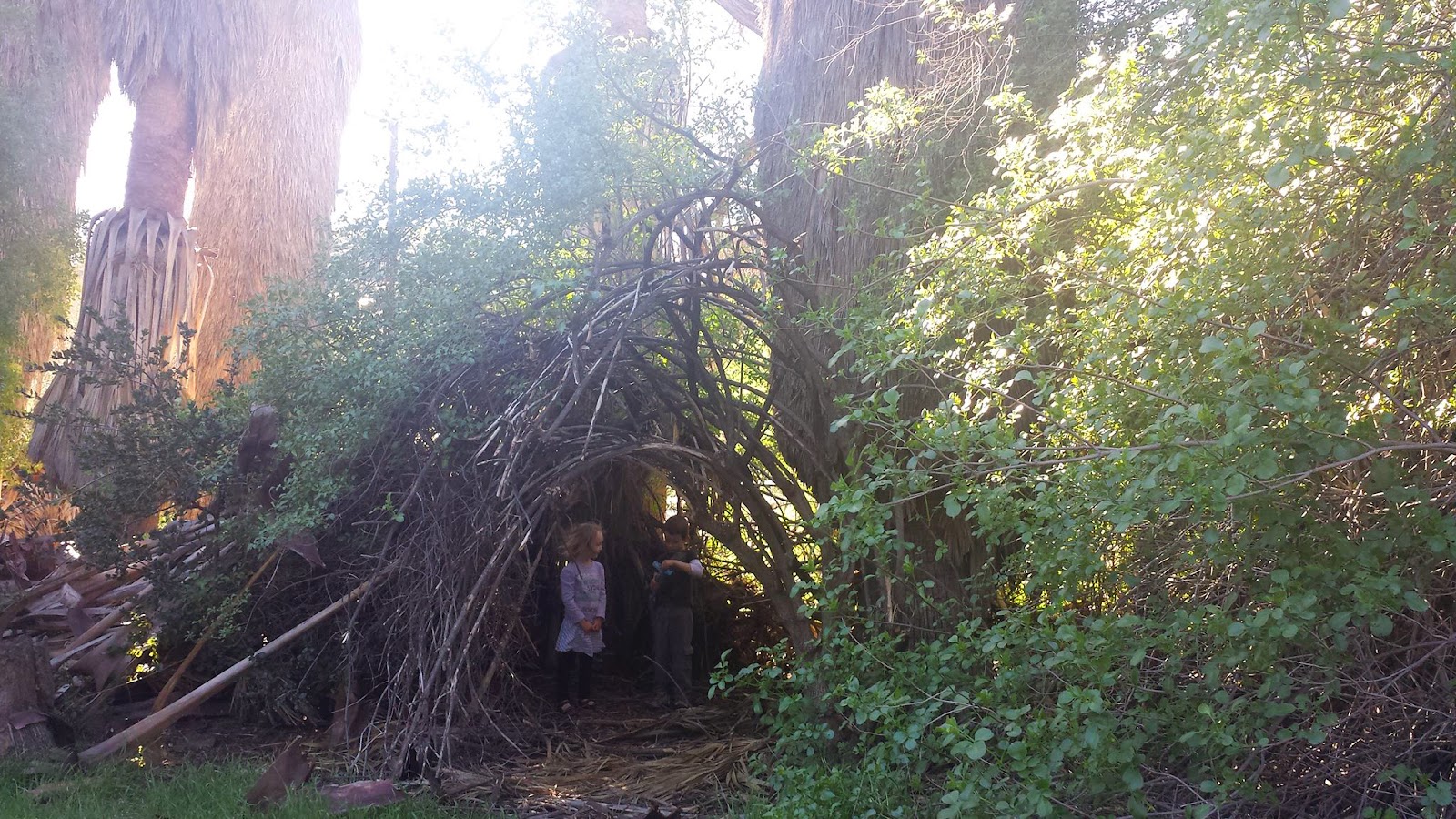
Santa Clarita Valley Adventure Play was founded by Jeremiah Dockray and Erica Larsen-Dockray in 2014 after Jeremiah began the playwork course.  While working on a course assignment he came across an abandoned 2 acre park which is now the developing home of Eureka Villa Adventure Playground.  It will be the only adventure playground in Los Angeles County.

palmfort01_edit.jpg
Aside from the park’s development, they have held numerous pop-up adventure playgrounds all over Los Angeles County for private and public events.  For more information on them please visit www.scvadventureplay.com

Anyone interested in attending or registering can visit the Campference information page at:  https://popupadventureplaygrounds.wordpress.com/playwork-campference-2017/

Early bird registration ending on 10/2/2016 is $375 for campers and $300 for non-campers.  Regular registration ending on 1/16/2017 is $475 for campers and $400 for non-campers.  Camping rates include meals, snacks, and basic camping equipment if needed.  Financial aid may be available on a first come basis.

CONTACT:

Morgan Leichter-Saxby, Co-Founder Pop-Up Adventure Play

Jeremiah Dockray, Co-Owner Santa Clarita Valley Adventure Play info@scvadventureplay.com

Check out the whole press release here.

Play Wales calls for sector response to proposed changes to playwork qualifications

The national body, Play Wales is calling for a strong response from the playwork sector to proposed new qualifications in Health and Social Care, which includes playwork.

Qualifications Wales, which published its review of the qualifications framework in July, is proposing to restrict the number of qualifications approved for funded training programmes in Wales, a move that would, according to Play Wales, weaken playwork training.

Play Wales isconcerned that … the Playwork Principles would be diluted by incorporation into a single suite of qualifications’.

In its draft response to the proposals Play Wales states that the proposed changes will ‘impact negatively on the current strategic direction in which playwork qualifications are being developed’. The draft response goes on to say that Play Wales is ‘concerned that the underpinning ethos of the National Occupational Standards (NOS), namely the Playwork Principles, would be diluted by incorporation into a single suite of qualifications’.

Play Wales believes that whatever decision is taken in Wales ‘could, in the longer term, have an impact on the playwork sector throughout the UK’ and urges the playwork community to respond.

Play Wales’ draft consultation response can be read here and the organisation welcomes comments, to help inform its final response, by email to workforce@playwales.org.uk by 28th September 2016.

Play Wales has also invited others to use its draft and final response, when published, as a basis for submitting their own response to the Qualifications Wales consultation, which closes at 6.00pm on 5th October 2016.


Playwork union conference to include talk on Playwork Foundation

A one day conference in Eastbourne on 19 November, hosted by Community, Youth and Play Workers in Unite  will feature a discussion about the emerging Playwork Foundation led  by Adrian Voce of the new body’s steering group, under the heading ‘Do we need a professional identity and if so how do we develop it?’.

Under the theme of ‘identifying risk and building resilience‘ the conference will ‘offer a range of seminars, expert panels and workshops facilitated and delivered by key professionals in the field, and the wider youth and play sector, that will identify, explore and offer new insight into some of the more complex and challenging issues that professionals and the children and young people that they work with face. The event will provide delegates with an excellent opportunity to discuss and debate the key issues and challenges faced in delivering a high quality service that provides children and young people with the best possible start in life’.

For full details please visit the conference homepage here


Entangled in the midst of it

A diffractive expression of an ethics for playwork

by Wendy Russell

Wendy at White City AP SMAP Feb 2016 cropped
Photo: Andrew Higgins


Abstract

The Playwork Principles establish the professional and ethical framework for UK playworkers. They also create contradictions that have an ethical dimension. Following an historical contextualisation, the chapter critiques the assumption of the autonomous rational agent implicit in the Playwork Principles’ understanding of both play and playwork. It reconfigures playwork as relational, affective and affecting, embodied, situated and irreducible to representation in language. Through a diffractive reading of the work of Karen Barad, Rosi Braidotti and Judith Butler, it offers a posthuman, nomadic and relational ethics, acknowledging the emergent, ongoing and intra-active co-production of play spaces in which playworkers are already implicated.

Read Dr Russell’s full (pre-proof) chapter* here.

*The author’s submitted version (pre-proof) for inclusion in M. MacLean, W. Russell and E. Ryall (2015) (eds), Philosophical Perspectives on Play, London: Routledge.

Thousands of children expected for Playday 2016

Tomorrow, 3 August, tens of thousands of children and young people from across the United Kingdom will be out playing, celebrating Playday – the national day for play, when hundreds of local and regional play events are taking place to promote the importance of children’s right to play.

This year’s Playday theme, ‘Play Matters…’ celebrates the many benefits of outdoor play: climbing trees, making dens, jumping in puddles, making mud pies, rolling down hills, playing with water, chasing, hide and seek, climbing.

Playday national coordinators, Play England, Play Scotland, Play Wales and PlayBoard Northern Ireland issued a statement, saying:

“It will be no surprise to learn that when children talk about their preferred play experiences, they more often than not cite outdoor play as their favourite activity. This makes sense; the outdoors is the very best place for children to practice and master emerging physical skills. Frequent and regular opportunities to explore and play in the outdoor environment are essential for children’s … well-being, health, happiness, learning and development”.

To mark this year’s Playday, publishers Routledge, part of the Taylor and Francis Group, have made a selection of play-related academic papers and articles available free of charge for the duration of August. Visit their site here to view the selection.

sticker

About Playday

Playday was originated by a small group of playworkers in London in 1986 as a response to threatened cuts and closures to adventure playgrounds and play schemes (Plus ca change!)

It has become the national day to celebrate children’s play in the UK, traditionally held on the first Wednesday of August. As well as a coordinated annual event, Playday continues to be part of the campaign to highlight the importance of play in children’s lives and their right for this to be provided for within the public realm.

For more information see www.playday.org.uk

Follow #Playday2016 on Twitter

or visit the Playday Facebook page

Special, disabled or just unique? Language can be important, but attitude is everything.


SEN-terms-image3-400x242
Photo: First Discoverers
In this adapted re-blog from the First Discoverers website, Adrian Voce discusses the language of disability and suggests that attitudes and understanding, more than institutional terminology, are the key to supporting all children equally.

Working with children who are deemed to have ‘Special Educational Needs’ or ‘disabilities’ (SEND), and their families, can, especially to the inexperienced practitioner, be a minefield of seemingly innocuous, everyday terms that are, depending on the audience, either out-dated, inappropriate or simply offensive. David Williams has commented on the First Discoverers site that ‘different agencies will explain the difficulties of children with SEN in markedly different ways’. Some, such as psychiatrists … even distinguishing between normal and abnormal groups of children: language that in other professions, such as social work for example, is no longer acceptable. This can present a dilemma for playworkers wanting to use the right language.

Even the officially sanctioned terminology can seem unhelpful to some families. A few years ago when I was developing proposals for a local Parent Partnership Scheme under the SEN Code of Practice, the consultation that I carried out with parents revealed some quite stark disconnects between the institutional and professional language deployed in this area, and ways that parents and their children spoke about what they were looking for in the way of a response to the many challenges they faced.

‘Our children’s needs are exactly the same as other children’s’
– parent of a child with ‘SEN’

One of the most profound pleas was from the mother of a child with language and mobility impairments who told me that even the label ‘special educational needs’ was both patronising and undermining. ‘Our children’s needs are exactly the same as other children’s’, she said. ‘They are only special in the sense that every child is special’. Describing their educational needs as ‘special’, she felt, made it seem that they were asking for more, when all they want is the same opportunities as everyone else.

And so, with even the official, overall term for this group of children proving controversial, how should we navigate this terrain safely, without stumbling into the ‘misunderstandings’ or ‘inhibit(ed) communication’, that Williams says is all too common? I have some suggestions:

1. Forget the idea that there is a ‘group’ of children that ‘has SEND’ (and another group that does not)

The term SEN (or SEND) has its origins in education policy (Warnock, 1978) and educational institutions, which have developed a means of categorising children to allocate additional or different resources to their learning. Thus the term is not describing something that is intrinsic to the child; it is a label that only has meaning in relation to how the education system responds to him or her.

Whether or not a child ‘has’ SEN(D), therefore, is really an illogical consideration. What we really mean is, does this child qualify for this additional support? This may – and does – change: over time, in different institutions and according to different education policies. And of course, outside of the education system the term SEN has no real meaning at all. Children all have educational needs, and they are all special. Whether they will get more or different support in school or not is really quite arbitrary.

2. Understand and adopt the social model

This approach to the term SEN may seem like splitting hairs, a pedantic or – dare I say – overly ‘PC’ approach; until we consider the social model of disability, and find that the question of what is intrinsic and what is relational, permeates the entire experience of disabled people.

I use the term ‘disabled people’ advisedly here because the majority of organisations run by disabled people themselves prefer it. They have adopted the social model of disability, as – now – have many other disability charities, such as Scope. In the social model, people are disabled by attitudes and environments that discriminate against them. They may have impairments of various kinds – such as sensory, language, learning or mobility impairments – but how disabled or enabled they are is a result of how society responds.

Disability is relational, not intrinsic

For example, I am quite considerably short-sighted, a relatively minor but still significant visual impairment. Am I disabled? No, society has made it easy for me to adjust; my glasses are affordable and readily available. Were this not so, driving, watching television, catching a bus, going to the cinema or even identifying people in the street would be beyond me. I would, to a degree, be disabled. So do I ‘have a disability’? No. Disability is relational, not intrinsic. It depends on how society responds to my impairment.

People with various impairments are not intrinsically disabled, any more than children with different challenges at school ‘have’ SEN. It is the medical model of talking about them, which conflates impairment with disability, that construes it this way by placing the disability with the person, not with society’s response to him or her. Why does this matter? Because it tends to have the insidious effect of letting society off the hook; abnegating our responsibility to ensure equal rights and opportunities for everyone.

The social model of disability is one of the cornerstones of disability equality training, which is recommended for anyone working with children.

3. Be child-centred

Sometimes misinterpreted to mean ‘letting children have their own way’, the child-centred approach, in fact, creates a space in which children are better able to feel what they feel, take responsibility for it and find the best response. In clinical psychology, the person-centred approach originated with the American psychologist Carl Rogers (1951), who found, in his extensive study of service men and women with Post-Traumatic Stress Disorder, that certain qualities in the clinician or therapist were more important to the outcome of counselling than the particular practice or methods they deployed. These qualities were what Rogers called ‘unconditional positive regard’, ‘presence’ and ‘congruence’. Being non-directive, accepting, present and authentic, in other words, counted for more than any particular therapeutic technique in creating the opportunity for patients to heal and recover. Playworkers will recognise these qualities as being also a key to fully applying the playwork principles.

being child-centred means that you will always see, respect and respond to the individual child – not the abilities or impairments they may have

How is this approach relevant to working with disabled children? Because being child-centred means that you will always see, respect and respond to the individual child – not the abilities or impairments they may have or the labels they may have been given – and so create a space in which the child may find their own strength, creativity and purpose; choose their own play.

Truly inclusive projects and services are not simply those that admit the widest range of children, but those that respond to each one as the unique and special person that they are. Get this right, and the language will tend to take care of itself.

Adrian Voce

Adrian Voce is the author of Policy for play: responding to children’s forgotten right. A former playworker, he is also an experienced ‘special needs’ assistant, parent partnership worker and inclusive play trainer.


References

Rogers, Carl (1951), Client-Centered Therapy: Its Current Practice, Implications and Theory. London: Constable.

Warnock, Baroness, Mary, (1978), Special Educational Needs: Report of the Committee of Enquiry into the Education of Handicapped Children and Young People (The Warnock Report), London: HMSO.

Hackney Play Association seeks new Play Development & Training Manager

Details at the link below:

http://www.hackneyplay.org/recruitment-play-development-training-manager/