Play Wales have announced a series of 4 webinars that will explore Play Sufficiency Duty in Wales. Though part of further research into the Welsh legislation and implementation, the webinars will also explore the adoption and campaign for similar play sufficiency measures in other parts of the UK.
What is Play Sufficiency?
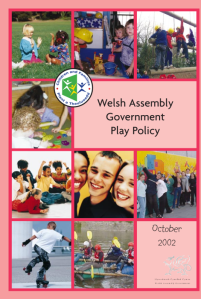
The Welsh Government’s journey to play sufficiency began in 2002, when on the 22nd October, the government unveiled its Play Policy. This policy outlined how play:
has contributed to human development;
is intrinsically motivated and an imperative;
has significantly contributed to the evolution and development of our species;
is how children learn about the world;
is freely chosen, personally-directed and intrinsically motivated;
is not necessitated upon an external goal or reward; and,
is a fundamental and integral part of health development for both the child but also wider society.
The policy also stated that play is so critical to all children’s physical, social, mental, emotional, and creative skills development, that society should seek every opportunity to support it and create environments that foster it. Furthermore, decision-making at all levels of government should consider the impact of their decisions on children’s opportunities to play.
Fast-forward, and the Children and Families Measure 2010 established Wales as the first country in the world to legislate for children’s play. Specifically, Chapter 2, Section 11 of the Measure set out a duty on all local authorities in Wales to “assess the sufficiency of play opportunities in its area for children in accordance with regulations” – something which would become more commonly known as the Play Sufficiency Duty.
The first part of the Duty commenced in November 2012 and all local authorities in Wales submitted their first Play Sufficiency Assessments in March 2013. These examined:
Demographics of each area
Open space and potential play space
Dedicated play provision
Recreational provision
Other factors that promote play opportunities (e.g. traffic, transport, planning etc)
In July 2014, the second part of the Duty commenced which required (as far as is reasonable and practical) local authorities to secure sufficient play opportunities for children in each county, having regard to their previously submitted Play Sufficiency Assessment.
To coincide with Section 11 being fully implemented, statutory guidance – ‘Wales: A Play Friendly Country’ – was issued by Welsh Ministers to local authorities on how to assess for sufficient play opportunities, and how to secure sufficient play opportunities.
Through the Planning Act 2019, Scotland similarly introduced a duty for local authorities in Scotland to undertake Play Sufficiency Assessments as part of Local Place Plans (also introduced by the legislation). And, in England, Leeds recently became the first city to voluntarily undertake Play Sufficiency Assessments led by Active Leeds through a project funded by Sport England: Get Set Leeds Local (GSLL). Play Sufficiency was also the key ask in Play England’s manifesto for the 2024 UK General Election.
The Play Wales webinars are split into 4 distinct sessions that explore the scale of play sufficiency – from the macro of the duty as a mechanism to strive towards play-friendly places, to the micro of play sufficiency at the community level. Though each webinar can stand alone, attending all four will give a more thorough insight (so make sure you book a ticket for each event!). All sessions are 12:30 – 2pm. Dates and links below:
This is why play is so important – a new film from Play Wales feat. Michael Sheen
Click the image to watch the trailer
“All work and no play makes you… what, exactly?” booms the voice of Welsh actor Matthew Rhys Evans across the Conference Hall of Glasgow Caledonian University. It’s Wednesday 7th June 2023, and I’m attending the International Play Association’s (IPA) triennial world conference in Glasgow thanks to a bursary from IPA Cymru. And despite the kilt-clad piper playing outside the Annie Lennox Building just the morning before, here I am, transported back to the land of my fathers as Play Wales premieres its new film ‘This is why play is so important’.
The film, commissioned by Play Wales, aims to communicate to adults working with children (and parents and carers) the importance of play. As I’m sure anyone in the playwork sector will attest, that’s easier said than done! It’s the thing that makes play and playwork so difficult for the wider world to quickly grasp – it is both simple and complex. Our impact, as adults, upon play is too readily underestimated. And the consequences of children and young people being deprived opportunities to play, freely overlooked yet so immeasurably detrimental to the health of both the child and the community in which they live.
That being said, if there’s a film to try and win hearts and minds of the masses in just a quarter of an hour, this is it. I should admit my bias and the reason the film resonated so deeply for me, at this point. The Venture, and all the wonderful children and young people who bring it to life, are prominent characters in the film. The Venture is also the place where I started out as a playworker and where I currently work as Communications Manager and Inclusion Project Manager.
A view of the sandpit and tower structures of The Venture’s adventure playground, in Wrecsam, Wales.
The film uses the voices of children and young people from across Wales and mixes them with adult memories and testimonies of play and its importance. It also provides a visual tour of the myriad of landscapes and playscapes in Wales: adventure playgrounds, streets, sea shores, gardens, skate parks, schoolyards, and verdant valleys shaded by woodland.
SPOILER ALERT: Just over halfway through the film, we get a couple of mentionable cameos. Around the 8-minute mark, complete with blond hair that might be from filming season 2 of Good Omens, we get the unmistakable Michael Sheen projecting out of the screen as he describes the joy of riding a tricycle repeatedly around a track. This is followed, not long after, by former Children’s Commissioner for Wales (and patron of The Venture) Keith Towler who tells the tale of a leap too far – an account of what Bob Hughes might have called “Deep Play” – and a plummet to hard ground below. Under normal circumstances, such stories might evoke a squeamish reaction and the conclusion that such experiences have no value and should be prevented. Yet here, in the safe confines of this well paced and gently-toned film, the moment fills the room around me with a ripple of laughter indicative of both amusement and affinity.
I’ve since watched the film several times. Once again in Scotland, at the closing of the IPA conference, at the Welsh premiere in a dusty barn in Llanwrthwl as part of Playworkers’ Forum, and during the northern premiere at Tŷ Pawb, Wrecsam, with some of the stars of the show. Each time, despite the assumption that I would not be brought to tears again, I find myself sniffling and smiling through the joy and adulation of this new piece of playwork culture.
What struck me in that conference hall in Glasgow, was a moment of clarity. A reminder of why we do what we do, as playworkers, and the journey we have travelled over the last few years.
In March 2020, COVID detained our ability to playwork overnight. But we eventually found a way. We ploughed through the guidance and the science; we jumped through the bubbles and the track and trace. And eventually, quietly and unceremoniously, we returned to the playwork we once knew. But it’s not the same. Funding is far more competitive; playworkers are now teaching assistants or scooped up by Aldi and Lidl; children and young people are forced onto the “catch up” conveyor belt; and that’s without even beginning to examine the impacts of lockdowns and what happened during them.
The Venture’s gates closed at the brink of the first UK-wide lockdown
But some good came out of COVID. At the beginning of 2021, we tentatively established The Venture Play Inclusion Project (PIP) – closed playwork provision for children and young people with neurodevelopmental conditions. This was because we were increasingly hearing accounts of autistic children and young people being excluded from playing in public parks and green spaces due to the volume of people and the negative/stigmatic responses of the general public. Our adventure playground at The Venture, mostly vacant during the day at that time, was offered as a sanctuary for these children and young people, and their families (and support bubble), to come and play unabated. A time and space where they could be their authentic selves in a playful environment, with adults who honoured their play: playworkers. Since then, PIP has become a group session popular with children and young people of all ages. We even attracted the attention of the Prime Minister of Wales, Mark Drakeford, who visited in May 2022 and experienced his first s’more!
Prif Weinidog, Mark Drakeford, making his first ever s’more at The Venture’s Play Inclusion Project
Dexter, one of the “OG’s” of the Play Inclusion Project, with Prif Weinidog, Mark Drakeford, and Chief Officer of The Venture, Malcolm King OBE.
There, on the big screen in Glasgow, were these children – a testament of our project. It seemed unfathomable that we hadn’t known them until COVID. Yet here, in 2023, my heart leapt at the sight of their younger selves. My mind hurtled backwards to those hand-sanitising times, where we pushed forward a front against the virus to enable these children to play in their own way. Those memories meeting and mixing with the present. Only days before, at our now-regular Saturday PIP session, these same amazing children were sharing their creativity, their aspirations, their worries, their battles. I suddenly realised how much they’d grown! Physically, their faces and features gave testimony to the passage of time and, in some cases, the ravages of puberty. They’ve also grown as people – and so have we!
Playworker Nic on the sandpit of The Venture’s adventure playground
My partner, Nic, who is autistic and volunteered on those initial PIP sessions, is now a fully-fledged playworker on the inclusion project and the open-access playwork provision at The Venture. I, as a result of many conversations with parents/carers, also completed my own journey of diagnosis and can now embrace my neurodiversity.
Jackie Boldon, Dr Wendy Russell, Penny Wilson, Angharad Wyn Jones, Siôn Edwards in the Conference Hall of Glasgow Caledonian University
It was there, amongst playworkers and play advocates from around the globe, that I suddenly saw the bigger picture. It shouldn’t have taken a global pandemic, but through COVID we realised just how inclusive and universal playwork practice can be to enable children and young people to play. Those 15 minutes were cathartic.
For me this film is more than just an advocacy tool. It’s a touchstone to the past – a reminder of the route we took; an affirmation for the present for when times (and budgets) get tough; and, a torch for the future, when light is needed to help guide the way.
Diolch o galon / Thank you to Play Wales, Welsh Government, and all the contributors (especially the children and young people) from the bottom of my heart for creating such a beautiful piece.
I can’t guarantee that you will experience the film in the same way I do, but I will promise that it’s 15 minutes of your day well-spent.
Mwynha / Enjoy!
This is why play is so important
This article was written by Siôn Edwards and represents his personal opinions, rather than those of The Playwork Foundation.
The All Wales Playworkers Forum has been running since 2007. Orginally established by Play Wales to provide a forum for those working in adventure playgrounds it has evolved to meet the needs of the sector. The Playworkers Forum is run by a dedicated steering group of playworkers, for playworkers. In the past a number of regional play associations took it in turns to administer the event with our collective aim being to keep the costs as low as possible, whilst bringing as many playworkers as possible together to share information, network and recharge our batteries. More recently, with the sad closure of the vast majority of the regional associations, Play Wales have taken over administration of the event on behalf of the sector, with the steering group working hard to keep things fresh and exciting for all participants from year to year.
Over the years we have toured around Wales, from as far south as the Gower Peninsula to as far north as Hawarden. We’ve made temporary homes in orchards, willow globes and big tops and generally we have almost always had the weather on our side. Anyone who’s ever attended will be fully aware of how much of a special event it has become in the playwork calendar. As our infrastructure has changed here in Wales, the forum has also been opened up to anyone from across the UK and it has brought playworkers together to share their unique experiences and support each other. The event has always been an overnighter, with participants camping out under the stars and often sat up into the small hours gazing at the glowing embers of our fire and putting the world to rights.
Over the years we’ve been lucky to attract some of the best playwork trainers, speakers and academics and they have all really helped to make the event what it is. We tend to have a blend of theoretical and practical sessions, normally focussed around an emerging or current hot topic. One of the annual highlights is without a doubt the ‘Annual Playwork Games’ hosted by Martin King-Sheard. Two teams of goblins and elves compete in a head to head to find out who will be crowned champions for the year ahead.
This years event was somewhat different from previous years, due to the lockdowns that sadly made meeting in person impossible. Instead, to ensure that we maintained continuity we all came together on 24th June 2020 for an online book club that was organised and facilitated by Play Wales. It was so much of a success that they are now continuing these for free as a monthly professional development opportunity for play and playwork professionals in Wales. Each month they select a freely available online paper, article or other publication relating to play and playwork for you to read and then you can join an hour’s discussion and reflection on the content. All Book Club meetings are held on the Zoom online meeting platform. More information is available here.
In the first book club, participants discussed the Play Wales guidance paper ‘dynamic risk management of common but potentially hazardous play behaviours’. This paper was written by Mike Barclay, Dave Bullough and Simon Bazley. The paper is available for free download here.
The event was facilitated by Martin King-Sheard and Marianne Mannello from Play Wales, who also ran a ‘Q and A’ session with one of the papers authors, Simon Bazley. The successful event was then followed by an online version of the playworker games where contestants competed to find out who would be crowned champions for 2020. It was a close call with competitors racing around their houses to undertake a series of challenges and games. In the end the mighty elves came through victorious once again, just beating the goblins in the last game.
Anyone interested in attending future events should keep an eye out on the Play Wales website as we hope to be back to meeting in person once again in 2021 if local and national restrictions allow.




 The Playwork Foundation