A situated ethos of playwork

Turning the playwork story into a narrative for change.

In this new collaboration, Adrian Voce and Gordon Sturrock cast their collective eye over the recent history of playwork in the UK to draw out some lessons for the field on how it might regroup and take a leading role in making the case for a comprehensive national play policy: one consistent with its distinct ethos and approach. 
Abstract

Playwork is a distinct approach to working with children, and a particular set of perspectives on the nature of children’s play in a broader context. We concur with others (e.g. Brown, 2017) that its theory and practice – on play and development, constructs of childhood, the role of adults with children, the allocation and use of space, and children’s rights – are unique among the children’s professions.

This paper attempts to describe some of these perspectives, the practice tenets that arise from them, and the distinct ethos we suggest they comprise. We then propose a broad rationale for playwork advocacy, ­congruent with this ethos and its political dimension.

Vision

We also attempt to set out a long-term vision for the place of playwork practice within a renewed, reimagined public realm; and we suggest some specific shorter-term, more tangible objectives, towards the aim of formulating a sustained government policy framework that recognises and supports playwork without compromising it: achievable milestones on a roadmap to the longer-term vision.

Through a critical appraisal of the field’s recent history, the paper considers how organisational structures for playwork advocacy and professional development have, until now, with the odd exception, been ultimately run not by practitioners but by various branches of government, its agents, employer bodies or established children’s charities – generally more aligned with the current hegemony than with anything approximating to the playwork ethos. We argue that, in the absence of a cohesive and authoritative playwork representative body, this has led to near fatal compromises in the development and dissemination of the playwork approach.

Conundrum

The paper addresses the perennial conundrum of a community of practice that profoundly challenges the status quo; yet which, nevertheless, needs to find sufficient leverage in the mainstream policy discourse to secure the resources it needs to sustain its work. As the professional playwork fraternity attempts to regroup after eight years of austerity and UK government policy reversals, we suggest there is an urgent need for the field to coalesce around a binding narrative – accommodating the plurality of perspectives and approaches that have evolved – to explicitly articulate its ethos in a way that can both speak to a wide public audience and impact on the policymaking process.

The paper concludes that the framework for this narrative should be children’s rights, refracted through the prism of the playwork ethos, which is a bulwark against instrumentalist agendas. We suggest that the playwork field, though greatly incapacitated by the dismantling of its infrastructure and the closure of many of its services and courses, has a legitimate claim to be the practice community best qualified to interpret General Comment 17 of the UNCRC (CRC, 2013) for the UK context. We propose that fully engaging with the rights discourse is the logical strategy for playwork advocates; aligning our ethos to an authoritative, coherent policy case that also resonates with a wider political narrative of social and spatial justice, universal human rights and full citizenship for all.

Adrian Voce and Gordon Sturrock
June 2018

Download the full paper here

Adrian Voce is a founding trustee of the Playwork Foundation. His contribution to this paper is in his personal capacity and does not represent the collective view of the charity.

Photo: Adrian Voce (Tiverton adventure playground, Devon).
Playwork foundation launches at London event

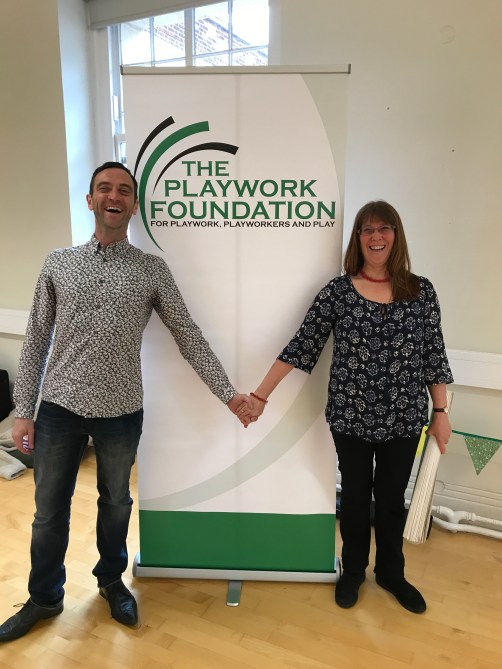
The Playwork Foundation was launched as a membership organisation at a special event in London last week.

The Playwork Foundation finally opened for business last week at a special launch event in London.

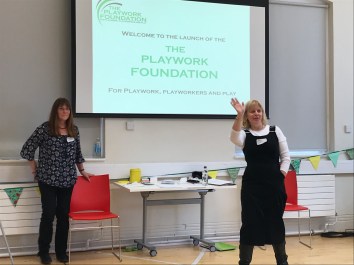
Board members Ali Wood and Karen Benjamin, experienced playwork trainers, writers and consultants, introduced the event with a review of the foundation’s development, which began at a meeting called by Bob Hughes and the late Professor Perry Else at the University of Sheffield Hallam, in 2013.

Wood and Benjamin said that an extensive consultation with the field had found overwhelming support for a new vehicle for playwork and had established some clear aims and principles.

Development

They said that, although slow because of the lack of resources, the development work had been proceeding steadily to this point. The new body has a charitable constitution, adopted by a board of trustees, and is awaiting registration. It has a website, a list of potential members and has developed a dialogue with national bodies in each of the four UK nations. The time was ripe, they said, to launch a membership scheme as the next significant milestone.

UNIQUE

Among the guest speakers at the launch event, held at Goldsmiths University of London, was Professor Fraser Brown of Leeds Becket University, who welcomed the launch and spoke about what makes playwork unique, illustrating each quality with a story in his inimitable style. Professor Brown said the playwork approach ‘actively resists dominant and subordinating narratives and practices’. Playworkers, he said, practice non-judgmental acceptance of children, holding them in ‘unconditional positive regard’, akin to the approach of person-centred counselling as developed by Carl Rogers. He said playwork offers children flexible environments, in which to afford them opportunities for the fullest possible range of play types.

entreaty

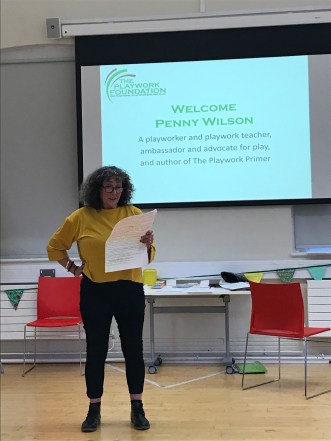
Penny Wilson, the London-based playworker and author of The Playwork Primer greeted the launch of the new body with a lyrical and impassioned entreaty from the field, reflecting the discourse at the recent adventure playground conference in Bristol.  Wilson said the field wants ‘an organisation that is tailor made – like playwork is  – a bespoke design with enough strength in its warp and weft to be responsive and resilient, to be able to meet and greet the unpredicted; an organisation that is play literate and promotes play literacy’.

INDEPENDENT

Adrian Voce, author of Policy for Play, and a member of the foundation’s board, spoke about the need for the playwork field to create its own vehicle, after previously seeing its support structures hosted or controlled by organisations with wider remits – and for whom play would only ever be a priority when it was in favour with government or brought in extra funding.

Quoting Labour Party leader Jeremy Corbyn, Voce said it was a mistake to believe that the decline in playwork opportunities was long-term. He said the period of austerity should be seen as an opportunity to re-group, stronger and wiser than before, ready to take the case for play and playwork into the next election campaign. He suggested that we need to now move quickly given the volatility of the political situation.

Meynell spoke about the longer-term history of playwork development, and previous incarnations of the national movement. He hoped the new organisation would help to revive the field after the decline of the austerity years.

Although modest in scale, many of those attending said the event – and the new body – felt like something they could identify with and belong to. Others said it was a significant moment in playwork’s history.

Time will tell.

More details of the different presentations, including a full transcript of Penny Wilson’s speech, will be made available soon.

WITH THANKS TO GOLDSMITHS UNIVERSITY OF LONDON, WHO HOSTED THE EVENT FREE OF CHARGE

JOIN THE PLAYWORK FOUNDATION HERE

The Playwork Foundation Board is

Simon Bazley (pictured, top)
Karen Benjamin (inset, right)
Barbara McIlwrath
Tanny Stobart
Debbie Willett
Ali Wood (pictured, top and inset left)
Adrian Voce