The consultation on the draft National Occupational Standards (NOS) for Playwork is now open – and with the deadline approaching, The Playwork Foundation will be hosting a final “catch‑all” webinar on 1st May, 10am – 12pm, to support a final surge of responses from across the sector.
Whether you’ve already skimmed the documents, haven’t yet had time to engage, or simply want clarity before submitting your response, this webinar is your opportunity to get up to speed before the consultation closes.
If you would like to submit feedback in some other way (e.g., audio, video) contact nosreview@play.wales let us know and we’ll do what we can to help.
The Consortium is encouraging responses from across the sector, including practitioners, managers, trainers, employers, awarding bodies, local authorities and community organisations.
What Happens Next…
After the consultation closes:
The UK Playwork NOS Consortium and Writing Group will review all feedback
A consultation report will be drafted and published
The final NOS will be released around June 2026, in both Welsh and English
Awarding Bodies and Awarding Organisations will begin re‑mapping or re‑developing their playwork qualifications
This marks the beginning of a new phase for the playwork workforce, with updated standards that reflect contemporary practice, international alignment and the core principles of a playwork approach.
A significant milestone for the play sector in Yorkshire has just been announced: the inaugural Sheffield Play Conference will take place on Tuesday 19th May 2026 at the Adventures Hub (formerly known as Highfields Adventure Playground) in Sharrow.
The organisers describe it as “a vibrant celebration of all things play” bringing together volunteers, students, professionals, decision-makers and community members for a full day dedicated to strengthening play across the city and region.
The conference is a welcome and timely development, as Sheffield has been steadily building a movement for child-friendly neighbourhoods, and this event marks the first formal gathering of that growing community.
The Conference is broad in scope – designed to bring together people working across:
Students in child development, youth work, teaching and social care
Anyone responsible for children’s play spaces, from parks to housing
The event has emerged from the work of the Sheffield Play Partnership, a collaboration focused on reversing the decline in community play provision and strengthening the city’s capacity to deliver high‑quality, inclusive play opportunities.
Their work includes:
Mapping citywide play provision
Identifying gaps and inequalities
Developing new community-led play projects
Supporting collaborative models that connect voluntary groups, families and local authorities
A Vision for a Regional Play Movement
The organisers are clear that this is not a one‑off event. They describe the conference as “the first step in an ambition to gather the region’s play community in one place”, with the hope that it will become an annual fixture and eventually a truly regional gathering.
The UK Playwork National Occupational Standards (NOS) Consortium has opened the sector‑wide consultation on the draft Playwork NOS. This consultation marks a major milestone in the long‑term effort to strengthen and modernise the standards that underpin playwork qualifications, training and professional expectations across Great Britain and Northern Ireland.
As a member of the Consortium, The Playwork Foundation strongly encourages practitioners, managers, trainers, organisations and partners to take part. See the latest information sheet below:
The formal review process began in early 2025. Since then, the Consortium has:
RAG‑rated all existing NOS
Identified standards requiring revision or replacement
Drafted new standards across three job roles
Developed a new Functional Map
Produced a comprehensive Glossary to support clarity and consistency
This work has been shaped by research, scoping exercises and conversations with playworkers and playwork organisations. Key themes emerging from this engagement include:
a focus on playwork as an approach – playworking
recognition that playwork happens in many places and spaces
the need for streamlined, clearer standards
reaffirmation that the Playwork Principles remain intrinsic to all NOS
Alongside the draft NOS, the Consortium has produced a glossary to support shared understanding across Great Britain and Northern Ireland. It includes definitions for key concepts like:
Accessible play spaces – “barrier‑free… offering participation opportunities for a range of differing abilities”
Additional support needs – recognising that needs may be short-term, long-term or intermittent, and do not require a diagnosis.
Inclusive playwork practice – removing physical, social, cultural and organisational barriers so all children can shape their own play.
Playwork approach – “supporting and facilitating play as described by the Playwork Principles”
Observation, reflection and reflective practice – central processes for understanding and supporting children’s play.
The Glossary also acknowledges variations in terminology across Great Britain and Northern Ireland and provides clarity where multiple terms are in use.
The Playwork Foundation will host a catch-all session in April based on the feedback and participation at each of the national play organisations’ events, and to take a multi-national perspective.
Then what?
After the consultation closes, the Consortium and Writing Group will:
review all feedback
refine and finalise the NOS
publish a consultation report
release the final NOS in June 2026, in Welsh and English
Awarding Bodies and Awarding Organisations will then begin re‑mapping or redeveloping playwork qualifications.
Why Your Voice Matters
National Occupational Standards shape:
qualification frameworks
training and CPD
job descriptions
organisational policies
workforce development strategies
This review is a rare opportunity for the sector to shape the standards that will define playwork practice across Great Britain and Northern Ireland. The Playwork Foundation encourages all practitioners, organisations and partners to take part.
Your insight, experience and expertise are essential.
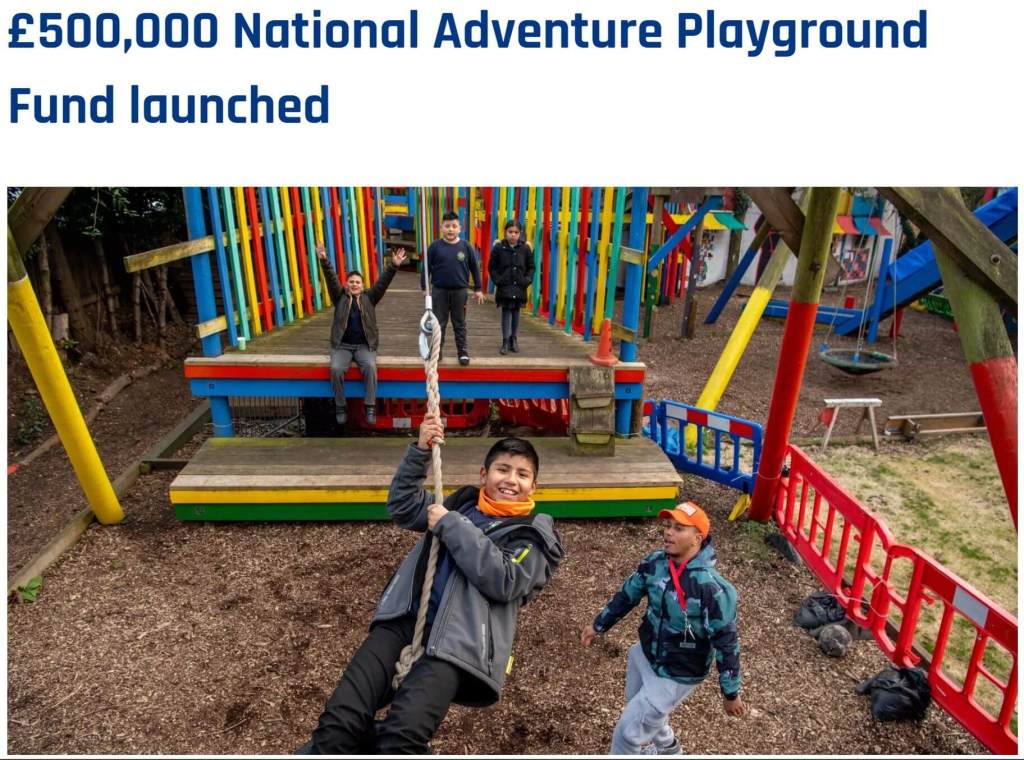
A new £500,000 fund has been established to support staffed adventure playgrounds in England, offering grants of £20,000 – £50,000 to enhance child-led play in low-income communities. Applications close 20/03/26.
A new £500,000 philanthropic fund has been announced to support staffed adventure playgrounds in England. The fund is made possible through a personal donation from philanthropist Alex Gerko, founder of XTX Markets, whose charitable work spans education, science, and community initiatives.
The focus on staffed adventure playgrounds reflects a growing recognition of the unique role these spaces play in children’s lives.
What the fund offers
The fund provides unrestricted grants of £20,000–£50,000, alongside sustainability support for successful applicants. To be eligible, playgrounds must be:
staffed by skilled playworkers
free‑of‑charge
places where children can come and go as they wish
committed to child‑led play
Successful applicants will also take part in four one‑hour sessions designed to strengthen long‑term resilience.
The application asks for information about opening hours, attendance, land or site arrangements, reserves, and the main challenges they face.
Play England announced the fund as a national programme aimed at protecting, restoring and growing staffed adventure playgrounds – highlighting that the fund will prioritise playgrounds in low-income communities and those experiencing financial pressure.
They emphasised that staffed adventure playgrounds are not discretionary amenities but distinct, staffed spaces where children shape their own play with the support of skilled playworkers. They highlighted the contribution these spaces make to independence, inclusion and year-round community connection.
At the same time, Play England noted that many adventure playgrounds have faced sustained financial pressure as local authority budgets have tightened. Provision has reduced in some areas, and several sites remain at risk.
Play England framed the fund as a welcome step within a broader picture: a contribution toward restoring and protecting staffed adventure playgrounds, and a sign that national recognition and investment may be beginning to align with long-standing sector advocacy.
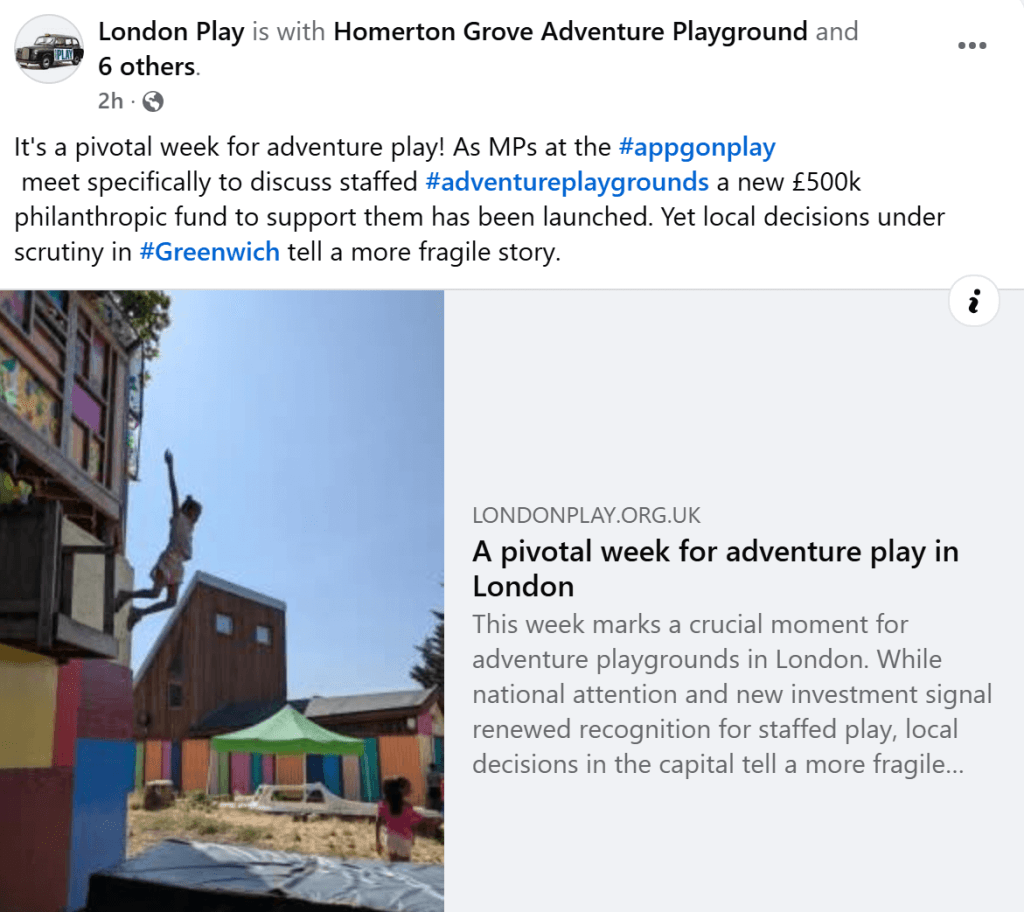
“A Pivotal Week for Adventure Play…”
London Play also welcomed the national attention and investment while similarly highlighting the fragility of local provision in the English capital – in particular the recent proposals to close or downgrade several staffed playgrounds in Greenwich.
This cautious optimism is echoed in the comments sections, with some expressing appreciation for the fund whilst also stating that £500,000 wouldn’t solve the long‑term structural pressures facing the sector.
Nevertheless, the hope is that this donation – in tandem with the parliamentary attention at this week’s All-Party Parliamentary Group on Play meeting on adventure playgrounds and playwork – will help build a broader recognition and attract future investment.
Any funding directed specifically toward staffed provision is a positive development, particularly at a time when many adventure playgrounds and other community-based playwork providers face uncertainty.
As ever, we will continue to support where we can by sharing information and evidence, and helping ensure that the value of staffed playwork provision – guided by the Playwork Principles – remains visible in national, inter-national and local decision-making.
This post was written by Siôn Edwards – current Chair of The Playwork Foundation – and represents his personal views and not necessarily those of The Playwork Foundation itself, or its Board of Trustees.
London playworkers and play advocates are invited to gather at Martin Luther King Adventure Playground this Friday 14th March, from 11:30am, for the next London Adventure Playground meet-up organised by London Play.
The event aims to foster collaboration and offer an opportunity to share stories in a friendly setting. Located at 3 Sheringham Rd, London N7 8PF, MLK adventure playground has recently reopened, so this will also be an opportunity to have a look around.
The event is free to attend and offers a valuable opportunity for those interested in the future of play in London.
Agenda:
11:30 AM: Arrival and hellos (Tea/coffee available)
11:40 AM: Welcome by Fiona Sutherland, London Play
11:45 AM: Swings and roundabouts (Group speed networking session)
12:15 PM: MLK and play in Islington by Simon Rix, Islington Play/MLK
12:45 PM: 2025: A pivotal year for play? by Fiona Sutherland, London Play, and Sereena Keymatlian, Haringey Play
1:05 PM: AOB (Wrap up, next steps)
1:15 PM: Light lunch/networking and playground tour
This event promises to be an enriching experience for anyone passionate about play and its future in London. Don’t miss out on this opportunity to connect with like-minded individuals and explore new ideas for enhancing play in England’s capital.
For this and more London Play news, check out the Spring edition of London Playwire.
The Playwork Foundation are back in Eastbourne for the National Playwork Conference for England 2025. Here are some of the extracts from our annual Eastbourne Bulletin, so you too are in the loop!
Talking politics because it’s necessary
Looking out from the Cavendish Hotel to the English Channel, our thoughts may turn eastward to Ukraine, where the Russian invasion has entered its third year, or to Gaza, where conflict continues to devastate countless lives.
Or, our thoughts may drift westward, across the Atlantic, where a new President resides in the White House.
Or, in Wales, your thoughts may cast ahead to the 2026 general election, when boundary changes, a new voting system, and more Members of the Senedd will likely shift the political landscape.
But, that’s all just politics. Right?
To me, playwork is inescapably political. We advocate for the rights of others. We consider the broader social and economic contexts where we advocate for play, and then we contend and collaborate to secure it. If we succeed, we stand guard. Eternal vigilance is the price of liberty, so they say.
Inspired by the words of another political figure from across the pond, my message for this conference (if I might be so bold) is this:
We must use our power; we must organise, mobilise, educate andadvocate. Our strength flows from our faith in each other, and our refusal to surrender to cynicism.
Not because it is easy, but because it is necessary. Not because victory is guaranteed, but because the fight is worth it.
The Playwork Foundation will continue to do all we can to support playwork, playworkers and play whenever we can across these isles and the wider world – you can too by joining today (it’s free!).
Our thanks to Meynell and his team for curating and coordinating another incredible conference. We hope you all enjoy your time in Eastbourne – please come and say “hello”!
Siôn Edwards, Chair
Calmer with Starmer? Or just playing it safe
This time last year, things could only get better. Then, on 5th July, Labour formed the new Westminster Government.
So, is it all Teletubbies and Cool Britannia (a la ‘97) for children and young people now? Here’s what Starmer has got over the line so far:
A watershed for junk food advertising on TV
Energy drinks age-restricted to 16+
Single headline judgementsof schools in England scrapped
There have also been strong commitments in terms of budget or policy for:
Free breakfast clubs in every primary school in England
A new National Youth Strategy for England
Additionally, there has been collaboration with the Scottish Government, Welsh Government, and Northern Ireland Executive to:
Ban the sale of tobacco to anyone born after 1st January 2009
Restrict the sale of vapes
Whilst you’d be right to ask “Where is play and playwork?” in all of this, progress has been made to push them onto the Westminster agenda:
In December 2023, Play England celebrated a win from their manifesto: namely, the recognition of “formal play spaces” in the National Planning Policy Framework for England.
Then, in January 2024, Play England supported Tom Hayes MP to secure a Westminster Hall debate on the provision of playgrounds by local authorities in England. This discussion also expanded into areas such as the importance of free play, adventure playgrounds, and the role of playworkers.
Furthermore, Play England have made submissions to the Children’s Wellbeing and Schools Bill Committee, the State of Play Inquiry and played a key role in the Raising the Nation: Play Commission (hosted by the Centre for Young Lives).
The Playwork Foundation supports Play England’s campaign for Play Sufficiency legislation and a new National Play Strategy for England.
Adventure Playground Network
The Adventure Playground Network is a collaborative venture to connect “people who make play” at adventure playgrounds – including playworkers – to discuss issues affecting the sector, and to shape the agenda for future meetings.
Each meeting is led by a different person with the support of The Playwork Foundation.
From our earlier meetings, we have several existing working groups leading on areas of work, including:
Adventure Playground Insurance task and finish group
The Network is also the focus of a recent paper from Dr. Mike Wragg (School of Health, Leeds Beckett University) in the International Journal of Play entitled “Encouraging state of playwork in the UK”:
Talking about what we do has always been vital for playworkers. We do so daily with our teams, and, if we are lucky, at events like the National Playwork Conference.
During lockdown, Trustee Penny Wilson, of AssemblePlay and author of The Playwork Primer fame, organised informal gatherings to help playworkers navigate a world without playwork. These evolved into Playwork in Progress, a regular, open Zoom meeting for playworkers worldwide to share and learn.
Penny continues to chair these free, weekly online reflective practice sessions on behalf of The Playwork Foundation most Fridays from 3pm.
In October 2024, Karen Benjamin and Trustee Helen Stephenson kicked-off our pilot series of free webinars on play and playwork for the out-of-school (OOS) sector with a session entitled What is Play?.
We have now run eight sessions, on topics including: the role of the playworker, the play cycle, play types, loose parts, play environments, risk and intervention styles.
Trustee Ali Wood and former Trustee Karen Benjamin at launch of The Playwork Foundation (Photo courtesy of Adrian Voce).
In A New Beginning for Playwork, Adrian Voce describes The Playwork Foundation’s origins at a 2013 meeting convened by Bob Hughes and Professor Perry Else, which concluded “a fully independent playwork practitioner body” was needed.
In 2017, The Playwork Foundation launched at Goldsmiths, University of London.
Today, we announce our next chapter as we transition in the coming months from a Foundation model Community Interest Organisation (CIO) to an Association model.
This change means our members will have a direct and democratic influence on our work and ambitions. To be the first to know when this will launch, join us for free by visiting playwork.foundation/join.
Other news
Club Central Conference In October 2024, Trustees Helen Stephenson and Anne-Marie Mackin delivered a “Playful Play Spaces” workshop at the Club Central Conference.
We also sponsored the Play Setting of the Year award at the Out-of-School Club Awards. Congratulations to winners Marble Hill Adventure Playground!
The Right Way In October 2024, our Chair, Siôn Edwards, attended the launch of “The Right Way” – a framework from the Children’s Commissioner for Wales to help public bodies integrate children’s rights.
We’ll also be joining the panel for the Commissioner’s next event: A Wales for All Children, focusing on engagement with disabled children and those with additional learning needs.
National Play Conference Trustees attended Play Wales’ national play conference in November 2024.
Out-of-school (OOS) Network Following the success of our OOS webinars, we will be piloting a series of online networking sessions in the autumn 2025 term. These will be led by Trustee Anne-Marie Mackin, an OOSC Manager based in Scotland with 30 years of experience.
The aim of these sessions is to be a relaxed space to share ideas and issues.
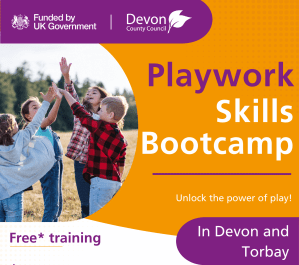
Playwork training Following on from our work with Devon County Council to develop playwork training for HAF providers, The Playwork Foundation have recently developed playwork training to accompany a pilot Playwork Skills Bootcamp currently being run in Devon and Torbay.
Play Wales have announced a series of 4 webinars that will explore Play Sufficiency Duty in Wales. Though part of further research into the Welsh legislation and implementation, the webinars will also explore the adoption and campaign for similar play sufficiency measures in other parts of the UK.
What is Play Sufficiency?
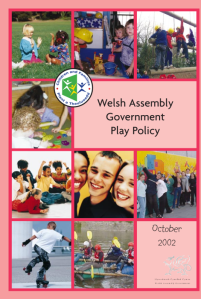
The Welsh Government’s journey to play sufficiency began in 2002, when on the 22nd October, the government unveiled its Play Policy. This policy outlined how play:
has contributed to human development;
is intrinsically motivated and an imperative;
has significantly contributed to the evolution and development of our species;
is how children learn about the world;
is freely chosen, personally-directed and intrinsically motivated;
is not necessitated upon an external goal or reward; and,
is a fundamental and integral part of health development for both the child but also wider society.
The policy also stated that play is so critical to all children’s physical, social, mental, emotional, and creative skills development, that society should seek every opportunity to support it and create environments that foster it. Furthermore, decision-making at all levels of government should consider the impact of their decisions on children’s opportunities to play.
Fast-forward, and the Children and Families Measure 2010 established Wales as the first country in the world to legislate for children’s play. Specifically, Chapter 2, Section 11 of the Measure set out a duty on all local authorities in Wales to “assess the sufficiency of play opportunities in its area for children in accordance with regulations” – something which would become more commonly known as the Play Sufficiency Duty.
The first part of the Duty commenced in November 2012 and all local authorities in Wales submitted their first Play Sufficiency Assessments in March 2013. These examined:
Demographics of each area
Open space and potential play space
Dedicated play provision
Recreational provision
Other factors that promote play opportunities (e.g. traffic, transport, planning etc)
In July 2014, the second part of the Duty commenced which required (as far as is reasonable and practical) local authorities to secure sufficient play opportunities for children in each county, having regard to their previously submitted Play Sufficiency Assessment.
To coincide with Section 11 being fully implemented, statutory guidance – ‘Wales: A Play Friendly Country’ – was issued by Welsh Ministers to local authorities on how to assess for sufficient play opportunities, and how to secure sufficient play opportunities.
Through the Planning Act 2019, Scotland similarly introduced a duty for local authorities in Scotland to undertake Play Sufficiency Assessments as part of Local Place Plans (also introduced by the legislation). And, in England, Leeds recently became the first city to voluntarily undertake Play Sufficiency Assessments led by Active Leeds through a project funded by Sport England: Get Set Leeds Local (GSLL). Play Sufficiency was also the key ask in Play England’s manifesto for the 2024 UK General Election.
The Play Wales webinars are split into 4 distinct sessions that explore the scale of play sufficiency – from the macro of the duty as a mechanism to strive towards play-friendly places, to the micro of play sufficiency at the community level. Though each webinar can stand alone, attending all four will give a more thorough insight (so make sure you book a ticket for each event!). All sessions are 12:30 – 2pm. Dates and links below:











 The Playwork Foundation