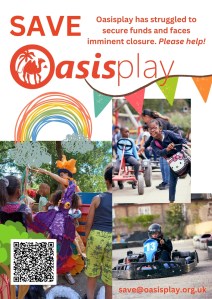
According to a post on Instagram, a community meeting is being held tonight at Stockwell Adventure Playground to discuss the future of Oasisplay.
On the Oasisplay website, it explains how, due to the closure of funding bodies and diminishing donations, Oasisplay is facing “a huge deficit” this financial year – going so far as to say that, without substantial fundraising, they will be forced to “close with immediate effect”.
“We feel confident that with the support of the community Oasisplay will survive the current situation. Please help by spreading the word and link to our fundraising page”
Further information from the JustGiving fundraising page:
Oasisplay describes its four sites as “a Nature Garden, a youth led Go Kart Track and two amazing Adventure Playgrounds, catering for children from birth to 18 years of age, or 25 years for disabled people” and how the organisation has been a part of the local community for 50 years.
According to the JustGiving page, each year they provide over 2000 hours of free and inclusive environmental play sessions, playwork provision on their adventure playgrounds, karting and mechanics sessions, holiday playschemes, day trips, community events, educational sessions and youth leadership opportunities.
In addition to these core provisions, Oasisplay also host a weekly food hub at each of their sites, distribute free tickets to local attractions and events to support local families, offer volunteering opportunities, and host activity sessions for schools.
At the time of publishing, £38,200 had been raised equating to 25% of their £150,000 goal
Like most open-access playwork provision, their services are open to all those who wish to use them. However, many referrals come from local authority and other multi-agency groups such as social services, youth offending teams, schools and other community organisations. This may be part of the reason why their services are in higher demand than ever.
Whilst many similar organisations and provisions have been lost in recent years, the impacts of the COVID-19 pandemic and cost-of-living crisis continue to significantly affect the both the financial and health status of their community. .
Unfortunately Oasisplay has not been immune to the tough economic climate and we too have had to scale back significantly in the last 2 months, despite intense need. We are determined that this is a temporary measure and with your support we will not only be able to save Oasis from complete closure, but also bring back all of the services that we have recently cut.
£10 will pay for 1 child to attend an After School Club at the playground
£50 will pay for 3 children to attend a Saturday Club at the playground
£100 will pay for petrol and spare parts for 2 weeks of Karting sessions at the Kart Track
£150 will pay for an under-5’s Forest School Foragers session at the Nature Garden
£250 will pay for a kart maintenance and mechanics session for young people at the Kart Track
With their goal set at £150,000, what exactly will that funding be put towards?
£60,000 will fill their shortfall for the current financial year, keeping their gates open until April 2025.
£100,000 will keep sites open until August 2025 for the paying groups and projects for which additional funding can be secured.
£150,000 would allow Oasisplay to reinstate some of their free services until August 2025 and provide time to find further funding.
We are making a robust financial plan for the future, including significant cost cutting measures. We continue to explore all possible funding options and are in talks with Lambeth Council about how they may be able to help us to keep this vital service open.
Dr Pete King of Swansea University is researching the playwork field’s response to the pandemic and has two opportunities to get involved.
Adventure Playgrounds
Dr. King is looking for anyone involved in adventure playground to take part in a study on how adventure playgrounds have been adapted since post-lockdown measures were put in place in July 2020. The research study will involve a short 20-30 minutes interview using Zoom. If you would like to take part, please contact Pete at p.f.king@swansea.ac.uk where you can be sent more information about the study. The research study has ethical approval from the College of Human and Health Science at Swansea University.
After-school clubs or holiday playschemes
Dr. King is also looking for anyone involved in afterschool clubs or holiday playschemes to take part in a study on how you have adapted since post-lockdown measures were put in place in July 2020. The research study will involve you to take part and complete a short survey which can be accessed here.
Trustee Ali Wood describes how Meriden Adventure Playground, in Chelmsley Wood in the West Midlands, is managing to continue its vital work through the Covid crisis
Like all other playgrounds, we had to close during the lockdown. We furloughed most of the staff but kept two on to stay in touch with the community and to help set up a new food bank and make deliveries – along with made-up play packs – to local families. We opened up again at the beginning of July, having spent weeks working out to how to do this safely without losing the power and fun of playing – we eventually set up an online booking system (which has been a nightmare to administrate) so that we could open to groups of 20 three times a day. We required adults to socially distance, but not the children and we also encouraged both children and parents to complete a questionnaire about how they had been feeling and playing during the lockdown.
A SPECTRUM OF EXPERIENCES
These have yielded some really interesting responses showing a whole spectrum of experiences – ranging from those who had a really tough tine and were still very worried right through to those who had loved being off school and having more time to play. It was interesting to see the correlation that matched up the most anxious children with the most fearful and stressed out parents… We also noticed initially that most of the children were more reticent than usual and it took a few sessions for them to get back to their gung-ho selves.
Being an outdoors only site did make things easier and by August we had nearly all the staff back and were up to 40 children a session and we had also formed a partnership with SOLAR – our local Mental Health NHS Foundation Trust – who have been paying for the exclusive use of the site twice a week with groups of children on their caseloads. It has been wonderful to see these isolated children particularly, forming friendships with others like them and building up confidence and competence and starting to open up and talk. This is a partnership we shall definitely be building on – the psychologists have a passion for free play and we are learning from each other and sharing good practice. Youth nights also started up halfway through July and moved up to 30 per session and attracting new young people we didn’t know.
A BUSY SUMMER
So it was a very busy summer interspersed with cameos of spraying disinfectant and dishing out hand sanitiser together with constantly explaining the ‘rules’ for limited numbers to parents who kept turning up at the gate. There has been a lot of ‘can we – can’t we?’ reflections along the way but confidence has grown all-round and despite things not being as they were, the magic and power of playing has definitely returned and feels great. We looked forward to the school term starting so we could build back up our unaccompanied regulars after-school – many of whom had not returned because they would normally have turned up here in the holidays all day and every day which has not been possible due to online booking. Many of them did return and we soon went back to offering food again as many of them were hungry.
We are now into the second national lockdown but have managed to stay open. After many conversations with both the police and with public health officials about the need to continue supporting kids, we have been allowed to open as long as there is a maximum of 15 ‘children or young people most in need’ present. That left us with a real conundrum – how could we decide who was most needy. We managed to structure things so that we have at least two sessions five days a week and are working on trying as far as possible to get the same kids at the same sessions so there is less ‘mingling’ (despite the fact that all these are kids are mingling on the streets after school and in the park). Despite the agreement we had forged, the local police force still came to disperse everyone at the first youth session last Thursday, but fortunately they listened and drove off and we are hoping that doesn’t keep happening.
We are also spending time having strategic discussions and planning for the future in response to the pandemic – we are exploring offering alternative education placements and more therapeutic play sessions as a means of reaching those children most in need, whilst earning extra much-needed income. These are not easy times for playwork!
Ali Wood Trustee, Meriden Adventure Playground
If anyone would like to buy our 2021 calendar for a fiver plus postage, that would be great as we are having to do this more by post this year! Email aliwood@meridenadventureplayground.com for one or more copies – all proceeds go towards feeding kids!
This research is part of a larger project that Alison was working on, funded by a Leverhulme Research Fellowship, focused on how organised street play sessions using the Playing Out model were remaking relationships between people and places on the street. Fieldwork on this project was just about to begin as Covid-19 emerged and as the first lockdown was announced in the UK, meaning playing out sessions swiftly vanished as did Alison’s fieldwork sites.
Yet just as swiftly, we witnessed the flourishing of all kinds of other activities that connected play, neighbours and streets: mutual support networks emerged; traffic levels dropped; residents took to the streets. We saw the emergence of all sorts of playful acts – rainbows in windows and Thursday night claps to thank NHS and key workers, teddy bear trails, and the proliferation of pavement chalking. These emergent spaces seemed all the more important in the face of the closure of other public spaces of play and connection, including playgrounds.
With the restrictions on movement, debates emerged around access to public space, especially for children, and particularly for those without private gardens. Pressure on public parks led to threats of closure and the media reverberated with testy discussions about what were legitimate reasons to be outside. Within these debates, children’s right to play outdoors was challenged at times by police and by vigilant neighbours, and families expressed anxieties about the safety of outdoor play.
The research study
In this context, together we worked with other play activists and researchers to present a case for outdoor play on streets, arguing that this was a space which needed protection and advocacy. But we also wanted to do some research to get a better sense of what was going on in terms of play and playfulness on streets. We wanted detail: to get at the ‘granular’ connections people were making with their streets in lockdown.
We developed a qualitative survey to gather data about playful activities, and changes in the material environment and feel of the street. The survey was circulated through social media and networks of community groups, play organisations and beyond. We received 78 responses from across England, Scotland and Wales. Reflecting the limits of online research and of our own networks, the majority of respondents were White, well-educated owner-occupiers. More than three-quarters of the respondents were women and two-thirds were aged 35-54, but more than a quarter of respondents did not have children under 18 living with them. We followed up the survey with 13 online video interviews. In these interviews, we explored participants’ survey responses in more detail but also explored the sites of play through drawing maps, using Google Maps on-screen, and sharing photos and videos. We also invited respondents’ children to participate and in 5 of the interviews a total of 12 children aged between 4 and 11 years joined for all or part of the conversation.
It is relevant to note that playworkers and community activists were disproportionately represented amongst our respondents; in part, this reflects our recruitment strategy but also, we feel, reflects the desire and willingness of such people to recognise and engage in playful acts in their communities.
What we present here in terms of ‘findings’ are very much preliminary, as we are still analysing the detail of the rich data we gathered, and we have focused on what might be of particular interest to a playwork readership.
Time, space and permission to play
We know that if conditions are right, children will play; these interdependent conditions have been categorised as time, space and permission, and as a matter of spatial justice. One thing that most children did have during lockdown was time, given that most stopped attending schools and other organised activities. Nationally, although time spent outdoors did not appear to change significantly for primary aged children, socialising was of course greatly reduced. In our research, not all parents had extra time, but several respondents did comment on the time available to spend chatting, at a distance, with neighbours. Many talked of spending more time with their children, and of children spending more time playing with their siblings if they had them, more time exploring and playing in local streets and green spaces, more time inventing their own ways to play.
Time, space and permission to play intermingled in various and sometimes contradictory ways. All had witnessed a number of changes on their streets, the most common being less traffic and more people walking in the road, reflecting widespread narratives of street life during lockdown. More people were using their street for walking, running or cycling, or to linger in front gardens, yards and pavements. This suggests a real shift in the presence of people on streets, with a sense of much more connecting with neighbours.
Just over half felt their streets were quieter during lockdown, both in terms of activity on the street (particularly traffic) and noise. Only 12% reported that traffic was slower whereas over a quarter reported seeing speeding vehicles, reflecting what has been reported elsewhere. Many also noted that the reduced traffic levels were short-lived, lasting only until lockdown started to be relaxed.
Although 60% reported that they had seen chalking on roads and pavements, a clear sign of the presence of children on streets (even if at times it was adults chalking), just 35% saw more children playing on the street. Additional responses suggested a mixed picture: on streets where children ordinarily played out, some reported that there was a reduction when lockdown started, as families followed government guidance to “stay at home”:
“I have really missed the sound of children playing … during lockdown. At first I found this eerie and sad.”
Others suggested that children were playing out more of the time as they weren’t at school. On streets where children ordinarily rarely played out, some saw no change, but some did witness a significant increase:
“For the first couple of weeks, there was no traffic at all and we could see children playing on the street corners – this has never happened before”.
There was a temporality to all these patterns – as there was for much of what was reported – with a peak lockdown period (from 23 March to 13 May) marked generally by higher levels of street activity, but in some instances lower levels of children’s presence as parental anxieties and unclear rules restricted children’s access to outdoor space.
The kinds of activities respondents reported, in addition to simply seeing and talking to more neighbours more of the time (something significant in itself), included bingo, doorstep discos, music (live and recorded), dancing, singing, sports (including street marathons for charity), cycling and scooting, chalking, nerf wars, chalk trails and hopscotch, nature trails and bug hunts, rock snakes, rainbow trails, teddy bear trails and tea parties, toy and book swaps, football, kerby, hula-hooping, and more.
In some instances, play was animated or curated by activists, working from home or furloughed, and shifting their professional playful and community practices to their streets. In each of these instances, these playworkers and community workers opened up spaces for other neighbours, of all ages, to engage in a process of play, stepping back, in the tradition of playworking, to enable children and their families to occupy the playful environments created, but often linking this to other forms of support for those who needed it.
These diverse forms of play were experienced in all sorts of ways but a few common themes emerged. Some talked of a simple joy in seeing children playing:
“the sound of laughter and general buzz really does lift the spirits … It has been nice to see the street come alive again.”
This seemed to resonate with hope in the context of the pandemic and also the opening up more spaces for neighbours to connect:
“Seeing kids playing with each other, despite the situation, brings a smile to my face. The children may be aware of what’s going on, but being able to play without any inhibitions brings back memories of playing when I was young too. It makes the street inviting for families and brings more children out to play.”
This sense of playfulness creating a space for connection appeared in a number of responses:
“I love it. We can connect. I love the creativity, the generosity, the community spirit that it engenders. The opportunity it offers for us as older neighbours to be playful with the children/families nearby.”
For some, especially those more vulnerable and shielding, this was translated into an increased sense of security and comfort:
“They mean so much to me. I feel safer knowing my neighbours.”
“Being creative and playful felt comforting”
Much of this was connected directly to changes in the materialities and atmospheres of the street itself, created by these playful acts, such as chalking and planting, which shifted not only these respondents’ relationships to their street, but more broadly.
“Planting in the street makes me feel hopeful. And I felt really proud, sharing footage with friends and family to show them what a great street I live in! And how a sense of community can be fostered.”
Of course, these experiences were not all joyful; the pandemic and the rules of lockdown encroached on street life and on playfulness in sometimes difficult and painful ways. Respondents were aware of diverse attitudes to the rules, sometimes unsure of what was and wasn’t permitted, wary of upsetting their neighbours but also anxious that their own attempts to be playful might be watched and shamed from a neighbouring window or doorstep. Others, including those shielding or with vulnerable family members, oscillated between the comfort and security offered by seeing their neighbours animating the street and the fear that too many connections might exacerbate the pandemic and extend the lockdown. One interviewee noted how, as time went on, the rainbow pictures were still up in windows, but they had faded: she felt this was a kind of dystopian image and that the NHS, where she worked, had been forgotten, adding “they all clapped, but they broke the rules”.
Maps and materialities
A changed relationship with their most local environments was a recurring theme in our follow-up interviews where respondents described and mapped in different ways their playful practices through lockdown. Through this process, the very detailed material geography of streets – and its remaking during the weeks of lockdown – came to the fore, showing how differently streetscapes are experienced by children, and the ways they perceive the possibilities for playing.
One 8-year-old talked about how all the parked cars meant she couldn’t balance along the kerb; her 11-year-old brother marked his map with the section of the street where the kerb was particularly high, making it good to jump off on bikes and scooters. A 7-year-old talked about there being lots of rocks in the street – there was brick paving and many of the bricks were loose. A 9-year old recalled dancing across the street with her friend, from facing pavements that allowed them keep a two-metre distance.
Many people talked about staying hyperlocal. The maps reflected this, for example, showing the small spaces of the local park, discovered and explored during lockdown, and the route there through snickets, alleyways and side roads, peopled by neighbours with rainbows in their windows, hammocks in their front gardens, and chalk on their pavements. Others talked of playing in the nearby woods because they felt less watched over. One mother of a 4-year-old talked about how, because the playground was closed, her daughter “learned how to be in the woods. Now she will make up her own games, do more self-directed play”. “Sticks,” the daughter informed us, “are not toys, they’re animals”.
The importance of play and street geography
In many ways, lockdown opened up spaces for play and connection for our respondents and remade streets and neighbourhoods in multiple and positive ways, but these playful transformations took place in the shadow of Covid-19. This meant that play on streets was also at times restrained and restricted, conditions potentially antithetical to play. As official guidance on outdoor play and children socialising remains opaque and contradictory and as we face more lockdowns over the autumn and winter, the need to advocate for and make space for play on our streets and in our communities continues.
This is especially the case for those children for whom conditions for play are more restricted than for our comparatively privileged and fortunate respondents, including those in overcrowded, temporary or sub-standard accommodation and those whose access to outdoor space is limited. These are perhaps the children more likely to be those that use open access playwork services, suggesting there is a need for further research in this area and perhaps for a broader think about playwork in the community.
As one of our local organisations said ‘We may be all in the same storm at the moment, but we are not in the same boat’.
Children and young people have lost so much, and in the places we work large numbers of them are on free school meals, with no access to the internet and some of them have no paper or basic art and craft materials at all. Given all that is happening, art, creativity and the opportunity to express yourself becomes more important than ever.
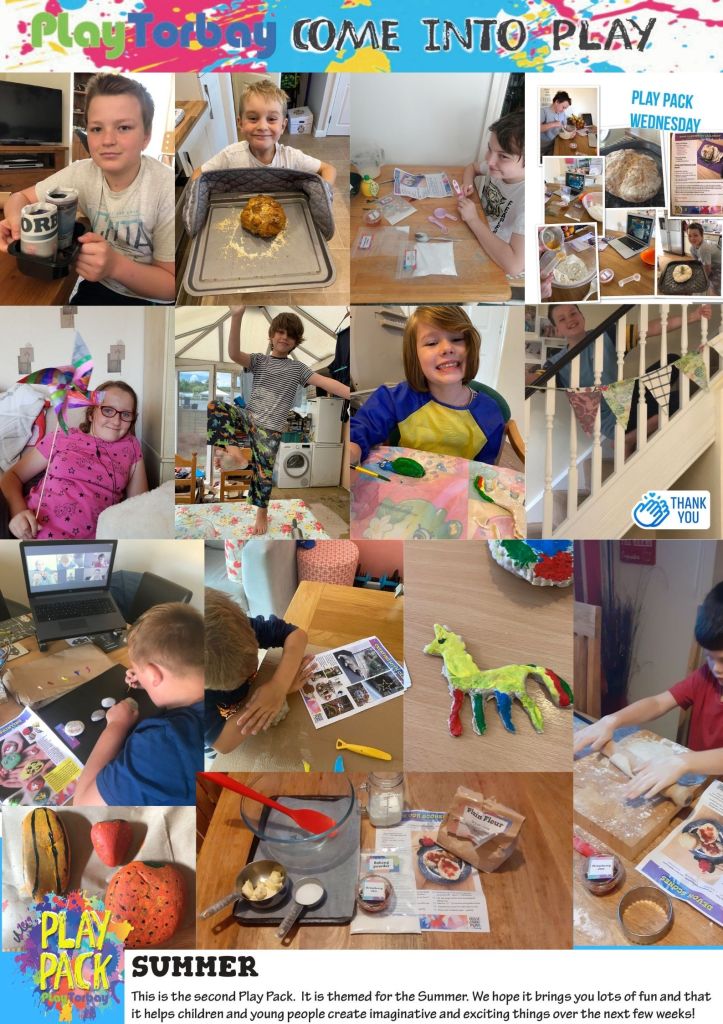
In Torbay our local play organisation joined forces with colleagues from Imagine This… a partnership of 43 voluntary sector children and young people’s organisations in Torbay, and we developed and provided Let’s Create and Play Packs for children and young people across ALL age ranges 0 – 19 years including treasure and sensory baskets for little ones and acrylic paints, sketch books and opportunities to take part in on-line sessions for teenagers.
Play Torbay is providing Packs for children aged 5 – 12 which included a range of scrap and craft materials that would usually end up as waste, along with instructions of fun things to make and do. Participants can access a weekly virtual session led by experienced playworkers, who talk through ideas of how to use the pack to its full potential, as well as providing opportunities for the young people and their families to engage with each other. If any families would prefer not to join the online session, the playworker can contact them directly instead with ideas of how to get the most out of the pack. We are also offering support to families who may be struggling to cope, with signposting and referral to other services where that’s required.
With support from a number of different funders, since March we have developed 4 differently themed packs and jointly delivered over 1,000 packs with over 80% going to families who are disadvantaged in some way. We have a waiting list so fund-raising is continuing because we would really like to ensure the service can carry on through these difficult times. Anyone who feels they may benefit from being involved in the Let’s Create and Play Pack project can contact Play Torbay by emailing admin@playtorbay.co.uk
To get an idea of the different things the packs offer, in the ‘Winter Play Pack’ there are separate bags for 8 planned sessions where you can try out different skills. There are detailed instruction sheets, so you make can things in a similar way, or you can use the materials in lots of different ways including making your own ‘fidget board’, ‘creating a plastic planter and growing seeds’ and designing your own ‘tree decorations’.
The exciting news is that we are now planning a fifth Play Pack with an eco-theme. This new pack is currently in design phase and subject to funding, will be available from January and run till the end of March 2021. The aim of the Eco Play Pack is to develop creative and playful ways for young people to actively be involved and take their share in protecting the planet. We are working with Torre Abbey and the Trove Scrapstore, a resource hub providing materials to re-make, recycle and re-use; and with Torbay Climate Action colleagues to develop opportunities to explore how solar panels work, re-using plastic and creating eco bricks, the importance of insulation and zero carbon solutions, passive house building, supporting natural habitats, permaculture and plants, etc.
Building on the success of weekly Zooms with Play Packs, where we can host as many as 20 families in a session, we are now planning to invite different presenters to join to talk through and demonstrate an idea, such as building a mini solar-powered boat, or planting winter salad leaves and then discuss further possibilities with young people. One of our ultimate aims is to explore the possibility of developing an inclusive, eco-friendly, people-powered, carbon-neutral adventure playground and we hope that the Eco Play Pack will support and encourage young people and their families to contribute to the future design of the playground.
Jackie Boldon, a new trustee of the Playwork Foundation, describes some of the different ways that organisations in the North East have responded to children’s need and right to play in Newcastle and North Tyneside:
Elswick Lamp Post Play Project
Playworkers from Play in Newcastle ran multiple projects across Newcastle in different school and community venues this summer, funded by the Department of Education’s Fit and Fed initiative through Street Games. In Elswick, the Play in Newcastle playworkers ran an estate based “Lamp Post Play Project”, with games, creative activities, dance and challenges over 7 Wednesdays of the summer holidays. On week one, the playworkers were shocked by the huge amounts of litter and fly-tipping which was seen as a barrier to children’s outdoor play. With a bit of pressure, the Council carried out a “clean up”, which was greatly appreciated by all residents and enabled children living on the estate to play safely outdoors every day. All the children who engaged with the Lamp Post Play project received a backpack with activity cards and play resources to provide them with new play ideas over the summer. (These can be found here)
The children had great fun and parents and grandparents were very appreciative of the Lamp Post Play Project. The playworkers have been asked to set up a year-round kids club. The project was supported by Hawthorn School, West End Schools Trust, Sussed and Able and the West End Children’s Community.
YMCA Lamp Post Play Project
A second Lamp Post Play Project was run by the YMCA in North Tyneside. With BBC Children in Need funding, children who would have attended a school-based after school and holiday club were offered creative play activities on their doorstep. Children were desperate for someone new to talk to and to support their play and parents were very grateful for the respite. The scheme ran for 4 weeks.
As soon as World War Two broke out, YMCAs developed mobile canteens to bring refreshments to the troops. In the same spirit, YMCA North Tyneside is now doing its bit to help bring a little joy to children’s lives during the Covid 19 crisis. During the lockdown, many children have been confined to their homes and denied access to their friends. Even now, it is still difficult for many organisations to open their doors to children to enable them to meet and play. So, in order to combat this, YMCA North Tyneside, funded by Children in Need and inspired by Jackie Bolden has decided to take their play provision to the children’s door steps. Adhering to social distancing requirements, YMCAs play workers, armed with their box of tricks, present themselves at door steps. They then engage children in a range of fun and creative activities. After an hour or so, they then move on to another door step and so on.
‘The response has been fantastic. The children have loved the activities on their doorsteps and it has been heartening to hear them talk about their lock down experiences. Equally, parents have welcomed the play workers presence and have urged them to return’
— Don Irving, Youth and Play Manager YMCA North Tyneside.
‘The doorstep sessions that the YMCA have been running are amazing. The children always look forward to Carlie and Demi from the YMCA arriving. My children are so proud of the various things they make and cant wait to the next time the workers come back. (Mr Roy Oliver…parent)
A comment from one of the children from another family referring to the YMCA workers: –
‘We have interesting chats and they listen to my feelings. They make us laugh and cheer us up…its great
(Sophie aged 10)
Another parent;- Leigh Johnson says‘ My children really looked forward to the YMCA workers coming to see the girls. They sit at the bottom of the front garden and take part in the activities. As well as the company, they chat about the lockdown period and what it has meant to them’
Benwell Playful Lives Project – Newcastle
Children in the Benwell area of Newcastle have been supported by a team of playworkers from the regional charity – Children North East to play outside their own homes over the summer, in family bubbles for 45 minute long free play session. Some children benefitted from as many as 6 sessions over 4 weeks of the school holidays. The children and parents had great fun inventing imaginary games and engaging in all types of play. This pilot project was supported by the Extended Schools Officer from Bridgewater School who coordinated the referral process and was funded through Street Games by the Department of Education. Jackie Boldon from Sussed and Able provided playwork training and advice. See the full story here
The Power of Playful Lives
Three-year-old Lyla is waiting in anticipation for our Playful Lives project workers, Lorna and Paula and student social worker, Lauren, to turn up.
It’s an overcast day but this hasn’t dampened anyone’s enthusiasm. As soon as the team walk through the garden gate, Lyla and her two brothers, Joseph, six and Thomas, five, run up to them shouting suggestions of what to play first.
The boys can’t wait to play tag whilst Lyla, full of bounce, heads for the trampoline with Lauren, It’s a welcome break for their mam, Lisa, who admits she finds keeping three children under six entertained 24/7 a bit of a stretch.
“Playful Lives has been great because the children have had no interaction with anyone other than me,” says Lisa, who is a teaching assistant at a local school.
I love them and they love me but they must be sick of me by now! Just the fact that there’s three extra pairs of hands here today – even for just half an hour to an hour – it’s brilliant.
The family has been shielding since March and the start of the Coronavirus lockdown due to Joseph’s asthma. “We’ve actually only been out three times since the 17 March,” Lisa says.
The last time the Playful Lives team was here, they used old cardboard boxes to make a pirate ship with the children. This session has a loose theme of ‘physical play’ so it’s running round the garden playing tag and hide and seek.
Playful Lives is a new Children North East project and part of Newcastle City Council’s Best Summer Ever, a holiday activity scheme aimed at supporting the city’s five to 18-year-olds during the school holidays. Our charity is working closely with the West End Schools Trust, a charitable educational trust formed by eight primary schools, and other partners to create a multi-agency Children’s Community in this part of the city. There’ll also be an ongoing research element to the work overseen by Newcastle University. Schools like Bridgewater Primary have recommended families who feel they could benefit from the Playful Lives project to engage with our team.
Andrew and Shirley’s family have also enjoyed the project. They have two daughters, Maddison, who’s nine and Tamzin, ten. “This has kept the kids really entertained and they look forward to them coming,” Shirley says.
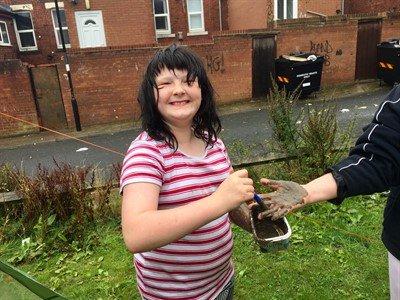
On the day we visit, it’s tanking down with rain so Andrew has put up a big family tent on ground next to their house. Tamzin, who is being assessed for an attention deficit disorder, loves messy play so Lorna suggests making ‘mud paint’ and Tamzin gets set digging a hole. “We like to demonstrate that it doesn’t have to cost lots of money to keep children occupied and engaged,” Lorna explains.
Whilst Maddison experiments with coloured painting inside the tent, Tamzin makes mud handprints before persuading mam to have her hands and face painted – with mud!
Andrew stands by enjoying the spectacle. “I was into everything like this when I was young – mud fights and making dens with cut grass. The street was full of kids. I don’t think kids get the chance to use their imagination so much any more because they’re so used to the electronic age. So things like Playful Lives is great with people like yourselves coming out and showing that they can get involved.”
Playful Lives worker, Paula, who, along with other Playful Lives staff, benefited from training with a freelance playwork specialist, Jackie Boldon, says the project has been a big hit with families this summer.
Playful Lives has given children the opportunity to engage in different activities together as a family whilst having fun in a safe environment. The interaction with different people – our team members – has had a positive effect on helping the children with their transition back to school and it has decreased isolation for the families by giving them something to look forward to outside of the family home.
Julia Sexton reflects on an extraordinary period for staff and children at Pitsmoor Adventure Playground, where she is a trustee.
In Rising to the Covid Challenge I described how staff at Pitsmoor Adventure Playground had responded to the challenge of keeping the relational space of the adventure playground alive and well whilst the physical space was closed to children, young people and families.
The playground’s physical space reopened this summer, in July. There was some understandable initial apprehension from staff, children, young people and their families about what the reality of reopening during the pandemic would be like. A main strength of the playground is its diversity; the staff team reflect the cultural diversity of the children, young people and families who use the playground. With research indicating that BAME people have a higher risk of contracting covid 19 (Public Health England, 2020) there were worries about what the impact of meeting regulations to keep everyone safe would be on keeping play at the heart of the playground when it reopened. As one playworker reflected ‘I was worried at the beginning; would we be able to build dens, build a swimming pool, play with water and just get close to the children?’
Pirates and zombies
Once the playground was reopened, there have been children running around, playing games of ‘pirates’ and ‘zombies’, football, cricket, basketball, hopscotch, hoola hooping, whizzing down the slide, hanging off the ‘witch’s hat’ roundabout and shrieking with joy as it spins around, making music with frying pans and saucepans, digging and planting, playing hide and seek, painting and drawing and constant shrieks of laughter and smiling faces and much more besides; much more than was anticipated to be possible before reopening.
Reading this you could be forgiven for thinking that the covid restrictions have had little impact on what is on offer at the playground, but you would be wrong. It has been a slow and steady process to be able to confidently offer most of the familiar play opportunities and resources although with some changes. For example, sand, water and the zip wire have not been available in line with risk assessment guidelines and art materials have been available for individual use only. Ever resourceful, the staff continually found alternative ways of doing the familiar things that were affected by the restrictions. Birthdays, always popular celebrations on the playground have continued to be celebrated with cake but involved clapping as an alternative to singing and blowing out candles. A playground favourite game, ‘tiggy’ played by children and playworkers has continued but as ‘tiggy no tiggy’ to enable abiding by social distancing guidance.
relational space
Keeping the relational space of the playground alive and well, whilst physically closed through socially distanced face to face outreach work, the press and other media, helped to keep the playground in people’s minds. Prior to reopening it was important to brief children, young people and families on the changes to expect on returning to the playground to prepare and reassure them that the playground was a safe place for them to play. Running a pilot session was crucial to enable ironing out any glitches and identifying any operational adjustments needed.
Regaining as much as possible of the co-created ‘everydayness’ of the playground required planning, preparation and reflection with all the team members; paid and volunteers. Effective teamwork has been crucial to ensure that the transition to reopening went smoothly and safely. Clear guidance that all of the team understood has been key to this, ensuring staff felt informed and supported. To effectively manage the changes to the playground systems and practice required having sufficient staff so that staff felt confident in their roles and not overwhelmed. Staff found that parents/carers often sought out opportunities to chat with them about their experiences and fears and having enough staff to accommodate this comfortably was essential for the health and wellbeing of the families.
Implications for our ethos
Some of the required changes have had implications for the ethos of the playground and playwork practice, needing careful ongoing reflection, discussion and planning to implement, manage and review. The playground previously aimed to offer the ‘three frees’ (Conway, 2009, p.4); being free of charge, open access and children and young people being free to choose how they play (Lester and Russell, 2013). It remains free of charge but currently cannot be open access. At the entrance to the playground there are now social distancing markers and a registration table. Here all visitors are greeted, welcomed and checked that they have been booked in, as the numbers of visitors on site has been limited, initially to 20 a session; generally 15 children and young people and up to 5 parents/carers in social bubbles.
To accommodate as many children as possible on-site during the day whilst also complying with social distancing and cleaning guidelines, the playground offered two, 2-hour pre-bookable sessions a day, Monday to Friday. All visitors are required to sanitise their hands prior to entering (hand sanitisers are also located throughout the playground) and temperature checks are taken and recorded as part of checking no one has any symptoms of covid 19. Whilst the children and young people are free to play there are some restrictions as to what and how equipment and resources can be accessed.
Feedback from the children, young people and parents/carers about the reopening of the playground has been very positive.
‘We couldn’t wait to be able to play on the playground, it was like every special day coming together when we were allowed back on to play again’ M aged 10
‘It was horrible being stuck in the house all the time. It’s been great being back with my friends and the playworkers’ A aged 11
‘There’s some bits changed but it is still great’ A aged 12
‘The Covids changed everything and made it hard for everyone but it is good we’ve still got Pitsmoor Adventure Playground and that it’s not shut down. We can come here to play, we can’t play anywhere else, it’s not safe’ E aged 13
‘I’ve been struggling with feeding my kids. I lost my job you see when the covid came. I was on a zero hour contract and they got rid of me. It’s been really hard but the playground were there for us all the time and now its opened to play, it’s made a real difference to my kids. They’re smiling again’ – Mother of 4 children
‘A huge difference’
‘Just being able to take my kids somewhere to play and have quality time is vital to me as a lone father. I was climbing the walls at home with them during lockdown not knowing what else to do. There’s only so many walks you can take them on before they get bored. They couldn’t wait for the playground to reopen and it’s made a huge difference to all our lives. They love every minute of the sessions they’ve gone to and are complaining they can’t go every day and having to learn the new covid way means taking turns, which isn’t a bad life lesson for them to learn either. Staff have been brilliant. They are really up on safety and it gives us confidence’ – Father of 3 children
This summer at the playground has been an exceptional one for multiple reasons. The reality of reopening during a pandemic has been that changes have been made to how the playground operates and to playwork practice to keep everyone safe. However, it is possible to keep play at the heart of the work by offering time and space for children and young people to play in challenging times. Whilst initially children, young people and their families along with the staff, were apprehensive about the reopening of the playground, they have found the adjustment smooth and safe.
Julia Sexton
References Conway, M. (2009). Developing an adventure playground: the essential elements. Practice Briefing 1. London: NCB.
Lester, S. and Russell, W. (2013). ‘Utopian visions of childhood and play in English social policy’ In Parker, A. and Vinson, D. (eds.) Youth Sport, Physical Activity and Play: Policy, Intervention and Participation. Abingdon: Routledge, pp. 40-52.
Public Health England (2020). Disparities in the risk and outcomes of
The Play Safety Forum and the UK’s four national play bodies have jointly published a report by risk and play specialists Professor David Ball, Tim Gill, and Andy Yates, about Covid-19 and children’s play.
After surveying the current evidence, the report concludes that current UK policy ‘is much more harmful to children than beneficial’ and ‘should be urgently reviewed, because:
the benefits to children of playing outside bring a host of social, emotional, and physical rewards. These have long been undervalued and at this time appear to have been completely ignored. Consequently, children are suffering harm;
the evidence is that the risks posed by COVID-19 to children playing in outdoor spaces is very low;
proportionate decisionmaking requires that trade-offs between the risks and benefits of safety interventions are part of the decision process’.
The cautious optimism among play advocates in recent weeks, that the Covid-19 pandemic may lead to a fundamental re-evaluation of what is most important for children, their families, and communities, was given a cold reality check on Sunday, when the UK’s most progressive mainstream newspaper, the Guardian/Observer, dedicated its entire editorial to an 8-point ‘manifesto for children’ without once mentioning their need to play. It is an illustration (again) of how lowly children’s own priorities are within the national debate about what is best for them.
At the start of the lockdown nobody was too surprised, in the circumstances, that the government’s response to an open letter from more than 40 play researchers, practitioners, and advocates asking for ‘clear advice’ about outdoor play, merely reiterated that we all must ‘focus on preventing the spread of Covid-19 (and) protecting the most vulnerable in society’. When the government’s only other stated priority was ‘offering support to those impacted by social-distancing, including companies and employees’, it was clear that the sudden constraints on space and opportunity for children to play was not going to be even a secondary issue for ministers.
‘There is little evidence that children’s profound need to play has received any more consideration. How lowly their own priorities are within the national debate about what is best for them’.
Now, as we move towards a substantial easing of the lockdown, these fears are born out. Children’s profound need to play has received little or no consideration from the government.
Researchers concerned
Some eminent researchers, including the ‘Play First’ alliance, have expressed serious concerns about the effect that a lack of play opportunities is having on children’s mental health, and called on the government to ease lockdown ‘in a way that provides all children with the time and opportunity to play with peers, in and outside of school … even while social distancing measures remain in place’. Others have specifically called for a nationwide plan to repurpose residential streets for play during lockdown and beyond.
The four national UK play organisations have endorsed a report from the Play Safety Forum calling for the government’s approach to be ‘urgently reviewed’ on the basis that the current policy ‘completely ignores’ the benefits of outdoor play to children (especially at a time of stress and uncertainty), while the risks of infection are ‘very low’.
Strong words
These are strong words, and necessarily so. The government in Westminster has indeed ignored children’s play as a policy issue ever since it first came to power on 2010, in spite of long recognising it as such. Having abandoned the Play Strategy for England, it believes local authorities should make their own policies for play, but has starved them of the cash that most of them would need to do anything meaningful, at the same time as deregulating both planning and childcare in ways that relegate children’s play to the status of an optional extra.
‘For children the overwhelming priority is playing with their friends’.
Now, however, would be the moment to think again. Millions of parents, teachers and children are stressed, tired and seriously unhappy after a full term-and-a-half trying to keep up with the curriculum via variable on-line platforms and ad hoc home-schooling, without receiving any of the ‘softer’ benefits of being part of the school community. For children this overwhelmingly means playing with their friends.
The government has announced a ‘Covid catch-up’ package for primary and secondary schools to support children returning to school in September to recover lost ground, and has also said that providers running holiday clubs and activities for children over the summer holiday will be able to open ‘if the science allows’ (although the guidance on this seems to be delayed). The relative importance attached to these two measures? £1 billion is allocated to the former, zero to the latter, which is conceived primarily as a service to parents – who will no doubt have to cover the cost themselves. For many, many children – the same children for whom the £1b catch-up fund is designed – this will mean summer play schemes are unaffordable. In turn, many independent providers will be unable to operate – which puts an additional pressure on schools, just as they need the mother of all breaks.
A play recovery fund
The answer is obvious. A discreet ‘play recovery’ fund should be established, in consultation with the play and playwork sectors, to enable non-school based holiday play schemes to be offered free of charge in the areas that will need them most. And the government should also talk to Playing Out, its network of street play activators, and the growing number of local authorities who now support temporary street closures for play, to consider an expanded national programme of street play sessions over the summer.
Some will think such an idea cavalier: that children’s outdoor play is simply too random and chaotic to observe any kind of public health protocols, even with the distancing requirements relaxed. But even if the Play Safety Forum’s persuasive risk-benefit assessment is disregarded, the government should know that the playwork field is highly professional, and always resourceful. Whatever the safety measures might need to be, no one will be better at engaging with children to follow them than playworkers.
Playwork responds to the crisis
For a field seriously depleted after 10 years of austerity, deregulation, and (in England) policy neglect, the field rallied well to respond to the crisis – in spite of some of its fundamental tenets seeming completely untenable in a public health emergency that demands distance, isolation, and regimentation. Playwork practitioners and advocates have offered timely guidance on how to sustain play opportunities through the lockdown, including playing at home. Adventure playgrounds have reached out to offer relational space and support to communities whose physical playgrounds were closed, and some practitioners have given new meaning to the term face-to-face playwork by taking it to the online platforms with which we are all now so familiar.
Play England and the great playwork theorist, Bob Hughes, have set out some wise words and good practical advice on ‘Play after Lockdown’. But first, in this time of national crisis, with families desperately needing a break before a return to the new normal – many of them unable to go away because of increased job insecurity or unemployment – the country needs the play sector to step up and do what it does best: give our kids space and support to have a good time. From within the billions that this terrible pandemic has cost the economy, is a few million for a well-deserved and badly needed Summer of Play, too much to expect? At the very least, the Observer should include it in its manifesto.
Playworker Sîon Edwards describes how the adventure playgrounds in Wales are responding to the Covid-19 crisis with their customary playfulness and innovation.
All four playgrounds in Wales are in the northeast, with three in Wrexham and one in Rhyl. Fortunately, this close proximity means I’m able to give a bit of an update on the majority (with the exception of our friends on the north coast). In short, like all other playgrounds in Wales (adventure or otherwise) … they’re closed! However, we have been doing different things to keep in touch with our communities and stay playful.
Food distribution
At The Venture, we initially responded by providing food packages. This was spurred on by the fact that only around 10% of daily Free School Meals (FSM) were being collected from local estate offices, likely due to a fear of going to a central collection point. Our desire was to emulate the success of the Welsh Government ‘Holiday Hunger Playwork Pilot’, where a FSM alternative is distributed through play provision, indiscriminately (i.e. irrespective of eligibility for FSM) during school holidays.
A consortium of local community organisations was quickly established and a small number of volunteers engaged to prepare and distribute food packages that could last a number of days, rather than daily (whilst of course maintaining social-distancing). Eventually, Wrexham County Borough Council (WCBC) moved to a direct payment system (equivalent to £19.50 per week) and the food distribution had to be ceased due to mounting costs.
“So far, I’ve had my own disco in the living room, practiced handstands, made a hammock, built a den, made collages, and played bowling with my empty Actimel bottles!”
On the more playful side, we’ve been going live for ‘Amser Story’ (storytime) in the early evening and producing a daily ‘On This Day’ (OTD) video. OTD features historic facts related to each day, to complement independent home-learning but also, more importantly, to provide a platform to share information with and from the local community.
Improvised bowling using old Actimel cartons
One key feature of OTD has been the ‘Playful Timetable’ from the WCBC Play & Youth Support Team which gives playful activity ideas that can be child-led, both indoors and outdoors. To name a few, so far, I’ve had my own disco in the living room, practiced handstands, made a hammock, built a den, made collages, and played bowling with my empty Actimel bottles!
Just over the field on the Caia Park estate, at Gwenfro Valley Adventure Playground, the steering group of volunteer community members have been meeting during lockdown via Facebook Messenger and focussing on fundraising via social media.
Further south, in the village of Plas Madoc, The Land is closed but playworkers there have been coming up with ways of encouraging children outside at home. Using reclaimed wood from local businesses, the playworkers are building bespoke benches, with designs inspired by the individuals who will eventually use them. Their latest design is the ‘Kiddo Lounger’!
“The planters mean they can bring a little bit of The Land into their own back garden”
They’ve also been creating trough planters, to encourage interaction with the natural world. On The Land, children will play with the elements: digging, gardening, and eating herbs and strawberries that have been grown on-site. The planters mean they can bring a little bit of The Land into their own back garden, bring a sense of competence and pride whilst also providing an opportunity to relax in the fresh air.
Recharging the batteries
Personally, I’ve found great comfort in the frequent online meetings with the Playwork Foundation. I’ve found, like the UK conference in Eastbourne, the meetings recharge my playworker batteries during a time when I easily feel disconnected and unable to do that thing that is hard to pin down in words, known as playwork.
Fellow trustee, Penny, has also been hosting weekly reflective sessions via Zoom which has been a great source of support and inspiration! You can get in the loop by searching for the Facebook Page ‘Play For Today’. I’ve yet to join “The Playworkers Lockdown Party 2020”, live on Facebook, but one of these nights I hope to join in – from what I’ve seen it’s certainly something that is likely to be talked about for years to come (Wendy’s glasses come to mind!).
Meynell TV is also a welcome innovation, to combat the Netflix dominance, which you can find on YouTube by searching for “Meynell Games”, while the annual Eastbourne get-together has been reimagined as 8 Weeks of Conference.
Whilst the countries of the UK diverge in terms of lockdown easing, the one thing the nation of playworkers can be sure of is that is not going to be “business as usual” for quite some time, and I would hazard a guess that the key to unlocking our play spaces will be innovation. I look forward to seeing what you come up with!
Cofion gynnes o’r Gymru | Warm regards
Sîon Edwards
Sîon is a playworker at the Venture in Wrexham, and a trustee of the Playwork Foundation







 The Playwork Foundation