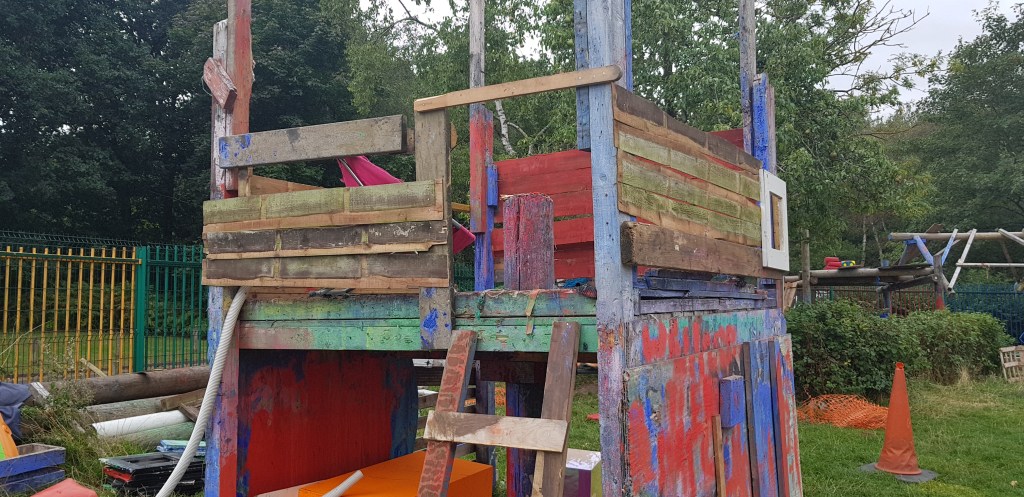
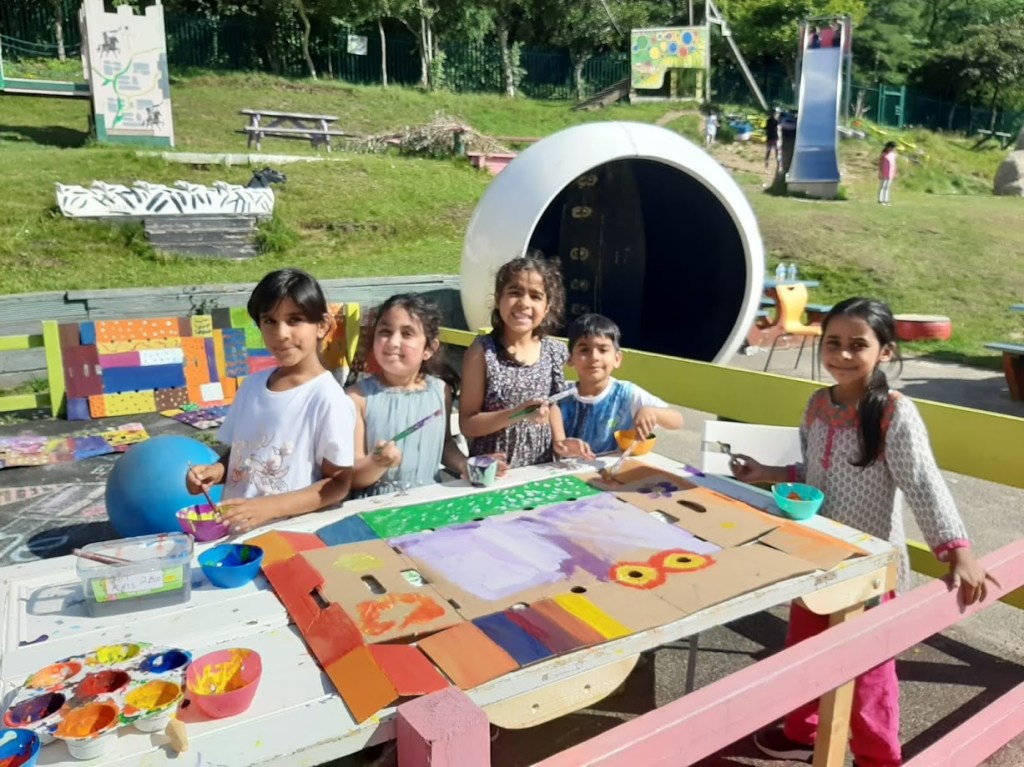
Inspecting your adventure playground

As practitioner-led structure building declines, Rob Wheway of the Children’s Play Advisory Service explains how inspection training is part of a renaisance of this quintessential feature of the traditional adventure playground.

Over the course of its history, adventure play has had a variety of attributes promulgated as its defining practice ethos, with different aspects taking prominence at different times, as fashion – both in playwork and in the wider zeitgeist – fluctuates. First ‘risky play’ takes the limelight, then ‘creative play’, before ‘natural play’ wrestles it away for a while … and so it goes on.

Whichever way the zeitgeist goes, though, it is an abiding characteristic of adventure playgrounds that they are made and built by playworkers. The ethos of adventure play is self-build: playworkers build them, and playworkers are responsible for them.

However, many playworkers are currently employed on adventure playgrounds that have either not been rebuilt for some years, or where contractors have been used in preference to training the workforce in the relevant skills.

Such practitioners, having had no role in the building of their playgrounds, are in a difficult position. This was highlighted of the recent case involving the failure of a piece of ‘self-build’ equipment (which had, in fact, been placed by a contractor) and which had not been adequately inspected.  It was this case which probably propelled the furore with an insurance company a couple of years ago, and led to headlines that adventure play is too dangerous to insure.

Upskilling the workforce

The response to this turn of events could be to further deskill the workforce and deaden the adventure playground with rigidity – no more self-build, no more flexibility, no more children ‘spoiling’ bought equipment with hammers and nails … Or, it could be to develop further methodologies to overcome insurers’ fears and to upskill the workforce’s competence in caring for and developing the play environments they provide.

In pursuance of the latter, the short course ‘Inspecting your Adventure Playground’ has been developed by the Children’s Play Advisory Service, which is recognised as one of the foremost resources for health and safety expertise in both the fixed-equipment and adventure play fields.

This course is designed to provide a framework for playworkers to both perform operational inspections of their playsites, and keep an ongoing paper trail as evidence that due care has been taken to repair and maintain the attendant structures.  This both ensures that the site remains in an acceptable state between annual inspections, and covers the organisation and workforce against claims of negligence in the event of unexpected and unforeseeable catastrophe.

Piloted with playworkers

The course has been piloted with playworkers running adventure playgrounds, mostly to a good reception. Participants have commented, “I thought the information given on this course was relevant in order for playworkers to have a better understanding of how to keep a playground safe” and, “Very informative… all adventure playground staff need this training.”  However, there remains some confusion over operational inspection, dynamic risk assessment and annual, independent inspection.

The course is not a substitute for annual, independent, inspection by a competent and qualified person.  Its methodology works in tandem with independent inspection and is intended to overcome the tendency, which overworked playworkers may have, to put the independent inspection, once completed, aside until the following year, in order to avoid the onerous and laborious tick-box sheets which can become robotic, not really checks at all; or the tendency to do the checks, but not to record them. Neither does its methodology work the same as dynamic risk assessment, which is a process for judging actions in the provision, rather than a system for recording the physical safety of the provision itself.

As there is currently no accrediting body for courses in playwork (which the Playwork Foundation and others are working to remedy) the current ‘Inspecting your Playground’ course does not carry a qualification. It does, however, both equip playworkers with the tools to prove competence should the need arise and, more importantly, mitigate against such eventualities by enabling them to be more fully responsible for their own sites.

Rob Wheway
Children’s Play Advisory Service (CPAS)

For more information contact Rob Wheway, Director of CPAS. on whewayr@gmail.com or 024 7650 3540


Ali Wood of the Playwork Foundation adds…

The Playwork Foundation has heard from a number of playworkers in adventure playgrounds with self-build structures about how best to inspect and maintain these to ensure they remain safe. We, therefore, want to promote the course run by the Children’s Play Advisory Service, ‘Inspecting Adventure Playgrounds’ that enables playworkers to do just that. 

At Meriden AP, for example (where I am a trustee), we are currently having to deal with a personal injury claim regarding a child who came on her first visit and broke her leg at the bottom of a slide constructed from large tunnel piping several years earlier.  Had our staff not done this course with Rob Wheway and Simon Rix, we may well have had difficulty providing the necessary evidence for both the solicitor and the insurance company, to show we were not negligent in both checking and maintaining this slide and all our other structures in a meaningful way. 

We were also able to call on Rob Wheway for the extra information we needed regarding what the law does and doesn’t require of us regarding self-build structures and his help was invaluable. I would really urge AP playworkers to do this course so you really know the ongoing condition of your structures both above and below ground and can be sure they are therefore safe.

Ali Wood

Ali Wood is a playwork trainer and writer who is a trustee both of the Playwork Foundation and Meriden Adventure Playground.

Images: Meriden Adventure Playground

Researching playwork in the pandemic

Dr Pete King of Swansea University is researching the playwork field’s response to the pandemic and has two opportunities to get involved.

Adventure Playgrounds

Dr. King is looking for anyone involved in adventure playground to take part in a study on how adventure playgrounds have been adapted since post-lockdown measures were put in place in July 2020.  The research study will involve a short 20-30 minutes interview using Zoom.  If you would like to take part, please contact Pete at p.f.king@swansea.ac.uk where you can be sent more information about the study.  The research study has ethical approval from the College of Human and Health Science at Swansea University.

After-school clubs or holiday playschemes

Dr. King is also looking for anyone involved in afterschool clubs or holiday playschemes to take part in a study on how you have adapted since post-lockdown measures were put in place in July 2020.  The research study will involve you to take part and complete a short survey which can be accessed here.


For more information, about the studies please email p.f.king@swansea.ac.uk

The research study has ethical approval from the College of Human and Health Science at Swansea University.

Meriden in the pandemic

Trustee Ali Wood describes how Meriden Adventure Playground, in Chelmsley Wood in the West Midlands, is managing to continue its vital work through the Covid crisis

Like all other playgrounds, we had to close during the lockdown.  We furloughed most of the staff but kept two on to stay in touch with the community and to help set up a new food bank and make deliveries – along with made-up play packs – to local families.  We opened up again at the beginning of July, having spent weeks working out to how to do this safely without losing the power and fun of playing – we eventually set up an online booking system (which has been a nightmare to administrate) so that we could open to groups of 20 three times a day.  We required adults to socially distance, but not the children and we also encouraged both children and parents to complete a questionnaire about how they had been feeling and playing during the lockdown. 

A SPECTRUM OF EXPERIENCES

These have yielded some really interesting responses showing a whole spectrum of experiences – ranging from those who had a really tough tine and were still very worried right through to those who had loved being off school and having more time to play.  It was interesting to see the correlation that matched up the most anxious children with the most fearful and stressed out parents…  We also noticed initially that most of the children were more reticent than usual and it took a few sessions for them to get back to their gung-ho selves.  

Being an outdoors only site did make things easier and by August we had nearly all the staff back and were up to 40 children a session and we had also formed a partnership with SOLAR – our local Mental Health NHS Foundation Trust – who have been paying for the exclusive use of the site twice a week with groups of children on their caseloads.  It has been wonderful to see these isolated children particularly, forming friendships with others like them and building up confidence and competence and starting to open up and talk. This is a partnership we shall definitely be building on – the psychologists have a passion for free play and we are learning from each other and sharing good practice.  Youth nights also started up halfway through July and moved up to 30 per session and attracting new young people we didn’t know.

A BUSY SUMMER

So it was a very busy summer interspersed with cameos of spraying disinfectant and dishing out hand sanitiser together with constantly explaining the ‘rules’  for limited numbers to parents who kept turning up at the gate. There has been a lot of ‘can we – can’t we?’ reflections along the way but confidence has grown all-round and despite things not being as they were, the magic and power of playing has definitely returned and feels great.  We looked forward to the school term starting so we could build back up our unaccompanied regulars after-school – many of whom had not returned because they would normally have turned up here in the holidays all day and every day which has not been possible due to online booking.  Many of them did return and we soon went back to offering food again as many of them were hungry.  

We are now into the second national lockdown but have managed to stay open.  After many conversations with both the police and with public health officials about the need to continue supporting kids, we have been allowed to open as long as there is a maximum of 15 ‘children or young people most in need’ present.  That left us with a real conundrum – how could we decide who was most needy.  We managed to structure things so that we have at least two sessions five days a week and are working on trying as far as possible to get the same kids at the same sessions so there is less ‘mingling’ (despite the fact that all these are kids are mingling on the streets after school and in the park). Despite the agreement we had forged, the local police force still came to disperse everyone at the first youth session last Thursday, but fortunately they listened and drove off and we are hoping that doesn’t keep happening.

We are also spending time having strategic discussions and planning for the future in response to the pandemic – we are exploring offering alternative education placements and more therapeutic play sessions as a means of reaching those children most in need, whilst earning extra much-needed income.  These are not easy times for playwork!

Ali Wood
Trustee, Meriden Adventure Playground


If anyone would like to buy our 2021 calendar for a fiver plus postage, that would be great as we are having to do this more by post this year!  Email aliwood@meridenadventureplayground.com for one or more copies – all proceeds go towards feeding kids!

An Exceptional Summer at Pitsmoor

Julia Sexton reflects on an extraordinary period for staff and children at Pitsmoor Adventure Playground, where she is a trustee.

In Rising to the Covid Challenge  I described how staff at Pitsmoor Adventure Playground had responded to the challenge of keeping the relational space of the adventure playground alive and well whilst the physical space was closed to children, young people and families. 

The playground’s physical space reopened this summer, in July. There was some understandable initial apprehension from staff, children, young people and their families about what the reality of reopening during the pandemic would be like. A main strength of the playground is its diversity; the staff team reflect the cultural diversity of the children, young people and families who use the playground. With research indicating that BAME people have a higher risk of contracting covid 19 (Public Health England, 2020) there were worries about what the impact of meeting regulations to keep everyone safe would be on keeping play at the heart of the playground when it reopened.  As one playworker reflected ‘I was worried at the beginning; would we be able to build dens, build a swimming pool, play with water and just get close to the children?’ 

Pirates and zombies

Once the playground was reopened, there have been children running around, playing games of ‘pirates’ and ‘zombies’, football, cricket, basketball, hopscotch, hoola hooping, whizzing down the slide, hanging off the ‘witch’s hat’ roundabout and shrieking with joy as it spins around, making music with frying pans and saucepans, digging and planting, playing hide and seek, painting and drawing and constant shrieks of laughter and smiling faces and much more besides; much more than was anticipated to be possible before reopening.

Reading this you could be forgiven for thinking that the covid restrictions have had little impact on what is on offer at the playground, but you would be wrong. It has been a slow and steady process to be able to confidently offer most of the familiar play opportunities and resources although with some changes. For example, sand, water and the zip wire have not been available in line with risk assessment guidelines and art materials have been available for individual use only. Ever resourceful, the staff continually found alternative ways of doing the familiar things that were affected by the restrictions. Birthdays, always popular celebrations on the playground have continued to be celebrated with cake but involved clapping as an alternative to singing and blowing out candles. A playground favourite game, ‘tiggy’ played by children and playworkers has continued but as ‘tiggy no tiggy’ to enable abiding by social distancing guidance.  

relational space

Keeping the relational space of the playground alive and well, whilst physically closed through socially distanced face to face outreach work, the press and other media, helped to keep the playground in people’s minds. Prior to reopening it was important to brief children, young people and families on the changes to expect on returning to the playground to prepare and reassure them that the playground was a safe place for them to play. Running a pilot session was crucial to enable ironing out any glitches and identifying any operational adjustments needed.

Regaining as much as possible of the co-created ‘everydayness’ of the playground required planning, preparation and reflection with all the team members; paid and volunteers. Effective teamwork has been crucial to ensure that the transition to reopening went smoothly and safely. Clear guidance that all of the team understood has been key to this, ensuring staff felt informed and supported. To effectively manage the changes to the playground systems and practice required having sufficient staff so that staff felt confident in their roles and not overwhelmed. Staff found that parents/carers often sought out opportunities to chat with them about their experiences and fears and having enough staff to accommodate this comfortably was essential for the health and wellbeing of the families.

Implications for our ethos

Some of the required changes have had implications for the ethos of the playground and playwork practice, needing careful ongoing reflection, discussion and planning to implement, manage and review.  The playground previously aimed to offer the ‘three frees’ (Conway, 2009, p.4); being free of charge, open access and children and young people being free to choose how they play (Lester and Russell, 2013). It remains free of charge but currently cannot be open access. At the entrance to the playground there are now social distancing markers and a registration table. Here all visitors are greeted, welcomed and checked that they have been booked in, as the numbers of visitors on site has been limited, initially to 20 a session; generally 15 children and young people and up to 5 parents/carers in social bubbles.

To accommodate as many children as possible on-site during the day whilst also complying with social distancing and cleaning guidelines, the playground offered two, 2-hour pre-bookable sessions a day, Monday to Friday. All visitors are required to sanitise their hands prior to entering (hand sanitisers are also located throughout the playground) and temperature checks are taken and recorded as part of checking no one has any symptoms of covid 19. Whilst the children and young people are free to play there are some restrictions as to what and how equipment and resources can be accessed.

Feedback from the children, young people and parents/carers about the reopening of the playground has been very positive.  

‘We couldn’t wait to be able to play on the playground, it was like every special day coming together when we were allowed back on to play again’ M aged 10

‘It was horrible being stuck in the house all the time. It’s been great being back with my friends and the playworkers’ A aged 11

‘There’s some bits changed but it is still great’ A aged 12

‘The Covids changed everything and made it hard for everyone but it is good we’ve still got Pitsmoor Adventure Playground and that it’s not shut down. We can come here to play, we can’t play anywhere else, it’s not safe’ E aged 13

‘I’ve been struggling with feeding my kids. I lost my job you see when the covid came. I was on a zero hour contract and they got rid of me. It’s been really hard but the playground were there for us all the time and now its opened to play, it’s made a real difference to my kids. They’re smiling again’ – Mother of 4 children 

‘A huge difference’

‘Just being able to take my kids somewhere to play and have quality time is vital to me as a lone father. I was climbing the walls at home with them during lockdown not knowing what else to do. There’s only so many walks you can take them on before they get bored. They couldn’t wait for the playground to reopen and it’s made a huge difference to all our lives. They love every minute of the sessions they’ve gone to and are complaining they can’t go every day and having to learn the new covid way means taking turns, which isn’t a bad life lesson for them to learn either. Staff have been brilliant. They are really up on safety and it gives us confidence’ – Father of 3 children

This summer at the playground has been an exceptional one for multiple reasons. The reality of reopening during a pandemic has been that changes have been made to how the playground operates and to playwork practice to keep everyone safe. However, it is possible to keep play at the heart of the work by offering time and space for children and young people to play in challenging times. Whilst initially children, young people and their families along with the staff, were apprehensive about the reopening of the playground, they have found the adjustment smooth and safe. 

Julia Sexton


References
Conway, M. (2009). Developing an adventure playground: the essential elements. Practice Briefing 1. London: NCB.

Lester, S. and Russell, W. (2013). ‘Utopian visions of childhood and play in English social policy’ In Parker, A. and Vinson, D. (eds.) Youth Sport, Physical Activity and Play: Policy, Intervention and Participation. Abingdon: Routledge, pp. 40-52.

Public Health England (2020).  Disparities in the risk and outcomes of

COVID-19.  Retrieved https://assets.publishing.service.gov.uk/government/uploads/system/uploads/attachment_data/file/908434/Disparities_in_the_risk_and_outcomes_of_COVID_August_2020_update.pdf

Photos: Pitsmoor Adventure Playground 

Wales’ adventure playgrounds take playwork to their communities in lockdown

Playworker Sîon Edwards describes how the adventure playgrounds in Wales are responding to the Covid-19 crisis with their customary playfulness and innovation.

All four playgrounds in Wales are in the northeast, with three in Wrexham and one in Rhyl. Fortunately, this close proximity means I’m able to give a bit of an update on the majority (with the exception of our friends on the north coast). In short, like all other playgrounds in Wales (adventure or otherwise) … they’re closed! However, we have been doing different things to keep in touch with our communities and stay playful.

Food distribution

At The Venture, we initially responded by providing food packages. This was spurred on by the fact that only around 10% of daily Free School Meals (FSM) were being collected from local estate offices, likely due to a fear of going to a central collection point. Our desire was to emulate the success of the Welsh Government ‘Holiday Hunger Playwork Pilot’, where a FSM alternative is distributed through play provision, indiscriminately (i.e. irrespective of eligibility for FSM) during school holidays.

A consortium of local community organisations was quickly established and a small number of volunteers engaged to prepare and distribute food packages that could last a number of days, rather than daily (whilst of course maintaining social-distancing). Eventually, Wrexham County Borough Council (WCBC) moved to a direct payment system (equivalent to £19.50 per week) and the food distribution had to be ceased due to mounting costs.

“So far, I’ve had my own disco in the living room, practiced handstands, made a hammock, built a den, made collages, and played bowling with my empty Actimel bottles!”

On the more playful side, we’ve been going live for ‘Amser Story’ (storytime) in the early evening and producing a daily ‘On This Day’ (OTD) video. OTD features historic facts related to each day, to complement independent home-learning but also, more importantly, to provide a platform to share information with and from the local community.

Improvised bowling using old Actimel cartons

One key feature of OTD has been the ‘Playful Timetable’ from the WCBC Play & Youth Support Team which gives playful activity ideas that can be child-led, both indoors and outdoors. To name a few, so far, I’ve had my own disco in the living room, practiced handstands, made a hammock, built a den, made collages, and played bowling with my empty Actimel bottles!

Just over the field on the Caia Park estate, at Gwenfro Valley Adventure Playground, the steering group of volunteer community members have been meeting during lockdown via Facebook Messenger and focussing on fundraising via social media.

Further south, in the village of Plas Madoc, The Land is closed but playworkers there have been coming up with ways of encouraging children outside at home. Using reclaimed wood from local businesses, the playworkers are building bespoke benches, with designs inspired by the individuals who will eventually use them. Their latest design is the ‘Kiddo Lounger’!

“The planters mean they can bring a little bit of The Land into their own back garden”

They’ve also been creating trough planters, to encourage interaction with the natural world. On The Land, children will play with the elements: digging, gardening, and eating herbs and strawberries that have been grown on-site. The planters mean they can bring a little bit of The Land into their own back garden, bring a sense of competence and pride whilst also providing an opportunity to relax in the fresh air. 

Recharging the batteries

Personally, I’ve found great comfort in the frequent online meetings with the Playwork Foundation. I’ve found, like the UK conference in Eastbourne, the meetings recharge my playworker batteries during a time when I easily feel disconnected and unable to do that thing that is hard to pin down in words, known as playwork.

Fellow trustee, Penny, has also been hosting weekly reflective sessions via Zoom which has been a great source of support and inspiration! You can get in the loop by searching for the Facebook Page ‘Play For Today’. I’ve yet to join “The Playworkers Lockdown Party 2020”, live on Facebook, but one of these nights I hope to join in – from what I’ve seen it’s certainly something that is likely to be talked about for years to come (Wendy’s glasses come to mind!).

Meynell TV is also a welcome innovation, to combat the Netflix dominance, which you can find on YouTube by searching for “Meynell Games”, while the annual Eastbourne get-together has been reimagined as 8 Weeks of Conference.

Whilst the countries of the UK diverge in terms of lockdown easing, the one thing the nation of playworkers can be sure of is that is not going to be “business as usual” for quite some time, and I would hazard a guess that the key to unlocking our play spaces will be innovation. I look forward to seeing what you come up with!

Cofion gynnes o’r Gymru | Warm regards

Sîon Edwards

Sîon is a playworker at the Venture in Wrexham, and a trustee of the Playwork Foundation

Birmingham adventure playgrounds featured in oral history project

General Public’s Oral Histories has launched part one of it’s Let Us Play project, an investigation of the ‘state of play’ today. Initially this involves the collation of an archive of material to capture the Birmingham adventure playground movement of the 1960-1980’s (funded by The National Lottery Heritage Fund).

This will be followed by a wider ‘live period’ of events and exhibitions in 2021/22. This has been initiated through an Arts Council R&D grant. This has seen the development of a new piece of moving image work, a Sparkbrook adventure playground digital trail/app, mapping of play in the city from the 1960’s through to the present day, collaborations with academics at UoB and developing a series of creative play weeks/exhibitions in close proximity to the old playground sites.

Photo: Meriden Adventure Playground


Visit the Let Us Play project here

Rising to the Covid challenge

Julia Sexton, a trustee of Pitsmoor Adventure Playground, describes how the physical space of the playground is giving way, during lockdown, to the relational space of the project’s integral links with its community

Adventure playgrounds are more than just physical spaces. They are relational spaces (Lester, Fitzpatrick and Russell, 2014); each unique and individual, created through physical, emotional and social encounters (Massey, 2005). As a relational space, the adventure playground is co-produced through on-going, every day, ordinary encounters, habits and routines (Lester, Fitzpatrick and Russell, 2014) involving humans and things situated within wider social, political and material environments.

So, what happens when due to the Covid-19 outbreak and the regulations put in place to minimise the risk of the virus spreading, adventure playgrounds close? The physical space is closed to children and families and the everyday, ordinary encounters, habits and routines that co-produce the relational space are disrupted, but can the relational space continue in a different form?

“Playworkers are nothing if not resourceful”

Playworkers are nothing if not resourceful and the staff at Pitsmoor Adventure Playground have risen to the challenge in these difficult times of keeping the relational space of the adventure playground alive and well, helping people stay safe and working hard to keep play on everyone’s agenda, locally, regionally and across the UK.

Just as all adventure playgrounds are unique and individual, the support provided also needs to be unique and individual to the children, families and communities they serve. There are many amazing ideas and activities on the internet but many of the children and families that use the playground do not have devices, so this needed to be considered when thinking about different ways to support the children’s play. 

Whilst understanding that children can play with anything or in fact no things, just their imagination, the playworkers recognised that there can be constraints to children being able to do this for lots of reasons such as limited resources and space at home, parental understanding of play and remote teaching lessons and homework. In response to this the playworkers felt that it was important to continue to support the children having opportunities to direct themselves and be spontaneous in their play as they had had when playing on the playground.

Contacting families

The playground staff have been in contact with families by telephone to check that they are ok. Play packs have been made up using materials from the playground and Scrap Dragon, the local scrapstore, for distribution to families.  Careful consideration has been given to including varied materials such as different types of card and paper, oddments of wool, pom poms, pipe cleaners, random sparkles, cardboard boxes, glue, small pack of crayons, children’s scissors and a children’s book. The books were donated by the Fun Palace Co-ordinator at the Crucible Theatre, Sheffield and a local business loaned the use of their truck to help with deliveries. The packs contain a realistic collection of items so the cost to the playground is manageable and also so every child can have their own pack, rather than having to share with siblings and causing squabbles, in perhaps already stressed households. 

So far, about 85 packs have been given out; most delivered by hand with some being posted out to children who live further afield. There has been a very positive response to the play packs; parents and children eagerly awaiting their play pack delivery, happy to see, from the safe distance of their doorsteps, playground staff doing the deliveries. In addition, there have been very appreciative messages posted on social media about the play packs. These packs will continue to be made, ever evolving to include different items whilst requests keep coming in via social media, telephone and word of mouth.

Sharing ideas

For those children and families with access to devices, social media, such as Facebook and Twitter have been used to share play ideas, challenges, advice and information including videos such as one made with Knottingley Adventure Playground about the importance of children staying home. In addition, the manager and the finance officer have given interviews about the importance of play during the covid-19 outbreak on local radio.

The playground is in regular contact with partner organisations such as the Council’s Community Response Team, voluntary organisations, other local community and faith groups, developing thinking strategically about how to better support children, young people, families and communities during this time. As a community hub, the playground has produced a leaflet detailing the most useful local and citywide support services, mainly pictorial so it can be understood by speakers of other languages, and with messages about staying indoors and keeping safe.

“the relational space is able to continue, just in different forms”.

The playground is listed on this as being able to help with shopping and with emergency food parcel referrals. The playground has been actively involved in supporting the local Food Bank’s move to a delivery service, using the playground’s minibus and helping to collect/buy food and assisting with successfully applying for funding.

The physical space of the playground may be currently closed to children and families; and the everyday, ordinary encounters, habits, and routines that co-produce the relational space have been disrupted. However, the relational space is able to continue, just in different forms.

Julia Sexton

Julia is a Senior Lecturer at the Sheffield Institute of Education and a trustee of Pitsmoor Adventure Playground. She is also a trustee of the Playwork Foundation.

References

Lester, S., Fitzpatrick, J. and Russell, W. (2014) ‘Co-creating an Adventure Playground (CAP): Reading playwork stories, practices and artefacts’, Available at: https://www.academia.edu/7020633/Lester_S._Fitzpatrick_J._and_Russell_W._2014_Cocreating_an_Adventure_Playground_reading_playwork_stories_practices_and_artefacts

Massey, D. (2005). For space. London: Sage Publications Ltd.


For more information about Pitsmoor Adventure Playground please visit: https://www.facebook.com/PitsmoorAdventures/
Serving our community in lockdown


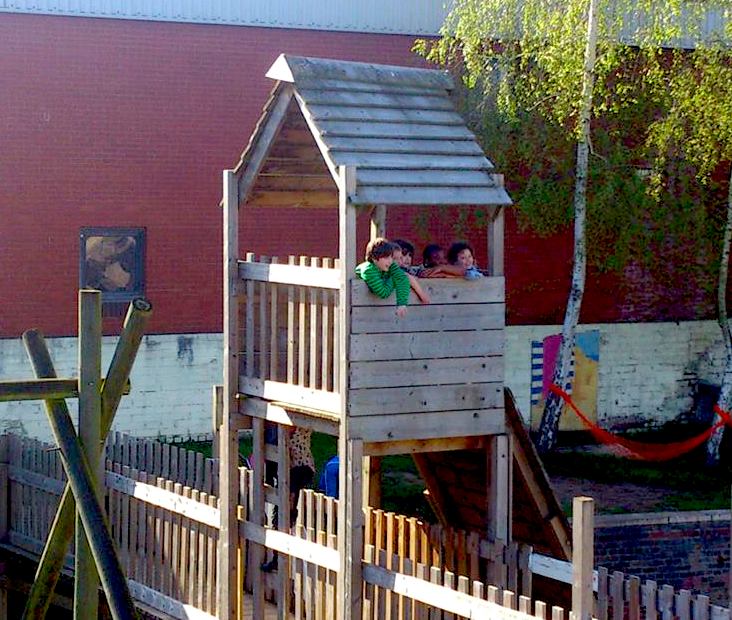
Ali Wood, a trustee of Meriden Adventure Playground in the West Midlands, describes how the lockdown has affected the service, and how the playground has become part of the wider community response.

Meriden Adventure Playground is currently closed, as are other adventure playgrounds. We have furloughed most of our staff and been talking with funders about how their funding could still be used at the end of all this. The couple of staff members who are still working have been hard at it, updating policies and procedures, doing site maintenance and admin and updating the website. They are also staying in touch with children, young people and families via Facebook, Instagram or phone, with useful information, regular play challenges, and activity ideas.

We have managed to acquire some emergency funding and so have joined forces with the local food bank; making up play packs to give away at the same time as giving out food deliveries to those families with either no or very little income, who have fallen through the cracks (and there are many around here). We are also able to give out free condoms to those who request them. Our play packs are not ‘activity’ packs as such (although they include paints, chalks, glue, card, and paper, etc. and ideas for activities and games) and they include a letter to parents on supporting play from the child’s perspective, and using loose parts naturally available at home or included in the packs.

Struggling families

We have been negotiating with the Council (which owns our land) to see if we can open the playground a few days a week so that families referred to us via schools or Children’s Services as really struggling,  (no outdoor space themselves, cramped home conditions, children with specific needs, etc.) can come in, one family at a time, for a prearranged hour.

Senior members of the Council have seriously thought about the idea of us opening for one family at a time, but have decided that, currently, it would be giving out the wrong messages to the public – especially as we are situated within an actual park and so are very visible to everyone visiting the park; police have already been needing to monitor those using the park, as social distancing is often not being practised.

However, we have agreed that as restrictions ease, we want to be at the forefront of the response, and help to pick up the pieces. To that end, we will be talking again with senior officers in two weeks’ time to see if this response can change. In the meantime, we have been allowing two or three parent volunteers at a time to do on-site maintenance work (whilst insisting on distancing!), as it gives them respite from all being in the house together – and makes them more able to cope when they return home.

Ali Wood

photo: Meriden Adventure Playground

Are adventure playgrounds really under threat from a risk-averse insurance industry?


Simon Bazley, after taking the temperature of this week’s media flurry about insurance companies and adventure playgrounds, decided to do a little bit of his own investigative journalism. He discovered that the picture is not exactly as described by some illustrious newspapers, and suggests that the more serious threats lie elsewhere.

A couple of weeks ago, around 14th January, I learned through social media that Felix Road Adventure Playground in Bristol had been advised, in the words of its manager, Eddie Nutall, that “adventure playgrounds were not economically viable to them anymore … good luck, and sorry.” 

Upon hearing this, I was naturally concerned about the implications for other adventure playgrounds across the UK and I decided to do some digging, getting in touch with some of my own contacts within the insurance industry.  In short, they said “what are you worrying about? It’s only one insurer and there are many others; just speak to a broker”. 

These contacts, quite senior people in the industry, went on to suggest that it is quite normal for an insurance provider to change their emphasis within various portfolios but that, as one company leaves the market, it provides opportunities for others to compete for the business.  

The Times and the Sun

Fast forward two weeks, and I, like many of us in our field, was a little shocked to read the Times’ and Suns’ versions of events.

“Adventure playgrounds in danger of mass closure after insurer Zurich pulls out”? (The Times)

PARK STRIFE : ‘Claims culture’ could force mass closure of playparks as insurer Zurich ‘threatens to end cover’
(The Sun)

These headlines, which appeared on Monday this week, made me sit up and take more notice than I usually do of certain mainstream media. But are they factually correct?  If so, then our sector has a serious problem, a sentiment manifest in the waves anxiety sweeping across social media all week. ‘Is this the final nail in our coffin?’ was one typical comment.

Panic

The trigger for this panic has surely been the Times’ assertion that Zurich, until now, was ‘the only insurer willing to back (adventure playgrounds)’. But my initial enquiries suggested this was not true, and so let’s take a closer look.

Speaking to a friend and colleague yesterday, I learned that the oldest adventure playground in Wales, Wrexham’s The Venture, was insured by Royal Sun Alliance (RSA), not Zurich. RSA also insures my own work as a self-employed playworker and play consultant. 

Further investigation, via my insurance broker, Keegan and Pennykid in Edinburgh, provided more evidence that the problem has been exaggerated, to say the least.  They advised me that they have a number of adventure playgrounds as clients and have successfully negotiated policies for them via RSA and Aviva, two of the largest insurance providers in the UK. According to Keegan and Pennykid, other companies are also amenable.

Bigger picture

From just a little research, it is clear that The Times story is inaccurate. Of course, we need to try and ascertain the bigger picture, and I would encourage all adventure playgrounds to respond to a survey that has been issued by London Play (see below). I am currently trying to find out who insures the other three adventure playgrounds still remaining in Wales and will feed this into the gathering evidence base.

Hopefully, a concerted and collaborative bit of data gathering will tell us whether or not adventure playgrounds across the UK can, in general, get reasonable insurance, with fair terms and conditions at a reasonable price. If not, then, as a playwork sector, we may indeed have a problem.

If, on the other hand, the answer is yes, albeit that some playgrounds may be now looking for new cover, then perhaps we can use this current attention on our work to highlight our value, collaborate on good practice and workable solutions; and maybe even strike some better deals with the insurance industry.

There is more than one meaning to the term ‘a good risk’!

Simon Bazley

Simon Bazley is the CEO of Playful Futures and a trustee of the Playwork Foundation.

London Play has asked for help in collecting some information about insurance and adventure playgrounds. If you run, work for or volunteer at an adventure playground anywhere in the country please complete the survey at the link below soon as possible. Thank you!

https://www.surveymonkey.co.uk/r/H9X3M2D

How youth workers can go the extra mile for play

whittling
When Ali Wood enrolled for an event, ‘In Defence of Youth Work’, in Birmingham, she saw that the agenda featured discussions on youth work in different settings and situations. Never being shy about speaking out for play, Ali asked if youth work in adventure playgrounds could be added to the programme. This is a synopsis of her resulting workshop, and Ali’s rationale for it.

I qualified as a youth and community worker in 1985 and worked in a whole range of centres and clubs in Birmingham for a number of years.  Things were changing though –both in the local authority and across the country and it wasn’t hard to see the writing on the wall.  Funding for community work was dwindling fast and youth work as it had been was changing and becoming more issue-based, but somehow in that process we ended up losing numbers of young people – partly due to focussing more on discussion work than recreational activities and young people’s choices.  I ‘defected’ to playwork, which had begun with the introduction of adventure playgrounds in London in the 70’s and over the ensuing decades built up its own theory base, research evidence for play and qualifications for playworkers. I have been there ever since.

Adventure playgrounds

So for those of you who don’t know and have never been to one – what’s an adventure playground?  There aren’t that many left around since all the recent local authority cuts, so you’d be forgiven if you hadn’t come across one.¹  Basically an adventure playground is a community-rooted self-built site for both children and young people, where kids can come and be themselves and do their thing – which often includes the stuff that they can’t do elsewhere like lighting fires, using tools and building, making food, digging, climbing, swinging, jumping off high platforms, managing risk for themselves, playing with water and mud. It’s also a space where they know they’ll feel heard and valued and where spontaneous conversations will likely yield support or information they need.

they know they’ll feel heard and valued and spontaneous conversations will likely yield support or information they need. 

So what’s the difference between playwork and youthwork – or doing youth work on such a site?  In some ways – when you get youth workers who have a real sense of vocation – not a lot necessarily in practice.  But there are givens here that may not be automatically understood or recognised.

First principles

Firstly there is the understanding of the fundamental importance of play in children and young people’s lives. And by play, we mean that as it is expressed in the first two Playwork Principles² – which provide a professional and ethical framework for playwork.

  1. All children and young people need to play. The impulse to play is innate. Play is a biological, psychological and social necessity, and is fundamental to the healthy development and wellbeing of individuals and communities.
  2. Play is a process that is freely chosen, personally directed and intrinsically motivated. That is, children and young people determine and control the content and intent of their play, by following their own instincts, ideas and interests, in their own way for their own reasons.

If you recall some of your own memories of playing (and do this now before you read on!), I can pretty much guarantee that these will consist of being outside, taking risks and being away from adults – and the older you are, the more that will be the case.  Am I right?  And why do those three things feature so widely in people’s memories? Because children naturally long for freedom and independence as they grow; and if adults are around, those adults are likely to try and control, supervise, guide, direct, organise, stop or take over whatever kids are doing. Start watching yourself, and how much you do this when you’re with kids!

gathering on platform 2

So, children seek out time and space away from adult eyes in order to play. However, over the last few decades, kids have had less and less free time away from adults when they can make their own mistakes, be daft, work stuff out and try things out for themselves, be responsible for themselves and each other. Yet it is play as described above that is the natural medium for these things to happen, but opportunities for play have been squeezed, banned, or diluted – often with the supposed best of adult intentions – because we have forgotten how vital free play is and we are bewitched by the spirit of the age of over-protection and structured education of our children and young people. In playwork we call this play deprivation³ and it is a concept that other professions are also recognising as really damaging.

So, youth work really needs to understand what play is, why kids crave it and how to support it and respect it without getting in the way (and that honestly isn’t easy and takes a lot of reflective practice!) instead of planning a load of other stuff that we think is more important and riding rough-shod over young people in the process.  More than ever – because of being more play deprived in their own childhoods – young people need to play⁴.

Understanding risk

Secondly, in playwork there is a different understanding about risk, it’s necessity in young lives and how we can manage it. We use an approach that has been recognised and is promoted by the Health and Safety Executive⁵ for anyone working with children and young people and yet somehow youth work has not taken this on. It is the process of constant risk:benefit assessment⁶, whereby instead of automatically intervening to ‘make something safe’, playworkers observe children and young people in whatever they are doing and dynamically assess the risks of this, but also the benefits –i.e. what kids will gain from doing whatever it is, and also to think through ways of minimising the risks if this is necessary, without taking over and ‘doing it for them’.

Young people don’t have a death wish, they have an inbuilt sense of self-protection and survival that too often we have crushed by not allowing them to use it. 

It takes courage and practice, but it works. Young people don’t have a death wish, they have an inbuilt sense of self-protection and survival that too often we have crushed by not allowing them to use it.  When they know they are responsible for themselves, they really take that on and their skills and confidence flourish. On the adventure playground where I work and where we have unaccompanied children from 7-18 years on site,  we’ve had about half a dozen accidents that have entailed a visit to A & E in ten years, and yet our kids regularly use axes and mallets, hammers and saws, throw themselves off platforms and cook on the open fire.  Youth work really needs to better understand risk-benefit assessment in practice.

Differences

So, the main differences when doing youth work on an adventure playground (and we have youth only sessions at our playground as well as open sessions for all ages), entail youth workers:-

  1. developing a deep understanding of play in all its forms and how to support it;
  2. a profound respect for children and young people that recognises their capabilities and competencies first;
  3. a richer kind of reflective practice⁷ that puts us adults – with all our feelings and motives – under the microscope to examine how our interventions are too often colonial and patronising; and
  4. a commitment to risk:benefit assessment observation and recording.

This takes passion and courage, lots of supportive teamwork and the willingness to regularly go the extra mile. But in many ways, although I have called myself a playworker for the last twenty years, it is much more akin to the youth work I first felt so drawn to in the 80s.

Ali Wood

Ali Wood is a playwork writer, researcher and trainer. She is chair of Meriden Adventure Playground in the West Midlands, and a founding board member of the Playwork Foundation.

Photos: Meriden Adventure Playground

References

  1. http://www.playengland.org.uk/resources-list/adventure-playgrounds/
  2. http://issuu.com/playwales/docs/the_playwork_principles_-_an_overvi?e=5305098/11658290
  3. http://www.playwales.org.uk/login/uploaded/documents/INFORMATION%20SHEETS/play%20deprivation%20impact%20consequences%20and%20potential%20of%20playwork.pdf
  4. http://issuu.com/playwales/docs/building_resilience_?e=5305098/31468341
  5. http://www.hse.gov.uk/entertainment/childrens-play-july-2012.pdf
  6. http://issuu.com/playwales/docs/play_and_risk?mode=window
  7. https://issuu.com/playwales/docs/reflective_practice?e=5305098/62475902