What is unique about playwork?

eran-marshmallow-e1513346778660.jpg

At the launch of the Playwork Foundation in November 2017, Professor Fraser Brown described the elements of playwork practice that he identifies as unique within the children’s workforce, using playwork stories to illustrate each point.

He has now followed up his presentation with an expanded paper, which can be downloaded below, while the list of unique elements is set out here:

The Unique Elements of Playwork

A conceptualisation of the child that actively resists dominant and subordinating narratives and practices.

A belief that, while playing, the ‘being’ child is far more important than the ‘becoming’ child.

An adherence to the principle that the vital outcomes of playing are derived by children in inverse proportion to the degree of adult involvement in the process.

A non-judgemental acceptance of the children as they really are, running hand in hand with an attitude, when relating to the children, of ‘unconditional positive regard’.

An approach to practice that involves a willingness to relinquish adult power, suspend any preconceptions, and work to the children’s agenda.

The provision of environments that are characterised by flexibility, so that the children are able to create (and possibly destroy and recreate) their own play environments according to their own needs.

A general acceptance that risky play can be beneficial, and that intervention is not necessary unless a safety or safeguarding issue arises.

A continuous commitment to deep personal reflection that manages the internal relationship between the playworker’s present and former child-self, and the effects of that relationship on their current practice.

Fraser Brown

Read Professor Brown’s full paper: What Is Unique About Playwork

Photo: Adrian Voce


fraser-brown Inaugural

Fraser Brown is the world’s first Professor of Playwork and the author of numerous papers, chapters and books on play and playwork.

He and the playwork team at Leeds Beckett University have contributed a chapter to the forthcoming Cambridge Handbook of Play (Roopnarine & Smith 2018), which will include  a discussion of these unique elements of playwork.


Last chance to complete ‘play cycle’ survey

179974_10151043886721609_215244782_n

There are only three days left before the online survey on the play cycle closes.

All those working in the playwork field are encouraged to complete the survey and contribute to a valuable research project.

Take the survey here.

Thank you!

On behalf of Dr. Pete King and Shelly Newstead

An organisation that reflects who we are

dscf1578

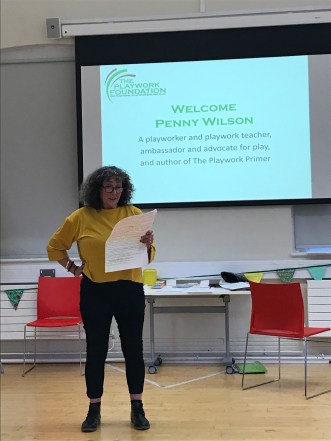
When Penny Wilson was asked to speak at the recent Playwork Foundation launch event, she took her brief seriously; consulting with colleagues and deeply reflecting, both on her practice and on the chequered history of playwork representation. The result was this impassioned entreaty for an organisation that can do justice to the extraordinary work that playworkers do, and live up to the principles by which they stand.


As I was thinking about what I wanted to say today, I did two things.

I talked to fellow playworkers who had been at the recent Felix Road Adventure Playground conference in Bristol and asked what they would like to take from that extraordinary event to share with you. The conversations at Felix Road were some of the best I have ever heard about Playwork and deserve to be repeated here. It was reflective analytic practice at its best. We learned a lot from each other.

The second thing I did was to spend time on the adventure playground where I work, Glamis, just watching the playing of the children and thinking about what I was absorbing as I watched. What I saw there reminded me of the life changing moment when I first met adventure play – what Lady Allen refers to as ‘a flash of understanding’ of the essence of why we do what we do, how we should conduct ourselves … and what we need from the Playwork Foundation.

What follows is a collection of thoughts and quotations drawn from these two experiences.
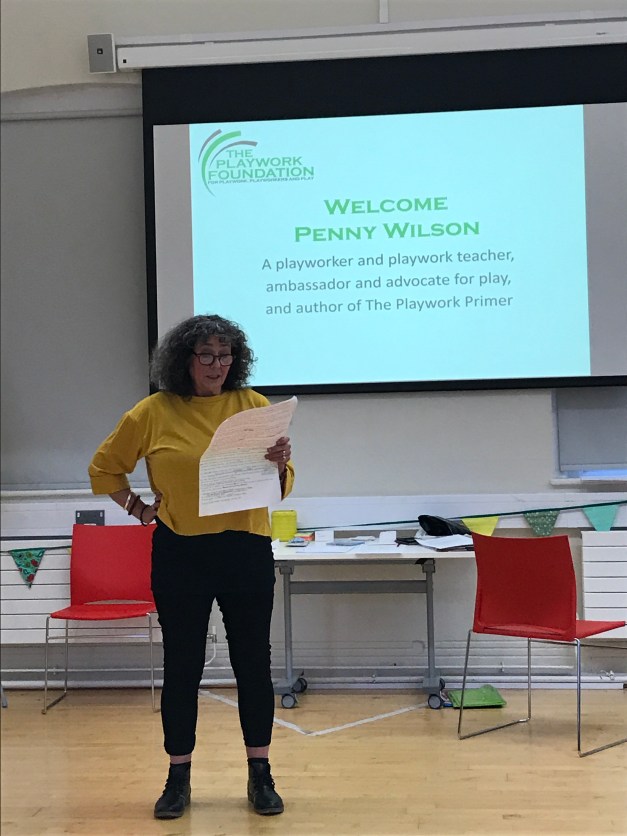

IMG_2217

We have watched many clips, shared by academics and on Facebook, showing other species at play. We have seen baby fishes playing with an air bubble and through that playing, expanding its experience to discover how this fish body can become a fish being – finding it’s fish world.

We see infant gorillas playing and through the course of that playing reaching a state of complete gorilla-ness. A human child has to play because through the process of playing we become human.

What we do as playworkers is really important.

We are the only people whose work is to pay attention to children’s freely chosen play. And it is magnificent. It is more amazing than anything the adult world has achieved by a billion miles. It is the process by which the universe of the child becomes self aware.

We are the only people with responsibility to hold in trust this unbelievable spectacle – this awesome phenomenon.

We are witnesses to something extraordinary.

A professional child-minder helped me out with this at Glamis yesterday. She said:

‘you would think that I spend all day in play with children, but I can’t. The professional demands put upon me are such that I have to photograph, to evidence everything the child does. Children now automatically stop and pose for a photo to be taken every time they do anything. We are building self-surveillance into them. They live in a panopticon of their own minds. Poor policies are directly harming children.’

What we try for is the lightest of light touches in whichever way we need to intervene in the play of the child. Like a snail recoils and retreats at the salty heat of touch from our fingertips, so can play clench up if we get our approach wrong.

We can’t adulterate, misappropriate, hijack or sell play. We will not use it to teach, to interpret, or to make children fit.

Play is the opposite of sport, which demands a competition to decide the elevation of the fittest, the elimination of the weakest and a strict unquestioning obedience to The Rules (unless of course you are the governing body).

We cannot improve upon it, but playhoods are short and we do have to advocate for it to happen, to improve the microclimate for play, wherever possible. Children cannot do this advocacy for themselves because they don’t know what they have never had and because they are considered to be less than adults, so they remain unheard. To do this we have to be rooted in the community of children. Play is social glue. It is a common heritage.

So we need to be humble, delicate and robust in the service of play – and as bold as Ripley fighting an alien in the advocacy, campaigning and defending of it. 

People have a passion for stargazing, exploring space, watching amazing documentaries about animal life on our planet, hearing about the 100 objects that changed the world. They visit galleries, cathedrals and museums to be in the presence of incredible creations or spine-tingling antiquities, yet nobody, nobody but us sees, everyday, things “more amazing than those by a billion miles.”

We create the time and space in which “children create their own universes in play”.

We are curators of play.

We have seen organisations come and go, ebb and flow. Some thrived and were beautiful and then withered. Some changed, from nurturing parents to cuckoos inhabiting a space which had once supported playworkers, then throwing them out of the nest in order to promote their own agendas.

Some have used play as a commodity to be bought and sold. Others have watered their play provision down to homeopathic levels of dilution. Some have treated playworkers like a glove-puppet, with their hands stuck up our arses, manipulating our mouths so we appear to be saying the words they are speaking.

Some have underpaid us, undermined us, undervalued us. Some have been used by parasite career opportunists for their own advancement. Some have bitched, some have fought duels, some are haters.

Some have just been bullshitters, dickwibbling, asset-stripping cockwombles.

We have become weary and wary. 

We have become Groucho Marxists, not wanting to be a member of any club that would have us as a member. We do not want to be identified under a ‘One Ring To Rule Them All’ set of qualifications which misrepresents play, lobotomises our thinking, neuters our practice, and castrates our passion for our work.

We don’t want play treated like an infantilised mediocrity, reduced to a pulp through the sieve of child development.

We do not want to be identified by a qualification that has no sense of the child as an equal being to an adult (yet capable of far greater creations).

We do not want to be identified by an organisation that deliberately creates a play dependency, when we know deep in our hearts that we are longing for a time when we are no longer necessary because children will be able to play freely without our intervention.

We want …

… an organisation that is tailor-made, as playwork is – a bespoke design, with enough strength in its warp and weft to be responsive and resilient; to be able to meet and greet the unpredicted.

… an organisation that is play-literate and which promotes play-literacy.

Playwork practice can be adapted to almost any situation. A good play organisation – a play foundation – must therefore have play at its core, be founded upon continual Reflective Analytic Practice, be flexible and nimble enough to respond to the unexpected.

It must be rooted in the Playwork Principles.

It must have integrity and honesty.

It must include us all and not lord it over us.

It must be a place where playworkers who are also artists, poets, engineers, scientists, dancers and Grouchos are all at home. ‘We are all different and that is fantastic.’ We are bigger than the sum of our parts.

It should speak our language, our brain language.

It should be a wily, quirky and tenacious advocate for play, sharing our words and images in most excellent ways. It must find fellow organisations with common ground, with similar purpose and nurture a community of like-minders. At a time of new barriers, it should forge new links.

It should be an identity that we are all proud to share.

It should be both a place to find current information, and a safe home for our history.

It should let us question and challenge – and be robust enough to withstand this and treat us the same way. It must be courteous and honourable.

We must trust it.

Its touchstone must be play.

It should support the fiercely proud and determinedly humble curators of play.

It should be our mirror.

It should reflect who we are.


Penny Wilson
Speech to the Playwork Foundation launch event on 8 November 2017.

With thanks to Eddie Nuttall, Ben Tawill, Simon Rix, Amica Dall, Arthur Battram, Sarah the child-minder, and the children of Glamis adventure playground.


JOIN THE PLAYWORK FOUNDATION HERE

cropped-playwork-foundaion-logo.jpg

Playwork foundation launches at London event

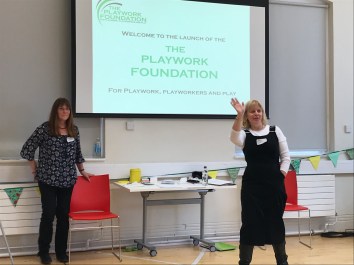
The Playwork Foundation was launched as a membership organisation at a special event in London last week.

The Playwork Foundation finally opened for business last week at a special launch event in London.

Board members Ali Wood and Karen Benjamin, experienced playwork trainers, writers and consultants, introduced the event with a review of the foundation’s development, which began at a meeting called by Bob Hughes and the late Professor Perry Else at the University of Sheffield Hallam, in 2013.

Wood and Benjamin said that an extensive consultation with the field had found overwhelming support for a new vehicle for playwork and had established some clear aims and principles.

Development

They said that, although slow because of the lack of resources, the development work had been proceeding steadily to this point. The new body has a charitable constitution, adopted by a board of trustees, and is awaiting registration. It has a website, a list of potential members and has developed a dialogue with national bodies in each of the four UK nations. The time was ripe, they said, to launch a membership scheme as the next significant milestone.

UNIQUE

Among the guest speakers at the launch event, held at Goldsmiths University of London, was Professor Fraser Brown of Leeds Becket University, who welcomed the launch and spoke about what makes playwork unique, illustrating each quality with a story in his inimitable style. Professor Brown said the playwork approach ‘actively resists dominant and subordinating narratives and practices’. Playworkers, he said, practice non-judgmental acceptance of children, holding them in ‘unconditional positive regard’, akin to the approach of person-centred counselling as developed by Carl Rogers. He said playwork offers children flexible environments, in which to afford them opportunities for the fullest possible range of play types.

entreaty

Penny Wilson, the London-based playworker and author of The Playwork Primer greeted the launch of the new body with a lyrical and impassioned entreaty from the field, reflecting the discourse at the recent adventure playground conference in Bristol.  Wilson said the field wants ‘an organisation that is tailor made – like playwork is  – a bespoke design with enough strength in its warp and weft to be responsive and resilient, to be able to meet and greet the unpredicted; an organisation that is play literate and promotes play literacy’.

INDEPENDENT

Adrian Voce, author of Policy for Play, and a member of the foundation’s board, spoke about the need for the playwork field to create its own vehicle, after previously seeing its support structures hosted or controlled by organisations with wider remits – and for whom play would only ever be a priority when it was in favour with government or brought in extra funding.

Quoting Labour Party leader Jeremy Corbyn, Voce said it was a mistake to believe that the decline in playwork opportunities was long-term. He said the period of austerity should be seen as an opportunity to re-group, stronger and wiser than before, ready to take the case for play and playwork into the next election campaign. He suggested that we need to now move quickly given the volatility of the political situation.

Meynell spoke about the longer-term history of playwork development, and previous incarnations of the national movement. He hoped the new organisation would help to revive the field after the decline of the austerity years.

Although modest in scale, many of those attending said the event – and the new body – felt like something they could identify with and belong to. Others said it was a significant moment in playwork’s history.

Time will tell.

More details of the different presentations, including a full transcript of Penny Wilson’s speech, will be made available soon.

WITH THANKS TO GOLDSMITHS UNIVERSITY OF LONDON, WHO HOSTED THE EVENT FREE OF CHARGE

JOIN THE PLAYWORK FOUNDATION HERE
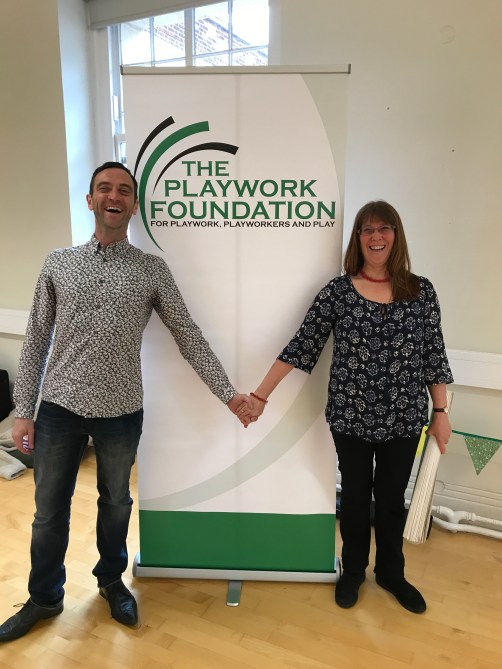
The Playwork Foundation Board is

Simon Bazley (pictured, top)
Karen Benjamin (inset, right)
Barbara McIlwrath
Tanny Stobart
Debbie Willett
Ali Wood (pictured, top and inset left)
Adrian Voce

Playwork Foundation membership launch – 8 November

Wednesday, 8 November 2017
1.00 – 4.30 pm
Goldsmiths, University of London, SE14

Free, with refreshments

Room number RHB 300
Goldsmiths College
New Cross
London, SE14 6NW

 Speakers include

Professor Fraser Brown, Penny Wilson, Adrian Voce and Meynell

The Playwork Foundation is launching a membership scheme. To mark the occasion, this event is an opportunity to hear different perspectives on the playwork field and its challenges. There will be round-table discussions about the importance of the profession, its future and what is most needed from a new membership body.

The Playwork Foundation is being created as a membership body for the playwork community, offering playwork practitioners, trainers, students, researchers and others:

  • A collective voice to raise awareness about the value of play and playwork
  • A platform to promote and debate issues that affect playwork
  • A strong, credible representative vehicle to make the argument for playwork to policy-makers, the media and the world at large
  • A network for mutual support, dissemination of research, and sharing good practice.

 Please join us! To reserve a place email kbenjamin@glos.ac.uk

The Play Cycle 20 Years On

 In 1998, Gordon Sturrock and the late Perry Else presented a paper at the IPA International Play Conference in Colorado, Canada.  The paper was titled ‘The playground as therapeutic space: playwork as healing’, later referred to as ‘The Colorado Paper’ and introduced the Play Cycle to playwork theory.

In the last twenty years, elements of the Play Cycle (such as ‘play cues’, ‘play return’, ‘play frame’ and ‘annihilation’’) have entered into common use within the playwork sector, and appear in training and education , text books  and underpins professional playwork practice.   The aim of this exploratory study is to investigate understandings and applications of the Play Cycle within the playwork field over the last 20 years.

This study is open to anybody who is currently involved in playwork but must be aged 18 years or over. The research will be undertaken by Dr Pete King from Swansea University and Shelly Newstead (UCL IOE). For more details about the study, please contact Pete at p.f.king@swansea.ac.uk or 01792 602 314.

To take part in this study please click here

The questionnaire can be completed online using a computer, tablet or phone. The study is open from Wednesday 20th September to Friday 1st December 2017.

Thanks,

Dr Pete King.


‘Youth vs. the world’

playfreenyc

Like so many, Meriden Adventure Playground, in the West Midlands, is having to fight a rearguard action to preserve even its meagre level of funding. It faces an uncertain future; something not lost on its young users.

These include a girl called Misha, who earlier this week delivered this message, via the playground staff, to the adult world.

I am your future, I am your forgotten youth.

I am the friend you played kirby with. I was your secret keeper, your companion, climber of trees, jumper of brooks, the mischief-maker, the person that defended you, the one that held your hand.

I am youth, I am you.

You cut our clubs and you make places disappear, you disregard our fun and bring us fear.

Communities ignore us, governments use us, we are just tools to be abused. The media shows lies to sell papers. The government tells lies to gain votes, while the youth are left powerless without any hope.

Who will be our hero, who will be our voice, what will we do if someone doesn’t make a noise when we try to stand up for ourselves? We only get pushed back down.  

“You cut our clubs and you make places disappear, you disregard our fun and bring us fear”

Why do you hate us? What have we done for you to treat us this way? You say you only want the best for us, but without asking us you don’t know what we want, what we need.

Instead you assume you know what’s best and when it all goes wrong, who do you blame? Us.

We never seem to please you, everything we do is wrong one way or the other. We try so hard but you only see us for the bad. What is your problem with us? Why are we being moaned at for being ourselves?

We go out not to be criticised but to have fun. Who cares what we look like, who cares about what you think you see. The inside is what matters.

I have a dream that one day we will all be seen as equals.

Misha
(aged 11)


Withdrawing qualifications is another blow to playwork

Play England has reported that CACHE (Council for Awards in Care, Health and Education) has closed its Level 2 Award and Certificate, Level 3 Award and Level 4 Award and Certificate qualifications to new registrations. The other main awarding organisation, City and Guilds are also now only open for registrations of full Diplomas at levels 2, 3, and 5, although they are still offering the Level 4 Award. All of these qualifications, for both awarding organisations, are only available for registration until November 2017.

According to Play England, these qualifications, vital to the growth of a professional playwork sector for two decades, no longer fit within the Regulated Qualifications Framework (RQF) that replaced the former Qualifications and Credit Framework (QCF) under the Coalition Government.

Under the RQF, the ‘stepping stone’ awards and certificates, which could previously lead incrementally to full diplomas via the credit system, is being phased out. Thus, when existing qualifications come up for renewal, unless they are suitable for conversion to the new framework they are being withdraw, in spite of many playworkers and their employers preferring the modular approach.

Prospects

But the prospects of playwork in England adapting to this new context are affected by a funding squeeze. With registrations for playwork qualifications declining because of a dearth of available finance, awarding organisations are finding it harder to make the business case for the development of new ones. At a roundtable meeting at the National Playwork Conference in Eastbourne last week, co-hosted by Play England and the Playwork Foundation, it was agreed to lobby CACHE and City and Guilds, to extend registration of the level 2, 3 and 5 qualifications beyond the end of the current year. The two organisations have written to the awarding bodies and are encouraging playwork trainers and employers to do the same.

Nicola Butler, chair of Play England, says: ‘Playwork is a highly skilled job. Parents, playworkers and employers all want the playwork profession to have the training that is needed for the job, but while most playwork employers would like to be able to invest more in professional development of their workforce but are prevented from doing so by the lack of public funding’.

So what are the reasons for this decline in the playwork sector after so many years of growth? One factor is the partial de-regulation of the school-age play and childcare sector. Since September 2014, there has been no statutory requirement for out-of-school clubs and holiday play-schemes to employ staff with ‘full and relevant’ childcare or playwork qualifications. (Over-8s and open-access providers have never been required to register).

Cuts

At least as significant as the change in regulatory requirements has been the effect of cuts to local authority play services, which in many places have been withdrawn altogether.  A 2014 report showed that capital and revenue spending on children’s play by England’s local authorities from 2010-13 fell by 50% and 61% respectively and it is clear that deep cuts have continued.

Many believe that playwork is now in something of an existential crisis, certainly in England. 10 years ago, the first phase of a 10-year national play strategy included funding to qualify 4,000 playworkers and a new graduate level qualification for playwork managers. Since then, the government has, according to the Children’s Rights Alliance for England, ‘undermined’ children’s right to play by abandoning the play strategy and not having a minister with responsibility for play policy for the first time since the 1980s; a situation that remains, in spite of the calls for a wide ranging national play policy by an All Party Parliamentary Group on children’s health in 2015.

What does all this mean for children? Most obviously, vital play services such as staffed adventure playgrounds (where playwork originated) are being closed. In some places these are being replaced with fixed equipment play areas, as in Watford; in others, such as Battersea Park, children can now indulge in ‘tree-top adventures’ for between £20 – £38 a session, where they used to play for free on structures that they had helped to build. Wendy Russell of the University of Gloucestershire estimates there only 150 traditional adventure playgrounds remaining in Britain, compared to around 500 at their peak; and with the erosion of playwork training and the on-gong pressures on funding, she has called those that remain an ‘endangered species’.

Extended schools

Less apparently, but perhaps even more significantly (certainly for larger numbers of children) the removal of a requirement for qualified staff means that children attending after-school and holiday play services – not voluntarily, let’s remember, but because their parents need to work – are now much more likely to be supervised either by classroom assistants or staff with no training at all; often on school premises.

When Labour introduced the concept of ‘wrap-around’ services as a key development of its ‘childcare revolution’, it was quick to distance itself from the term ‘extended schools’; but what the abandonment of playwork practice as the benchmark for quality in out-of-school provision means for many children, is that they are now effectively in school for up to 10 hours a day.


 A New Playwork Apprenticeship

The one area of potential growth for the playwork training sector is apprenticeships. The government is introducing an Apprenticeship Levy, although most small centres are not eligible for this funding unless subcontracted by larger providers. On this point, the Playwork Foundation is concerned that a high proportion of the few larger centres offering playwork apprenticeships employ trainers and assessors who are ‘not occupationally competent’.

A group of playwork employers has submitted an expression of interest to develop a new Playwork Trailblazer apprenticeship, which aims to: enable employers to access playwork apprenticeships; clarify what they should cover; develop the skills needed for quality playwork provision; and reinforce that they need to be delivered by trainers and assessors fully competent in playwork.

Adrian Voce

An edited version of this article was published in Children and Young People Now on 14 March 2017

This article is about playwork qualifications in England. For an overview of the situation in Northern Ireland, Scotland and Wales read this

An overview of playwork qualifications in the UK

dscf1578

Changes to the regulatory framework and a steep decline in services have led to a fragmented landscape for playwork training and qualifications in the UK. This briefing, produced in consultation with the four UK national play bodies, attempts to clarify the picture in each of the home nations.

If you would prefer to download this briefing as a pdf document please click here

England

 Since September 2014, there has no longer been a statutory requirement for out of school clubs and holiday playschemes registered on the Ofsted Early Years Register to employ staff with ‘full and relevant’ childcare or playwork qualifications. Providers who only take children over-8 years, or which are open access, have never been required to register (although they may do so voluntarily if they wish).

Together with the effect in England of cuts to local authority play services across, which in many places have been withdrawn altogether, this has meant that, despite the needs and wishes of the playwork sector – playworkers, playwork employers and commissioners – for trained and qualified staff, there is now very little funding for playwork qualifications.

Additionally, the funding available for playwork training providers has been for playwork apprenticeships, with the majority of smaller centres not eligible for it unless subcontracted by larger providers. Thus, a big proportion of the few larger centres or colleges that do offer playwork apprenticeships have often recruited trainers and assessors either not occupationally competent in playwork or with no experience of working to the Playwork Principles, or both. This has been difficult to challenge, as awarding bodies have not always supported external quality assurers who question centre staff’s competence.

img_3780

The government is currently introducing more funding for apprenticeships through its Apprenticeship Levy, and awarding organisations are currently considering development of future playwork apprenticeships. Groups of playwork employers are currently making the case for the development of playwork apprenticeships to:

  1. Enable playwork employers to access apprenticeships;
  2. Develop the skills needed for quality playwork provision;
  3. Clarify what the playwork apprenticeships should cover; and
  4. Reinforce that they need to be delivered by trainers and assessors that are occupationally competent in playwork.

Northern Ireland

 Here, out of school clubs and holiday playschemes for children under 12 are required to register with their local Health and Social Care (HSC) Trusts, who are responsible for registering and inspecting all services with responsibility for children in sessional or full day care against the requirements laid down in the Children (Northern Ireland) Order 1995. The Minimum Standards for Child-minding and Day Care for Children Under Age 12 were developed to clarify the requirements contained in the legislation. The implementation guide for these standards can be read here.

All registered settings are required to have a Play Policy. The Play Policy should be underpinned by the Playwork Principles and recognise children’s capacity for development through play.

All leaders must have a current Safeguarding and Child Protection Certificate. If this is not the case, this must be achieved as part of the induction process and within one month of appointment. If the Leader is the Designated Child Protection Officer, evidence of certificated training must be in place prior to commencing duties.

The following qualifications have been agreed by DoH as those that meet the requirements for the Person in Charge/Leader and Deputy Leader role Out of School Clubs role:

  • BA Hons Degree in Early Childhood Studies, or Degree level qualification in Early Years or Playwork;
  • QCF level 5 Diploma in Children’s Care Learning and Development (Management) Wales/NI QCF;
  • QCF Level 5 Diploma in Playwork QCF;

or

  • a relevant occupational qualification in early years’ education, social work, nursing, youth work, teaching or health visiting;

and

  • 2 years’ experience working in a play, education, youth or day care setting. Volunteer experience can be included providing it is with the same age group relevant to the setting.

All staff and volunteers working directly with children must complete a minimal three-hour, face-to-face, formal certificated Safeguarding/Child Protection course every three years. (It is currently a requirement of the Safeguarding Board of Northern Ireland that training must be face to face). All staff and volunteers must have a valid Safeguarding/Child Protection certificate at all times.

All group-based services must have at least one person identified as a Designated Officer for Safeguarding. In full day care this should be a member of staff. In sessional care this should be a named individual. Designated officers must have a current certificate for Designated Officer Training valid for three years. All managers must have a current Safeguarding and Child Protection Certificate. If this is not the case, this must be achieved as part of the induction process and within one month of appointment. If the Manager is the Designated Child Protection Officer, evidence of certificated training must be in place prior to commencing duties.

Leaders or supervisors should have at least a qualification at QCF Level 3 Diploma in Child Care, Learning and Development or Playwork. Where staff members in any setting have previously attained Level 2, 3 or 5 NVQ qualifications in Playwork or Early Years Care and Education, this will be an acceptable alternative to QCF Diplomas.

Where staff members in any settings have previously attained Level 2, 3 or 5 NVQ qualifications in Playwork or Early Years Care and Education, this will be an acceptable alternative to the QCF Diplomas. 50% of all staff must hold at least a level 2 qualification. Staff members are, however, encouraged to progress their knowledge and skills through continuous professional development, which may be attained by both short courses and accredited qualifications. The Transitional Award in Playwork is also available for those already qualified with a level 3 CCLD.

Most qualifications are self-funded, although means-tested grants are available at Level 3 and Level 5 to those who do not hold a qualification at the same, or higher level. One college offers full-time Level 2 and Level 3 courses, so these are free as long as students attend 3 mornings a week and either have, or will complete, either GCSE Maths and English, or an Essential Skills Level 2 in Numeracy and Literacy. Some funding is available at all levels through bursaries or local community funds. Some training organisations offer Playwork at Level 2 under the ‘Training for Success’ programme.

Wales

The Care and Social Services Inspectorate for Wales (CSSIW) has National Minimum Standards for Regulated Childcare in Wales, covering settings providing for children up to age 12. The leader in charge must have at least a level 3 qualification recognised by the Care Council for Wales’ through its current list of Accepted Qualifications for the Early Years and Childcare Workforce in Wales or Skillsactive’s Integrated Qualification Framework for Playwork. At least 50% of the rest of the staff must have at least a recognised Level 2 qualification.

In 2015, a Level 3 Award in Managing a Holiday Play Scheme (MAHPS) was developed by Play Wales. This provides a qualification that has been added to the SkillsActive List of Required Qualifications to work within the Playwork Sector in Wales, specifically for persons in charge of a holiday play scheme.

Where the person in charge of a holiday playscheme does not hold a Level 3 Playwork qualification, but does hold another relevant qualification at level 3 (e.g. youth work, teaching, childcare), gaining the MAHPS award meets the requirements for registration. In the first instance this was envisaged as an interim qualification. However, discussions are continuing with a view to removing the current time constraint.

This award was developed because a significant proportion of holiday play providers were experiencing difficulties in meeting the qualification requirements set out in the NMS for the Person in Charge holding a level 3 Playwork qualification. These difficulties in accessing qualified staff have contributed to a reduction in registered holiday play provision and concerns remain about further loss of provision

Several years ago, Play Wales also developed – at levels 2 and 3 – Awards, Certificates and Diplomas in Playwork Principles into Practice (P³), including substantial materials for learners. It has however been a challenge in recent years to deliver these, due to funding arrangements that favour the apprenticeship route. In the meantime the Level 3 Diploma (NVQ) in Playwork available in England and Northern Ireland has been available; more recently as an apprenticeship, although this has not been widely accessed, as the number of playwork jobs has diminished.

A number of providers across Wales also had difficulties in meeting the standard of qualifying half their staff at Level 2 or above, and so many of these had reduced their opening hours to under two hours to avoid registration. A new level 2 qualification called the Award in Playwork Practice (L2APP) has just been developed and considered suitable to meet registration requirements on its’ own for non-supervisory staff working on holiday playschemes.

This will also serve the purpose of a transitional qualification for those with a level 2 childcare qualification (CCLD), to help providers move forward. This award is offered through Agored Cymru, a Welsh awarding body, and can additionally be used as good practice continuing professional development, for those in other sectors who wish to further their understanding and perhaps occasional practice of playwork. Agored Cymru is not confined to Welsh learners only – there is the potential for training providers in England to consider its delivery.

In addition, Wales is currently developing a new CCLDP (Children’s Care, Learning and Development and Play) which will include some content on play and an understanding of the playwork approach – this is to be ready by September 2019. It will not act as a qualification for those in playwork roles but will ensure that new childcare learners get a basic grounding in playwork principles.

Scotland 

In Scotland, out of school care services are registered with, and regulated by, the Care Inspectorate against the same national care standards as other daycare of children services, such as nurseries.

Out of school care staff are registered with, and regulated by, the Scottish Social Services Council; in accordance with legislation, managers of out of school care services must either be qualified to, or working towards a degree level qualification in Childhood Practice. This is the same requirement as that for managers of other daycare of children services.

The registration categories are linked to job function, which is, in turn, linked to qualifications. Scotland has its own credit and qualifications framework (SQCF), which is considerably different in terminology, levels and grading. Currently a support worker would register with the SVQ Level 2 Playwork or National Progression Award. A Playwork Practitioner would register with an SVQ Level 3 Playwork or an HNC with Playwork options.

A Lead Practitioner/Manager in Playwork would register with an SVQ Level 4 Playwork, in the first instance leading to a SCQF Level 9 qualification such as the PDA Childhood Practice at SCQF Level 9 or a BA in Childhood Practice. (Please view the SSSC web site to view further qualifications linked to registration requirements). The Scottish Modern Apprenticeship Framework Active Leisure and Wellbeing at level 2 and level 3 also has a pathway for Playwork.

Ali Wood

Reference

Children’s Rights Alliance for England (CRAE), 2015, UK implementation of the Convention On The Rights Of The Child: Civil society alternative report to the Committee on the Rights of the Child, England, London: CRAE

UK National Play Organisations

For further information about playwork training and qualifications in any of the UK home nations, please contact the relevant national body:

Play England                                          www.playengland.org.uk
Playboard Northern Ireland              www.playboard.org
Play Scotland                                          www.playscotland.org
Play Wales                                               www.playwales.org.uk

Join the discussion

Play England will be hosting a discussion at the National Playwork Conference in Eastbourne on 7th-8th March for all those interested and/or concerned about the future of playwork qualifications. If you are a playwork employer and can lend your support, please contact Nicola@playengland.net

Adventure playgrounds are too important to consign to history

Eran at Glamis

A variety of recent projects in the arts, heritage and academic sectors have taken adventure playgrounds as their theme, bringing welcome attention to this important part of the UK play scene. However, cautions Adrian Voce, it would be a mistake, and a missed opportunity, if the surge of interest were to be predominantly nostalgic or historical.

Over the last year or so, adventure playgrounds in the UK seem to have become the subject of wider than usual attention far beyond the usual play and playwork sectors. In truth, this swell of interest is around an accumulation of separate projects and initiatives, which have each either come to fruition, or have been launched, with attendant publicity, around the same time.

Perhaps the most high profile of these, certainly in terms of popular culture, is no less than a brand new stage musical. The Lockleaze adventure playground in Bristol, known locally simply as ‘The Vench’, is both the subject and the setting for an original new comedy-musical, described by the Bristol Post as ‘a wildly funny and vivid new production about a miscreant group of Bristolian misfit teenagers who come together to build an adventure playground’. Junkyard will open on 24 February at Bristol’s Old Vic theatre.

Sharing memories

The Vench was also one of a number of adventure playgrounds in the West of England cities of Bristol and Gloucester, recently mined by researchers for the memories that they have inspired and bequeathed to their local communities. Sharing Memories of Adventure Playgrounds (SMAP) was a research project of the University of Gloucestershire (featured recently on these pages here) that beautifully conveyed, through an exhibition, a film and a short report, the unique role that places like the Vench can play in the lives of successive generations of communities, and the value they hold for neighbourhoods where there may not otherwise be much that children can call their own.

Elsewhere in England, researchers and curators at the Queen Mary, University of London and the V&A’s Museum of Childhood respectively are also collaborating on an exciting new initiative on the social history of London’s adventure playgrounds. Adventures in the City: the politics and practice of children’s adventure play in urban Britain, 1955–97 is a funded PhD project that began last year and will culminate in a new, interactive, permanent exhibition (an adventure playground, one presumes – as much as such a thing is possible within this context) at the museum’s popular Bethnal Green site in East London.

One hears of other doctorates that have identified adventure playgrounds and their history as a subject ripe for researching (e.g. Shelly Newstead’s paper at Child in the City 2014). There are other artistic ventures too. Mark Neville’s recently opened exhibition of photographs on the theme of ‘Child’s Play’ chooses adventure playgrounds as the setting for what it describes as ‘play in free space’. Neville juxtaposes his commanding images of children very much taking their space in some of London’s adventure playgrounds with those of children in less sympathetic contexts: the ‘structured space’ of school, and the ‘oppressed space’ of war and poverty.

‘Fulfilling childhood’

2015 saw the release of a short documentary film by Erin Davis ‘about the nature of play, risk and hazard’ set in The Land, an adventure playground in North Wales. ‘The Land’, as the documentary is also called, was described by Hanna Rosin in The Atlantic as a film that ‘will change everything you think you believe … In scene after natural scene the truth becomes obvious: With a little bit of creativity, empathy and guidance, children can be freed to experience a much more fun, adventurous and fulfilling childhood.’

This kind of exposure and recognition for a form of provision that perennially struggles on meagre budgets and – with some rare exceptions – little support from their local authorities, can only be welcome. It is important too, that both academia and the heritage sector are taking adventure playgrounds seriously as the subject of both research and cultural archive.

img_3779Nevertheless, play advocates may also feel a little uneasy that so much of this attention is from an historical perspective. It is more than implied in this approach that adventure playgrounds today, if not quite anachronistic, are certainly an ‘endangered species’, as Dr. Wendy Russell acknowledged at the launch of the SMAP project last month. She estimates that there are no more than 150 remaining in the UK – and that not all of these are necessarily adventure playgrounds in the original sense of the term – compared to more than 500 in their 70s heyday.

Sense of community

Exploring the reason for this decline needs an article (or a PhD!) all to itself, but as Mark Neville’s exhibition and its accompanying book assert, Erin Davis’ film so eloquently conveys and the children past and present of Bristol and Gloucester’s adventure playgrounds say for themselves, the unique experience of playful community that is given to children in a proper adventure playground, is too vital to be merely the subject of a museum piece.

These supported spaces to play – with materials large and small, with the elements, and with the full spectrum of human curiosity, invention, and interaction – protected from the future focused, outcomes-obsessed world of adult-laid plans and rules for them, enrich the lives of the children who attend them. That this is in ways that are difficult to measure within the reductionist outcomes frameworks now routinely applied to public services should not, but inevitably often does, make it difficult to make the case that modern Britain needs more, not fewer adventure playgrounds.

We must hope that, far from ushering them towards the door marked ‘cultural artefact’, researching the history of adventure playgrounds, exhibiting them in museums and celebrating them through the arts will alert a new generation of advocates, policymakers and funders to their unique value to children and communities now.

Adrian Voce

Photos: Eran at Glamis Adventure Playground in 2016, and Glamis’ rules, by Adrian Voce

*this article’s final two paragraphs were edited for clarity on 23 February.