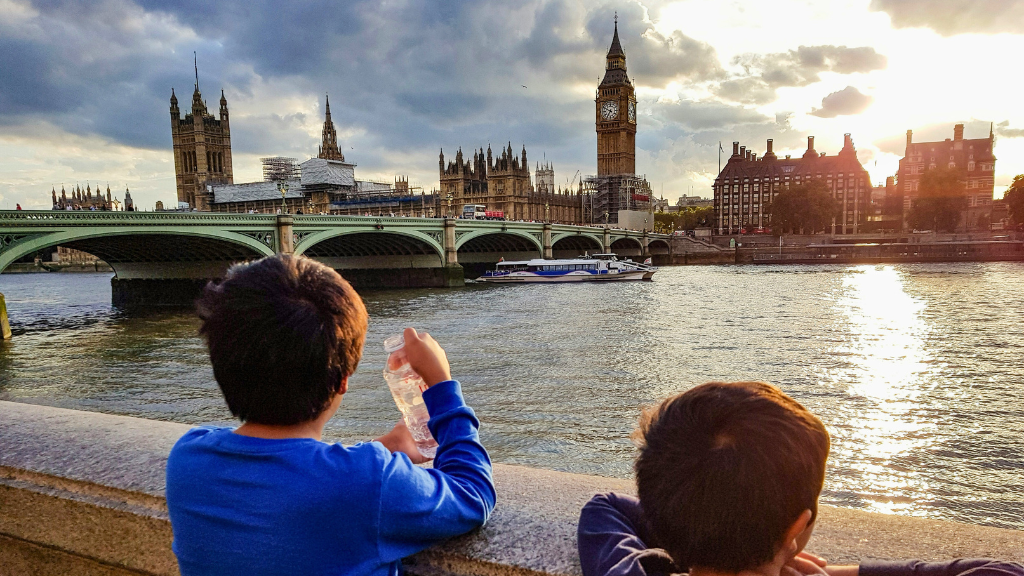
On Tuesday 13th May 2025, Play England will unveil its new 10-year strategy, It All Starts with Play!, at the House of Commons. The launch will coincide with the announcement of a new All-Party Parliamentary Group (APPG) on Play during a special event in the Terrace Pavilion, overlooking the River Thames.
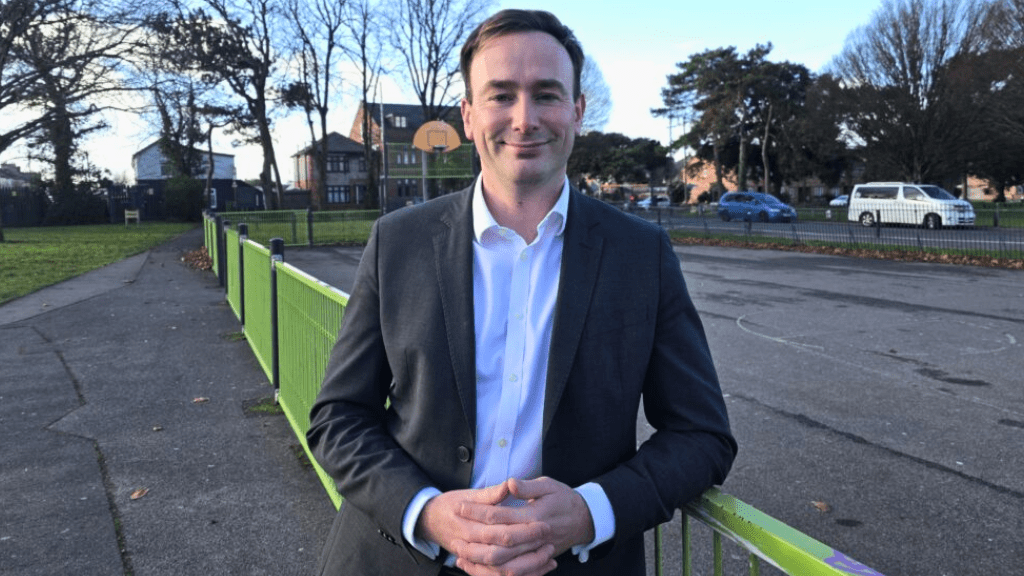
Hosted by Labour MP for Bournemouth East, Tom Hayes, the event will bring together politicians, sector leaders, and advocates of children’s right to play. Alongside formal remarks, the event also teases the opportunity to “play and connect with key voices shaping the future of play in policy, planning, and public life”.
Tom Hayes MP may be fresh in your memories from January this year when he successfully tabled Westminster’s longest debate on play in 17 years – and, notably, the first debate on play in 8 years!
His motion focused on the provision of playgrounds by local authorities in England, during which he outlined two pivotal proposals:
1. That the Play Strategy for England be “dusted off… to better spend the money already in the system”.
These proposals were key tenets of the 2024 Play England Manifesto, making it unsurprising that Hayes was joined by Eugene Minogue, CEO of Play England, at the Palace of Westminster.
So, could the launch of It All Starts with Play! be the pivotal moment for play that playworkers in England have been waiting for?
It certainly prompts reflection on the challenges both Play England and the wider playwork sector in England have faced since the 2010 UK General Election.
The National Play Strategy, introduced by Ed Balls and Andy Burnham in 2008, represented a landmark commitment to children’s play in England, backed by £235 million to create thousands of play spaces and adventure playgrounds. However, the strategy was abandoned by the Cameron-Clegg Coalition just two years later, signalling the beginning of a sharp decline of play provision and policy across England.
With no national commitment to play, local authorities and other play providers have grappled with fragmented funding and ever-dwindling resources.
This absence of a cohesive strategy and government funding has also left the sector drawing on piecemeal funding and more corporate and private sponsorship, sometimes leading to a distortion of the role of play and playwork to comply the agendas of such funding streams.
That is why when graphics of the event sponsors accompanied the invitation to the Westminster event, some playwork advocates raised concerns about what such financial backing signalled for the future of play in England. So much so, that on sharing the news over the weekend, one commentator challenged me to “follow the money”.
PLEASE NOTE: In the original article (posted 30/04/25), it incorrectly asserted that the following organisations were sponsors of Play England. It has since been clarified that these are the sponsors of the event at Westminster, not Play England as an organisation. Our apologies for this misrepresentation.
Before I do so, it is important to note that it has been made clear by Play England that these sponsors have had no role in shaping the new 10-year strategy, which has been developed independently through the year-long process of consultation and engagement throughout 2024.
Sutcliffe Play – employee-owned playground equipment manufacture and design.
Play Innovation – provider of outdoor play, sports equipment and Multi Use Games Areas (MUGA)
Notts Sport – owners of ChildsPlay who specialise in the design and supply of artificial turf carpets for fixed equipment playgrounds
PlayNation – a publication by NationMedia in partnership with Play England, promoting play and physical activity for children & young people, and a publishing partner for the strategy itself
SAPCA– trade association for the sports and play construction industry
After closer inspection, I think it was a fair challenge to pose! But, is it tantamount to an orchestrated conspiracy or simply pragmatic promotion?
On the one hand, these organisations do not seem nefarious in their own field. They can bring expertise, resources, and innovation to the table when considering – like Tom Hayes’ debate did – the future of fixed equipment playgrounds in England. Their financial support also enables Play England to launch their new strategy on a scale befitting of such a prestigious venue. By doing so, the strategy is given an elevated platform and brings key players together more effectively and with intention.
On the other hand, it’s reasonable to question whether such alignments risk prioritising expensive, prescriptive, equipment-focused solutions to spatial injustice in children’s play more broadly – at the expense of rich play, dynamic environments curated by playworkers when it comes to policy-making.
In that model, jet-washable synthetic surfacing marginalises the mud and mums community-driven initiatives that form our heritage of adventure playgrounds and playschemes. At the same time, childhood itself risks being seen through a purely utilitarian lens, where play is not valued for its own sake but as a tool to ensure “active children become active adults”, as Mark Hardy, API Chair, framed it in the video above.
Or can both things be true? That ethically-sourced and inclusive fixed equipment playgrounds are championed, whilst the profits from such pioneering are used to fund play advocacy to secure the sector after more than two decades of neglect. That lucrative, purchasable forms of play “pay their way” by offsetting their dilution of the play spaces valued by playworkers, enabling organisations like Play England to shape policy in ways that align with principled play advocacy.
The challenge lies in balancing the benefits of sponsorship with the need to safeguard the ethos of play for play’s sake – distinct from physical activity or sport. By advocating for robust legislation and community-led initiatives, Play England has the opportunity to reclaim the narrative. Defending and strengthening the playwork perspective of play will be crucial amid what some fear is the growing influence of play equipment and sports industries.
That being said, the progress secured by Eugene and the Play England Trustees is a testament to immense passion and sustained perseverance – no doubt, like many in the sector, often unpaid and under intense scrutiny. As this next chapter unfolds, The Playwork Foundation will remain a critical friend and honest broker, advocating for the playwork principles and children’s right to play to remain central in future policy and practice.
I, for one, remain eager to see what the strategy holds. And, if certain reassurances are anything to go by, we (to borrow the Royal ‘we’) might just be pleasantly surprised!
Those wishing to attend the event on Tuesday 13th May should RSVP by Monday 6th May 2025 using the link in the email. Applicants are advised that spaces are limited and subject to confirmation.
This article was written by Siôn Edwards, the current Chair of The Playwork Foundation. They reflect his personal views and not necessarily those of The Playwork Foundation as a whole.
Playwork is a practice – an art – in space and time. The role of the community and culture surrounding both the child and the playworker needs to be at the forefront of our discussions regarding the future of our practice now more than ever before, argues Eddie Nuttall.
Click below to hear this article in Eddie’s own words…
“Who is trying to transform, and for what motive? When there is a good fit between who you are and your actual environment then development just seems to happen”
In the walking discipline of a seasoned ‘deep topographer’, or Flaneur as the French would have it, the layers of the city become revealed through a process of immersion with the environment one is passing through. It takes some experience to feel one’s way into the substrate of a place, but the rewards of doing so can be rich: a time before one’s own time can be found alive in that moment, and the echoes of other lives and happenings whisper all around. At times this experience can be almost akin to a mystical encounter that sharply contrasts the mundane; what the everyday world tells us in solid terms about the environment turns out to be a very partial truth at best – the deep layers of our human stories are alive in this very moment in the places where we live and work.
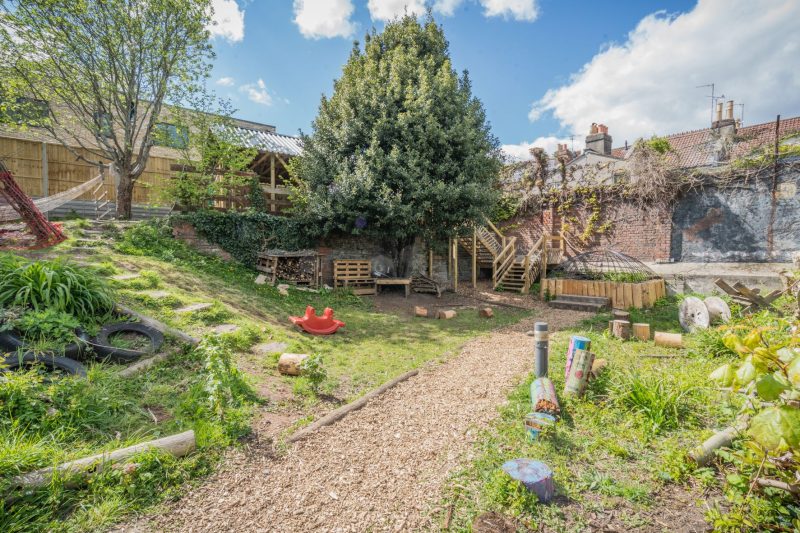
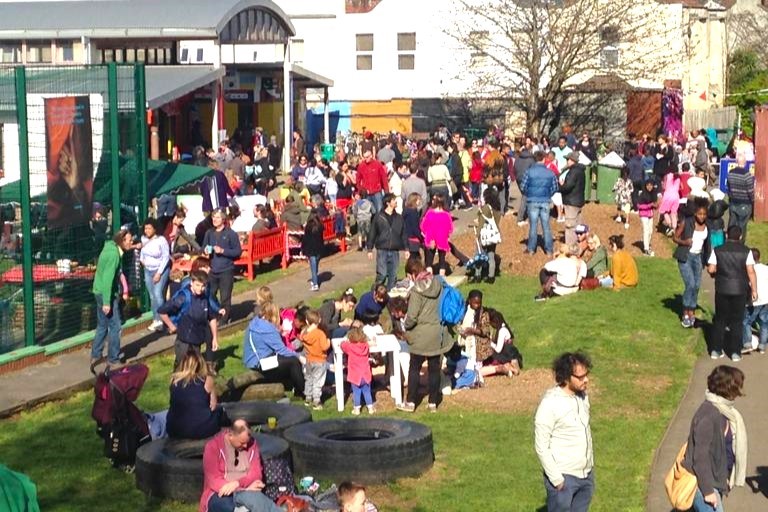
Few of the places I have been a playworker have the kind of layers that Felix Road adventure playground has built up in its half century as a ludic habitat. Firstly, there is the actual physical substrate to the place, which has played an accidental role in its longevity as a community play space. In very simple practical terms, you can’t build houses on it, as there is a very real risk that those houses could disappear down one of the 100-foot mineshafts that lie beneath the topsoil. This has kept the developers away and has allowed time and history to deepen the playground as a project, and coupled with the careful cultural tending it has received over the years, a unique environment has been established; an environment that taught me extraordinary things about both playwork and how people grow and develop in a supportive and rich setting.
Felix Road’s genesis can be traced to the Winter of 1972, when a young ‘playleader’ by the name of Jenny Evans – fresh from a NPFA3 play leadership course – was offered the opportunity to develop an abandoned plot that had belonged to the coal board and Cowlins into a site for play for the large numbers of local children wandering the streets. A diminutive 20 year old, Jenny describes being distinctly nervous about running the playground at the time, and there were a number of encounters in that first year that would test her resolve, including disturbing a group that had a knife one evening in a dimly lit corner of the site. Through time, Jenny gained the trust and respect of the community, forming a particularly close bond with the younger children in Easton, many of whom were first generation windrush kids or Sikhs that had also come to Britain to help with the on-going postwar reconstruction. As the workers held the space and tended to the environment, a distinct ludic culture began to emerge. Bev Douglas, the daughter of a first-generation Jamaican family that had settled in Easton, describes her personal experience of ‘Ventures at the age of eight:
For me, having an adventure playground nearby meant that I could play freely in my own way, in my own time, with no rules or hierarchy that I had to adhere to. Everyone who played there contributed to the build and shaped the environment according to their own vision. Apart from the playworkers, adults remained absent in our play space, so for me it was special. I was very much a loner outdoors. I loved how the secure environment of the adventure playground made me feel, enjoying my own company as it gave me a feeling of independence and a total sense of freedom. I could also run, jump, crawl and skip around the apparatus, together with other kids, and be as feral as the next one. It was up to me who I gave permission to join me in my little world.
Douglas, B (2021) Cutie. Silverwood
Over the years, the surrounding community would develop a deep affection for this discombobulated and forgotten enclave of post industrial Britain, and would come to play a significant part in the overlaying of a new narrative for the space. Unexpected friendships and alliances would unfold at Felix Road, in a distinctly Bristolian fashion, as the working class white and black residents came into contact with the more bohemian end of Bristol’s cultural scene. Somehow this coupling worked to form an effective relationship; rich in cultural heritage and at once deeply creative and recalcitrant. It is hard to describe the flavour of the environment it gave birth to, but a phrase that might aptly describe Felix Road on a busy day (and ‘busy day’ simply requires an absence of rain) is a carnival of colour and creativity.
From a professional perspective one didn’t have to worry about play much at Ventures. As my old teacher Stuart Lester used to say, ‘if the circumstances are right, playwork is a doddle.’ What he meant by this is that if children have a rich, open-ended, permissive environment to interact with, then a hugely diverse repertoire of play behaviours will bear forth, as surely as a rainbow will shimmer in the air of a sunlit downpour. This was palpably the case during my first school holiday experience as coordinator at the playground; I could barely conceal the grin on my face as I tended to and observed what I could honestly describe as the best play setting I’d ever witnessed in my twenty-some years of playworking. ‘it’s in the bloody brickwork’, I amazed to myself.
Most environments that I had worked in up to my employment at Felix Road were not purposed for play in the first instance, and in many cases they were outright hostile to the free association of children. In my formative playwork years in Manchester I had watched children trying to build dens in a school next to gossamer-thin chain link fencing separating them from an industrial estate; I can recall months spent in church halls and annexed classrooms; I remembered the height restrictions and whitewashed breezeblock interior of my old addy, devoid of artwork or any evidence of children generally – even adventure playgrounds were not exempt from recourse to to the functionalism of the urban environment that lay beyond it’s walls. This was not how it was at Felix Road however. there was an innate understanding that a different configuration of time, space and interaction was necessary there, and this understanding ran deep. It was such a powerful credo that almost everyone that came through the gates could appreciate the logic of the space and the permissions it afforded. The space worked magic upon anyone who entered it.
In such a wonderfully attuned ludic habitat, I had an unprecedented amount of freedom to consider those that were ‘holding the space’ for playing – the playworkers. As well as the obvious requirement for a senior to convene planning and debriefing sessions, I would stand for long periods of time on the structures and watch the adults interacting with the children. Through the seasons I built up a kind of panchromatic picture of their interactions; as much an emotional tapestry as it was a logical or intellectual one. This picture very much informed how I approached my relationship with them both individually and collectively, and served to strengthen that relationship in ways that are perhaps less common in other more hierarchical models of management.
My employment as the coordinator from 2014 to 2022 was as the latest in a long line of ‘seniors’, and anything I could find out about these people deeply interested me. One of the most important instructors I had in this regard was Garfield Martin, who had been the coordinator for many years but had elected to stay on as a playworker when I came in. Garf embodied the historic community for me; he had the kind of open hearted ethic that a thousand training courses could never instil in a person and through his natural disposition to the role he ensured that we all held to the same principles. If we had to bring a group of kids into the office because racist language had been used for example, there was in fact little we need to say to them – they knew that wasn’t the Felix way, and that in the slings and arrows of the kind of hierarchical play that children can and must engage in they knew they had crossed a line.
Garfield applied this simple approach to other incidents that might have provoked more authoritarian responses in less experienced playworkers. I recall a time during my first year when I was making dinner for the kids in the kitchen, alongside a Roma lad called Dan and a white working class girl called Lacey, who were concurrently running the tuck shop. We were packing away at the end when suddenly Dan exclaimed “she took it, she took it!” Lacey moved quickly towards the door looking distressed, and left. It transpires that she had impulsively pocketed a fiver from the float, and Dan had caught her in the act.
In the debrief at the end, we pondered how to tackle this incident. Garfield was untroubled. “she will bring it back in a couple of days; she knows she did something wrong and from what you are describing it was a reflex thing rather than something she planned.” There was a pause, and Garf smiled. “If you can’t fail at an adventure playground, where can you fail?”
I loved this simple wisdom; it reminded me of the famous Zen story, summarised thus:
“Master, how does one gain enlightenment?” “Through good judgement.” “And how does one gain good judgement?” “Experience.” “And where can experience be found? “In bad judgement.”
Two days later Lacey came back with the money. She attended the playground for another five years and went on to become a volunteer for us, completing two weeks work experience at ‘Ventures in 2018. She was a regular visitor until I left last year.
Three brief case studies in a rich community playground and professional development4
Aliya Douglas
Aliya came to work at Felix during my very first holiday. As I remember it she was in her first year of sixth form at the time; I recall a shy and very polite young person who was very popular, particularly with the Roma girls. Her elder brother Joel was also on the team; a quiet, gentle presence who was pursuing separate interests in music, spoken word art and filmmaking5. Aliya was an occasional presence in the Felix Archive of photos, often in close proximity to Carol, a playworker of Caribbean heritage who sadly passed away in 2013 (Aliya had dual Pakistani and Jamaican heritage). Aliya remained a regular on the Felix team for the next eight years. I was privileged to watch her gradually change in this time; to become an articulate woman with a deeply held conviction in social justice.
In Spring of last year, Aliya participated in a project led by The University Of East Anglia that was exploring ‘postcolonial narratives in contemporary Britain’. She had expressed an interest in doing a presentation to the students and I was happy for her to run with it. I got a couple of messages late the night before saying she had finally finished, followed by some exhaustion emojis, but I had little insight into the content of what she was going to present other than it being ‘something about playwork.’
Aliya really took me back with what she brought to that session. She initially gave a whistle-stop of everything I had presented in previous training days at Felix, from enriched environments to The Principles to The Play Cycle. But it was the second part of her presentation that really hit home.
With heartfelt passion and no little emotion, she spoke of how Felix Road had been the only environment outside of home where who she was made total sense and was in turn completely accepted. She explained how her relationship with the playground had helped her to develop the confidence to navigate the challenges she encountered during her schooling, and afterwards, how it had been a key factor in her becoming the woman who she was today. I recall her looking at me at the end and I was fighting back the tears. I felt both proud and honoured to be a witness to what I was hearing and to also have been a witness to part of the journey that Aliya was describing.
A cynical mind might have passed this off as rhetorical hyperbole. Only I knew that Aliya’s experience was genuine and it was by no means an exceptional narrative either.
Archive, Jr James. “University of East Anglia, Norwich: Link Between Access Balconies of Residential (Right) and Academic (Left) Buildings.” Flickr.
Julia Grobe
Julia came to stay in Easton in the Winter of 2017. An Erasmus exchange student doing teacher training, Julia had seen our website and liked the look of the place. Julia had no significant adventure play background, though she had visited some of Germany’s playgrounds and had felt drawn to the philosophy.
A committed vegan with connections to the East German punk scene, Julia had a quiet and considered demeanour that combined intriguingly with a subtly animated physical presence. In her teens Julia had been a ballroom dancer, and at 5’ 11” she filled a room, but her gentle nature and quiet emotional intelligence was a perfect counterweight to her physical stature.
Julia stayed with us over Christmas of that year, and spent her days digitally archiving the piles of photographs boxed up on the playground’s mezzanine, then sitting and painting with the kids after school or pottering around outside. She was popular and her gentle, intelligent nature saw her quickly accepted by all the regulars. She internalised the culture of the playground rapidly and in the few short months she was there blossomed into one of the best playworkers I have worked with. I was of the opinion that in another couple of months Julia would have been able to run Felix Road and represent the community admirably.
Playworking in an urban environment isn’t just about sensitivity. You have to have fire and authority at times, and be quick on your feet when things flare up both literally and figuratively, whether that is amongst the children or between a group of parents. Julia really surprised me on this front one afternoon in late January.
During this period we were struggling with a group of 16-18 year olds who had been asked to leave the playground indefinitely for persistent poor conduct and bullying. That afternoon a couple of them were on the site and causing problems – kicking kids off the pool table, getting up in people’s faces and so forth. The group in question had been persistently disrespectful to girls and female playworkers on site. Julia stepped in and was helping to get them off site when one of the older boys, who was known to be especially volatile, grabbed a gardening fork and turned on Julia.
“Do you want me to use this, bitch?” He spat. His stocky, muscular frame added weight to his threat, and I worried what the outcome might be.
Julia held her ground and stood to her full height, towering a full six inches over him.
“Go on then,” she responded, meeting him with a firm gaze. She was nonplussed by his aggression and fearless in her response. The boy put the fork down, and skulked out of the gate.
Marya Kadir
I remember the day Marya came into Felix Road quite vividly. A bundle of energy and enthusiasm, Marya had come to ask about volunteering and it was clear within five minutes that she was going to bring some incredible attributes to the playground; everything about her demeanour said ‘playworker’ to me. She went about talking with the kids straight away and had that kind of ‘sing-song’ cadence in her voice that a lot of playworkers use to such wonderful effect; she made strong and warm eye contact with everyone; she moved playfully.
It was of no surprise to me to find out when we spoke later that she had spent a lot of her childhood on Felix Road after her family settled in Easton after coming to the UK from Kurdistan, and knew Garfield and others from her childhood. She was another clear example of someone that had internalised the culture of the playground to a point that she basically became a playworker in the first moment of returning there.
Marya attended training with us and with BAND6 before the holidays began, and joined us on the team over the summer as a paid worker. In the Autumn she was seconded one day a week to supporting a child with autistic traits who she developed a really trusting relationship with. In the year I left she returned to her career as a physiotherapist but she really enriched Felix Road in the time she was there.
Love merely as the best There is, and one would make the best of that By saying how it grows and in what climates… To say at the end, however we find it, good, Bad or indifferent, it helps us, and the air Is sweetest there. The air is very sweet.
James Merrill Quoted in Gillian, C (2002) The Birth Of Pleasure. Vintage.
As precious as these spaces are, adventure playgrounds are sadly by no means sacrosanct in the urban landscape. As well as the hundreds that have foreclosed over the last seventy years, the importance of the adventure playground community in holding the space is not always well understood by those operating in the organisational context outside of the participating community, and that this sometimes partial understanding of the environment can be exacerbated by spacial factors as cities shift and community infrastructure is regenerated, reimagined and repackaged to encourage those with greater financial resources into an area. I have witnessed more than once the ownership of an adventure playground drifting away from the community of children and parents and towards the more removed and less situated designs of the organisation (or organisations) that maintains the space, and away from notions of freely chosen play towards assumed ideas of neoliberal citizenship or socialisation. All of this represents a paradigm shift from a response-based ethic as adult custodians of the established ludic culture (in essence, in service of the children and their playing) to a more institutionally focussed narrative that will default to shaping the space around the prevailing memes of the funding climate; where play happens alongside the main organisational imperatives; where children are ‘active citizens’ or ‘green ambassadors’ or ‘learners’ or ‘young consultants.’ The stories that are held by the community and the space itself are slowly eclipsed (if not co-opted) by the earnest narratives of progress and utility that are so ingrained in our society yet are in fact in contradistinction to the foundational narratives of playwork and the simple right all children should have to environments for play and free expression.
When we muse about the future of adventure playground communities in all of this, it can be useful to our resolve to think of the village in the broadest sense that we possibly can, in the light of the sad truth that a great many of these historic spaces have come to pass, or shifted in purpose, orientation and function. We have to counter what the English mathematician Alfred North Whitehead called ‘the fallacy of simple location’7. At its most fundamental level, the adventure playground and its community exists as a shared emotional notion between individuals that have the intention to hold a space for children to play within. Over time the community grows around this idea, like the accretion of planets around a host star, and the foundational precepts of the space become established by the good intentions of that community – to create and maintain a space for children to express themselves freely. That such spaces have been able to hold their ground in the cities of the United Kingdom and mainland Europe for over seventy years is an astonishing testament to the persistence of the human spirit in the face of the expansion of capital and the huge changes to urban environments that have occurred in that time.
The places that we play have a huge influence on the kind of humans that we become. For those of us that are playworkers this is a particularly pertinent truism. It is vital that we do not lose sight of the need to hold spaces for children in the difficult years that exist ahead of us, and in the many ways we as a society are called to do so: to rewild, to lobby and campaign, to demand, to occupy, to provoke. Those that undertake these tasks are playworking, even if they do not self-identify with the hitherto vocational title of ‘playworker’. We must take the village forth into our communities and cities and become the change that we want to see for our children.
Quoted in an interview at the Integral Experience Conference, Asilomar, California, 2009. See Cook-Greuter S (2004) Making the Case for a Developmental Perspective. Industrial & Commercial Training Volume 36 – Number 7 – 2004:275-281 Emerald group Publishing ISSN 0019- 7858 ↩︎
NPFA was the national Playing Fields Association (now Fields In Trust), a charity set up to promote accessible spaces for play, sport and recreation, and an early sector skills provider for play leaders – the older term for a playworker between the late 1940’s and early 1970’s ↩︎
These case studies and further examples will be explored in a forthcoming co-authored book on adventure playgrounds, children’s agency and urbanism. ↩︎
Aliya and Joel are Niece and nephew to Bev Douglas, the aforementioned author of Cutie.↩︎
Bristol Area Neighborhood Daycare provide training for plaworkers local to the city. ↩︎
Quoted in Santos, F., Sia, S. (2007). The Fallacy of Simple Location and the Ontologies of Substance and Event. In: Personal Identity, the Self, and Ethics. Palgrave Macmillan, London. ↩︎
Penny Wilson offers a personal view of the struggles of playwork in a world that undervalues play, and of how the Playwork Foundation represents an opportunity for developing our common cause, building mutual support and working together for the growing recognition we deserve.
Sometimes, being a playworker feels isolated. We struggle – with local authorities, housing associations, funders, government, the media and the public – to communicate what we are doing and why. The play illiterate look down on us; often either patronising or simply dismissing us and our work.
We have a strong body of knowledge, dating back some 70 years showing the urgent need for free play to be accessible to children, showing how best to support that play and design and provide for it. We have developed play theory, and there is a mountain of research showing how play –unstructured, child-led play – is of overwhelming benefit to children.
We have a language to explain the mechanics of the craft of playwork. Yet still we find resistance in almost every sphere of influence to our work. We can prove and prove and prove the efficacy of playwork in the lives of children over and over and over again. We state and restate our case and our perspectives. We write and rewrite the simple things we need to be understood.
The world seems to be play-blind.
Yet, we are continually thwarted in our work. People cannot see or hear play. They show endless resentment towards play and those who advocate for it. We all have hundreds of examples of the insults and semi-truths that have been conjured up to discredit and infantilise play and playworkers. It is frustrating and belittling. The world seems to be play-blind. We feel as powerless as the child trying to play. The odds are against us. We have no voice.
In our teams, we can band together, talk and use humour to counteract the frustrations. We can think laterally, advocating for play in creative, imaginative and positive ways. We can start social media discussion groups to broaden our thinking and engender mutual support. We can do this locally and internationally.
We can sometimes afford to go to conferences and, whenever
that is possible, it is great for us. But our wages are low and our projects
mostly insufficiently funded; we cannot often find the funds to attend, and they
cannot always cover our absence when we do.
Some of us decide that higher education in play is the route to becoming more respected and better informed; to be heard. This is also great, but it is only a partial solution. We are asked for our base-level qualifications to gain employment, but even that level of qualification, enfeebled as it often is, is now almost impossible to gain.
the craft and knowledge and voice of the playworkers, advocating for the right of (every) child to play, is undermined
The play equipment industry has a loud voice. It has products to sell, an easy solution to a tick box requirement of landlords and landholders to provide some play space. Buy it and … Snap! The problem is solved. Quick and simple. The relationship between society and children’s play is resolved with one easy gift; give the kid a sweetie to stop it crying. Once again, the craft and knowledge and voice of the playworkers, advocating for the right of (every) child to play, is undermined by a passive-aggressive sop to short term gratification.
Even the organisations established to promote play are
frequently unsupportive and undermining of playworkers, choosing to promote
their own structural interests by
renaming our work so that they can appear to have invented something new
themselves or look to volunteers to replace us. Our unions are happy to accept
our dues, but there is seldom a reasonable return for those dues. We are
unrepresented. No one hears us. No one speaks up for us We are beset with
difficulties. We always have been. We feel sorry for ourselves and undervalued.
A place to take pride in ourselves …
It is unsurprising therefore that we turn on each
other, choosing to try to scramble to the top of the heap and squash our peers
down to raise ourselves up. We are frequently vicious in our infighting. We prefer
to squabble with each other than to seek common ground in the acceptance and
respect of our differences.
We need a shared identity. We need to feel proud of ourselves and of each other. We need to be able to stand tall and advocate for play with pride. Playworkers need to have a metaphorical bonfire to sit around, a place to understand what we share and why we are so prepared to remain so dedicated to our work in the face of such overwhelming adversity. A place to find ourselves reflected in the faces or our peers. A place to take pride in ourselves.
The Playwork Foundation is an attempt to provide
recognition, support and a voice for those of us who practise the craft of playwork.
It can be the mirror we need to show us who we are so that we can look with pride on our image.
With no staff and negligible funding, the Foundation is nevertheless struggling on all our behalf with some of the thorny problems associated with the current turmoil around accredited training; and working with others to advocate for the policy changes the sector needs. But it can be a great deal more. It can share writing from those of us who like to write. It can hold images and papers and anything else we decide we need: memes on social media; information; ideas; resources.
The Foundation can be whatever we need it to be. Let’s make it our shared campfire. To do this it needs us to support it, to chip in, to use our voice and our enterprise. It is true that there is a cost element, which is a challenge to those of us living hand-to-mouth on playworker wages, but here is an opportunity, a chance to strengthen our voice and to find common ground; to turn away from the frustrations and infighting that shames and holds back our profession; to stand tall and move on.
For her Sociology Masters, Lucy Benson used ideas about children’s being and becoming as a foundation for generating research with children. In this abstract, she suggests that though these ideas are not new, they are worth revisiting as a useful foundation for the playwork approach, and for all those with an interest in childhood, and in how children are constructed and presented.
There
are some physiological differences between children and adults which cannot and
should not be disregarded. Prout and James describe this phenomenon: ‘The immaturity of children is a biological
fact but the way in which that immaturity is understood and made meaningful is
a fact of culture’ (Prout, 2005). Until fairly
recently, understandings of children were almost entirely focused on what
children’s existence meant to their future adulthood; children were seen as
dependent and incomplete humans who were to be invested in because they
represented the future, rather than because their lives had meaning in the
present. They were considered as human becomings rather than human beings. This
is still the dominant standard used to understand UK childhood(s).
In
the 1990s childhood sociologists made a strong case for children as complete
beings, actors with a capacity to influence their own lives and the lives of
others. This understanding of children as complete beings has helped to
stengthen the children’s rights movement.
Nevertheless, this concept was shaken up by Nick Lee in his book Childhood and Society, where he questioned the validity of dichotomies such as biology versus sociology, and being versus becoming. Instead, he argued that in an ever-changing world, whose pace of change propels forward with gathering speed, there is nothing stable; humans do not become something and then remain in that same state throughout their lives. Human beings are in a perpetual state of change and, in this light, we can accept the constant becoming and re-becoming of both children and adults. This becoming does not negate the being of either child or adult, we are all beings in a state of becoming. Furthermore, the manner that we come into being does not need to be defined as either biological or cultural, as these parts of human selves are so utterly intertwined that it would be impossible to separate them.
If this rejection of dichotomies is accepted, then we can focus on the human as doing. It is our acts that are important, both to the being and becoming of our selves, and in the creation of conditions which we believe will improve our shared world.
Life is a prolific and open-ended narrative which is always more than the sum of it’s political and social constructs. It is with this spirit that I approach my work with children, considering us all as beings in a state of emergent becoming through our interactions. This, I believe, is a useful consideration for the foundations of playwork.
Children are not our future, they live alongside us in the present. We all make the future together.
Gallacher, L –
A., & Gallagher, M. (2008). Methodological Immaturity in Childhood
Research? Thinking through ‘particapatory methods’. Childhood 15(4),
499 -516.
Good, P. (2017,
January 20). Routines. The Cunningham Ammendment, p. 4.
James, A. (2011).
Agency. In J. Qvortrup, W. A. Corsaro, M.-S. Honig, (Eds.), The Palgrave
Hanbook of Childhood Studies (pp. 34-45). Basingstoke, Hampshire:
Palgrave Macmillan.
Lee, N. (2001). Childhood
and Society. Maidenhead, Berkshire: Open University Press.
Nieuwenhuys, O.
(2013). Theorizing childhood(s): Why we need postcolonial perspectives. Childhood,
Vol.20(1), 3-8.
Prout, A. (2005).
The Future of Childhood. Oxen: Routledge.
Ward, C. (1977). The
Child in the City. London: The Architectural Press Ltd.
Wells, K. (2009). Childhood in a Global Perspective. Cambridge: Polity.
Lucy Benson is head of adventure play at Islington Play Association in London, where she works with and for children in six adventure playgrounds. She recently co-authored a paper with Dr Rachel Rosen which was published in Children and Society, From Silence to Solidarity: Locating the Absent ‘Child Voice’ in the Struggle Against Benefit Sanctions. Lucy holds an MA in Sociology of Childhood and Children’s Rights from University College London. This article is derived from her dissertation, City Limits: Children’s Perspectives of an Unequal Borough in a Neo-liberal City.
NO. 1 IN AN ORIGINAL SERIES OF PAMPHLETS BY GORDON STURROCK
In this first of an original series of pamphlets, the UK playwork scholar Gordon Sturrock argues that avoiding the political implications of playwork practice will lead to its continuing, inevitable demise. Nor should we water our politics down to accommodate more dominant discourses. Instead, he argues, the field must vigorously embrace its true ethos, and so offer a vital alternative to the neo-liberal colonisation of education – and the wider public realm – to the rapacious capitalist project.
Gordon Sturrock is a playwork theorist and writer. He is co-author, with the late Perry Else, of The Play Cycle: An Introduction to Psycholudics (The Colorado Paper), and The Therapeutic Playwork Reader.








 The Playwork Foundation