As part of Scotland’s Play Park Renewal Programme, the Scottish Government and Play Scotland have launched the first nationwide consultation on local play parks.
The survey asks families and carers across Scotland to share their experiences of local play parks by considering questions like:
How often do you visit?
How long do you stay?
What works well in your local park?
And, what improvements and new features would you like to see?
The survey aims to evaluate current play park facilities to inform future Scottish Government policy and ensure funding to renew play parks reflects the needs of local families and their communities.
Though only open to people accessing play parks in Scotland, if you’re south of the border, you can help reach colleagues, family and friends in the Land of the Brave by sharing the survey.
A ready-made comms pack is also available that includes posters and template newsletter pieces and social media posts to help spread the word.
A petition launched by play-based learning consultant Ruth Lue-Quee is urging the Westminster Government to make play and enabling environments statutory for children aged 5 to 7 in England’s Key Stage 1. With over 31,000 signatures already secured – triggering an official government response – it now aims for 100,000 signatures to force a parliamentary debate.
Early Years Foundation Stage (EYFS), for children aged 0 to 5, ensures providers deliver learning and development requirements that embed play and have regard to “enabling environments”, where resources support child-initiated and adult-supported activities.
“Play is essential for children’s development, building their confidence as they learn to explore, relate to others, set their own goals, and solve problems. Children learn by leading their own play, and by taking part in play and learning that is guided by adults”
Department for Education
However, at Key Stage 1 (KS1), Years 1 and 2 (ages 5 to 7), there is no statutory requirement to maintain these play-orientated, child-led approaches. This petition seeks to bridge that gap by embedding EYFS principles into the statutory KS1 curriculum.
By extending the EYFS entitlement into Key Stage 1, schools in England would have to ensure areas for play-based learning and open-ended resources are always available to children aged 5 to 7 in school. It would also bring alignment with Northern Ireland, Scotland, and Wales, where play and enabling environments remain central to primary curricula:
🟨 Northern Ireland
Learning Through Play at Key Stage 1 from the Council for the Curriculum, Examinations and Assessment (CCEA) outlines how play supports all areas of learning in Years 1 and 2.
Statutory guidance Building the Ambition from the Scottish Government provides a national definition for “play and learning” as referred to in the Children and Young People (Scotland) Act 2014.
🟥 Wales
The Curriculum for Wales, introduced in 2022, embeds play across its 3 to 16-years-of-age framework. Developmental pathways such as exploration, communication and well-being provide a child-led foundation that continues throughout early education.
The Early Childhood Play, Learning and Care (ECPLC) Plan from the Welsh Government sets out principles, workforce standards and quality indicators to support play-rich environments across early childhood settings.
Encourage colleagues and parents and carers to add their voices
Contact local schools, nurseries and other childcare providers
You can also contact your local parliamentarians and politicians:
Contact your Member of Westminster Parliament (MP), and Member of the Legislative Assembly (MLA), Member of the Scottish Parliament (MSP) or Member of the Senedd (MS) as applicable
Contact your local Principal Council Councillors
Contact your local Town and Parish Councils (England) or Community Councils (Wales) and their Councillors
Enter your postcode below:
function clearDefault(el) {
if (el.defaultValue==el.value) el.value = “”;
}
function fillDefault(el) {
if (el.value==””) el.value = “Your Postcode”;
}
The Children’s Commissioner for England has unveiled an ambitious plan for the final two years of her tenure, coinciding with the office’s 20th anniversary.
Victoria Climbié’s death in 2000 exposed severe shortcomings in child protection in England, leading to the Laming Inquiry and significant changes to legislation, including the Children Act 2004. However, the tragic case of Sara Sharif, murdered by her father and stepmother in 2023, demonstrates that serious challenges remain in ensuring children’s safety.
As The Victoria Climbié Foundation points out, Sara was not a hidden child – she was known to authorities. Yet, despite this, she still fell through the cracks, echoing past failures in child protection. Her case is a tragic reminder that there remains an urgent need for improved multi-agency working, better information sharing, and stronger accountability within child protection systems.
With the memory of these tragedies casting long shadows, the Commissioner has vowed to intensify efforts to protect children in England. Her mission is to ensure children’s voices are heard and their needs prioritised in policy-making.
Despite two decades of progress, children are still side-lined in key national debates. The Commissioner highlights a lack of consideration for young voices in pivotal discussions, including responses to crises like the pandemic, the rise in small boat crossings, and the 2024 summer riots. Even in the current debate around assisted dying, children’s perspectives have been largely absent, the Commissioner claims.
“The past tells us what happens when we fail to protect children. The future must be different”
Rachel de Souza, Children’s Commissioner for England
A new Westminster Government is presented as an opportunity to reshape attitudes towards childhood. Over the next two years, the Commissioner intends to amplify young voices in decision-making, ensuring policy shifts show their lived experiences and aspirations.
One of the most significant initiatives is Mapping Childhood, a data project using four years of research to identify the best places to grow up in England. The findings will inform targeted interventions, reinforcing the principle that a child’s postcode should never dictate their future.
Additionally, the Commissioner will advocate for systemic reform, stressing that fragmented support services must be replaced with a unified approach across education, health, social care, and justice. The introduction of a consistent identifier is seen as a key tool to prevent children from falling through gaps – something the Commissioner also advocated for in her submission to the Children’s Wellbeing and Schools Bill Committee in February this year.
The Commissioner’s 2024 School Survey, which gathered responses from nearly 90% of schools in England, laid bare the immense pressures schools face in meeting children’s welfare needs.
The Commissioner’s Big Ambition survey revealed that only one in five children feel listened to by politicians. In response, the Commissioner vows to use children’s voices to guide policy through a strengthened Youth Ambassador network, a new Young Voices Forum, and the Festival of Childhood.
A commitment to child-friendly versions of all reports is hoped to improve accessibility with the Commissioner going further by calling on all Westminster departments and public bodies in England to follow suit.
“In 2025, when we say never again, we must mean it” pledged the Commissioner, as she enters this final stage of her tenure serving for England’s children.
Download the full report and the children’s version below:
On Tuesday 13th May 2025, Play England will unveil its new 10-year strategy, It All Starts with Play!, at the House of Commons. The launch will coincide with the announcement of a new All-Party Parliamentary Group (APPG) on Play during a special event in the Terrace Pavilion, overlooking the River Thames.
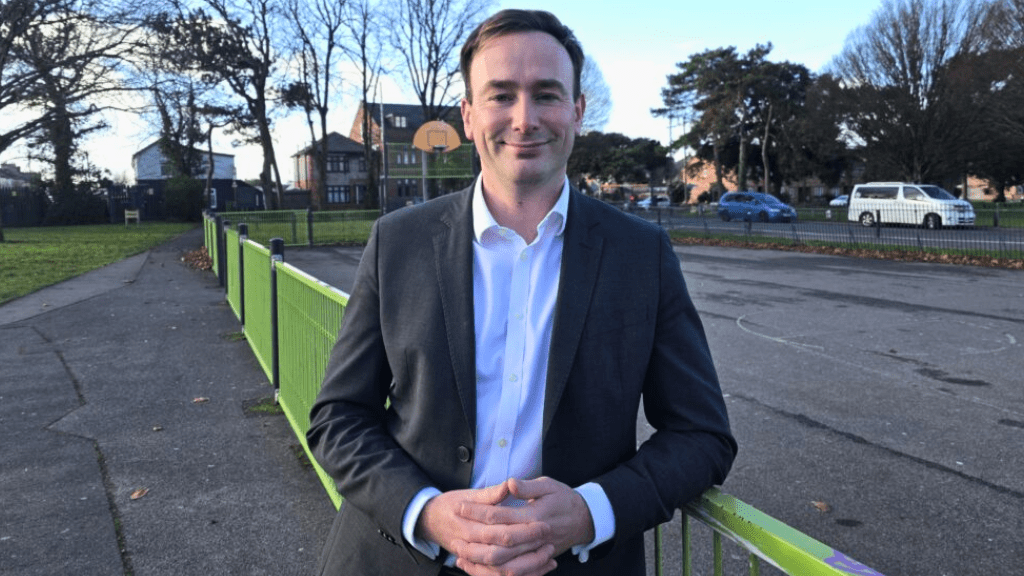
Hosted by Labour MP for Bournemouth East, Tom Hayes, the event will bring together politicians, sector leaders, and advocates of children’s right to play. Alongside formal remarks, the event also teases the opportunity to “play and connect with key voices shaping the future of play in policy, planning, and public life”.
Tom Hayes MP may be fresh in your memories from January this year when he successfully tabled Westminster’s longest debate on play in 17 years – and, notably, the first debate on play in 8 years!
His motion focused on the provision of playgrounds by local authorities in England, during which he outlined two pivotal proposals:
1. That the Play Strategy for England be “dusted off… to better spend the money already in the system”.
These proposals were key tenets of the 2024 Play England Manifesto, making it unsurprising that Hayes was joined by Eugene Minogue, CEO of Play England, at the Palace of Westminster.
So, could the launch of It All Starts with Play! be the pivotal moment for play that playworkers in England have been waiting for?
It certainly prompts reflection on the challenges both Play England and the wider playwork sector in England have faced since the 2010 UK General Election.
The National Play Strategy, introduced by Ed Balls and Andy Burnham in 2008, represented a landmark commitment to children’s play in England, backed by £235 million to create thousands of play spaces and adventure playgrounds. However, the strategy was abandoned by the Cameron-Clegg Coalition just two years later, signalling the beginning of a sharp decline of play provision and policy across England.
With no national commitment to play, local authorities and other play providers have grappled with fragmented funding and ever-dwindling resources.
This absence of a cohesive strategy and government funding has also left the sector drawing on piecemeal funding and more corporate and private sponsorship, sometimes leading to a distortion of the role of play and playwork to comply the agendas of such funding streams.
That is why when graphics of the event sponsors accompanied the invitation to the Westminster event, some playwork advocates raised concerns about what such financial backing signalled for the future of play in England. So much so, that on sharing the news over the weekend, one commentator challenged me to “follow the money”.
PLEASE NOTE: In the original article (posted 30/04/25), it incorrectly asserted that the following organisations were sponsors of Play England. It has since been clarified that these are the sponsors of the event at Westminster, not Play England as an organisation. Our apologies for this misrepresentation.
Before I do so, it is important to note that it has been made clear by Play England that these sponsors have had no role in shaping the new 10-year strategy, which has been developed independently through the year-long process of consultation and engagement throughout 2024.
Sutcliffe Play – employee-owned playground equipment manufacture and design.
Play Innovation – provider of outdoor play, sports equipment and Multi Use Games Areas (MUGA)
Notts Sport – owners of ChildsPlay who specialise in the design and supply of artificial turf carpets for fixed equipment playgrounds
PlayNation – a publication by NationMedia in partnership with Play England, promoting play and physical activity for children & young people, and a publishing partner for the strategy itself
SAPCA– trade association for the sports and play construction industry
After closer inspection, I think it was a fair challenge to pose! But, is it tantamount to an orchestrated conspiracy or simply pragmatic promotion?
On the one hand, these organisations do not seem nefarious in their own field. They can bring expertise, resources, and innovation to the table when considering – like Tom Hayes’ debate did – the future of fixed equipment playgrounds in England. Their financial support also enables Play England to launch their new strategy on a scale befitting of such a prestigious venue. By doing so, the strategy is given an elevated platform and brings key players together more effectively and with intention.
On the other hand, it’s reasonable to question whether such alignments risk prioritising expensive, prescriptive, equipment-focused solutions to spatial injustice in children’s play more broadly – at the expense of rich play, dynamic environments curated by playworkers when it comes to policy-making.
In that model, jet-washable synthetic surfacing marginalises the mud and mums community-driven initiatives that form our heritage of adventure playgrounds and playschemes. At the same time, childhood itself risks being seen through a purely utilitarian lens, where play is not valued for its own sake but as a tool to ensure “active children become active adults”, as Mark Hardy, API Chair, framed it in the video above.
Or can both things be true? That ethically-sourced and inclusive fixed equipment playgrounds are championed, whilst the profits from such pioneering are used to fund play advocacy to secure the sector after more than two decades of neglect. That lucrative, purchasable forms of play “pay their way” by offsetting their dilution of the play spaces valued by playworkers, enabling organisations like Play England to shape policy in ways that align with principled play advocacy.
The challenge lies in balancing the benefits of sponsorship with the need to safeguard the ethos of play for play’s sake – distinct from physical activity or sport. By advocating for robust legislation and community-led initiatives, Play England has the opportunity to reclaim the narrative. Defending and strengthening the playwork perspective of play will be crucial amid what some fear is the growing influence of play equipment and sports industries.
That being said, the progress secured by Eugene and the Play England Trustees is a testament to immense passion and sustained perseverance – no doubt, like many in the sector, often unpaid and under intense scrutiny. As this next chapter unfolds, The Playwork Foundation will remain a critical friend and honest broker, advocating for the playwork principles and children’s right to play to remain central in future policy and practice.
I, for one, remain eager to see what the strategy holds. And, if certain reassurances are anything to go by, we (to borrow the Royal ‘we’) might just be pleasantly surprised!
Those wishing to attend the event on Tuesday 13th May should RSVP by Monday 6th May 2025 using the link in the email. Applicants are advised that spaces are limited and subject to confirmation.
This article was written by Siôn Edwards, the current Chair of The Playwork Foundation. They reflect his personal views and not necessarily those of The Playwork Foundation as a whole.
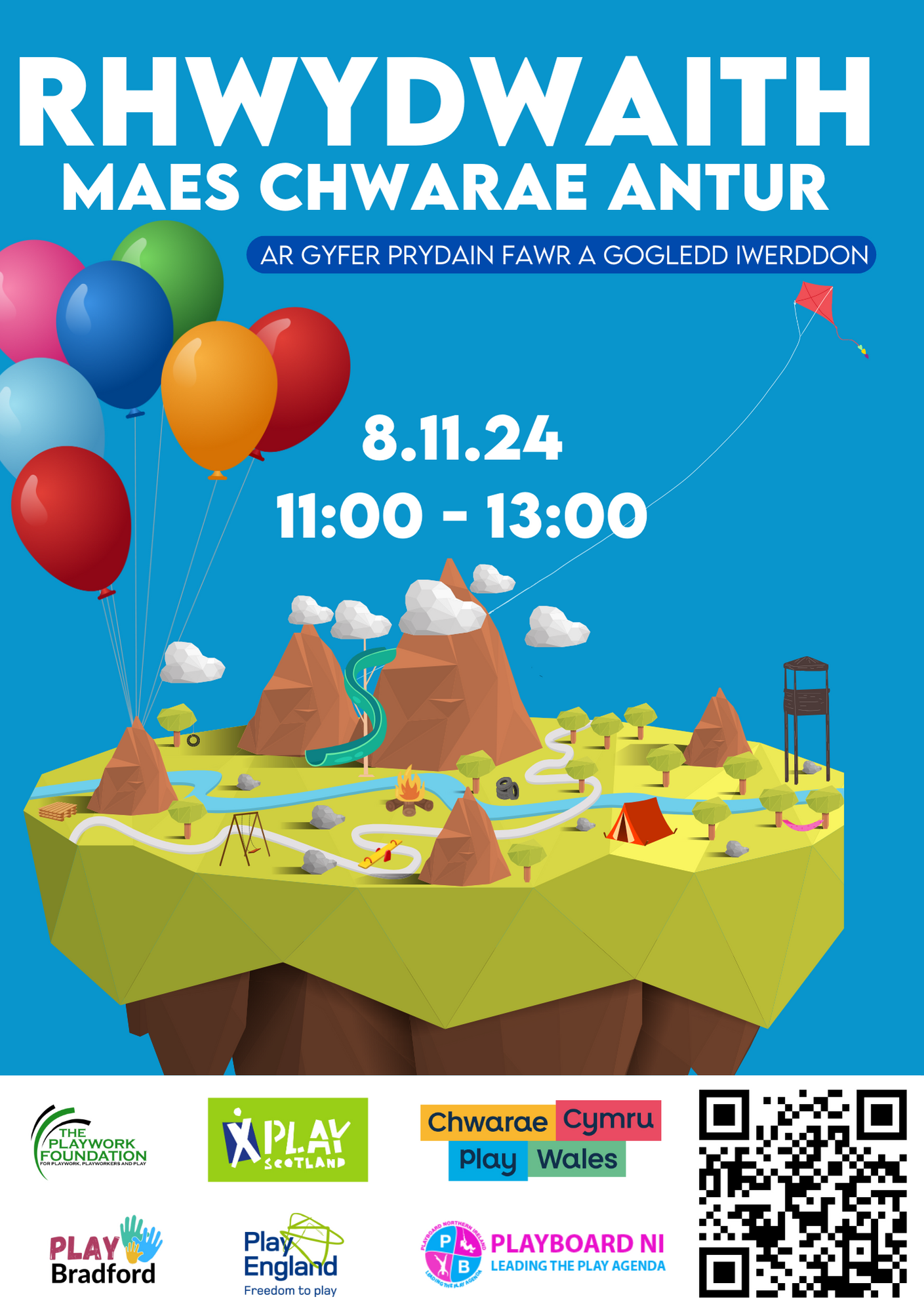
After an (unintentionally) extended period of quiet, the Adventure Playground Network is pleased to announce Friday 8th November, 11am – 1pm, as the next meeting date. To ensure you receive the most up-to-date information, including the link to the meeting, please ensure you sign up.
The Network has also been liaising with the Raising The Nation Play Commission to ensure that adventure playgrounds have an opportunity to contribute to the call for evidence. Please see the open letter to Adventure Playgrounds below:
The aim of the meeting was to amplify the voice of England’s adventure playgrounds in the Centre for Young Lives’ and Raising the Nation Play Commission’s ‘ENQUIRY INTO WHY PLAY IS SO CRITICAL TO CHILDREN’S WELLBEING AND HOW A NATIONAL PLAY STRATEGY CAN BE ESTABLISHED.’
The aim of the meeting was threefold:
Ensure that the crucial role of adventure playgrounds is not overlooked in the course of the Enquiry
Maximise the time available for contributions from adventure playgrounds to be made to the Enquiry
Offer the assistance of the adventure playground sector’s collective wealth of knowledge and experience to the development of a national play strategy for England.
The Centre for Young Lives has received evidence from all sectors including Health, Sport, Education, Early Years etc. Some adventure playgrounds have already submitted evidence, but the closing date is October 31st.
HOWEVER, the Adventure Playground Network has negotiated a rolling deadline, which means that the Centre will continue to welcome contributions from adventure playgrounds – via the Network – on an ongoing basis.
If you have any evidence of the wonderful work that you do, which you’d like to inform the enquiry, please consider sending it to Mike at m.wragg@leedsbeckett.ac.uk and we will ensure that your adventure playground is represented in this national enquiry into why play is so critical to children’s wellbeing and how a national play strategy can be established.
Evidence may consist of anything at all from data concerning numbers and backgrounds of beneficiaries, through to case-studies, presentations, testimonies, reflective diaries and films or video.
The Centre for Young Lives is also keen to visit adventure playgrounds across the country, so if you would be willing to show someone round your site, please let us know and we’ll pass on your details.
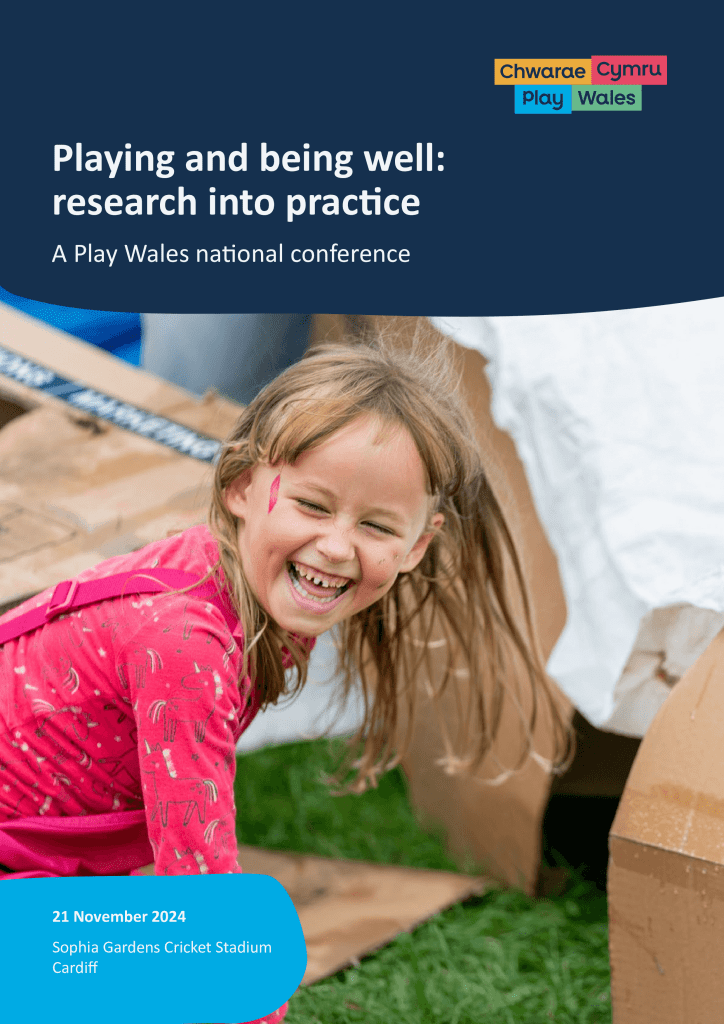
The second national conference since the COVID pandemic, this year’s conference will celebrate the launch of Play Wales’ most recent publication: Playing and being well.
Described as “a groundbreaking and exciting publication”, the literary review explores play sufficiency and the real-life impacts on the wellbeing of children.
Did you know Wales was the first country to legislate to support children’s play? Find out more here.
In addition to hearing from the authors themselves and having the opportunity to debate its findings, the conference will also provide attendees with the chance to contribute to case study workshops relating to the study’s themes, the Ministerial Review for Play and play sufficiency.
The horrific incident at The Hart Space in Southport, England, this week has shocked us all.
Our thoughts are with the children, families, friends, neighbours and other community members who are experiencing something so unbelievable as the event that took place this week. It is not fair or right or just.
Our thoughts are also with the emergency services who responded to the scene and the staff of the community centre who bore witness to this heinous attack. In particular, our thoughts are with those who were working directly with the children that afternoon. For playworkers, as for all who work with children, a worst possible scenario such as this is a deeply buried fear, because we are not only in a caring role for the children, but we care for them.
This attack lies so far beyond the parameters of our expectations that it would rarely appear in our risk assessments or protocols. And where it does feature, the thought of events such as this actually coming to pass is a horror we hope never to face.
We do not know why this event happened. The answer to that question lies elsewhere and will hopefully become clear so that calm and considered responses may come promptly.
What we do know is that, as a sector, we must continue to advocate for the right of the child to play.
To the people of Southport, we are thinking of you and will support you in any way we can.
To all of us supporting children in the summer holidays and throughout their lives, let us talk and find our own unique sector response.
Please let us know if there is anything we can do.
Interested in what each party has to say about children? Paul Wright at the Children’s Alliance has dissected the four main parties manifestos and picked out those pledges and policies relating to children.
You are invited to attend the Annual Open Meeting of The Playwork Foundation:
Wednesday 19th July
11am – 1pm, via Zoom
Our Open Meeting will be an opportunity for members and non-members alike to find out what The Playwork Foundation has been working on over the last year and also to hear from each of the national playboards of Great Britain and Northern Ireland on the latest insights and progress from all corners of the UK.
To receive the link, please sign up to The Playwork Foundation mailing list.
It’s an exciting time for both the playwork sector in the UK and The Playwork Foundation, and we want you to be part of the conversation and the journey.
We know, through attending conferences like Eastbourne and IPA, that talking to playworkers and other practitioners working with children and young people in other settings can be greatly beneficial to our ongoing professional development.
Sarah Wilson, who has been a playworker for 14 years, is aiming to bring those valuable opportunities to connect with each other out of the conferences and into the real world. Her aim is to link up frontline playworkers, managers, volunteers, and trustees of adventure playgrounds in an informal environment. The first of these get-togethers will be on Thursday 18th May 2023, from 7:30pm, at The White Swan, Highbury.
“When I first started out, I was keen to meet other Playworkers but quickly found that everyone was scattered and not really in contact. I hosted some Hackney playwork drinks about 8 years ago and it was a great chance for frontline playworkers, from different projects, to get together.
Now, as well as being Senior Playworker at Shakespeare Walk Adventure Playground, I also carry out annual health and safety inspections for other adventure playgrounds as an APIA-approved inspector and get the opportunity to meet playworkers at playgrounds who all say the same thing- they’d love to be in contact with others. I thought it was time to resurrect the Playworker socials! “
Sarah is hoping to hold more gatherings across London in the coming year, with the next gathering pencilled in for June in the Richmond area. Playworkers from other areas are also welcome to attend and Sarah would be happy to support/encourage other gatherings in other places.
For more information, or to let Sarah know you intend to go along, please email sarah@sarahwilsons.com.
Don’t forget, Trustee Penny Wilson (AssemblePlay) and Chair Siôn Edwards (Y Fenter | The Venture) host a virtual reflective practice sessions most weeks via Zoom. Join the mailing list to receive the link and regular provocations on all things play and playwork.