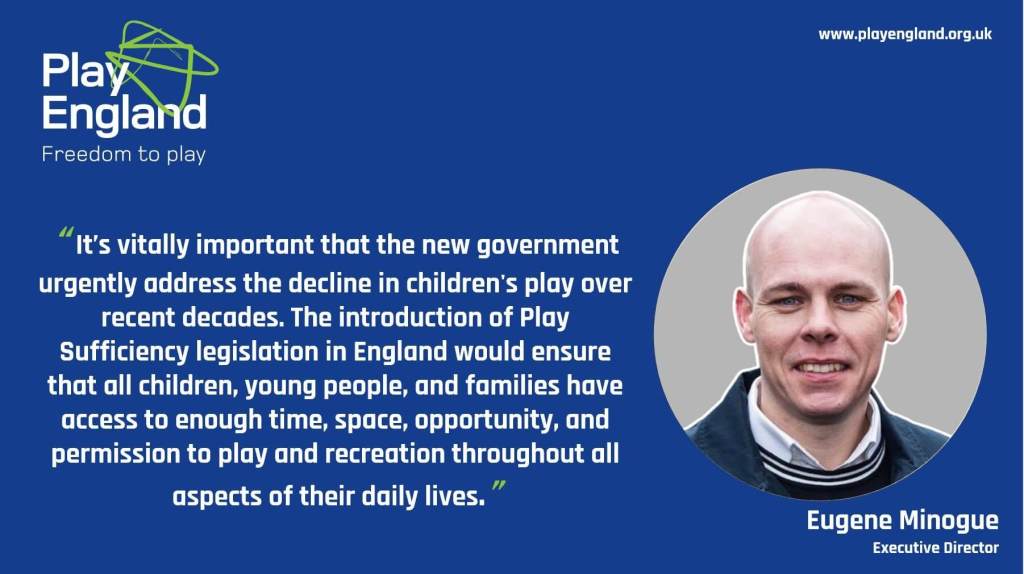
“Democracy is made in the playgrounds” – just one of the many quotable moments from a Westminster Hall debate last week. Brought to our attention by Jackie Boldon at Playwork in Progress, this was part of an hour-long debate secured by Tom Hayes, Labour MP for Bournemouth East, in partnership with Play England.
With Play England CEO, Eugene Minogue, in attendance, Tom expanded his opening statements with two key asks:
A new national Play Strategy for England; and
Play sufficiency legislation.
The Play England website details further success as a result of the debate in the securing of a meeting with the Parliamentary Under-Secretary of State (Local Growth and Building Safety), Alex Norris MP.
I look forward to meeting with the Minister to build on today’s debate and take forward the bold policy changes needed to give children their childhood back – Eugene Minogue, Play England, CEO
This is the latest in a long-standing campaign by Play England aimed at the new Labour Government in Westminster. In July last year, they published an open letter outlining the first steps of change that prioritised the importance of play, to which they received a response (albeit a little lacklustre) in September 2024 from the Ministry of Housing Communities & Local Government in England:
Play England is calling on supporters to help keep up the momentum by contacting their local Members of Parliament at Westminster. While play sufficiency legislation already exists in Wales and Scotland, supporters in these countries can still encourage their Westminster MPs to advocate for play and inspire their colleagues in England to take action.
Read the full debate on Hansard (official publisher of parliamentary transcripts).
To find out who you can contact, visit WriteToThem and enter your postcode.
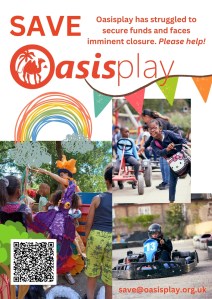
According to a post on Instagram, a community meeting is being held tonight at Stockwell Adventure Playground to discuss the future of Oasisplay.
On the Oasisplay website, it explains how, due to the closure of funding bodies and diminishing donations, Oasisplay is facing “a huge deficit” this financial year – going so far as to say that, without substantial fundraising, they will be forced to “close with immediate effect”.
“We feel confident that with the support of the community Oasisplay will survive the current situation. Please help by spreading the word and link to our fundraising page”
Further information from the JustGiving fundraising page:
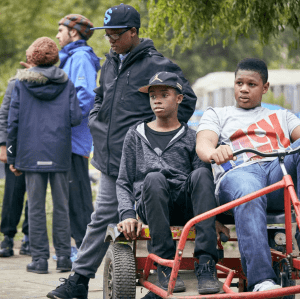
Oasisplay describes its four sites as “a Nature Garden, a youth led Go Kart Track and two amazing Adventure Playgrounds, catering for children from birth to 18 years of age, or 25 years for disabled people” and how the organisation has been a part of the local community for 50 years.
According to the JustGiving page, each year they provide over 2000 hours of free and inclusive environmental play sessions, playwork provision on their adventure playgrounds, karting and mechanics sessions, holiday playschemes, day trips, community events, educational sessions and youth leadership opportunities.
In addition to these core provisions, Oasisplay also host a weekly food hub at each of their sites, distribute free tickets to local attractions and events to support local families, offer volunteering opportunities, and host activity sessions for schools.
At the time of publishing, £38,200 had been raised equating to 25% of their £150,000 goal
Like most open-access playwork provision, their services are open to all those who wish to use them. However, many referrals come from local authority and other multi-agency groups such as social services, youth offending teams, schools and other community organisations. This may be part of the reason why their services are in higher demand than ever.
Whilst many similar organisations and provisions have been lost in recent years, the impacts of the COVID-19 pandemic and cost-of-living crisis continue to significantly affect the both the financial and health status of their community. .
Unfortunately Oasisplay has not been immune to the tough economic climate and we too have had to scale back significantly in the last 2 months, despite intense need. We are determined that this is a temporary measure and with your support we will not only be able to save Oasis from complete closure, but also bring back all of the services that we have recently cut.
£10 will pay for 1 child to attend an After School Club at the playground
£50 will pay for 3 children to attend a Saturday Club at the playground
£100 will pay for petrol and spare parts for 2 weeks of Karting sessions at the Kart Track
£150 will pay for an under-5’s Forest School Foragers session at the Nature Garden
£250 will pay for a kart maintenance and mechanics session for young people at the Kart Track
With their goal set at £150,000, what exactly will that funding be put towards?
£60,000 will fill their shortfall for the current financial year, keeping their gates open until April 2025.
£100,000 will keep sites open until August 2025 for the paying groups and projects for which additional funding can be secured.
£150,000 would allow Oasisplay to reinstate some of their free services until August 2025 and provide time to find further funding.
We are making a robust financial plan for the future, including significant cost cutting measures. We continue to explore all possible funding options and are in talks with Lambeth Council about how they may be able to help us to keep this vital service open.
Play Wales have announced a series of 4 webinars that will explore Play Sufficiency Duty in Wales. Though part of further research into the Welsh legislation and implementation, the webinars will also explore the adoption and campaign for similar play sufficiency measures in other parts of the UK.
What is Play Sufficiency?
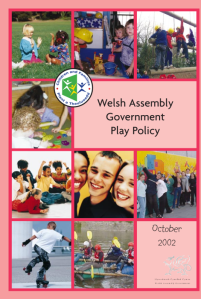
The Welsh Government’s journey to play sufficiency began in 2002, when on the 22nd October, the government unveiled its Play Policy. This policy outlined how play:
has contributed to human development;
is intrinsically motivated and an imperative;
has significantly contributed to the evolution and development of our species;
is how children learn about the world;
is freely chosen, personally-directed and intrinsically motivated;
is not necessitated upon an external goal or reward; and,
is a fundamental and integral part of health development for both the child but also wider society.
The policy also stated that play is so critical to all children’s physical, social, mental, emotional, and creative skills development, that society should seek every opportunity to support it and create environments that foster it. Furthermore, decision-making at all levels of government should consider the impact of their decisions on children’s opportunities to play.
Fast-forward, and the Children and Families Measure 2010 established Wales as the first country in the world to legislate for children’s play. Specifically, Chapter 2, Section 11 of the Measure set out a duty on all local authorities in Wales to “assess the sufficiency of play opportunities in its area for children in accordance with regulations” – something which would become more commonly known as the Play Sufficiency Duty.
The first part of the Duty commenced in November 2012 and all local authorities in Wales submitted their first Play Sufficiency Assessments in March 2013. These examined:
Demographics of each area
Open space and potential play space
Dedicated play provision
Recreational provision
Other factors that promote play opportunities (e.g. traffic, transport, planning etc)
In July 2014, the second part of the Duty commenced which required (as far as is reasonable and practical) local authorities to secure sufficient play opportunities for children in each county, having regard to their previously submitted Play Sufficiency Assessment.
To coincide with Section 11 being fully implemented, statutory guidance – ‘Wales: A Play Friendly Country’ – was issued by Welsh Ministers to local authorities on how to assess for sufficient play opportunities, and how to secure sufficient play opportunities.
Through the Planning Act 2019, Scotland similarly introduced a duty for local authorities in Scotland to undertake Play Sufficiency Assessments as part of Local Place Plans (also introduced by the legislation). And, in England, Leeds recently became the first city to voluntarily undertake Play Sufficiency Assessments led by Active Leeds through a project funded by Sport England: Get Set Leeds Local (GSLL). Play Sufficiency was also the key ask in Play England’s manifesto for the 2024 UK General Election.
The Play Wales webinars are split into 4 distinct sessions that explore the scale of play sufficiency – from the macro of the duty as a mechanism to strive towards play-friendly places, to the micro of play sufficiency at the community level. Though each webinar can stand alone, attending all four will give a more thorough insight (so make sure you book a ticket for each event!). All sessions are 12:30 – 2pm. Dates and links below:
I find that people fall into one of two camps: Those who know and care about NOS and those who are blissfully (and contently) unaware of them! If you are in the first camp, then we have some exciting news for you (if you’re in the second camp… sorry!).
Play Wales has recently published a second information sheet about the review of the National Occupational Standards (NOS) for playwork which has been taking place over the summer and anticipated to run into 2025:
The update outlines the work that has taken place this summer as well as what is expected to happen next as the review progresses. One of the headlines is the establishment of a Writing Group who will:
ensure the new playwork NOS the requirements set by the UK Standards and Framework Panel, the UK NOS Consortium and the Playwork NOS Scoping Review (2023).
Name
Location
Caroline Kerr
Northern Ireland
Martin King-Sheard
Wales
Dianne Larrington
England
Kay Maxwell
Scotland
Karen Sharp (Chair)
Scotland
Sarah Turton
Wales
Meynell Walter
England
Mike Wragg
England
Membership of the Writing Group
Recruitment to the Playwork NOS Advisory Group is ongoing, with expertise in the areas of higher education, qualifications and awarding bodies, further education delivery, open-access playwork and/or out-of-school childcare being sought. Interested parties are invited to email a CV and covering letter to nosreview@play.wales.
If you’re not able to volunteer for the Advisory Group, you will have the opportunity to feedback on the NOS during a wider public consultation expected to take place in the summer of 2025.
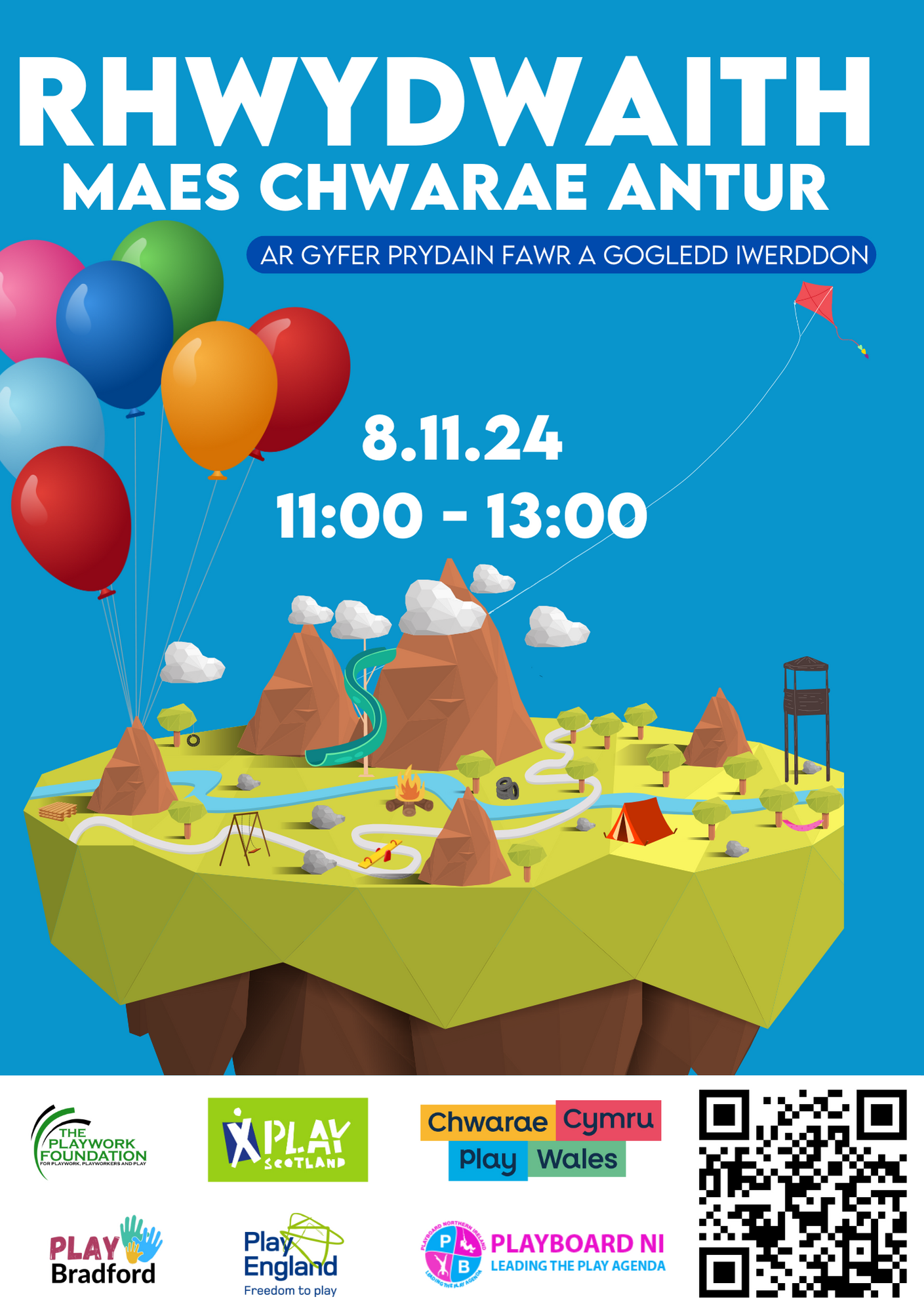
After an (unintentionally) extended period of quiet, the Adventure Playground Network is pleased to announce Friday 8th November, 11am – 1pm, as the next meeting date. To ensure you receive the most up-to-date information, including the link to the meeting, please ensure you sign up.
The Network has also been liaising with the Raising The Nation Play Commission to ensure that adventure playgrounds have an opportunity to contribute to the call for evidence. Please see the open letter to Adventure Playgrounds below:
The aim of the meeting was to amplify the voice of England’s adventure playgrounds in the Centre for Young Lives’ and Raising the Nation Play Commission’s ‘ENQUIRY INTO WHY PLAY IS SO CRITICAL TO CHILDREN’S WELLBEING AND HOW A NATIONAL PLAY STRATEGY CAN BE ESTABLISHED.’
The aim of the meeting was threefold:
Ensure that the crucial role of adventure playgrounds is not overlooked in the course of the Enquiry
Maximise the time available for contributions from adventure playgrounds to be made to the Enquiry
Offer the assistance of the adventure playground sector’s collective wealth of knowledge and experience to the development of a national play strategy for England.
The Centre for Young Lives has received evidence from all sectors including Health, Sport, Education, Early Years etc. Some adventure playgrounds have already submitted evidence, but the closing date is October 31st.
HOWEVER, the Adventure Playground Network has negotiated a rolling deadline, which means that the Centre will continue to welcome contributions from adventure playgrounds – via the Network – on an ongoing basis.
If you have any evidence of the wonderful work that you do, which you’d like to inform the enquiry, please consider sending it to Mike at m.wragg@leedsbeckett.ac.uk and we will ensure that your adventure playground is represented in this national enquiry into why play is so critical to children’s wellbeing and how a national play strategy can be established.
Evidence may consist of anything at all from data concerning numbers and backgrounds of beneficiaries, through to case-studies, presentations, testimonies, reflective diaries and films or video.
The Centre for Young Lives is also keen to visit adventure playgrounds across the country, so if you would be willing to show someone round your site, please let us know and we’ll pass on your details.
With tornadoes in England, floods across the island, and a yellow weather warning for the weekend, it’s definitely autumn. And, for those of us working outside, as we embrace the rain and the colder temperatures, we’re also reminded of another annual consideration: the increased risk of slips and falls on wet wooden surfaces!
Inevitably, this sparks a round of discussions and ideas that present both positives and negatives.
Do some of these mitigations actually create more risks? And, what impact do they have on the lifespan of the wood itself?
That latter question may be of little significance at your setting. Replacing the decking of a summer house might only cost a hundred pounds or so. However, when you expand that to the scale of wooden walkways on an adventure playground, you’re suddenly considering thousands rather than hundreds.
The AAA Zone
When I received an email on this very topic earlier this week from Paula Blake, Operations Manager at The AAA Zone, I thought it would be a good idea to share some of my response more publicly. That’s not to say I have the answer, but more so that I know there will be people out there in the same situation who very well might have the answer! It is also likely that one solution
So here are my Top 5 considerations:
1. Jetwash – this will remove surface algae (the thing that makes it most slippery), however, as well as the potential costs to hire a jetwasher if you don’t have one, jetwashing will consume both time and water. Volunteers might help reduce the time costs, but if you’ve just come off the end of a summer filled with water fights, the water bill might not handle another hit.
2. Score the wooden surface – if you’ve got someone with a chainsaw or other apt contraption, you could try criss-cross scoring the wood surface. Like the patterns on trainers, this can reduce the slipperiness, but it almost certainly reduces to the lifespan of the wood by inviting water to pool and enabling freeze-thaw expansion in the winter. There is also a marginal increase in the risk of grazes from falls onto the surface.
Important additional advice from Simon Rix (Trustee of The Playwork Foundation):
“Do not advise people to score decks with a chainsaw please. Apart from the difficulty of getting a positive result against the damage caused by such a brutal tool, using the tip of the blade is where you get kickbacks, the most common cause of chainsaw injuries.
Instead, use the cutting depth adjustment on your circular saw to set a depth of 5mm or so and run that across in your desired pattern. Much safer.
Also, remember that scoring in the direction of travel will not be effective, score across the direction of travel“
3. Anti-slip strips, coatings or chicken wire – the strips and chicken wire are probably the most effect in terms of reducing the slipperiness of a surface, but the increased damage to the skin when falling onto them, in my opinion, matches the risks posed by slipping in the first place, so they cancel each other out.
4. Sprays – anti-fungal and biocidal sprays, often marketed as general outdoor patio cleaners, can kill off the algae that tends to cause most of the problem. However, depending on the brand and your supplier, these can be costly and may also have a negative impact on the environment, so make sure you check the labels and instructions.
5. Sand or grit – The best middle ground I have found, is to sprinkle sand on the walkways as often as possible. It can itself present a slip hazard, but a lesser one than the untreated wet surface. The sand itself absorbs some of the moisture, whilst the friction underfoot also works to remove the algae slowly – this less aggressive approach also lessens the impact on the longevity of the wood. That being said, I’ve used this on sites where there has been an abundance of sand, so there was no additional cost.
During Playwork in Progress last week, regular Suzanne Axelsson shared a common and easy Swedish hack to keeping your wooden surfaces algae-free: soap! She was even kind enough to share these two articles on the topic after the session which give a comprehensive understanding of why you should use soap (and not “power” cleaners):
Both articles are in Swedish, but browsers (such as Chrome) should offer to automatically translate.
What are your handy hints or tips for this issue? Are there any other seasonal headaches that we can help solve? Please get in touch and let us know. If you would like to send your suggestions to Paula directly, you can email paula@theaaazone.com.
Siôn is the current Chair of The Playwork Foundation. His views are his own and not necessarily those of The Playwork Foundation. Any advice give is personal and should not be taken or relied upon as professional guidance.
Whenever I heard the term “think-tank”, I can’t help but think of the episode of Star Trek: Voyager (yes, I’m a bit of a Trekkie 🖖🏽) where Jason Alexander (of Seinfeld fame) plays the leader of a group of intelligent aliens which Capt. Janeway dubs “The Think Tank”. In true sci-fi drama style, this seemingly altruistic group turn out to be a nefarious force that are playing two parties against each other to get what they want.
Why am I telling you this?
Some time ago, a new piece of work emerged called the ‘Raising the Nation Play Commission‘ presenting itself as “An enquiry into why play is so critical to children’s wellbeing and how a national play strategy can be established”.
The commission is being led by Paul Lindley OBE, who describes himself on his website as a “passionate believer that we can create a society richer in opportunity, ideas and compassion” citing his entrepreneurship, books and campaigning as contributions to achieve this goal.
Paul is leading this piece of work in partnership with the Centre for Young lives – “independent think tank and delivery unit dedicated exclusively to improving the lives of children, young people, and families in the UK”. The Centre in turn is hosted by Oasis – (not the boy band) who describe themselves as a “movement” whose work extends across the UK and “spans from youth work to housing, and education to reforming youth justice”.
All sounds good, right?
If I was an investigative journalist, this would be the point where I drop the big expose on how these organisations are gathering for unscrupulous purposes. But, I’m not. I’m a playworker.
So what’s the big deal?
Well, hopefully there isn’t one. I see no cause for concern in the roll call of Commissioners. But there is an opportunity. The Play Commission is currently calling for evidence on six key areas:
Learning through play
Places to play
The right to play
Time to play
Digital play
Parents and play
So, what’s that got to do with us?
Taking a look at the “Commissioners” there are a few familiar names: Anne Longfield CBE (former Children’s Commissioner for England), Eugene Minogue (CEO, Play England), Professor Helen Dodd, & Ingrid Skeels (Playing Out) to name a few. All great advocates for children’s rights, including the right to play.
This is welcome news, and I trust their contributions and guidance to the commission will ensure that playwork is not overlooked. But we should not place all our assumptions on their shoulders.
Screenshot of just some of the Commissioners on the Play Commission website
As playworkers, the hint is in the name of our profession as to why this commission is of great interest and importance to us and the children and communities we serve. Unfortunately, the same cannot be said of the recognition of playworkers as the only profession whose primary agenda is to extend and facilitate children’s play by those who have an interest in play from other perspectives (e.g. health, education etc). Therefore, it is up to us to make sure that playwork as an approach, and playworkers as experts on the coalface of working with children at play, are adequately featured in the commissions findings.
The deadline for submissions is 30th September, so get your skates on! Submissions should be in a word document format and should set out evidence and recommendations. You can then email this to info@centreforyounglives.org.uk with the subject title “Call for Evidence – Play Commission submission”.
If you would like support to contribute to the commission, or you have a great idea or example of how you’ve contributed to the commission, please let us know so that we can help or share!
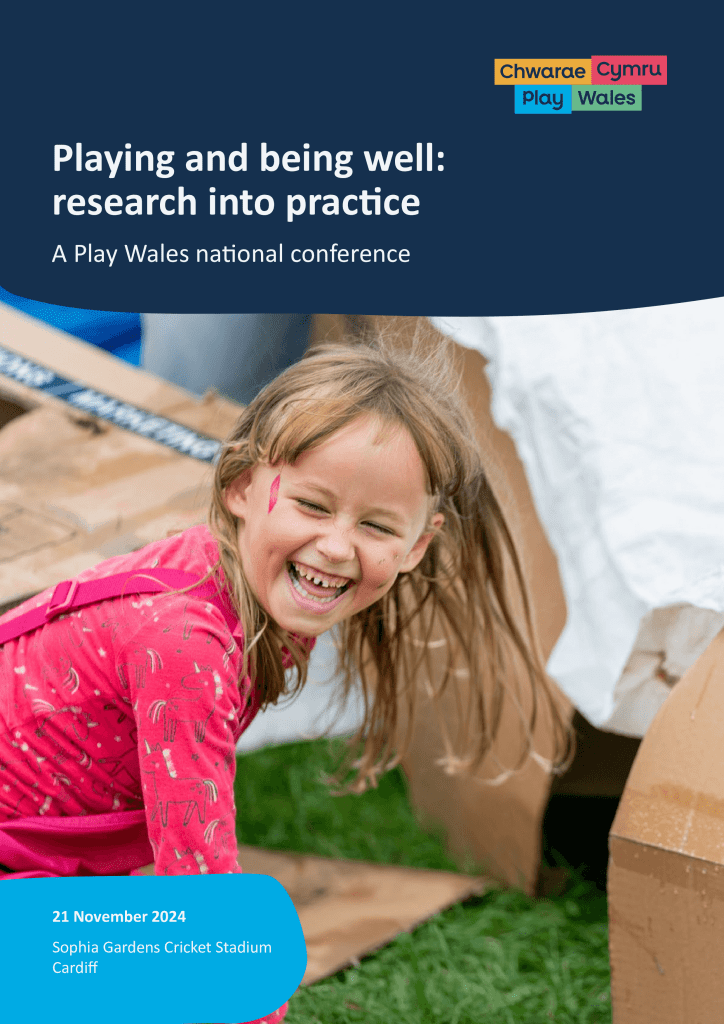
The second national conference since the COVID pandemic, this year’s conference will celebrate the launch of Play Wales’ most recent publication: Playing and being well.
Described as “a groundbreaking and exciting publication”, the literary review explores play sufficiency and the real-life impacts on the wellbeing of children.
Did you know Wales was the first country to legislate to support children’s play? Find out more here.
In addition to hearing from the authors themselves and having the opportunity to debate its findings, the conference will also provide attendees with the chance to contribute to case study workshops relating to the study’s themes, the Ministerial Review for Play and play sufficiency.
Well that jumped out us, didn’t it? All of a sudden, there it is: the announcement of the International Day of Play by the UN. June 11th, all over the world and every year. Remarkable. I am quite blown away by the enormity of this.
In my mind there is a sort of global TV or video scanning and we can watch as every nation pays tribute to our shared heritage of play. The language that unites us.
Of course, the irony is that children are being killed and oppressed and the ‘Right to Play‘ is not regarded as the glorious, life affirming wonder that we understand it to be. But we must never allow it to be thought of as a luxury. It’s as essential as “oxygen, nutrition and love”; it’s a basic human right and a biological imperative, and we need to advocate for it as such.
This day has snuck up on us. We were not expecting it at all. We have not fundraised or set aside budgets, or energy, or time to celebrate it as it deserves.
Adele Cleaver – playworker and author of Children Don’t Dissolve in the Rain – recently shared that she had requested that her child’s school plays, all afternoon, on that day. How simple and clever is that? The Head Teacher has agreed to it. Hurrah!
We can look at pavement play days, or take some loose parts to that boring fixed play equipment in the park so the children can zazz it up a bit and make it their own.
Perhaps we could just linger playfully in a place we normally wouldn’t linger with children, a shopping centre or a park by school.
At our play settings – where everyday is a play day – perhaps we just remember. Savour the moment. Film it. Document it. Photograph it, build a time capsule of it to add to each year.
Whatever you do to mark this day, the Playwork Foundation would love to hear about it and see your pictures, hear your stories.
It’s a chance to celebrate each other celebrating children playing, all over the world.
It gives me goosebumps. It really does.
This article was written by Penny Wilson of AssemblePlay and a Trustee of The Playwork Foundation. These views are her own personal views and not necessarily those of AssemblePlay and/or The Playwork Foundation.
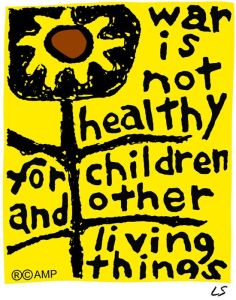
Anti-Vietnam War propaganda poster. USA, 1966. Lorraine Schneider for Another Mother for Peace, Inc.
From Penny Wilson
Inspired by the playwork team of Assemble Play, I have been asking how we as playworkers can speak out against the hideous conflicts ripping through our world at this time.
Even if we had a real-world location, I would not use it to post banners and slogans about specific wars. An adventure playground, for example, should be a neutral safe place where children can spend time away from the pressures that war brings even when it is happening many miles away.
However, a lack of an open gesture, a specific social media post or a banner, does not mean that we as Playworkers do not feel outrage and revulsion against war.
Playwork Principle 4: “For playworkers, the play process takes precedence and playworkers act as advocates for play when engaging with adult led agendas”.
As an individual Playworker, I feel the need to make some sort of stand on behalf of children killed and injured by adult agendas of war.
This does not apply to one theatre of war only.
I cannot say how I think each conflict should be resolved.
It does however imply that I should care enough to try to understand the situations where children are being killed and see what useful actions I can take to ameliorate each of them. This may be a financial contribution to a trusted organisation, and sharing trusted charities and sources of information when I find them. It may mean going on protests or signing petitions or running events…
Because I am a Playworker I would not want to tell people what to do or how to do it, but I would like to make the connection between my responsibilities to children which my work is founded upon and a larger statement, say ‘Playworkers for Peace’?
I can march beneath that banner.
I can hold that banner high.
At first the idea seems rather weak.
I cannot believe that Netanyahu is sitting there, waiting for a declaration from the Playworkers of the world for him to stop pursuing his current course of action. However, if it helps us as a sector feel that we can share our various thoughts and research and ideas and actions, then it has an intrinsic value, even if we are not sure what that may be.
We above all people are happy not to try to control things tightly. We know the strength of seeing what emerges.
I remember standing in a deserted street during the Iraq war with a group of playworkers. We had all been attending training together and without much conversation, went outside at midday to mark 5 minutes of silent protest. Ian held a banner above his head with the name of the adventure playground we were studying in high above his head.
No one saw us.
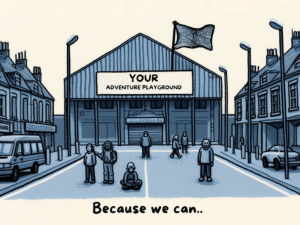
But we did it, because we could.
The children and families subject to that war, could not do what we had done.
Perhaps that in itself counts for something. It drew us together, it was unforgettable.
This article was written by Penny Wilson of AssemblePlay and a Trustee of The Playwork Foundation. These views are her own personal views and not necessarily those of AssemblePlay and/or The Playwork Foundation
















 The Playwork Foundation
