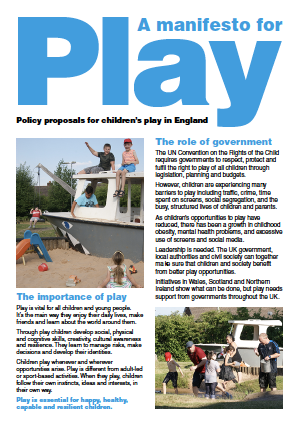
Play England, the Playwork Foundation and the International Play Association (England), have joined forces to publish a Manifesto for Play, ahead of any upcoming General Election.
The Manifesto, based on a series of consultations with children’s professionals, calls on Britain’s political parties to include Leadership, Legislation and Investment in children’s play in their election manifestos to transform the health, happiness and well-being of children in England.
Writing to Members of Parliament We are asking all members and supporters to write to their Member of Parliament asking MPs to support the Manifesto for Play.
The Manifesto for Play calls for 4 pledges for children that we want to see the political parties include in their election manifestos:
Leadership – create a Cabinet minister for children with responsibility for play
Legislation – make planning for play a statutory duty
Investment – more and better play opportunities, spaces and services for children including play in parks and public spaces, playgrounds, housing, play streets, after school and holiday play schemes, adventure playgrounds and schools
Delivering for play – investment in quality support and training for professionals.
Announcing the manifesto launch, Nicola Butler, Chair of Play England said:
“It’s time to start taking play seriously. Too many children and young people in England are unable to enjoy a wide range of play opportunities and are losing out on the benefits of play.
“Children tell us that play makes them happy and is an important part of their daily lives. They want more and better opportunities to play. That’s why we’ve joined forces with the Playwork Foundation and the International Play Association for England to launch this manifesto.”
Karen Benjamin, Chair of the Playwork Foundation said:
“Playworkers support children’s play through a specific approach and understanding, based on strong evidence and research, of the importance of time and spaces for play.
“It is vitally important that this profession is acknowledged and valued, and that spaces for children to play freely are protected for the benefit and enjoyment of all children.”
Meynell Walter, Chair of the International Play Association [England] said:
“Children have an innate need to play, recognised by the right to play being enshrined in Article 31 of the UN Convention on the Rights of the Child. IPA England dedicates its work to promoting this, and we call upon Government and public bodies to adopt and action the policy proposals in this manifesto. Leadership at all levels and associated funding is essential NOW to support opportunities for their play.”
Contacts for Media:
Libby Truscott, Play England, 07802 722 412
Play England is a national charity that campaigns for better play opportunities for children in England. Play England organises National Play Day in partnership with Playboard Northern Ireland, Play Scotland and Play Wales; and publishes guidance on Designing for Play and Managing Risk in Play Provision.
Karen Benjamin, the Playwork Foundation, 07718 028 753
The Playwork Foundation promotes the value of playwork, supports playworkers and advocates for children’s play. It makes the case for playwork services, helps to develop the playwork approach and provides a representative platform for playwork practitioners.
Meynell Walter, International Play Association England, 07403 617149
IPA England is a registered charity, a branch of the International Play Association. IPA’s purpose is to protect, preserve and promote the child’s right to play as a fundamental human right, upholding the right of all children and young people to the opportunity, time and space to play in their own way.
Click on the image to read the full Manifesto for Play
A collaboration of the Playwork Foundation and Play Wales has resulted in the Award in Delivering Dynamic Playwork Training (ADDaPT) being made available in England. Ali Wood reports.
Are you a playwork trainer or have offered playwork training? In England, the only playwork qualifications currently available are in the form of apprenticeships, and take-up is small; especially as there is no legal requirement for qualified playwork staff (unlike the rest of the UK). A few training providers are still managing to offer short playwork training courses locally, but gone are the days when playwork training and qualifications were widely available and free.
The Playwork Foundation has, therefore, for some time been liaising with Play Wales and with Agored Cymru – a Welsh awarding organisation who now offers various playwork qualifications that have been designed by Play Wales and are delivered across Wales, to see if the Welsh playwork qualifications can be made available in England. In order to ensure that only occupationally competent trainers deliver playwork qualifications that are inspiring and participative, Play Wales has also developed a short qualification for playwork trainers – the Award in Delivering Dynamic Playwork Training (ADDaPT) – which they have to undertake if they wish to deliver any playwork qualifications.
As a result of our deliberations, we are really pleased to announce it is now going to be possible for Welsh playwork qualifications to be delivered in England! An ADDapT course has therefore been arranged for English playwork trainers in order that they may be able to offer and deliver any or all of the other playwork qualifications available in Wales. To be accepted onto the ADDaPT course, trainers must already hold a teaching qualification suitable for working in Further Education and be able to show they are occupationally competent in playwork. The ADaPT course is three days in length and provides learners with an opportunity to explore interactive and playful techniques to use when delivering playwork training and qualifications. Participants must also complete an assessment workbook so that they can become an accepted Agored playwork trainer.
This is a great opportunity for English playwork trainers who could then offer short level 2 playwork qualifications that have not been possible in England until now. The first ADDaPT course has been arranged to take place at Gloucester University on Saturdays 2nd November, 11th November, and 7th December. The course includes content on:
Understanding the importance of meeting a range of learning needs and preferences
Understanding a range of playful and participative methods for teaching playwork
Designing a programme of learning for playwork
Reflecting on own practice
We can also tell you that the ADDaPT itself is an exceptional training course that really inspires and excites playwork trainers and is a professional development opportunity in itself.
Is this for you? There will be a cost of approximately £250 per participant (this could be a little more or a bit less depending on numbers attending) which covers the costs of the ADDaPT trainer, the resources and internal quality assurance.
Ali Wood
Ali Wood is a playwork trainer, researcher, and author. She is a trustee of the Playwork Foundation.
If you are interested in the ADDaPT training, please contact Ali Wood on aliwood@blueyonder.co.uk as soon as possible for further information and/or to reserve a place!
Gordon Sturrock, who has died, aged 71, was a giant of playwork: a voracious scholar and a fierce, original thinker, with a radical vision of the importance of play in the lives of children and society.
Although critical of how the practice was adapted by public policy in this area – driven, as he saw it, by a childcare and education agenda, rather than a true recognition of children’s right to play – Gordon was one of the very small number of playwork theorists whose ideas became part of the vocational training curriculum for the mainstream children’s workforce.
Gordon spent his first six years in India, where his nursemaid, or ayah, imbued him with a spiritual sense that never left him. He was returned to Scotland to be educated, a wrench from his parents that eventually resulted in his conviction that life traumas could be healed through therapy, play, and playwork. As he often said, ‘It’s never too late to have a happy childhood.’
After boarding school in Scotland, he trained in Jungian psychology and later referred to himself, with typical self-deprecation, as a ‘failed analyst’. His psychotherapy training introduced him to the work of DW Winnicott, and thus to a fascination with scientific and theoretical perspectives on children’s play, which would become his life’s work.
Knowing that an understanding of play from the literature would only take him so far, Gordon found work on the burgeoning adventure playground scene in London in the 1970s and 80s, eventually becoming the play officer for the London Borough of Camden. Here, he began to involve himself in the emerging moves to professionalise playwork, and its embryonic institutions, joining the board of the Joint National Committee for Training in Playwork.
Around this time, he became a founder director of
Interplay, a company that designed children’s fixed playground equipment; he
also worked hard to establish Children’s Village, an ambitious project
involving many activities and services for children, all under one umbrella.
Unfortunately, the recession spelt the end for both enterprises.
He then gravitated towards teaching, taking a lecturing position at Thurrock, University of East London, and increasingly collaborating on a variety of papers expounding his ideas. The most influential of these, written with the late Perry Else, and widely known in playwork circles simply as ‘the Colorado paper’ (1998), describes the ludic ecology, the play cycle, and the subjective role of the practitioner in responding to play cues. Sturrock and Else called this practice therapeutic playwork, and suggested it was rich in creative and healing potential.
In 2003-04, Gordon developed, for the University of
Gloucestershire, two undergraduate modules in therapeutic playwork, which
remained a fixture for the duration of that programme. His and Else’s ideas,
along with those of his friend and professional confidante, Bob Hughes, became
the bedrocks for the development of recognised training and qualifications in
playwork; part of the ongoing professionalisation of the field that had its
short-lived apotheosis in the £235m national play strategy for England (2008), later
abandoned to austerity.
Although subsequently operating outside academia, and not being widely published, Gordon remained one of the field’s leading thinkers right up to his death, sustaining a rich dialogue with many collaborators and colleagues, often in more mainstream positions than he; stimulating and provoking each, with the breadth of his own studies, the erudition of his ideas and interpretations, and the political and ethical positions he urged us to either embrace or challenge.
Gordon was an inspiring teacher and mentor, and a compelling speaker. He had a sharp but playful sense of humour: it was he who coined the collective noun for playworkers as ‘a lateness’. His writing, however, was not to everyone’s taste; it was not an easy read, with its characteristic sprinkling of academic vocabulary and numerous neologisms. But to those who persevered, he brought insights and interpretations to bear on a vocation that most of us understood only instinctively. His firm belief that play was at the very root of human experience led him to devour new ideas on everything from neuroscience and evolutionary biology, to the future of democracy and the commons movement. That he was able to make each of these perspectives highly relevant to understanding the space in which children play – and our responsibilities in entering it – was his great gift.
In his later years, his illness and its finality seemed to reinvigorate Gordon’s appetite for work. In 2018, already seriously unwell, he co-organised, with Bob Hughes, a Play Education conference in Cambridge, hoping to breathe new life into a field that seemed in the doldrums after eight years of austerity. The event revealed him to be as passionately motivated as ever to articulate a grand narrative of the playwork ethos and its practice. He also sought out new collaborators and embarked on a prolific writing spree that produced a book, co-authored with Dr. Pete King of the University of Swansea, and a series of original pamphlets, each to be now, sadly, published as posthumous works.
When you were at school you may have attended an after-school club at the end of the school day. The after-school club may have been in your school, community hall or even a leisure centre. The after-school club was not part of the school curriculum run by the school (for example it is not a football club or homework club organised by the school as an extra-curricular activity), but was a club where you could play. The after-school club had adults supervising who were called playworkers or childcare workers.
If you did attend an after-school club in your childhood, we are looking for adults (parents, carers and non-parents) to complete a short online survey on your experiences. The online survey is short and will take no longer than 10 minutes to complete and all information will be anonymous.
If you are interested in taking part, you can access the online survey by clicking on this link
For more information please contactDr Pete King atp.f.king@swansea.ac.uk or call 01792 602 314D
‘She seems genuinely impressed when she hears about the freedom and control that children have here, and especially at the sense of community and social connection they exhibit: that this is their place, of which they are immensely proud. Before she moves on, The Princess Royal turns to me and says that these children, from the ‘deprived’ social housing estates in the looming shadow of Waterloo Station, seem to be enjoying the kind of childhood that many supposedly better-off children would relish’.
From Policy for Play, responding to children’s forgotten right Adrian Voce (Policy Press, 2015)
Writing in the Guardian this week, Harriet Grant reports on what can only be described as a form of social apartheid, in the design of a small housing estate in London. The article relates how, in a new mixed development on the site of the old Lilian Baylis School in SE1, North Lambeth, children living in social housing are excluded from the supposedly ‘communal’ play areas, where access is exclusive to those from the privately-owned units.
The article has caused a media furore, with everyone from the Mayor of London, Sadiq Khan, to the Communities Secretary, James Brokenshire, decrying what architect Dinah Bornat, an expert on child-friendly housing, has called a shameful abuse of the planning process. Victoria Derbyshire’s daytime TV programme featured mums from each part of the estate, united in wanting all their children to be able to play together equally.
As of lunchtime today, the BBC was reporting that Henley Housing, the developer, has said it ‘has no objection to residents in the social housing estate accessing all the play areas’; it was ‘leading the way’ to find a ‘workable solution’. This was later confirmed by Grant in a follow-up to her Guardian story. The BBC reported that Warwick Estates, who manage the private part of the estate, however, are making no comment.
If they each think it’s wrong, who is responsible?
It is striking from Grant’s original piece how a variety of key players (no pun intended) – the designer, the developer, the council, the Mayor and the government – seem to agree (in the glare of media scrutiny anyway) that this segregation of children’s play space by home-ownership status is wrong. And yet there it is. If they each think it’s wrong, who is responsible? Dinah Bornat says she is still trying to get to the bottom of it. There has even been talk of a possible legal challenge by some housing law specialists and children’s rights advocacy groups.
My correspondence, going back to June last year, from one of the parents at Baylis Old School, reveals that the segregation of the play area is in fact only the latest instalment in a running battle at this site, between residents who understood from the marketing that they were moving into a genuinely child-friendly development, and the estate managers, for whom children’s play of any stripe seems to have been largely conceived as a nuisance to be policed.
Whether or not a ‘workable solution’ can be found for the Baylis Old School development (now it is in the media spotlight), the wider questions are: how common is this, and how can it be prevented? How can children’s right to play together in the common spaces of their immediate neighbourhoods – a feature of childhood as ancient as society itself, and believed by scientists to be a key to our evolution as a species – be better protected? Is this not a failure of public policy, wherein children’s right to play receives scant recognition, and no support, in defiance of various UN reports criticising the government for its dereliction?
I want to suggest four distinct policy measures that would make such an occurrence – and the wider disregard for children’s rights in public space –much less likely in the future.
1.Reform national planning policy
As the retreat of children from public space became a growing cause of concern through the 90s and 2000s, so the need for a greater role for planning policy to provide guidance on children’s play space became more and more accepted, with major planning documents such as the first London Plan and the government’s National Planning Policy Guidance 17 on Recreational Space, each highlighting the need for planners and developers to include children’s play within the overall concept and masterplan for any residential development.
At the time of the change of government in 2010, Play England had been commissioned to produce specific planning guidance that was to have been published by the Department for Communities and Local Government. It never saw the light of day and, as everyone now knows, the entire suite of national planning policy documents was soon torn up and replaced by one slim volume. It seems clear that The National Planning Policy Framework is only fit for purpose if that purpose is to allow the concept and design of the public realm to be led by developers. Brought in at a time of perceived crisis for the economy, it is now surely time for a review.
2. Reinstate children’s play as a matter of government policy
Would Lambeth council have allowed the developer at the Baylis Old School site to alter the plans and create a segregated play area if children’s play had been higher on their political radar? Perhaps, but, it would have been less likely. When there was a Secretary of State for Children, with a serious national play policy, including a 10-year strategy and a £390m funding programme (including £155m of lottery money), local authorities were required to have a current local play strategy and play partnership, based squarely on principles and understandings about children’s right to play. Children’s play in England since 2010 has all but disappeared from the policy agenda other than as a tool for early learning and will continue to be neglected by cash-strapped local authorities until there is again some national leadership on the issue.
3. Adopt the UN Convention on the Rights of the Child into UK Law
It has been both heartening and a bit depressing to see the parents from both sides of this unwanted divide citing children’s right to play equally, as per the UNCRC, in their campaign to end this terrible practice. Heartening, because we are often told there is not much appetite for children’s rights among the British public; the outpouring of sympathy for these children, and the stance of their parents suggests otherwise. Depressing because because the UK, (or, more particularly, the UK government, and therefore England) is one of the more reluctant signatories to the convention. The UK is one of the very few developed-world governments not to have adopted the convention into national legislation, ranked a lowly 187th by the Kids Rights Index which monitors the degree of integration of children’s rights into national policy and legislation. This is why finding a viable legal challenge to this shameful decision may be harder than it ought to be.
4. Designate London and other conurbations Child Friendly Cities
The UN’s Habitat conferences of the 90s highlighted the particular threats to the wellbeing of children and young people by increasing urbanisation, population growth and poor long-term planning by municipal government. UNICEF’s Child Friendly Cities Initiative is designed to ensure that local authorities, regardless of national government policy, fully adopt and implement the UNCRC within all relevant policies and processes. Very few British councils have signed up for the UNICEF initiative – many citing austerity and the cost of the programme – but some, like Bristol, have nevertheless declared their commitment to being a child friendly city and are developing plans and strategies accordingly. A child-friendly city is not just a city where child-friendly design principles are more widely adopted, but one where, as a cornerstone of the children’s rights ethos, these principles are applied equally to all children. 15 years after City Hall hosted the second international child-friendly city conference, Sadiq Khan should formally commit the capital to becoming a recognised Child Friendly City. His current London Plan revision is the perfect opportunity.
As a playworker in the 1980s, I had the privilege of working at an adventure playground in the same part of London as the Baylis Old School development. Like all such places (now sadly diminishing in number), it had its own unique character and culture, reflecting that of the local children who used it. One abiding memory is of how proud they were, not just of the playground (which they helped to build), but of their ‘manor’: the social housing estates in the shadow of Waterloo Station. Applying for grants for our project from the various funding programmes for deprived inner-city areas was frequently met with their scorn. “We’re not deprived; this ain’t a deprived area. Flaming cheek!’ would be one of the more printable reactions. As my story of the visit by our patron Princess Anne relates, there was support for this view from some unlikely sources.
Whatever else was going on in their lives, in one very important regard these children were indeed far from deprived. The adventure playground, and the wider public spaces surrounding it, were theirs to explore from an early age. With no gardens of their own, children from as young as 4-5 would be outside on a daily basis, in groups of siblings and friends – playing, making friends, getting up to mischief, growing up. The adventure playground was their place, but in those (pre-childcare registration) days of open-access, ‘drop-in-drop-out’ attendance, the wider public space of their estates was also their domain.
These kids, like so many who grew up before the outdoor world had become a no-go area for them, had the richest of play lives: meaning they grew up learning the physical and social competence, self-confidence and resourcefulness that only comes from having time and space to play, away from adult direction, structures and rules; immersing themselves, daily, in their own culture and society; making decisions and taking risks for themselves. In so doing they also developed the ‘place attachment’ so important to identity and citizenship.
Like the parents at Baylis Old School today, the adults in the lives of those children in the North Lambeth of the 1980s – indeed society as a whole, even if by a kind of benign neglect – understood the importance of their right to play, and that this right was for every child, regardless of where they live.
Adrian Voce is the current President of the European Network for Child Friendly Cities. He is a trustee of the Playwork Foundation and an associate board member of Playing Out. His book, Policy for Play was published in 2015.
The government panel did not think there were sufficient differences between playwork and early years education.
Ali Wood reports on the current situation of potential government funding for playwork training in England*
The playwork apprenticeship group in England has been advised that its second expression of interest to qualify for the government’s Trailblazer Apprenticeship programme, the key to funding from the Apprenticeship Levy has been declined. The group is preparing a third bid.
Since my previous overview, in February 2017, the government has been pressing ahead with its trailblazer apprenticeships and introduced more funding through the Apprenticeship Levy (available in England only).
In the current climate, this scheme represents the best hope for central funding and recognition for playwork training in England and a group of playwork employers drawn from across England, mostly from adventure playgrounds and after-school clubs, have been working hard to compile an expression of interest bid for a trailblazer playwork apprenticeship.
Whilst this sounds relatively quick and simple, it has not been – the first application was knocked back as the panel (which does not comprise anyone from a playwork background) did not think there were sufficient differences between playwork and early years education or even between playwork and youth work.
The group has liaised with
both of these sectors in compiling a new bid that does set out the differences
in approach but using language that will make sense to the reviewing panel. This has taken an extraordinary amount of
voluntary time (well done Playwork Trailblazer group!) and culminated in the
bid finally being resubmitted in February this year for a level 2 playwork
apprenticeship. The group has also
worked on putting together learning outcomes and assessment strategies at both
levels 2 and 3 as the plan is to submit a bid for level 3 once the level 2 has
been accepted.
This is a different kind of
apprenticeship to that which has gone before and the group has worked hard to
address those issues and failings highlighted above and to ensure content is up
to date and relevant to practice. If it
is accepted, it would come on stream either later this year or early next year
when previous qualifications are likely to be expiring.
We will bring you news as soon as we have it. Watch this space!
Wales and Northern Ireland
*Wales and Northern Ireland are of course still regulated and therefore playworkers in each of these nations are still required to have playwork qualifications. Wales has developed a number of excellent qualifications, currently available only in Wales, although Play Wales has been pushing for these to be made available elsewhere. Northern Ireland still offers playwork at levels 2, 3 and 5 via City and Guilds who have just agreed to re-extend registration on the current playwork diplomas beyond September 2019, although a potential expiry date is still to be agreed. CACHE is currently saying that they will review in September 2019 whether they will continue to offer playwork qualifications in England and Wales, as current take-up may not warrant a successful business case to continue.
Penny Wilson offers a personal view of the struggles of playwork in a world that undervalues play, and of how the Playwork Foundation represents an opportunity for developing our common cause, building mutual support and working together for the growing recognition we deserve.
Sometimes, being a playworker feels isolated. We struggle – with local authorities, housing associations, funders, government, the media and the public – to communicate what we are doing and why. The play illiterate look down on us; often either patronising or simply dismissing us and our work.
We have a strong body of knowledge, dating back some 70 years showing the urgent need for free play to be accessible to children, showing how best to support that play and design and provide for it. We have developed play theory, and there is a mountain of research showing how play –unstructured, child-led play – is of overwhelming benefit to children.
We have a language to explain the mechanics of the craft of playwork. Yet still we find resistance in almost every sphere of influence to our work. We can prove and prove and prove the efficacy of playwork in the lives of children over and over and over again. We state and restate our case and our perspectives. We write and rewrite the simple things we need to be understood.
The world seems to be play-blind.
Yet, we are continually thwarted in our work. People cannot see or hear play. They show endless resentment towards play and those who advocate for it. We all have hundreds of examples of the insults and semi-truths that have been conjured up to discredit and infantilise play and playworkers. It is frustrating and belittling. The world seems to be play-blind. We feel as powerless as the child trying to play. The odds are against us. We have no voice.
In our teams, we can band together, talk and use humour to counteract the frustrations. We can think laterally, advocating for play in creative, imaginative and positive ways. We can start social media discussion groups to broaden our thinking and engender mutual support. We can do this locally and internationally.
We can sometimes afford to go to conferences and, whenever
that is possible, it is great for us. But our wages are low and our projects
mostly insufficiently funded; we cannot often find the funds to attend, and they
cannot always cover our absence when we do.
Some of us decide that higher education in play is the route to becoming more respected and better informed; to be heard. This is also great, but it is only a partial solution. We are asked for our base-level qualifications to gain employment, but even that level of qualification, enfeebled as it often is, is now almost impossible to gain.
the craft and knowledge and voice of the playworkers, advocating for the right of (every) child to play, is undermined
The play equipment industry has a loud voice. It has products to sell, an easy solution to a tick box requirement of landlords and landholders to provide some play space. Buy it and … Snap! The problem is solved. Quick and simple. The relationship between society and children’s play is resolved with one easy gift; give the kid a sweetie to stop it crying. Once again, the craft and knowledge and voice of the playworkers, advocating for the right of (every) child to play, is undermined by a passive-aggressive sop to short term gratification.
Even the organisations established to promote play are
frequently unsupportive and undermining of playworkers, choosing to promote
their own structural interests by
renaming our work so that they can appear to have invented something new
themselves or look to volunteers to replace us. Our unions are happy to accept
our dues, but there is seldom a reasonable return for those dues. We are
unrepresented. No one hears us. No one speaks up for us We are beset with
difficulties. We always have been. We feel sorry for ourselves and undervalued.
A place to take pride in ourselves …
It is unsurprising therefore that we turn on each
other, choosing to try to scramble to the top of the heap and squash our peers
down to raise ourselves up. We are frequently vicious in our infighting. We prefer
to squabble with each other than to seek common ground in the acceptance and
respect of our differences.
We need a shared identity. We need to feel proud of ourselves and of each other. We need to be able to stand tall and advocate for play with pride. Playworkers need to have a metaphorical bonfire to sit around, a place to understand what we share and why we are so prepared to remain so dedicated to our work in the face of such overwhelming adversity. A place to find ourselves reflected in the faces or our peers. A place to take pride in ourselves.
The Playwork Foundation is an attempt to provide
recognition, support and a voice for those of us who practise the craft of playwork.
It can be the mirror we need to show us who we are so that we can look with pride on our image.
With no staff and negligible funding, the Foundation is nevertheless struggling on all our behalf with some of the thorny problems associated with the current turmoil around accredited training; and working with others to advocate for the policy changes the sector needs. But it can be a great deal more. It can share writing from those of us who like to write. It can hold images and papers and anything else we decide we need: memes on social media; information; ideas; resources.
The Foundation can be whatever we need it to be. Let’s make it our shared campfire. To do this it needs us to support it, to chip in, to use our voice and our enterprise. It is true that there is a cost element, which is a challenge to those of us living hand-to-mouth on playworker wages, but here is an opportunity, a chance to strengthen our voice and to find common ground; to turn away from the frustrations and infighting that shames and holds back our profession; to stand tall and move on.
Simon Bazley, after taking the temperature of this week’s media flurry about insurance companies and adventure playgrounds, decided to do a little bit of his own investigative journalism. He discovered that the picture is not exactly as described by some illustrious newspapers, and suggests that the more serious threats lie elsewhere.
A
couple of weeks ago, around 14th January, I learned through social media that Felix
Road Adventure Playground in Bristol had been advised, in the words of its
manager, Eddie Nutall, that “adventure playgrounds were not economically viable
to them anymore … good luck, and sorry.”
Upon
hearing this, I was naturally concerned about the implications for other
adventure playgrounds across the UK and I decided to do some digging, getting
in touch with some of my own contacts within the insurance industry. In
short, they said “what are you worrying about? It’s only one insurer and there
are many others; just speak to a broker”.
These
contacts, quite senior people in the industry, went on to suggest that it is
quite normal for an insurance provider to change their emphasis within various
portfolios but that, as one company leaves the market, it provides
opportunities for others to compete for the business.
The Times and the Sun
Fast forward two weeks, and I, like many of us in our field, was a little shocked to read the Times’ and Suns’ versions of events.
“Adventure
playgrounds in danger of mass closure after insurer Zurich pulls out”? (The Times)
PARK
STRIFE : ‘Claims culture’ could force mass closure of playparks as insurer
Zurich ‘threatens to end cover’
(The Sun)
These headlines, which appeared on Monday this week, made me sit up and take more notice than I usually do of certain mainstream media. But are they factually correct? If so, then our sector has a serious problem, a sentiment manifest in the waves anxiety sweeping across social media all week. ‘Is this the final nail in our coffin?’ was one typical comment.
Panic
The trigger for this panic has surely been the Times’ assertion that Zurich, until now, was ‘the only insurer willing to back (adventure playgrounds)’. But my initial enquiries suggested this was not true, and so let’s take a closer look.
Speaking
to a friend and colleague yesterday, I learned that the oldest adventure
playground in Wales, Wrexham’s The Venture, was insured by Royal Sun Alliance
(RSA), not Zurich. RSA also insures my own work as a self-employed playworker
and play consultant.
Further
investigation, via my insurance broker, Keegan and Pennykid in Edinburgh,
provided more evidence that the problem has been exaggerated, to say the
least. They advised me that they have a number of adventure playgrounds
as clients and have successfully negotiated policies for them via RSA and
Aviva, two of the largest insurance providers in the UK. According to Keegan
and Pennykid, other companies are also amenable.
Bigger picture
From just a little research, it is clear that The Times story is inaccurate. Of course, we need to try and ascertain the bigger picture, and I would encourage all adventure playgrounds to respond to a survey that has been issued by London Play (see below). I am currently trying to find out who insures the other three adventure playgrounds still remaining in Wales and will feed this into the gathering evidence base.
Hopefully, a concerted and collaborative bit of data gathering will tell us whether or not adventure playgrounds across the UK can, in general, get reasonable insurance, with fair terms and conditions at a reasonable price. If not, then, as a playwork sector, we may indeed have a problem.
If, on the other hand, the answer is yes, albeit that some playgrounds may be now looking for new cover, then perhaps we can use this current attention on our work to highlight our value, collaborate on good practice and workable solutions; and maybe even strike some better deals with the insurance industry.
There is more than one meaning to the term ‘a good risk’!
Simon Bazley
Simon Bazley is the CEO of Playful Futures and a trustee of the Playwork Foundation.
London Play has asked for help in collecting some information about insurance and adventure playgrounds. If you run, work for or volunteer at an adventure playground anywhere in the country please complete the survey at the link below soon as possible. Thank you!
When Ali Wood enrolled for an event, ‘In Defence of Youth Work’, in Birmingham, she saw that the agenda featured discussions on youth work in different settings and situations. Never being shy about speaking out for play, Ali asked if youth work in adventure playgrounds could be added to the programme. This is a synopsis of her resulting workshop, and Ali’s rationale for it.
I qualified as a youth and community worker in 1985 and worked in a whole range of centres and clubs in Birmingham for a number of years. Things were changing though –both in the local authority and across the country and it wasn’t hard to see the writing on the wall. Funding for community work was dwindling fast and youth work as it had been was changing and becoming more issue-based, but somehow in that process we ended up losing numbers of young people – partly due to focussing more on discussion work than recreational activities and young people’s choices. I ‘defected’ to playwork, which had begun with the introduction of adventure playgrounds in London in the 70’s and over the ensuing decades built up its own theory base, research evidence for play and qualifications for playworkers. I have been there ever since.
Adventure playgrounds
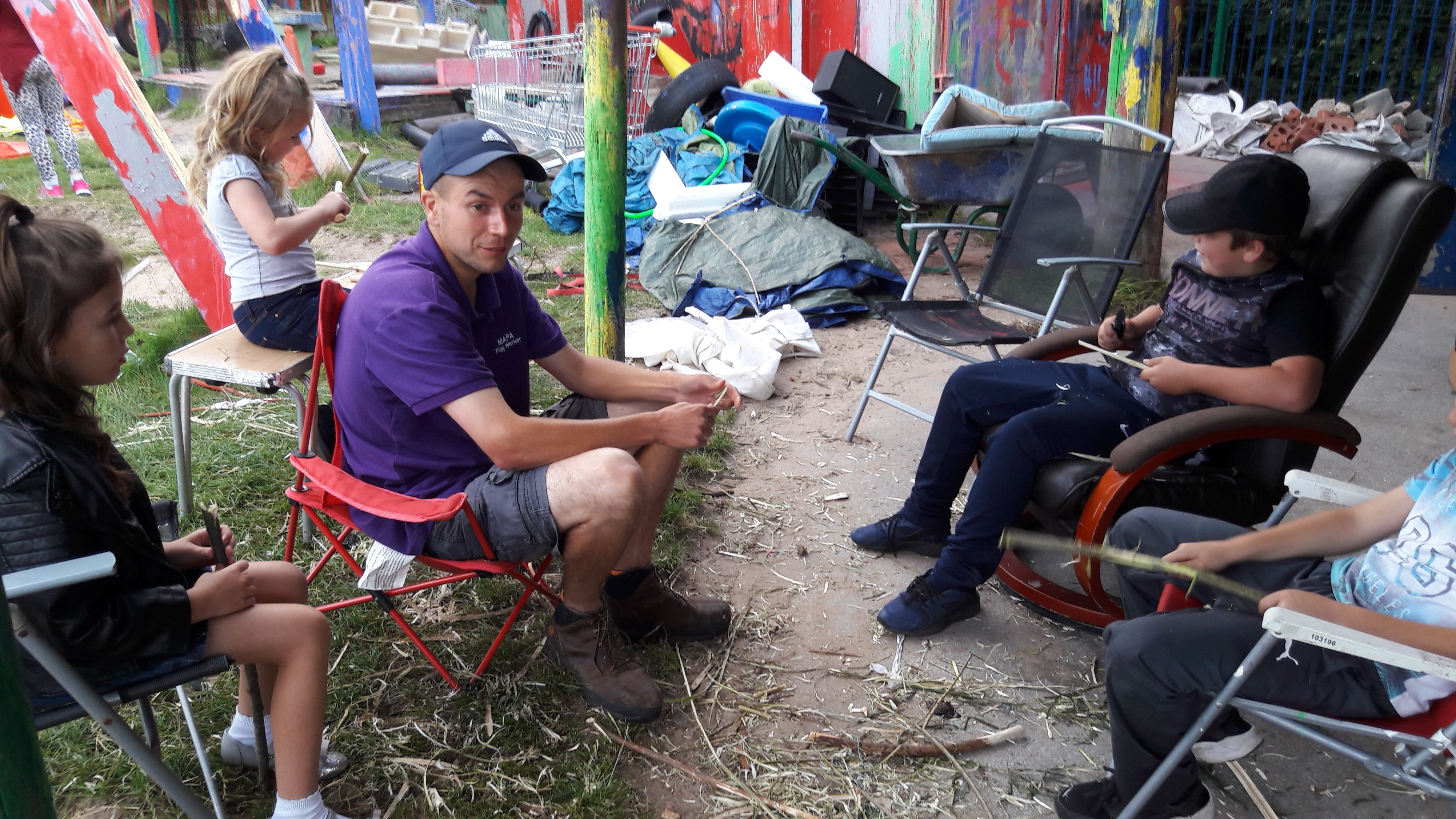
So for those of you who don’t know and have never been to one – what’s an adventure playground? There aren’t that many left around since all the recent local authority cuts, so you’d be forgiven if you hadn’t come across one.¹ Basically an adventure playground is a community-rooted self-built site for both children and young people, where kids can come and be themselves and do their thing – which often includes the stuff that they can’t do elsewhere like lighting fires, using tools and building, making food, digging, climbing, swinging, jumping off high platforms, managing risk for themselves, playing with water and mud. It’s also a space where they know they’ll feel heard and valued and where spontaneous conversations will likely yield support or information they need.
they know they’ll feel heard and valued and spontaneous conversations will likely yield support or information they need.
So what’s the difference between playwork and youthwork – or doing youth work on such a site? In some ways – when you get youth workers who have a real sense of vocation – not a lot necessarily in practice. But there are givens here that may not be automatically understood or recognised.
First principles
Firstly there is the understanding of the fundamental importance of play in children and young people’s lives. And by play, we mean that as it is expressed in the first two Playwork Principles² – which provide a professional and ethical framework for playwork.
All children and young people need to play. The impulse to play is innate. Play is a biological, psychological and social necessity, and is fundamental to the healthy development and wellbeing of individuals and communities.
Play is a process that is freely chosen, personally directed and intrinsically motivated. That is, children and young people determine and control the content and intent of their play, by following their own instincts, ideas and interests, in their own way for their own reasons.
If you recall some of your own memories of playing (and do this now before you read on!), I can pretty much guarantee that these will consist of being outside, taking risks and being away from adults – and the older you are, the more that will be the case. Am I right? And why do those three things feature so widely in people’s memories? Because children naturally long for freedom and independence as they grow; and if adults are around, those adults are likely to try and control, supervise, guide, direct, organise, stop or take over whatever kids are doing. Start watching yourself, and how much you do this when you’re with kids!
So, children seek out time and space away from adult eyes in order to play. However, over the last few decades, kids have had less and less free time away from adults when they can make their own mistakes, be daft, work stuff out and try things out for themselves, be responsible for themselves and each other. Yet it is play as described above that is the natural medium for these things to happen, but opportunities for play have been squeezed, banned, or diluted – often with the supposed best of adult intentions – because we have forgotten how vital free play is and we are bewitched by the spirit of the age of over-protection and structured education of our children and young people. In playwork we call this play deprivation³ and it is a concept that other professions are also recognising as really damaging.
So, youth work really needs to understand what play is, why kids crave it and how to support it and respect it without getting in the way (and that honestly isn’t easy and takes a lot of reflective practice!) instead of planning a load of other stuff that we think is more important and riding rough-shod over young people in the process. More than ever – because of being more play deprived in their own childhoods – young people need to play⁴.
Understanding risk
Secondly, in playwork there is a different understanding about risk, it’s necessity in young lives and how we can manage it. We use an approach that has been recognised and is promoted by the Health and Safety Executive⁵ for anyone working with children and young people and yet somehow youth work has not taken this on. It is the process of constant risk:benefit assessment⁶, whereby instead of automatically intervening to ‘make something safe’, playworkers observe children and young people in whatever they are doing and dynamically assess the risks of this, but also the benefits –i.e. what kids will gain from doing whatever it is, and also to think through ways of minimising the risks if this is necessary, without taking over and ‘doing it for them’.
Young people don’t have a death wish, they have an inbuilt sense of self-protection and survival that too often we have crushed by not allowing them to use it.
It takes courage and practice, but it works. Young people don’t have a death wish, they have an inbuilt sense of self-protection and survival that too often we have crushed by not allowing them to use it. When they know they are responsible for themselves, they really take that on and their skills and confidence flourish. On the adventure playground where I work and where we have unaccompanied children from 7-18 years on site, we’ve had about half a dozen accidents that have entailed a visit to A & E in ten years, and yet our kids regularly use axes and mallets, hammers and saws, throw themselves off platforms and cook on the open fire. Youth work really needs to better understand risk-benefit assessment in practice.
Differences
So, the main differences when doing youth work on an adventure playground (and we have youth only sessions at our playground as well as open sessions for all ages), entail youth workers:-
developing a deep understanding of play in all its forms and how to support it;
a profound respect for children and young people that recognises their capabilities and competencies first;
a richer kind of reflective practice⁷ that puts us adults – with all our feelings and motives – under the microscope to examine how our interventions are too often colonial and patronising; and
a commitment to risk:benefit assessment observation and recording.
This takes passion and courage, lots of supportive teamwork and the willingness to regularly go the extra mile. But in many ways, although I have called myself a playworker for the last twenty years, it is much more akin to the youth work I first felt so drawn to in the 80s.
Ali Wood
Ali Wood is a playwork writer, researcher and trainer. She is chair of Meriden Adventure Playground in the West Midlands, and a founding board member of the Playwork Foundation.
Children’s Access to Play in Schools ( CAPS ), a University of Gloucestershire project under the EU’s Erasmus programme, is introducing its Play-friendly Schools Quality Criteria to the UK at an event in Gloucester on 5 December.





 The Playwork Foundation