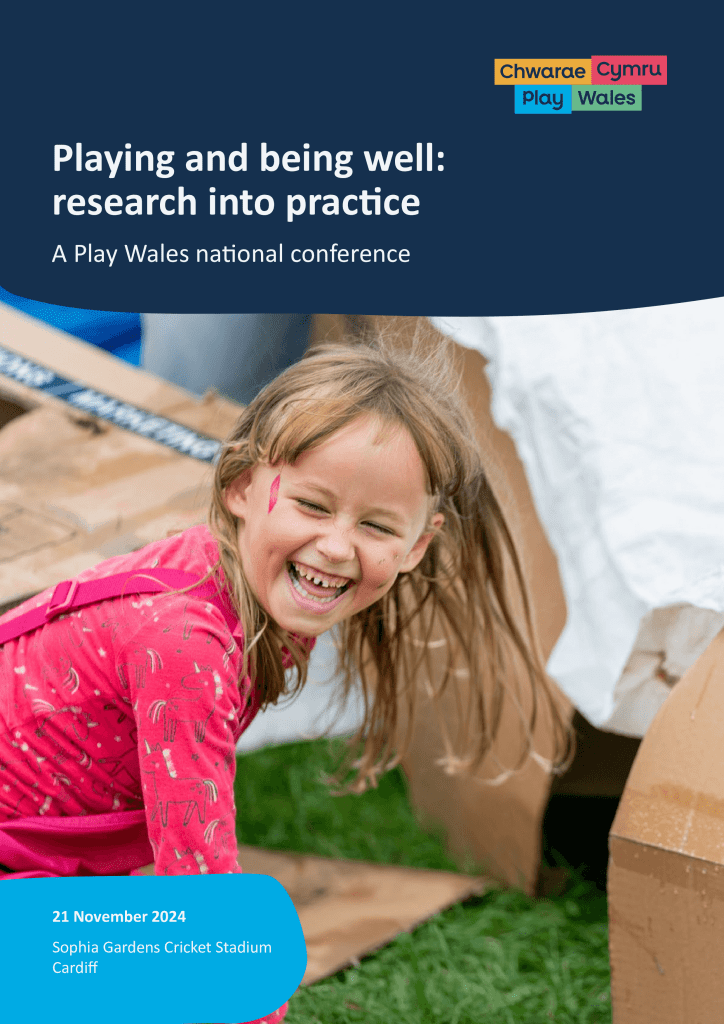
The second national conference since the COVID pandemic, this year’s conference will celebrate the launch of Play Wales’ most recent publication: Playing and being well.
Described as “a groundbreaking and exciting publication”, the literary review explores play sufficiency and the real-life impacts on the wellbeing of children.
Did you know Wales was the first country to legislate to support children’s play? Find out more here.
In addition to hearing from the authors themselves and having the opportunity to debate its findings, the conference will also provide attendees with the chance to contribute to case study workshops relating to the study’s themes, the Ministerial Review for Play and play sufficiency.
Dr Pete King of Swansea University is researching the playwork field’s response to the pandemic and has two opportunities to get involved.
Adventure Playgrounds
Dr. King is looking for anyone involved in adventure playground to take part in a study on how adventure playgrounds have been adapted since post-lockdown measures were put in place in July 2020. The research study will involve a short 20-30 minutes interview using Zoom. If you would like to take part, please contact Pete at p.f.king@swansea.ac.uk where you can be sent more information about the study. The research study has ethical approval from the College of Human and Health Science at Swansea University.
After-school clubs or holiday playschemes
Dr. King is also looking for anyone involved in afterschool clubs or holiday playschemes to take part in a study on how you have adapted since post-lockdown measures were put in place in July 2020. The research study will involve you to take part and complete a short survey which can be accessed here.
This research is part of a larger project that Alison was working on, funded by a Leverhulme Research Fellowship, focused on how organised street play sessions using the Playing Out model were remaking relationships between people and places on the street. Fieldwork on this project was just about to begin as Covid-19 emerged and as the first lockdown was announced in the UK, meaning playing out sessions swiftly vanished as did Alison’s fieldwork sites.
Yet just as swiftly, we witnessed the flourishing of all kinds of other activities that connected play, neighbours and streets: mutual support networks emerged; traffic levels dropped; residents took to the streets. We saw the emergence of all sorts of playful acts – rainbows in windows and Thursday night claps to thank NHS and key workers, teddy bear trails, and the proliferation of pavement chalking. These emergent spaces seemed all the more important in the face of the closure of other public spaces of play and connection, including playgrounds.
With the restrictions on movement, debates emerged around access to public space, especially for children, and particularly for those without private gardens. Pressure on public parks led to threats of closure and the media reverberated with testy discussions about what were legitimate reasons to be outside. Within these debates, children’s right to play outdoors was challenged at times by police and by vigilant neighbours, and families expressed anxieties about the safety of outdoor play.
The research study
In this context, together we worked with other play activists and researchers to present a case for outdoor play on streets, arguing that this was a space which needed protection and advocacy. But we also wanted to do some research to get a better sense of what was going on in terms of play and playfulness on streets. We wanted detail: to get at the ‘granular’ connections people were making with their streets in lockdown.
We developed a qualitative survey to gather data about playful activities, and changes in the material environment and feel of the street. The survey was circulated through social media and networks of community groups, play organisations and beyond. We received 78 responses from across England, Scotland and Wales. Reflecting the limits of online research and of our own networks, the majority of respondents were White, well-educated owner-occupiers. More than three-quarters of the respondents were women and two-thirds were aged 35-54, but more than a quarter of respondents did not have children under 18 living with them. We followed up the survey with 13 online video interviews. In these interviews, we explored participants’ survey responses in more detail but also explored the sites of play through drawing maps, using Google Maps on-screen, and sharing photos and videos. We also invited respondents’ children to participate and in 5 of the interviews a total of 12 children aged between 4 and 11 years joined for all or part of the conversation.
It is relevant to note that playworkers and community activists were disproportionately represented amongst our respondents; in part, this reflects our recruitment strategy but also, we feel, reflects the desire and willingness of such people to recognise and engage in playful acts in their communities.
What we present here in terms of ‘findings’ are very much preliminary, as we are still analysing the detail of the rich data we gathered, and we have focused on what might be of particular interest to a playwork readership.
Time, space and permission to play
We know that if conditions are right, children will play; these interdependent conditions have been categorised as time, space and permission, and as a matter of spatial justice. One thing that most children did have during lockdown was time, given that most stopped attending schools and other organised activities. Nationally, although time spent outdoors did not appear to change significantly for primary aged children, socialising was of course greatly reduced. In our research, not all parents had extra time, but several respondents did comment on the time available to spend chatting, at a distance, with neighbours. Many talked of spending more time with their children, and of children spending more time playing with their siblings if they had them, more time exploring and playing in local streets and green spaces, more time inventing their own ways to play.
Time, space and permission to play intermingled in various and sometimes contradictory ways. All had witnessed a number of changes on their streets, the most common being less traffic and more people walking in the road, reflecting widespread narratives of street life during lockdown. More people were using their street for walking, running or cycling, or to linger in front gardens, yards and pavements. This suggests a real shift in the presence of people on streets, with a sense of much more connecting with neighbours.
Just over half felt their streets were quieter during lockdown, both in terms of activity on the street (particularly traffic) and noise. Only 12% reported that traffic was slower whereas over a quarter reported seeing speeding vehicles, reflecting what has been reported elsewhere. Many also noted that the reduced traffic levels were short-lived, lasting only until lockdown started to be relaxed.
Although 60% reported that they had seen chalking on roads and pavements, a clear sign of the presence of children on streets (even if at times it was adults chalking), just 35% saw more children playing on the street. Additional responses suggested a mixed picture: on streets where children ordinarily played out, some reported that there was a reduction when lockdown started, as families followed government guidance to “stay at home”:
“I have really missed the sound of children playing … during lockdown. At first I found this eerie and sad.”
Others suggested that children were playing out more of the time as they weren’t at school. On streets where children ordinarily rarely played out, some saw no change, but some did witness a significant increase:
“For the first couple of weeks, there was no traffic at all and we could see children playing on the street corners – this has never happened before”.
There was a temporality to all these patterns – as there was for much of what was reported – with a peak lockdown period (from 23 March to 13 May) marked generally by higher levels of street activity, but in some instances lower levels of children’s presence as parental anxieties and unclear rules restricted children’s access to outdoor space.
The kinds of activities respondents reported, in addition to simply seeing and talking to more neighbours more of the time (something significant in itself), included bingo, doorstep discos, music (live and recorded), dancing, singing, sports (including street marathons for charity), cycling and scooting, chalking, nerf wars, chalk trails and hopscotch, nature trails and bug hunts, rock snakes, rainbow trails, teddy bear trails and tea parties, toy and book swaps, football, kerby, hula-hooping, and more.
In some instances, play was animated or curated by activists, working from home or furloughed, and shifting their professional playful and community practices to their streets. In each of these instances, these playworkers and community workers opened up spaces for other neighbours, of all ages, to engage in a process of play, stepping back, in the tradition of playworking, to enable children and their families to occupy the playful environments created, but often linking this to other forms of support for those who needed it.
These diverse forms of play were experienced in all sorts of ways but a few common themes emerged. Some talked of a simple joy in seeing children playing:
“the sound of laughter and general buzz really does lift the spirits … It has been nice to see the street come alive again.”
This seemed to resonate with hope in the context of the pandemic and also the opening up more spaces for neighbours to connect:
“Seeing kids playing with each other, despite the situation, brings a smile to my face. The children may be aware of what’s going on, but being able to play without any inhibitions brings back memories of playing when I was young too. It makes the street inviting for families and brings more children out to play.”
This sense of playfulness creating a space for connection appeared in a number of responses:
“I love it. We can connect. I love the creativity, the generosity, the community spirit that it engenders. The opportunity it offers for us as older neighbours to be playful with the children/families nearby.”
For some, especially those more vulnerable and shielding, this was translated into an increased sense of security and comfort:
“They mean so much to me. I feel safer knowing my neighbours.”
“Being creative and playful felt comforting”
Much of this was connected directly to changes in the materialities and atmospheres of the street itself, created by these playful acts, such as chalking and planting, which shifted not only these respondents’ relationships to their street, but more broadly.
“Planting in the street makes me feel hopeful. And I felt really proud, sharing footage with friends and family to show them what a great street I live in! And how a sense of community can be fostered.”
Of course, these experiences were not all joyful; the pandemic and the rules of lockdown encroached on street life and on playfulness in sometimes difficult and painful ways. Respondents were aware of diverse attitudes to the rules, sometimes unsure of what was and wasn’t permitted, wary of upsetting their neighbours but also anxious that their own attempts to be playful might be watched and shamed from a neighbouring window or doorstep. Others, including those shielding or with vulnerable family members, oscillated between the comfort and security offered by seeing their neighbours animating the street and the fear that too many connections might exacerbate the pandemic and extend the lockdown. One interviewee noted how, as time went on, the rainbow pictures were still up in windows, but they had faded: she felt this was a kind of dystopian image and that the NHS, where she worked, had been forgotten, adding “they all clapped, but they broke the rules”.
Maps and materialities
A changed relationship with their most local environments was a recurring theme in our follow-up interviews where respondents described and mapped in different ways their playful practices through lockdown. Through this process, the very detailed material geography of streets – and its remaking during the weeks of lockdown – came to the fore, showing how differently streetscapes are experienced by children, and the ways they perceive the possibilities for playing.
One 8-year-old talked about how all the parked cars meant she couldn’t balance along the kerb; her 11-year-old brother marked his map with the section of the street where the kerb was particularly high, making it good to jump off on bikes and scooters. A 7-year-old talked about there being lots of rocks in the street – there was brick paving and many of the bricks were loose. A 9-year old recalled dancing across the street with her friend, from facing pavements that allowed them keep a two-metre distance.
Many people talked about staying hyperlocal. The maps reflected this, for example, showing the small spaces of the local park, discovered and explored during lockdown, and the route there through snickets, alleyways and side roads, peopled by neighbours with rainbows in their windows, hammocks in their front gardens, and chalk on their pavements. Others talked of playing in the nearby woods because they felt less watched over. One mother of a 4-year-old talked about how, because the playground was closed, her daughter “learned how to be in the woods. Now she will make up her own games, do more self-directed play”. “Sticks,” the daughter informed us, “are not toys, they’re animals”.
The importance of play and street geography
In many ways, lockdown opened up spaces for play and connection for our respondents and remade streets and neighbourhoods in multiple and positive ways, but these playful transformations took place in the shadow of Covid-19. This meant that play on streets was also at times restrained and restricted, conditions potentially antithetical to play. As official guidance on outdoor play and children socialising remains opaque and contradictory and as we face more lockdowns over the autumn and winter, the need to advocate for and make space for play on our streets and in our communities continues.
This is especially the case for those children for whom conditions for play are more restricted than for our comparatively privileged and fortunate respondents, including those in overcrowded, temporary or sub-standard accommodation and those whose access to outdoor space is limited. These are perhaps the children more likely to be those that use open access playwork services, suggesting there is a need for further research in this area and perhaps for a broader think about playwork in the community.
There are growing calls this morning for governments and local authorities to urgently look at steps to allow more children to use their local streets for outside play.
A new paper by Prof. Alison Stenning and Dr. Wendy Russell explores the issues around children’s access to space during government restrictions, within the context of the vital importance of play for their wellbeing and resilience.
The paper suggests that rethinking the purpose of residential streets may hold a key to making the lockdown less harmful to children, more bearable for families, and, therefore more sustainable for communities.
NO. 1 IN AN ORIGINAL SERIES OF PAMPHLETS BY GORDON STURROCK
In this first of an original series of pamphlets, the UK playwork scholar Gordon Sturrock argues that avoiding the political implications of playwork practice will lead to its continuing, inevitable demise. Nor should we water our politics down to accommodate more dominant discourses. Instead, he argues, the field must vigorously embrace its true ethos, and so offer a vital alternative to the neo-liberal colonisation of education – and the wider public realm – to the rapacious capitalist project.
Gordon Sturrock is a playwork theorist and writer. He is co-author, with the late Perry Else, of The Play Cycle: An Introduction to Psycholudics (The Colorado Paper), and The Therapeutic Playwork Reader.
In this new paper, Ben Dalbey, inspired by the writing of Wendy Russell and Mike Wragg in the recently-published Aspects of Playwork: Play & Culture Studies, Volume 14 (Hamilton Books, 2018), and quoting extensively from their work, attempts to apply some of their ideas to a US context informed by race and class.
Abstract
The hegemony of neoliberal economic and social policy has had far-reaching cultural and political impacts in the UK and US, including changing the lives of children and governing the ways adults tend to think about childhood. Neoliberalism renders vast numbers of children deficient, devoid of value, or invisible, while encouraging the placement of a wide array of adult political and environmental anxieties in a socially-constructed neoliberal ideal of potential childhood success.
The field of playwork is uniquely situated as a profession working “with” instead of “over” children, but we are not immune to the impacts of this colonization of childhood. By lifting our eyes to see past the trope of the over-scheduled child of affluenza, playwork advocates and practitioners can improve our practice and place our advocacy within a context of revolutionary hope.
A new paper by Joel Seath and Gordon Sturrock, derived from and following communications at the PlayEd conference in Cambridge, May 2018.
Abstract
Playwork’s key claim is its unique manner of working for and with children. It currently suffers, however, from a lack of consensus regarding the benefits of its application. This paper challenges the dilution of playwork practice in acknowledging the art, grace and wisdom in connectivity of playworking. Drawing primarily on Antonio Damasio’s neurobiological analysis, the homeostatic disequilibrium operation at the core of body/neural intra-action is detected as reflected in the interaction of organisms.
In consideration of some key concepts of social ecology – consociation, mutual aid, co-operativity rather than competition, rhizomatic rather than hierarchical structures – and the neurobiological study of individuals’ feelings, emotive responses, affect and culture, this paper discusses the evolving phenomenon of the playworking adult and child at play in terms of a symbiotic being and becoming.
In 1998, Gordon Sturrock and the late Perry Else presented a paper at the IPA International Play Conference in Colorado, USA. The paper was titled ‘The playground as therapeutic space: playwork as healing’, later referred to as The Colorado Paper and introduced the Play Cycle to play theory.
In the last twenty years, elements of the Play Cycle (such as ‘play cues’, ‘play return’, ‘play frame’ and ‘annihilation’’) have entered into common use within the childcare sector. The aim of this exploratory study is to investigate understandings and applications of the Play Cycle within childcare over the last 20 years.
This study is open to anybody who is currently involved in childcare but must be aged 18 years or over. The research will be undertaken by Dr Pete King from Swansea University and Dr Shelly Newstead. For more details about the study, please contact Pete at p.f.king@swansea.ac.uk or 01792 602 314.
To take part in this study please click on the link here
The questionnaire can be completed online using a computer, tablet or phone.
In this critical response to Voce and Sturrock, Dr Pete KIng, highlighting a project from 2008, and his own study of it, suggests their proposals are nothing new, and that a greater emphasis is needed on the role of evidence-based research in developing playwork.
The recent paper by Voce and Sturrock (2018) offers five recommendation for playwork. Set within a political perspective, the five recommendations are: adopt a cohesive playwork narrative; make the policy case for children’s right to play; consolidate around a new professional body for playwork, review playwork training and qualifications and their infrastructure, renew alliances for the right to play and build a national campaign. Are these five recommendations offering anything new?
Let’s go back to 2008, the Possible Futures for Playwork project, funded by Play England and facilitated by the late Professor Perry Else. One aspect of the Possible Futures for Playwork Project asked the playwork field to propose an ‘ideas paper’ on how they see playwork progressing. In total 23 ‘ideas papers’ were submitted. Although the project did not conclude, a thematic analysis of the 23 ‘ideas papers’ (King, 2014) was undertaken and identified the following themes and sub-themes:
Theme: uniqueness of playwork; sub-themes: holistic development and playwork perspective of play
Theme: professionalism of playwork, professional body; educational and training reflective Practice
Theme: community based aspect of Playwork, subthemes: diversity of space and social interaction
Theme: relationship of playwork to ‘wider world’, subthemes: play policies/strategies and multi-professional work)
Theme: threats to playwork, subthemes: isolation, lack of ‘identity’ and Misunderstood).
(King, 2014)
The analysis of the 23 ‘ideas papers’ raised the following provocations for discussion:
How effective are play policies and strategies in promoting playwork to the ‘wider world’?
How relevant are the themes and sub-themes identified in this study (across each of the countries the UK?
How can playwork research be undertaken without a funding infrastructure, and what are the implications of playwork research for the professional status of playwork?
How can playwork still support what Sutton (2008) termed community cohesion in the future without the funding that was available in 2008?
How relevant are the playwork principles to playwork practice today?
How can the uniqueness of playwork support other professions and contexts where play takes place?
(King, 2014)
How do the themes and provocations from the 2008 Possible Futures for Playwork compare to the five recommendations from Voce and Sturrock (2018).
How effective are play policies and strategies in promoting playwork to the ‘wider world’?
Every country in the United Kingdom, as pointed out, except England, has a play policy or strategy. This paper has a narrow focus on England, and the defunct Play Strategy. No consideration of the other nations play policies and strategies are considered, especially for example Wales was the first country to have a play policy (2002) and strategy (2006). In addition, Wales has legislation in place for each of the 22 local authorities to undertake a Play Sufficiency Audit under the Children and Families (Wales) Measures (2010).
How relevant are the themes and sub-themes identified in this study (Possible Futures for Playwork Project) across each of the countries the UK?
If we take the five approaches suggested in this paper, we can map the themes and subthemes from the Possible Futures for Playwork Project:
Adopt a cohesive playwork narrative – uniqueness of playwork, playwork perspective of play
Make the policy case for children’s right to play – play policies and strategies
Consolidate around a new professional body for playwork – professionalism of playwork, professional body
Review playwork training and qualifications and their infrastructure – education and training
Renew alliances for the right to play – multi-professional work
Build a national campaign – lack of identity
It appears playworkers 10 years ago saw the future for playwork with similar aspirations to the five recommendations offered in this paper.
How can playwork research be undertaken without a funding infrastructure, and what are the implications of playwork research for the professional status of playwork?
The paper offers no consideration of playwork research, and how it can support both theory and practice. This is not addressed, rather it criticises on the one hand the small scale qualitative study undertaken for the Best Play (Children’s Play Council (CPC), National Playing Fields Association (NPFA) & PlayLink, 2000) publication, but in the final section fails to consider the role of research in developing playwork. For example, there is no recognition of developing evidence based research to support what playwork is, what playwork does and what playwork can possibly do.
How can playwork still support what Sutton (2008) termed community cohesion in the future without the funding that was available in 2008?
Rix’s (2018) response addresses the role of the community. Playwork takes place in a variety of contexts, not just adventure playgrounds, which this paper focuses on. The rise of the community play, for example play ranging, as well as different types of provision where playworkers work need more recognition, reflecting the Possible Futures for Playwork theme of community based aspect of playwork and the diversity of space and social interaction.
How relevant are the playwork principles to playwork practice today?
The position of the playwork principles (Playwork Principles Scrutiny Group (PPSG), 2005) are addressed briefly at the start, with an acknowledgment that any review would be welcome. What the playwork principles do not specifically state is the right to play, although Conway (2008) explains this in his chapter within ‘Foundations in Playwork’ (Brown & Taylor, 2008). The promotion of the right to play within this paper is clearly stated, but the lack of acknowledgment of how others who have been raising this, long before the Possible Futures for Playwork Project, are not recognised (for example Shier’s 1995 publication of Article 31 and how playworkers can support children’s right to play).
Are these five recommendations offering anything new?
Conway, M. (2008). The Playwork Principles. In F. Brown & C. Taylor (Eds.) (2008) Foundations of Playwork (pp. 119-122). Maidenhead: Open University Press.
King, P. (2014). The Possible Futures for Playwork project – a thematic analysis. Journal of Playwork Practice, 2(2), 143-156.
Turning the playwork story into a narrative for change.
In this new collaboration, Adrian Voce and Gordon Sturrock cast their collective eye over the recent history of playwork in the UK to draw out some lessons for the field on how it might regroup and take a leading role in making the case for a comprehensive national play policy: one consistent with its distinct ethos and approach.
Abstract
Playwork is a distinct approach to working with children, and a particular set of perspectives on the nature of children’s play in a broader context. We concur with others (e.g. Brown, 2017) that its theory and practice – on play and development, constructs of childhood, the role of adults with children, the allocation and use of space, and children’s rights – are unique among the children’s professions.
This paper attempts to describe some of these perspectives, the practice tenets that arise from them, and the distinct ethos we suggest they comprise. We then propose a broad rationale for playwork advocacy, congruent with this ethos and its political dimension.
Vision
We also attempt to set out a long-term vision for the place of playwork practice within a renewed, reimagined public realm; and we suggest some specific shorter-term, more tangible objectives, towards the aim of formulating a sustained government policy framework that recognises and supports playwork without compromising it: achievable milestones on a roadmap to the longer-term vision.
Through a critical appraisal of the field’s recent history, the paper considers how organisational structures for playwork advocacy and professional development have, until now, with the odd exception, been ultimately run not by practitioners but by various branches of government, its agents, employer bodies or established children’s charities – generally more aligned with the current hegemony than with anything approximating to the playwork ethos. We argue that, in the absence of a cohesive and authoritative playwork representative body, this has led to near fatal compromises in the development and dissemination of the playwork approach.
Conundrum
The paper addresses the perennial conundrum of a community of practice that profoundly challenges the status quo; yet which, nevertheless, needs to find sufficient leverage in the mainstream policy discourse to secure the resources it needs to sustain its work. As the professional playwork fraternity attempts to regroup after eight years of austerity and UK government policy reversals, we suggest there is an urgent need for the field to coalesce around a binding narrative – accommodating the plurality of perspectives and approaches that have evolved – to explicitly articulate its ethos in a way that can both speak to a wide public audience and impact on the policymaking process.
The paper concludes that the framework for this narrative should be children’s rights, refracted through the prism of the playwork ethos, which is a bulwark against instrumentalist agendas. We suggest that the playwork field, though greatly incapacitated by the dismantling of its infrastructure and the closure of many of its services and courses, has a legitimate claim to be the practice community best qualified to interpret General Comment 17 of the UNCRC (CRC, 2013) for the UK context. We propose that fully engaging with the rights discourse is the logical strategy for playwork advocates; aligning our ethos to an authoritative, coherent policy case that also resonates with a wider political narrative of social and spatial justice, universal human rights and full citizenship for all.
Adrian Voce is a founding trustee of the Playwork Foundation. His contribution to this paper is in his personal capacity and does not represent the collective view of the charity.
Photo: Adrian Voce (Tiverton adventure playground, Devon).






 The Playwork Foundation