Are adventure playgrounds really under threat from a risk-averse insurance industry?


Simon Bazley, after taking the temperature of this week’s media flurry about insurance companies and adventure playgrounds, decided to do a little bit of his own investigative journalism. He discovered that the picture is not exactly as described by some illustrious newspapers, and suggests that the more serious threats lie elsewhere.

A couple of weeks ago, around 14th January, I learned through social media that Felix Road Adventure Playground in Bristol had been advised, in the words of its manager, Eddie Nutall, that “adventure playgrounds were not economically viable to them anymore … good luck, and sorry.” 

Upon hearing this, I was naturally concerned about the implications for other adventure playgrounds across the UK and I decided to do some digging, getting in touch with some of my own contacts within the insurance industry.  In short, they said “what are you worrying about? It’s only one insurer and there are many others; just speak to a broker”. 

These contacts, quite senior people in the industry, went on to suggest that it is quite normal for an insurance provider to change their emphasis within various portfolios but that, as one company leaves the market, it provides opportunities for others to compete for the business.  

The Times and the Sun

Fast forward two weeks, and I, like many of us in our field, was a little shocked to read the Times’ and Suns’ versions of events.

“Adventure playgrounds in danger of mass closure after insurer Zurich pulls out”? (The Times)

PARK STRIFE : ‘Claims culture’ could force mass closure of playparks as insurer Zurich ‘threatens to end cover’
(The Sun)

These headlines, which appeared on Monday this week, made me sit up and take more notice than I usually do of certain mainstream media. But are they factually correct?  If so, then our sector has a serious problem, a sentiment manifest in the waves anxiety sweeping across social media all week. ‘Is this the final nail in our coffin?’ was one typical comment.

Panic

The trigger for this panic has surely been the Times’ assertion that Zurich, until now, was ‘the only insurer willing to back (adventure playgrounds)’. But my initial enquiries suggested this was not true, and so let’s take a closer look.

Speaking to a friend and colleague yesterday, I learned that the oldest adventure playground in Wales, Wrexham’s The Venture, was insured by Royal Sun Alliance (RSA), not Zurich. RSA also insures my own work as a self-employed playworker and play consultant. 

Further investigation, via my insurance broker, Keegan and Pennykid in Edinburgh, provided more evidence that the problem has been exaggerated, to say the least.  They advised me that they have a number of adventure playgrounds as clients and have successfully negotiated policies for them via RSA and Aviva, two of the largest insurance providers in the UK. According to Keegan and Pennykid, other companies are also amenable.

Bigger picture

From just a little research, it is clear that The Times story is inaccurate. Of course, we need to try and ascertain the bigger picture, and I would encourage all adventure playgrounds to respond to a survey that has been issued by London Play (see below). I am currently trying to find out who insures the other three adventure playgrounds still remaining in Wales and will feed this into the gathering evidence base.

Hopefully, a concerted and collaborative bit of data gathering will tell us whether or not adventure playgrounds across the UK can, in general, get reasonable insurance, with fair terms and conditions at a reasonable price. If not, then, as a playwork sector, we may indeed have a problem.

If, on the other hand, the answer is yes, albeit that some playgrounds may be now looking for new cover, then perhaps we can use this current attention on our work to highlight our value, collaborate on good practice and workable solutions; and maybe even strike some better deals with the insurance industry.

There is more than one meaning to the term ‘a good risk’!

Simon Bazley

Simon Bazley is the CEO of Playful Futures and a trustee of the Playwork Foundation.

London Play has asked for help in collecting some information about insurance and adventure playgrounds. If you run, work for or volunteer at an adventure playground anywhere in the country please complete the survey at the link below soon as possible. Thank you!
https://www.surveymonkey.co.uk/r/H9X3M2D

How youth workers can go the extra mile for play

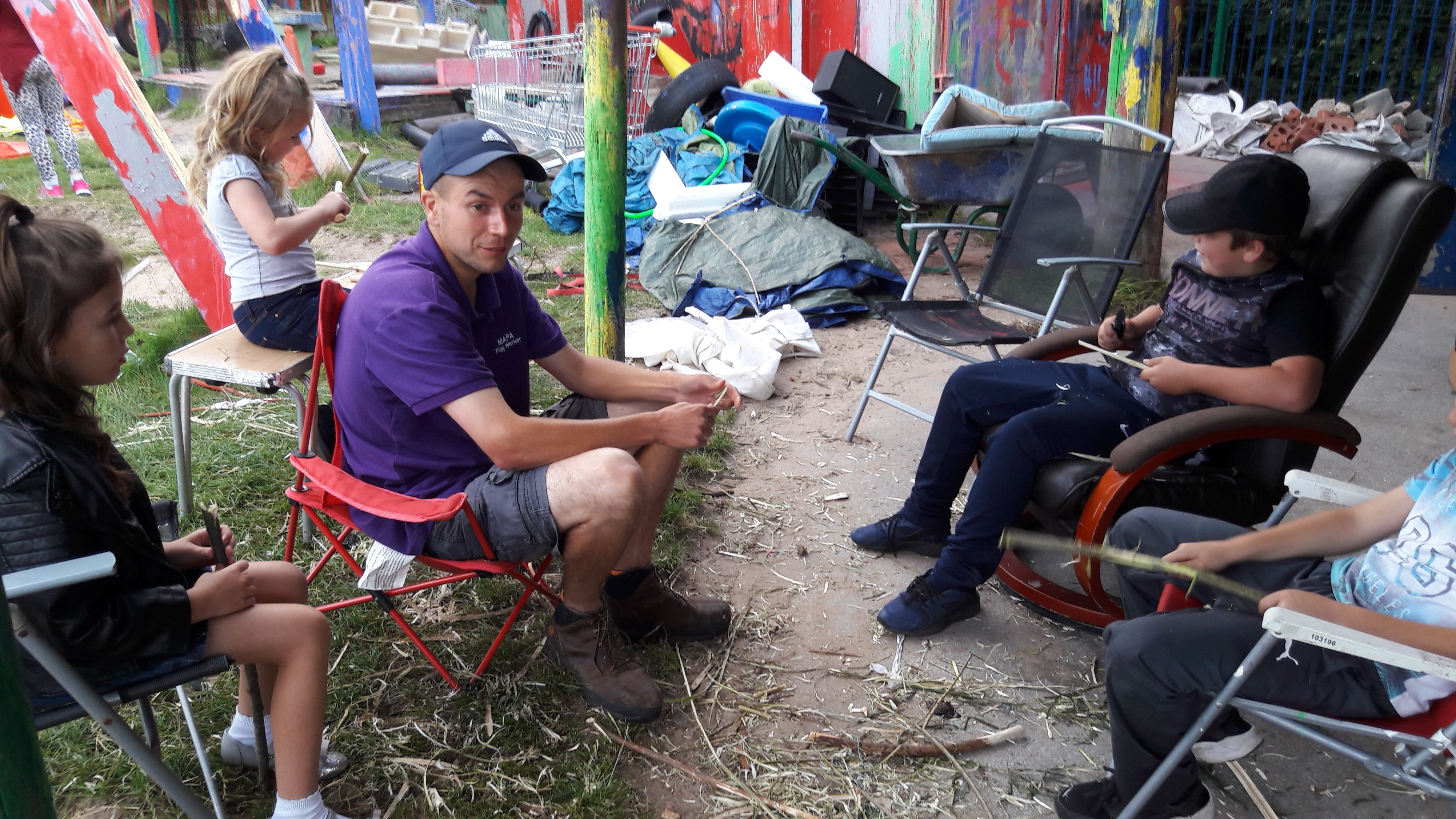
whittling
When Ali Wood enrolled for an event, ‘In Defence of Youth Work’, in Birmingham, she saw that the agenda featured discussions on youth work in different settings and situations. Never being shy about speaking out for play, Ali asked if youth work in adventure playgrounds could be added to the programme. This is a synopsis of her resulting workshop, and Ali’s rationale for it.

I qualified as a youth and community worker in 1985 and worked in a whole range of centres and clubs in Birmingham for a number of years.  Things were changing though –both in the local authority and across the country and it wasn’t hard to see the writing on the wall.  Funding for community work was dwindling fast and youth work as it had been was changing and becoming more issue-based, but somehow in that process we ended up losing numbers of young people – partly due to focussing more on discussion work than recreational activities and young people’s choices.  I ‘defected’ to playwork, which had begun with the introduction of adventure playgrounds in London in the 70’s and over the ensuing decades built up its own theory base, research evidence for play and qualifications for playworkers. I have been there ever since.

Adventure playgrounds

So for those of you who don’t know and have never been to one – what’s an adventure playground?  There aren’t that many left around since all the recent local authority cuts, so you’d be forgiven if you hadn’t come across one.¹  Basically an adventure playground is a community-rooted self-built site for both children and young people, where kids can come and be themselves and do their thing – which often includes the stuff that they can’t do elsewhere like lighting fires, using tools and building, making food, digging, climbing, swinging, jumping off high platforms, managing risk for themselves, playing with water and mud. It’s also a space where they know they’ll feel heard and valued and where spontaneous conversations will likely yield support or information they need.

they know they’ll feel heard and valued and spontaneous conversations will likely yield support or information they need. 

So what’s the difference between playwork and youthwork – or doing youth work on such a site?  In some ways – when you get youth workers who have a real sense of vocation – not a lot necessarily in practice.  But there are givens here that may not be automatically understood or recognised.

First principles

Firstly there is the understanding of the fundamental importance of play in children and young people’s lives. And by play, we mean that as it is expressed in the first two Playwork Principles² – which provide a professional and ethical framework for playwork.

  1. All children and young people need to play. The impulse to play is innate. Play is a biological, psychological and social necessity, and is fundamental to the healthy development and wellbeing of individuals and communities.
  2. Play is a process that is freely chosen, personally directed and intrinsically motivated. That is, children and young people determine and control the content and intent of their play, by following their own instincts, ideas and interests, in their own way for their own reasons.

If you recall some of your own memories of playing (and do this now before you read on!), I can pretty much guarantee that these will consist of being outside, taking risks and being away from adults – and the older you are, the more that will be the case.  Am I right?  And why do those three things feature so widely in people’s memories? Because children naturally long for freedom and independence as they grow; and if adults are around, those adults are likely to try and control, supervise, guide, direct, organise, stop or take over whatever kids are doing. Start watching yourself, and how much you do this when you’re with kids!

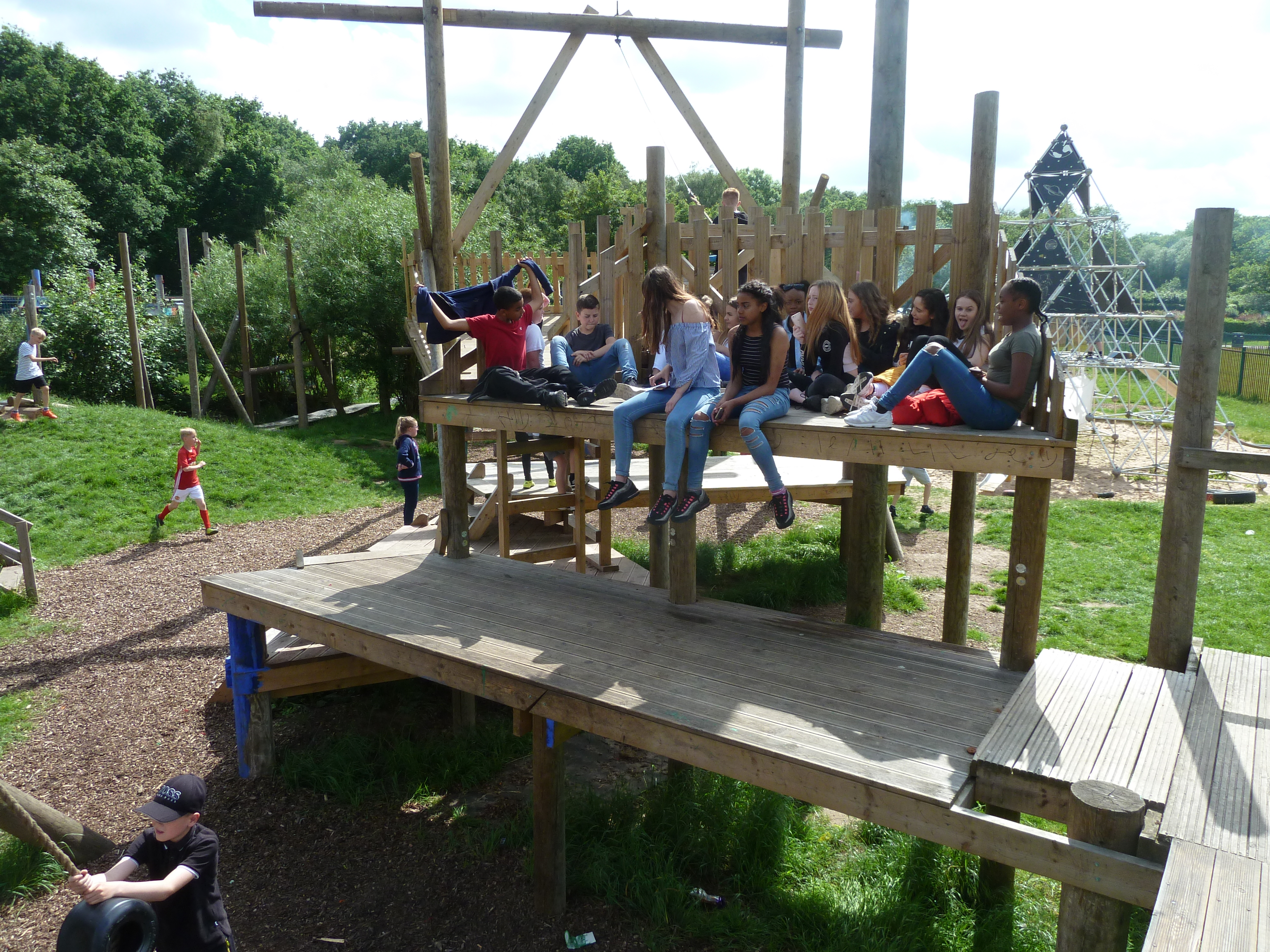
gathering on platform 2

So, children seek out time and space away from adult eyes in order to play. However, over the last few decades, kids have had less and less free time away from adults when they can make their own mistakes, be daft, work stuff out and try things out for themselves, be responsible for themselves and each other. Yet it is play as described above that is the natural medium for these things to happen, but opportunities for play have been squeezed, banned, or diluted – often with the supposed best of adult intentions – because we have forgotten how vital free play is and we are bewitched by the spirit of the age of over-protection and structured education of our children and young people. In playwork we call this play deprivation³ and it is a concept that other professions are also recognising as really damaging.

So, youth work really needs to understand what play is, why kids crave it and how to support it and respect it without getting in the way (and that honestly isn’t easy and takes a lot of reflective practice!) instead of planning a load of other stuff that we think is more important and riding rough-shod over young people in the process.  More than ever – because of being more play deprived in their own childhoods – young people need to play⁴.

Understanding risk

Secondly, in playwork there is a different understanding about risk, it’s necessity in young lives and how we can manage it. We use an approach that has been recognised and is promoted by the Health and Safety Executive⁵ for anyone working with children and young people and yet somehow youth work has not taken this on. It is the process of constant risk:benefit assessment⁶, whereby instead of automatically intervening to ‘make something safe’, playworkers observe children and young people in whatever they are doing and dynamically assess the risks of this, but also the benefits –i.e. what kids will gain from doing whatever it is, and also to think through ways of minimising the risks if this is necessary, without taking over and ‘doing it for them’.

Young people don’t have a death wish, they have an inbuilt sense of self-protection and survival that too often we have crushed by not allowing them to use it. 

It takes courage and practice, but it works. Young people don’t have a death wish, they have an inbuilt sense of self-protection and survival that too often we have crushed by not allowing them to use it.  When they know they are responsible for themselves, they really take that on and their skills and confidence flourish. On the adventure playground where I work and where we have unaccompanied children from 7-18 years on site,  we’ve had about half a dozen accidents that have entailed a visit to A & E in ten years, and yet our kids regularly use axes and mallets, hammers and saws, throw themselves off platforms and cook on the open fire.  Youth work really needs to better understand risk-benefit assessment in practice.

Differences

So, the main differences when doing youth work on an adventure playground (and we have youth only sessions at our playground as well as open sessions for all ages), entail youth workers:-

  1. developing a deep understanding of play in all its forms and how to support it;
  2. a profound respect for children and young people that recognises their capabilities and competencies first;
  3. a richer kind of reflective practice⁷ that puts us adults – with all our feelings and motives – under the microscope to examine how our interventions are too often colonial and patronising; and
  4. a commitment to risk:benefit assessment observation and recording.

This takes passion and courage, lots of supportive teamwork and the willingness to regularly go the extra mile. But in many ways, although I have called myself a playworker for the last twenty years, it is much more akin to the youth work I first felt so drawn to in the 80s.

Ali Wood

Ali Wood is a playwork writer, researcher and trainer. She is chair of Meriden Adventure Playground in the West Midlands, and a founding board member of the Playwork Foundation.

Photos: Meriden Adventure Playground

References

  1. http://www.playengland.org.uk/resources-list/adventure-playgrounds/
  2. http://issuu.com/playwales/docs/the_playwork_principles_-_an_overvi?e=5305098/11658290
  3. http://www.playwales.org.uk/login/uploaded/documents/INFORMATION%20SHEETS/play%20deprivation%20impact%20consequences%20and%20potential%20of%20playwork.pdf
  4. http://issuu.com/playwales/docs/building_resilience_?e=5305098/31468341
  5. http://www.hse.gov.uk/entertainment/childrens-play-july-2012.pdf
  6. http://issuu.com/playwales/docs/play_and_risk?mode=window
  7. https://issuu.com/playwales/docs/reflective_practice?e=5305098/62475902


Children’s Access to Play in Schools

Children’s Access to Play in Schools ( CAPS ), a University of Gloucestershire project under the EU’s Erasmus programme, is introducing its Play-friendly Schools Quality Criteria to the UK at an event in Gloucester on 5 December.

Download details here.

Unite calls for Labour to reinstate recognition of playwork qualifications

Katie the skateboarder

In its response to the Labour Party’s consulation on a statutory youth service, Unite the Union, which incorporates the former Community, Youth and Playworkers Union, has called for a return to the recognition of playwork qualifications.

Unite’s response says:

“Unite believes that playworkers would also gain from an increased recognition of their professional skills especially since September 2014, when the Government removed the statutory requirement for out of school clubs and holiday play schemes registered on the Ofsted Early Years Register to employ staff with ‘full and relevant’ childcare or playwork qualifications’ “

The deadline for submissions has been extended until the 30 November.

Information about the consultation and how to contribute can be found here

Unite’s full response can be read here

Photo: James Schaap


What is playwork under neoliberalism?

In this new paper, Ben Dalbey, inspired by the writing of Wendy Russell and Mike Wragg in the recently-published Aspects of Playwork: Play & Culture Studies, Volume 14 (Hamilton Books, 2018), and quoting extensively from their work, attempts to apply some of their ideas to a US context informed by race and class.

Abstract

The hegemony of neoliberal economic and social policy has had far-reaching cultural and political impacts in the UK and US, including changing the lives of children and governing the ways adults tend to think about childhood. Neoliberalism renders vast numbers of children deficient, devoid of value, or invisible, while encouraging the placement of a wide array of adult political and environmental anxieties in a socially-constructed neoliberal ideal of potential childhood success.

The field of playwork is uniquely situated as a profession working “with” instead of “over” children, but we are not immune to the impacts of this colonization of childhood. By lifting our eyes to see past the trope of the over-scheduled child of affluenza, playwork advocates and practitioners can improve our practice and place our advocacy within a context of revolutionary hope.

Read the full paper here

Ben Dalbey lives in Baltimore, Maryland, and is co-founder of Free For All Baltimore, a child-led community building project.

Photo: Petra Bensted

2nd ‘Playwork Campference’ announced for Houston, Texas, February 2019

A Second “Playwork Campference” has been announced for 15th-18th February 2019 in Houston. The organisers, Pop-Up Adventure Play, say it will  bring together “international experts on children’s play to discuss unconventional approaches to risk and inclusion”

Full details here

Photo: Calgary Community Services


Symbiotic homeostatic disequilibrium in playworking interaction

A new paper by Joel Seath and Gordon Sturrock, derived from and following communications at the PlayEd conference in Cambridge, May 2018.

Abstract

Playwork’s key claim is its unique manner of working for and with children. It currently suffers, however, from a lack of consensus regarding the benefits of its application. This paper challenges the dilution of playwork practice in acknowledging the art, grace and wisdom in connectivity of playworking. Drawing primarily on Antonio Damasio’s neurobiological analysis, the homeostatic disequilibrium operation at the core of body/neural intra-action is detected as reflected in the interaction of organisms.

In consideration of some key concepts of social ecology – consociation, mutual aid, co-operativity rather than competition, rhizomatic rather than hierarchical structures – and  the neurobiological study of individuals’ feelings, emotive responses, affect and culture, this paper discusses the evolving phenomenon of the playworking adult and child at play in terms of a symbiotic being and becoming.

Joel Seath and Gordon Sturrock

Download the full paper here

Image: ‘Rhizomatic tree of life’ by jef Safi

The Play Cycle 20 Years On

In 1998, Gordon Sturrock and the late Perry Else presented a paper at the IPA International Play Conference in Colorado, USA.  The paper was titled ‘The playground as therapeutic space: playwork as healing’, later referred to as The Colorado Paper and introduced the Play Cycle to play  theory.

In the last twenty years, elements of the Play Cycle (such as ‘play cues’, ‘play return’, ‘play frame’ and ‘annihilation’’) have entered into common use within the childcare sector.  The aim of this exploratory study is to investigate understandings and applications of the Play Cycle within childcare over the last 20 years.

This study is open to anybody who is currently involved in childcare but must be aged 18 years or over.  The research will be undertaken by Dr Pete King from Swansea University and Dr Shelly Newstead.  For more details about the study, please contact Pete at p.f.king@swansea.ac.uk or 01792 602 314.

To take part in this study please click on the link here

The questionnaire can be completed online using a computer, tablet or phone.

The study is open to Friday 21 December 2018.

Thanks

Dr Pete King

New policy roadshow date for London

abandoned grass light merry go round
Photo by Levi Damasceno on Pexels.com

Monday 12 November

Hosted by Hackney Play Association at

Pearson Street Adventure Playground
Hoxton
London E2 8EL

*Please note that this is a change to the date and venue previously advertised due to a clash with another play policy discussion event!

The Playwork Foundation, Play England and Hackney Play Association warmly invites you to this play policy forum. It is an opportunity for the children’s play community in London and beyond to come together to discuss the vital issues, national and local, facing our work.

The forum is part of a roadshow of discussion forums organised by Play England and the Playwork Foundation taking place across the country to share latest thinking and developments and consult with all those involved in supporting children’s play – to help shape a manifesto for play and coordinate campaigning for better play provision and opportunities.

These discussions will feed into and shape a national manifesto for play, to help put play back on the political agenda.

Speakers to be announced soon.

This event is free – all welcome!

Book your place here:

For more information please e-mail sophie@playengland.net


A Manifesto for play – a policy development event

Wednesday 5th September 2018
10am – 3pm

Sycamore Adventure Playground
Sycamore Green, Dudley, West Midlands, DY1 3QE

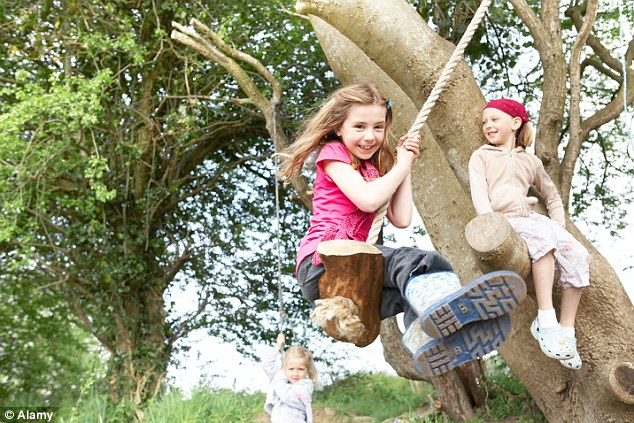
Rope swing girl-image-a-10_1434067322389

Sycamore Adventure Playground invites you to this play policy forum, ‘A manifesto for play’. It is an opportunity for the children’s play community in the West Midlands and beyond to come together to discuss the vital issues, national and local, facing our work.

Speakers will include:

  • Mike Barclay, PlaySufficiency Lead for Wrexham Council
  • Ben Tawil, Senior Lecturer in Childhood and Family Studies)
  • Libby Truscott, Trustee of Play England
  • Karen Benjamin, Chair of the Playwork Foundation
  • Anita Moore from St Pauls Trust
  • Laura Watts from the Children’s Quarter.

The forum is part of a roadshow of discussion forums organised by Play England and the Playwork Foundation taking place across the country to share latest thinking and developments and consult with all those involved in supporting children’s play – to help shape a manifesto for play and coordinate campaigning for better play provision and opportunities.

These discussions will feed into and shape a national manifesto for play, to help put play back on the political agenda.

This event is free – all welcome!

Book your place here:

https://www.eventbrite.co.uk/e/a-manifesto-for-play-play-policy-roadshow-dudley-west-midlands-tickets-48123864775

For more information please e-mail sophie@playengland.net