Over 60 people booked for our 2022 Playwork Foundation Open meeting. Many thanks to our speakers:
Margarite Hunter-Blair – Play Scotland
Martin King-Sheard – Play Wales
Alan Herron – Play Board Northern Ireland
Libby Truscott – Play England
Paul Hocker – London Play
Ali Wood – Meriden Adventure Playground
Penny Wilson & Sion Edwards – Wrexham City of Play
Also a big thank you to Sion Edwards – The Playwork Foundation’s new chair – for facilitating the meeting.
If you missed out or want to listen again an audio recording of the meeting is available here.
If you want to find out about future meetings, consider become a member of The Playwork Foundation and you’ll be added to our mailing list. Head over to our membership page for more information.
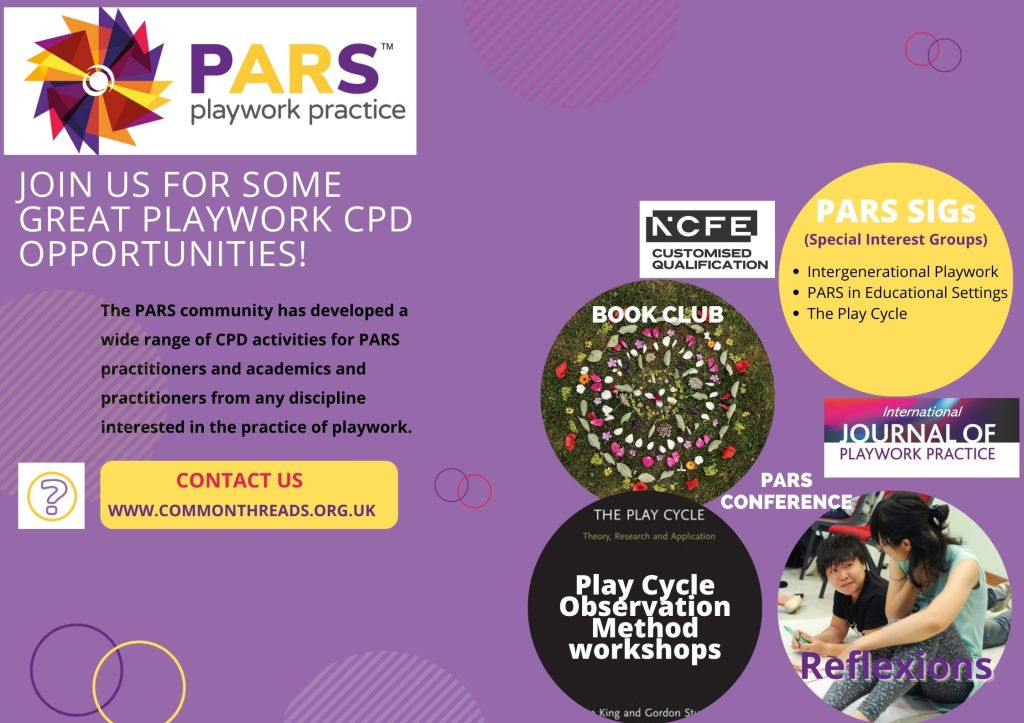
The PARS Community has developed a wide range of CPD activities for PARS practitioners and academics and practitioners from any discipline interested in the practice of playwork.
· The state of playwork across the UK by each of the four national play organisations
· Pete King on his post-Covid research with playworkers
· Sion & Penny on ‘Playwork in Progress’ reflection sessions
· Ali & Barbara on Playwork Training and Qualifications
5. The Playwork Foundation’s future plans
6. The future of Playwork – some provocations
All members are invited to attend to see the great presentations we have lined up, and take part in the debate about the future of playwork. Please reply to aliwood@blueyonder.co.uk who will send you reports and log-in details nearer the time.
In this original article, one of the country’s leading experts in children’s outdoor play, Rob Wheway, criticises the UK Government for neglecting children’s development, suggesting that the Covid-19 restrictions further increase the damage to their physical and mental health.
The UK Government’s exclusive focus on school-based education, ignoring children’s out-of-school activity, is damaging. It wrongly assumes that school education is sufficient for children’s development. The idea of extending the school day in England confirms this bias.
This fixation on school-focused education, at the expense of a wider view of child development, is puzzling. Children have nearly as many days for play (175) as days for school (190) each year. Even on school days, they have hours for play after school. Covid restrictions have increased the hours but restricted the opportunities.
Clearly, time for play is a larger portion of children’s lives than school. It is also the opportunity for children to develop some of their abilities in ways that are much more effective than school-based education. The most obvious of these is exercise. When they can play out, children do get a lot of exercise. Some of this is fast, such as tag-type games; some is sporadic, such as hide-and-seek and riding scooters or bikes; ball games give co-ordination; imaginative play often involves running around in a magical world from which adults are excluded. Where children can play out in safety, e.g. in small cul-de-sacs, children as young as 4 learn to cycle on 2-wheeled bikes without stabilizers.
Achieved without adults
All this exercise is done willingly, for the fun of it, rather than to achieve tested stages. In all these ways, for long periods of time, children who can play out, get more exercise than they do at school. It is achieved without adults needing to be there.
Less obvious than exercise is the social development children gain from play. When playing they have to organise the activity, make the rules, set the boundaries, settle disputes, reach compromises, make up after upsets. They have to be honest and give themselves up when they are out. If a friend arrives with two younger siblings they have to work out how to integrate them into the game.
Some children are lucky enough to live near an adventure playground where they can play freely. The playworker’s role is to enable rather than to organise the children. In this way children can build dens, use real tools, light fires. They can have more adventurous activities than on a conventional playground.
These benefits from play are there precisely because adults are NOT organising what happens. In play, adults do not follow a curriculum that is tested at various stages. Children take the initiative and organise themselves. They learn naturally what will give the most fun and fulfilment. We take the social development of all this sophisticated agreement-making for granted because children have always done it for themselves, throughout the ages.
What’s gone wrong?
So what’s gone wrong? There has been a massive environmental problem that is unrecognised. For generations, people had public open space just outside the home, where adults could walk and talk, and children could play. It was called the street. But now the car has been allowed to dominate even residential side roads. The result is that children cannot play out, and so they are less fit, more obese and less emotionally resilient than previous generations. Parents are blamed for wrapping their children in cotton wool and stopping them from playing, but they are in fact making sensible decisions to keep their children away from the danger of fast cars.
Covid restrictions have made matters worse and governments refuse to recognise that the increasing problems of damaged physical and mental health are caused by the lack of freedom to play – NOT a lack of school.
Playgrounds are valuable, but less than 10 per cent of children have access to a playground where they can play freely every day. The government in England is ignoring the other 90 per cent. Town parks or destination playgrounds are great as family facilities, but only for the one or two occasions per week when parents have time to take their children.
Restricting traffic
The Government makes the classic mistake of concentrating on outputs (number of playgrounds) rather than outcomes (can children play freely every day). The number of playgrounds is counted whether or not children can access them in safety. A strategy of restricting traffic on side roads would permit children to play out. They would be in small numbers and in the outdoors so would be safer than going back to crowded indoor classrooms.
Playing is a vital part of children’s development. Given a chance, it is what they will happily do for hours on end. It’s a natural part of their development. Of course, they will spend time on computer games, but as the previous generation found when radio and TV emerged, they still wanted to get out and play.
In summary, freedom to play outside, but close to home, is vital for children’s healthy development. Ignoring it is damaging children’s physical and mental health.
The Playwork Foundation is to play a supporting role in the new play conference, Play 2021, being organised by Playful Planet and the University of Birmingham on 7-8 July.
Play 2021, a conference on children, play and space, will be an online event but the organisers are also hopeful that in-person delegates will be allowed by the summer, and space has been booked for it on the university campus. Those registering for the online event now will have the option to upgrade to an actual seat at the conference as and when this is confirmed.
There is a call for papers for the conference, including from playwork practitioners and researchers, with playwork one of the themes of the event. The Playwork Foundation will join the conference committee to help curate this strand.
The event’s first speakers have been confirmed:
Tim Gill, the longstanding campaigner and writer on play and child-friendly environments, and author of the new RIBA publication Urban Playground;
Professor Helen Dodd, from the University of Reading, whose research on play and the pandemic has featured prominently in debates about the government response;
Ash Perrin, founder of the Flying Seagull Seagull project, which takes playfulness to children living in some of the world’s most troubled and deprived communities.
More speakers will be announced soon. Follow the Playful Planet site for regular conference updates.
The All Wales Playworkers Forum has been running since 2007. Orginally established by Play Wales to provide a forum for those working in adventure playgrounds it has evolved to meet the needs of the sector. The Playworkers Forum is run by a dedicated steering group of playworkers, for playworkers. In the past a number of regional play associations took it in turns to administer the event with our collective aim being to keep the costs as low as possible, whilst bringing as many playworkers as possible together to share information, network and recharge our batteries. More recently, with the sad closure of the vast majority of the regional associations, Play Wales have taken over administration of the event on behalf of the sector, with the steering group working hard to keep things fresh and exciting for all participants from year to year.
Over the years we have toured around Wales, from as far south as the Gower Peninsula to as far north as Hawarden. We’ve made temporary homes in orchards, willow globes and big tops and generally we have almost always had the weather on our side. Anyone who’s ever attended will be fully aware of how much of a special event it has become in the playwork calendar. As our infrastructure has changed here in Wales, the forum has also been opened up to anyone from across the UK and it has brought playworkers together to share their unique experiences and support each other. The event has always been an overnighter, with participants camping out under the stars and often sat up into the small hours gazing at the glowing embers of our fire and putting the world to rights.
Over the years we’ve been lucky to attract some of the best playwork trainers, speakers and academics and they have all really helped to make the event what it is. We tend to have a blend of theoretical and practical sessions, normally focussed around an emerging or current hot topic. One of the annual highlights is without a doubt the ‘Annual Playwork Games’ hosted by Martin King-Sheard. Two teams of goblins and elves compete in a head to head to find out who will be crowned champions for the year ahead.
This years event was somewhat different from previous years, due to the lockdowns that sadly made meeting in person impossible. Instead, to ensure that we maintained continuity we all came together on 24th June 2020 for an online book club that was organised and facilitated by Play Wales. It was so much of a success that they are now continuing these for free as a monthly professional development opportunity for play and playwork professionals in Wales. Each month they select a freely available online paper, article or other publication relating to play and playwork for you to read and then you can join an hour’s discussion and reflection on the content. All Book Club meetings are held on the Zoom online meeting platform. More information is available here.
In the first book club, participants discussed the Play Wales guidance paper ‘dynamic risk management of common but potentially hazardous play behaviours’. This paper was written by Mike Barclay, Dave Bullough and Simon Bazley. The paper is available for free download here.
The event was facilitated by Martin King-Sheard and Marianne Mannello from Play Wales, who also ran a ‘Q and A’ session with one of the papers authors, Simon Bazley. The successful event was then followed by an online version of the playworker games where contestants competed to find out who would be crowned champions for 2020. It was a close call with competitors racing around their houses to undertake a series of challenges and games. In the end the mighty elves came through victorious once again, just beating the goblins in the last game.
Anyone interested in attending future events should keep an eye out on the Play Wales website as we hope to be back to meeting in person once again in 2021 if local and national restrictions allow.
Dr Pete King of Swansea University is researching the playwork field’s response to the pandemic and has two opportunities to get involved.
Adventure Playgrounds
Dr. King is looking for anyone involved in adventure playground to take part in a study on how adventure playgrounds have been adapted since post-lockdown measures were put in place in July 2020. The research study will involve a short 20-30 minutes interview using Zoom. If you would like to take part, please contact Pete at p.f.king@swansea.ac.uk where you can be sent more information about the study. The research study has ethical approval from the College of Human and Health Science at Swansea University.
After-school clubs or holiday playschemes
Dr. King is also looking for anyone involved in afterschool clubs or holiday playschemes to take part in a study on how you have adapted since post-lockdown measures were put in place in July 2020. The research study will involve you to take part and complete a short survey which can be accessed here.
This research is part of a larger project that Alison was working on, funded by a Leverhulme Research Fellowship, focused on how organised street play sessions using the Playing Out model were remaking relationships between people and places on the street. Fieldwork on this project was just about to begin as Covid-19 emerged and as the first lockdown was announced in the UK, meaning playing out sessions swiftly vanished as did Alison’s fieldwork sites.
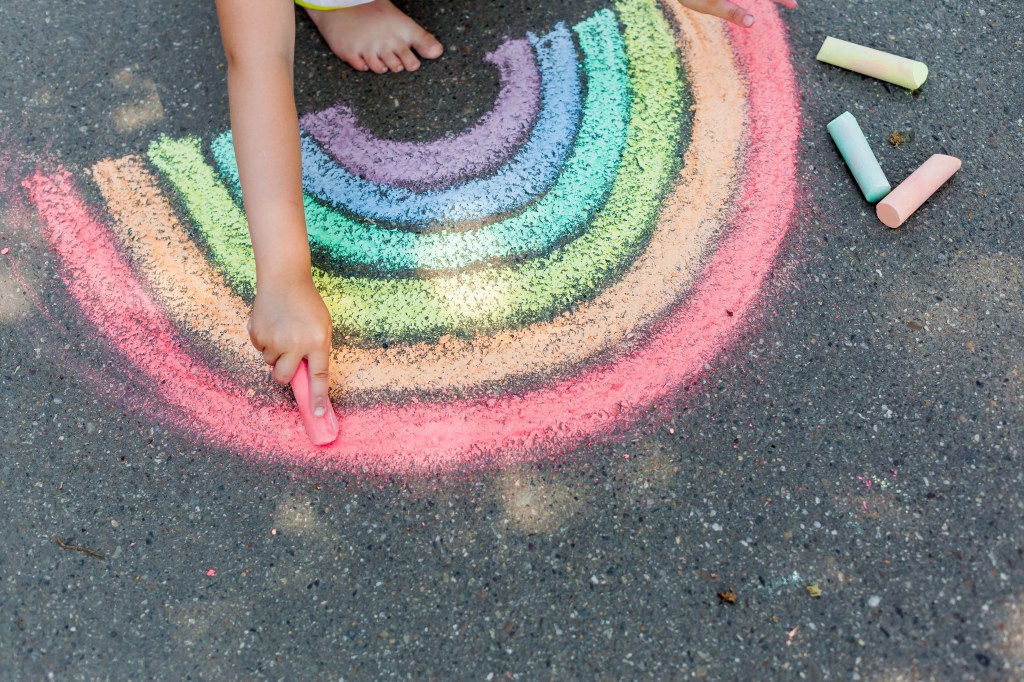
Yet just as swiftly, we witnessed the flourishing of all kinds of other activities that connected play, neighbours and streets: mutual support networks emerged; traffic levels dropped; residents took to the streets. We saw the emergence of all sorts of playful acts – rainbows in windows and Thursday night claps to thank NHS and key workers, teddy bear trails, and the proliferation of pavement chalking. These emergent spaces seemed all the more important in the face of the closure of other public spaces of play and connection, including playgrounds.
With the restrictions on movement, debates emerged around access to public space, especially for children, and particularly for those without private gardens. Pressure on public parks led to threats of closure and the media reverberated with testy discussions about what were legitimate reasons to be outside. Within these debates, children’s right to play outdoors was challenged at times by police and by vigilant neighbours, and families expressed anxieties about the safety of outdoor play.
The research study
In this context, together we worked with other play activists and researchers to present a case for outdoor play on streets, arguing that this was a space which needed protection and advocacy. But we also wanted to do some research to get a better sense of what was going on in terms of play and playfulness on streets. We wanted detail: to get at the ‘granular’ connections people were making with their streets in lockdown.
We developed a qualitative survey to gather data about playful activities, and changes in the material environment and feel of the street. The survey was circulated through social media and networks of community groups, play organisations and beyond. We received 78 responses from across England, Scotland and Wales. Reflecting the limits of online research and of our own networks, the majority of respondents were White, well-educated owner-occupiers. More than three-quarters of the respondents were women and two-thirds were aged 35-54, but more than a quarter of respondents did not have children under 18 living with them. We followed up the survey with 13 online video interviews. In these interviews, we explored participants’ survey responses in more detail but also explored the sites of play through drawing maps, using Google Maps on-screen, and sharing photos and videos. We also invited respondents’ children to participate and in 5 of the interviews a total of 12 children aged between 4 and 11 years joined for all or part of the conversation.
It is relevant to note that playworkers and community activists were disproportionately represented amongst our respondents; in part, this reflects our recruitment strategy but also, we feel, reflects the desire and willingness of such people to recognise and engage in playful acts in their communities.
What we present here in terms of ‘findings’ are very much preliminary, as we are still analysing the detail of the rich data we gathered, and we have focused on what might be of particular interest to a playwork readership.
Time, space and permission to play
We know that if conditions are right, children will play; these interdependent conditions have been categorised as time, space and permission, and as a matter of spatial justice. One thing that most children did have during lockdown was time, given that most stopped attending schools and other organised activities. Nationally, although time spent outdoors did not appear to change significantly for primary aged children, socialising was of course greatly reduced. In our research, not all parents had extra time, but several respondents did comment on the time available to spend chatting, at a distance, with neighbours. Many talked of spending more time with their children, and of children spending more time playing with their siblings if they had them, more time exploring and playing in local streets and green spaces, more time inventing their own ways to play.
Time, space and permission to play intermingled in various and sometimes contradictory ways. All had witnessed a number of changes on their streets, the most common being less traffic and more people walking in the road, reflecting widespread narratives of street life during lockdown. More people were using their street for walking, running or cycling, or to linger in front gardens, yards and pavements. This suggests a real shift in the presence of people on streets, with a sense of much more connecting with neighbours.
Just over half felt their streets were quieter during lockdown, both in terms of activity on the street (particularly traffic) and noise. Only 12% reported that traffic was slower whereas over a quarter reported seeing speeding vehicles, reflecting what has been reported elsewhere. Many also noted that the reduced traffic levels were short-lived, lasting only until lockdown started to be relaxed.
Although 60% reported that they had seen chalking on roads and pavements, a clear sign of the presence of children on streets (even if at times it was adults chalking), just 35% saw more children playing on the street. Additional responses suggested a mixed picture: on streets where children ordinarily played out, some reported that there was a reduction when lockdown started, as families followed government guidance to “stay at home”:
“I have really missed the sound of children playing … during lockdown. At first I found this eerie and sad.”
Others suggested that children were playing out more of the time as they weren’t at school. On streets where children ordinarily rarely played out, some saw no change, but some did witness a significant increase:
“For the first couple of weeks, there was no traffic at all and we could see children playing on the street corners – this has never happened before”.
There was a temporality to all these patterns – as there was for much of what was reported – with a peak lockdown period (from 23 March to 13 May) marked generally by higher levels of street activity, but in some instances lower levels of children’s presence as parental anxieties and unclear rules restricted children’s access to outdoor space.
The kinds of activities respondents reported, in addition to simply seeing and talking to more neighbours more of the time (something significant in itself), included bingo, doorstep discos, music (live and recorded), dancing, singing, sports (including street marathons for charity), cycling and scooting, chalking, nerf wars, chalk trails and hopscotch, nature trails and bug hunts, rock snakes, rainbow trails, teddy bear trails and tea parties, toy and book swaps, football, kerby, hula-hooping, and more.
In some instances, play was animated or curated by activists, working from home or furloughed, and shifting their professional playful and community practices to their streets. In each of these instances, these playworkers and community workers opened up spaces for other neighbours, of all ages, to engage in a process of play, stepping back, in the tradition of playworking, to enable children and their families to occupy the playful environments created, but often linking this to other forms of support for those who needed it.
These diverse forms of play were experienced in all sorts of ways but a few common themes emerged. Some talked of a simple joy in seeing children playing:
“the sound of laughter and general buzz really does lift the spirits … It has been nice to see the street come alive again.”
This seemed to resonate with hope in the context of the pandemic and also the opening up more spaces for neighbours to connect:
“Seeing kids playing with each other, despite the situation, brings a smile to my face. The children may be aware of what’s going on, but being able to play without any inhibitions brings back memories of playing when I was young too. It makes the street inviting for families and brings more children out to play.”
This sense of playfulness creating a space for connection appeared in a number of responses:
“I love it. We can connect. I love the creativity, the generosity, the community spirit that it engenders. The opportunity it offers for us as older neighbours to be playful with the children/families nearby.”
For some, especially those more vulnerable and shielding, this was translated into an increased sense of security and comfort:
“They mean so much to me. I feel safer knowing my neighbours.”
“Being creative and playful felt comforting”
Much of this was connected directly to changes in the materialities and atmospheres of the street itself, created by these playful acts, such as chalking and planting, which shifted not only these respondents’ relationships to their street, but more broadly.
“Planting in the street makes me feel hopeful. And I felt really proud, sharing footage with friends and family to show them what a great street I live in! And how a sense of community can be fostered.”
Of course, these experiences were not all joyful; the pandemic and the rules of lockdown encroached on street life and on playfulness in sometimes difficult and painful ways. Respondents were aware of diverse attitudes to the rules, sometimes unsure of what was and wasn’t permitted, wary of upsetting their neighbours but also anxious that their own attempts to be playful might be watched and shamed from a neighbouring window or doorstep. Others, including those shielding or with vulnerable family members, oscillated between the comfort and security offered by seeing their neighbours animating the street and the fear that too many connections might exacerbate the pandemic and extend the lockdown. One interviewee noted how, as time went on, the rainbow pictures were still up in windows, but they had faded: she felt this was a kind of dystopian image and that the NHS, where she worked, had been forgotten, adding “they all clapped, but they broke the rules”.
Maps and materialities
A changed relationship with their most local environments was a recurring theme in our follow-up interviews where respondents described and mapped in different ways their playful practices through lockdown. Through this process, the very detailed material geography of streets – and its remaking during the weeks of lockdown – came to the fore, showing how differently streetscapes are experienced by children, and the ways they perceive the possibilities for playing.
One 8-year-old talked about how all the parked cars meant she couldn’t balance along the kerb; her 11-year-old brother marked his map with the section of the street where the kerb was particularly high, making it good to jump off on bikes and scooters. A 7-year-old talked about there being lots of rocks in the street – there was brick paving and many of the bricks were loose. A 9-year old recalled dancing across the street with her friend, from facing pavements that allowed them keep a two-metre distance.
Many people talked about staying hyperlocal. The maps reflected this, for example, showing the small spaces of the local park, discovered and explored during lockdown, and the route there through snickets, alleyways and side roads, peopled by neighbours with rainbows in their windows, hammocks in their front gardens, and chalk on their pavements. Others talked of playing in the nearby woods because they felt less watched over. One mother of a 4-year-old talked about how, because the playground was closed, her daughter “learned how to be in the woods. Now she will make up her own games, do more self-directed play”. “Sticks,” the daughter informed us, “are not toys, they’re animals”.
The importance of play and street geography
In many ways, lockdown opened up spaces for play and connection for our respondents and remade streets and neighbourhoods in multiple and positive ways, but these playful transformations took place in the shadow of Covid-19. This meant that play on streets was also at times restrained and restricted, conditions potentially antithetical to play. As official guidance on outdoor play and children socialising remains opaque and contradictory and as we face more lockdowns over the autumn and winter, the need to advocate for and make space for play on our streets and in our communities continues.
This is especially the case for those children for whom conditions for play are more restricted than for our comparatively privileged and fortunate respondents, including those in overcrowded, temporary or sub-standard accommodation and those whose access to outdoor space is limited. These are perhaps the children more likely to be those that use open access playwork services, suggesting there is a need for further research in this area and perhaps for a broader think about playwork in the community.
As one of our local organisations said ‘We may be all in the same storm at the moment, but we are not in the same boat’.
Children and young people have lost so much, and in the places we work large numbers of them are on free school meals, with no access to the internet and some of them have no paper or basic art and craft materials at all. Given all that is happening, art, creativity and the opportunity to express yourself becomes more important than ever.
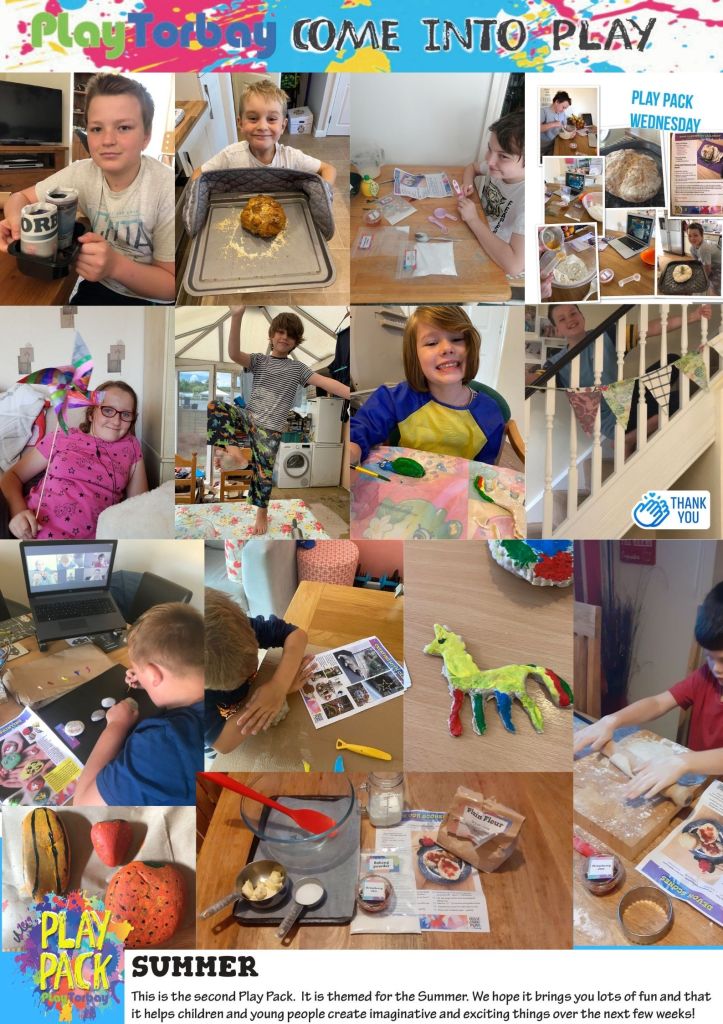
In Torbay our local play organisation joined forces with colleagues from Imagine This… a partnership of 43 voluntary sector children and young people’s organisations in Torbay, and we developed and provided Let’s Create and Play Packs for children and young people across ALL age ranges 0 – 19 years including treasure and sensory baskets for little ones and acrylic paints, sketch books and opportunities to take part in on-line sessions for teenagers.
Play Torbay is providing Packs for children aged 5 – 12 which included a range of scrap and craft materials that would usually end up as waste, along with instructions of fun things to make and do. Participants can access a weekly virtual session led by experienced playworkers, who talk through ideas of how to use the pack to its full potential, as well as providing opportunities for the young people and their families to engage with each other. If any families would prefer not to join the online session, the playworker can contact them directly instead with ideas of how to get the most out of the pack. We are also offering support to families who may be struggling to cope, with signposting and referral to other services where that’s required.
With support from a number of different funders, since March we have developed 4 differently themed packs and jointly delivered over 1,000 packs with over 80% going to families who are disadvantaged in some way. We have a waiting list so fund-raising is continuing because we would really like to ensure the service can carry on through these difficult times. Anyone who feels they may benefit from being involved in the Let’s Create and Play Pack project can contact Play Torbay by emailing admin@playtorbay.co.uk
To get an idea of the different things the packs offer, in the ‘Winter Play Pack’ there are separate bags for 8 planned sessions where you can try out different skills. There are detailed instruction sheets, so you make can things in a similar way, or you can use the materials in lots of different ways including making your own ‘fidget board’, ‘creating a plastic planter and growing seeds’ and designing your own ‘tree decorations’.
The exciting news is that we are now planning a fifth Play Pack with an eco-theme. This new pack is currently in design phase and subject to funding, will be available from January and run till the end of March 2021. The aim of the Eco Play Pack is to develop creative and playful ways for young people to actively be involved and take their share in protecting the planet. We are working with Torre Abbey and the Trove Scrapstore, a resource hub providing materials to re-make, recycle and re-use; and with Torbay Climate Action colleagues to develop opportunities to explore how solar panels work, re-using plastic and creating eco bricks, the importance of insulation and zero carbon solutions, passive house building, supporting natural habitats, permaculture and plants, etc.
Building on the success of weekly Zooms with Play Packs, where we can host as many as 20 families in a session, we are now planning to invite different presenters to join to talk through and demonstrate an idea, such as building a mini solar-powered boat, or planting winter salad leaves and then discuss further possibilities with young people. One of our ultimate aims is to explore the possibility of developing an inclusive, eco-friendly, people-powered, carbon-neutral adventure playground and we hope that the Eco Play Pack will support and encourage young people and their families to contribute to the future design of the playground.
Following the success of the first Playwork in Progress online reflective practice session, we’re back with the 2nd session on Monday 31st August, 2 – 3pm.
This is a chance for playworkers from across the UK (and, who knows, beyond!) to come together and share their experiences of playwork in this “new normal”, the barriers you face, and your plans for the future.
(Spaces are limited so please make sure you let us know if you book a place and are subsequently unable to attend).
We recognise that this may not be the most convenient day and time for everyone so we’re planning for future sessions already. To have your say, please complete one of the following surveys:
If you attended the first session please complete this survey.
If you’ve not been able to join us but would like to in the future, please complete this survey.
To keep up with the conversation, please like the public Facebook Page (and follow ‘Playwork in Progress’ on Instagram and Twitter.
This is open to both members and non-members of The Playwork Foundation, so please feel free to share this post with any of your playwork colleagues who may be interested in taking part.




 The Playwork Foundation