The Children’s Commissioner for England has unveiled an ambitious plan for the final two years of her tenure, coinciding with the office’s 20th anniversary.
Victoria Climbié’s death in 2000 exposed severe shortcomings in child protection in England, leading to the Laming Inquiry and significant changes to legislation, including the Children Act 2004. However, the tragic case of Sara Sharif, murdered by her father and stepmother in 2023, demonstrates that serious challenges remain in ensuring children’s safety.
As The Victoria Climbié Foundation points out, Sara was not a hidden child – she was known to authorities. Yet, despite this, she still fell through the cracks, echoing past failures in child protection. Her case is a tragic reminder that there remains an urgent need for improved multi-agency working, better information sharing, and stronger accountability within child protection systems.
With the memory of these tragedies casting long shadows, the Commissioner has vowed to intensify efforts to protect children in England. Her mission is to ensure children’s voices are heard and their needs prioritised in policy-making.
Despite two decades of progress, children are still side-lined in key national debates. The Commissioner highlights a lack of consideration for young voices in pivotal discussions, including responses to crises like the pandemic, the rise in small boat crossings, and the 2024 summer riots. Even in the current debate around assisted dying, children’s perspectives have been largely absent, the Commissioner claims.
“The past tells us what happens when we fail to protect children. The future must be different”
Rachel de Souza, Children’s Commissioner for England
A new Westminster Government is presented as an opportunity to reshape attitudes towards childhood. Over the next two years, the Commissioner intends to amplify young voices in decision-making, ensuring policy shifts show their lived experiences and aspirations.
One of the most significant initiatives is Mapping Childhood, a data project using four years of research to identify the best places to grow up in England. The findings will inform targeted interventions, reinforcing the principle that a child’s postcode should never dictate their future.
Additionally, the Commissioner will advocate for systemic reform, stressing that fragmented support services must be replaced with a unified approach across education, health, social care, and justice. The introduction of a consistent identifier is seen as a key tool to prevent children from falling through gaps – something the Commissioner also advocated for in her submission to the Children’s Wellbeing and Schools Bill Committee in February this year.
The Commissioner’s 2024 School Survey, which gathered responses from nearly 90% of schools in England, laid bare the immense pressures schools face in meeting children’s welfare needs.
The Commissioner’s Big Ambition survey revealed that only one in five children feel listened to by politicians. In response, the Commissioner vows to use children’s voices to guide policy through a strengthened Youth Ambassador network, a new Young Voices Forum, and the Festival of Childhood.
A commitment to child-friendly versions of all reports is hoped to improve accessibility with the Commissioner going further by calling on all Westminster departments and public bodies in England to follow suit.
“In 2025, when we say never again, we must mean it” pledged the Commissioner, as she enters this final stage of her tenure serving for England’s children.
Download the full report and the children’s version below:
On Tuesday 13th May 2025, Play England will unveil its new 10-year strategy, It All Starts with Play!, at the House of Commons. The launch will coincide with the announcement of a new All-Party Parliamentary Group (APPG) on Play during a special event in the Terrace Pavilion, overlooking the River Thames.
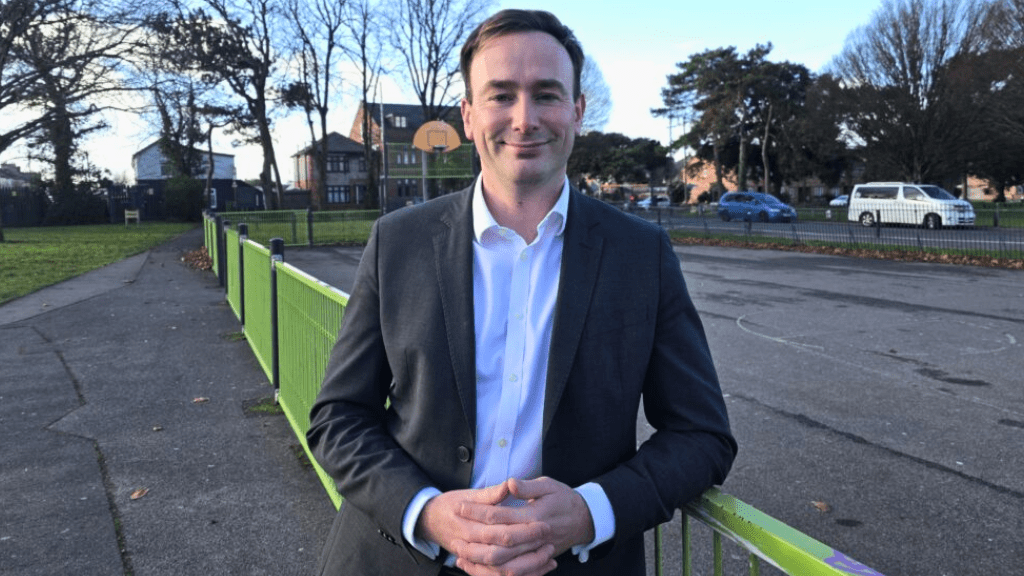
Hosted by Labour MP for Bournemouth East, Tom Hayes, the event will bring together politicians, sector leaders, and advocates of children’s right to play. Alongside formal remarks, the event also teases the opportunity to “play and connect with key voices shaping the future of play in policy, planning, and public life”.
Tom Hayes MP may be fresh in your memories from January this year when he successfully tabled Westminster’s longest debate on play in 17 years – and, notably, the first debate on play in 8 years!
His motion focused on the provision of playgrounds by local authorities in England, during which he outlined two pivotal proposals:
1. That the Play Strategy for England be “dusted off… to better spend the money already in the system”.
These proposals were key tenets of the 2024 Play England Manifesto, making it unsurprising that Hayes was joined by Eugene Minogue, CEO of Play England, at the Palace of Westminster.
So, could the launch of It All Starts with Play! be the pivotal moment for play that playworkers in England have been waiting for?
It certainly prompts reflection on the challenges both Play England and the wider playwork sector in England have faced since the 2010 UK General Election.
The National Play Strategy, introduced by Ed Balls and Andy Burnham in 2008, represented a landmark commitment to children’s play in England, backed by £235 million to create thousands of play spaces and adventure playgrounds. However, the strategy was abandoned by the Cameron-Clegg Coalition just two years later, signalling the beginning of a sharp decline of play provision and policy across England.
With no national commitment to play, local authorities and other play providers have grappled with fragmented funding and ever-dwindling resources.
This absence of a cohesive strategy and government funding has also left the sector drawing on piecemeal funding and more corporate and private sponsorship, sometimes leading to a distortion of the role of play and playwork to comply the agendas of such funding streams.
That is why when graphics of the event sponsors accompanied the invitation to the Westminster event, some playwork advocates raised concerns about what such financial backing signalled for the future of play in England. So much so, that on sharing the news over the weekend, one commentator challenged me to “follow the money”.
PLEASE NOTE: In the original article (posted 30/04/25), it incorrectly asserted that the following organisations were sponsors of Play England. It has since been clarified that these are the sponsors of the event at Westminster, not Play England as an organisation. Our apologies for this misrepresentation.
Before I do so, it is important to note that it has been made clear by Play England that these sponsors have had no role in shaping the new 10-year strategy, which has been developed independently through the year-long process of consultation and engagement throughout 2024.
Sutcliffe Play – employee-owned playground equipment manufacture and design.
Play Innovation – provider of outdoor play, sports equipment and Multi Use Games Areas (MUGA)
Notts Sport – owners of ChildsPlay who specialise in the design and supply of artificial turf carpets for fixed equipment playgrounds
PlayNation – a publication by NationMedia in partnership with Play England, promoting play and physical activity for children & young people, and a publishing partner for the strategy itself
SAPCA– trade association for the sports and play construction industry
After closer inspection, I think it was a fair challenge to pose! But, is it tantamount to an orchestrated conspiracy or simply pragmatic promotion?
On the one hand, these organisations do not seem nefarious in their own field. They can bring expertise, resources, and innovation to the table when considering – like Tom Hayes’ debate did – the future of fixed equipment playgrounds in England. Their financial support also enables Play England to launch their new strategy on a scale befitting of such a prestigious venue. By doing so, the strategy is given an elevated platform and brings key players together more effectively and with intention.
On the other hand, it’s reasonable to question whether such alignments risk prioritising expensive, prescriptive, equipment-focused solutions to spatial injustice in children’s play more broadly – at the expense of rich play, dynamic environments curated by playworkers when it comes to policy-making.
In that model, jet-washable synthetic surfacing marginalises the mud and mums community-driven initiatives that form our heritage of adventure playgrounds and playschemes. At the same time, childhood itself risks being seen through a purely utilitarian lens, where play is not valued for its own sake but as a tool to ensure “active children become active adults”, as Mark Hardy, API Chair, framed it in the video above.
Or can both things be true? That ethically-sourced and inclusive fixed equipment playgrounds are championed, whilst the profits from such pioneering are used to fund play advocacy to secure the sector after more than two decades of neglect. That lucrative, purchasable forms of play “pay their way” by offsetting their dilution of the play spaces valued by playworkers, enabling organisations like Play England to shape policy in ways that align with principled play advocacy.
The challenge lies in balancing the benefits of sponsorship with the need to safeguard the ethos of play for play’s sake – distinct from physical activity or sport. By advocating for robust legislation and community-led initiatives, Play England has the opportunity to reclaim the narrative. Defending and strengthening the playwork perspective of play will be crucial amid what some fear is the growing influence of play equipment and sports industries.
That being said, the progress secured by Eugene and the Play England Trustees is a testament to immense passion and sustained perseverance – no doubt, like many in the sector, often unpaid and under intense scrutiny. As this next chapter unfolds, The Playwork Foundation will remain a critical friend and honest broker, advocating for the playwork principles and children’s right to play to remain central in future policy and practice.
I, for one, remain eager to see what the strategy holds. And, if certain reassurances are anything to go by, we (to borrow the Royal ‘we’) might just be pleasantly surprised!
Those wishing to attend the event on Tuesday 13th May should RSVP by Monday 6th May 2025 using the link in the email. Applicants are advised that spaces are limited and subject to confirmation.
This article was written by Siôn Edwards, the current Chair of The Playwork Foundation. They reflect his personal views and not necessarily those of The Playwork Foundation as a whole.
Tickets are on sale for the Play in Education, Development, and Learning (PEDAL) Conference 2025, celebrating 10 years of research into play and early childhood development. Aptly titled “Playing for the Future: 10 Years of PEDAL”, this one-day event on 11th June 2025 promises to bring together leading minds from research, policy, and practice to discuss the past, present, and future of play.
PEDAL was established in 2015 with a donation from the LEGO Foundation. Based at the University of Cambridge’s Faculty of Education, PEDAL is dedicated to unlocking the true value of play through world-class research. The Centre’s work focuses on understanding how play impacts children’s development and learning, developing innovative programs to support families, schools, and communities, and influencing policy and practice to improve children’s lives globally. PEDAL also trains the next generation of play researchers, fostering a global network of experts committed to advancing the field
Meet the speakers:
Risky Play: Ellen Beate Hansen Sandseter explores the benefits of thrilling play for children’s development.
Next 1000 Days: Dr. Catherine Draper shares insights from South Africa on early learning and executive function.
Crisis Support Systems: Dr. Nikhit D’Sa discusses activating home, school, and church networks in Haiti.
Inclusive Play: Dr. Julian Grenier emphasises play’s importance for underserved communities.
Future of Play: Bo Stjerne Thomsen reveals why play drives creativity and resilience.
Workshops and panel discussions to be announced.
Attendees will have the chance to engage in insightful workshops and networking opportunities, exploring innovative ways to ensure inclusive and valued play for future generations.
The event will take place at the Faculty of Education and the Mary Allan Building in Homerton College, Cambridge. Tickets are priced at £20, covering lunch and refreshments. Wheelchair access, hearing loops, and quiet spaces available.
Spaces are limited, so secure your place today to join the conversation and contribute to the future of play!
Steven has been immersed in playwork since 1983, working on adventure playgrounds in Exeter, Cambridge, and York. He now serves as a trustee of Play Torbay, managing two adventure playgrounds: Indigos in Brixham and Wildfox in Paignton.
For those who have not had a chance to read the whole document, the report says:
“Adventure playgrounds can be particularly effective in encouraging children and young people into natural spaces, and we have received a wealth of evidence specifically about their importance and how they can differ from the typical ‘local playground’. We are planning to hear more from adventure playground practitioners ahead of our final report publication in June”
There will also be a follow up to the Mentimeter survey trialled by Sereena Keymatlian (Haringey Play Association) at Eastbourne with questions her playworkers wanted to ask delegates about current practice; with an opportunity to ask your own question in real time.
Plus, latest news on the insurance survey, mapping adventure playgrounds and the design of a potential survey on adventure playground funding.
Don’t forget to put future dates in your diary. All dates can be found on the Network’s dedicated webpage playwork.foundation/apn.
If there is something you would like to raise with the Network, or (like Steven) you would like to chair a Network meeting or present on a topic, you can contact our dedicated inbox: apn@playwork.foundation.
London playworkers and play advocates are invited to gather at Martin Luther King Adventure Playground this Friday 14th March, from 11:30am, for the next London Adventure Playground meet-up organised by London Play.
The event aims to foster collaboration and offer an opportunity to share stories in a friendly setting. Located at 3 Sheringham Rd, London N7 8PF, MLK adventure playground has recently reopened, so this will also be an opportunity to have a look around.
The event is free to attend and offers a valuable opportunity for those interested in the future of play in London.
Agenda:
11:30 AM: Arrival and hellos (Tea/coffee available)
11:40 AM: Welcome by Fiona Sutherland, London Play
11:45 AM: Swings and roundabouts (Group speed networking session)
12:15 PM: MLK and play in Islington by Simon Rix, Islington Play/MLK
12:45 PM: 2025: A pivotal year for play? by Fiona Sutherland, London Play, and Sereena Keymatlian, Haringey Play
1:05 PM: AOB (Wrap up, next steps)
1:15 PM: Light lunch/networking and playground tour
This event promises to be an enriching experience for anyone passionate about play and its future in London. Don’t miss out on this opportunity to connect with like-minded individuals and explore new ideas for enhancing play in England’s capital.
For this and more London Play news, check out the Spring edition of London Playwire.
The Playwork Foundation are back in Eastbourne for the National Playwork Conference for England 2025. Here are some of the extracts from our annual Eastbourne Bulletin, so you too are in the loop!
Talking politics because it’s necessary
Looking out from the Cavendish Hotel to the English Channel, our thoughts may turn eastward to Ukraine, where the Russian invasion has entered its third year, or to Gaza, where conflict continues to devastate countless lives.
Or, our thoughts may drift westward, across the Atlantic, where a new President resides in the White House.
Or, in Wales, your thoughts may cast ahead to the 2026 general election, when boundary changes, a new voting system, and more Members of the Senedd will likely shift the political landscape.
But, that’s all just politics. Right?
To me, playwork is inescapably political. We advocate for the rights of others. We consider the broader social and economic contexts where we advocate for play, and then we contend and collaborate to secure it. If we succeed, we stand guard. Eternal vigilance is the price of liberty, so they say.
Inspired by the words of another political figure from across the pond, my message for this conference (if I might be so bold) is this:
We must use our power; we must organise, mobilise, educate andadvocate. Our strength flows from our faith in each other, and our refusal to surrender to cynicism.
Not because it is easy, but because it is necessary. Not because victory is guaranteed, but because the fight is worth it.
The Playwork Foundation will continue to do all we can to support playwork, playworkers and play whenever we can across these isles and the wider world – you can too by joining today (it’s free!).
Our thanks to Meynell and his team for curating and coordinating another incredible conference. We hope you all enjoy your time in Eastbourne – please come and say “hello”!
Siôn Edwards, Chair
Calmer with Starmer? Or just playing it safe
This time last year, things could only get better. Then, on 5th July, Labour formed the new Westminster Government.
So, is it all Teletubbies and Cool Britannia (a la ‘97) for children and young people now? Here’s what Starmer has got over the line so far:
A watershed for junk food advertising on TV
Energy drinks age-restricted to 16+
Single headline judgementsof schools in England scrapped
There have also been strong commitments in terms of budget or policy for:
Free breakfast clubs in every primary school in England
A new National Youth Strategy for England
Additionally, there has been collaboration with the Scottish Government, Welsh Government, and Northern Ireland Executive to:
Ban the sale of tobacco to anyone born after 1st January 2009
Restrict the sale of vapes
Whilst you’d be right to ask “Where is play and playwork?” in all of this, progress has been made to push them onto the Westminster agenda:
In December 2023, Play England celebrated a win from their manifesto: namely, the recognition of “formal play spaces” in the National Planning Policy Framework for England.
Then, in January 2024, Play England supported Tom Hayes MP to secure a Westminster Hall debate on the provision of playgrounds by local authorities in England. This discussion also expanded into areas such as the importance of free play, adventure playgrounds, and the role of playworkers.
Furthermore, Play England have made submissions to the Children’s Wellbeing and Schools Bill Committee, the State of Play Inquiry and played a key role in the Raising the Nation: Play Commission (hosted by the Centre for Young Lives).
The Playwork Foundation supports Play England’s campaign for Play Sufficiency legislation and a new National Play Strategy for England.
Adventure Playground Network
The Adventure Playground Network is a collaborative venture to connect “people who make play” at adventure playgrounds – including playworkers – to discuss issues affecting the sector, and to shape the agenda for future meetings.
Each meeting is led by a different person with the support of The Playwork Foundation.
From our earlier meetings, we have several existing working groups leading on areas of work, including:
Adventure Playground Insurance task and finish group
The Network is also the focus of a recent paper from Dr. Mike Wragg (School of Health, Leeds Beckett University) in the International Journal of Play entitled “Encouraging state of playwork in the UK”:
Talking about what we do has always been vital for playworkers. We do so daily with our teams, and, if we are lucky, at events like the National Playwork Conference.
During lockdown, Trustee Penny Wilson, of AssemblePlay and author of The Playwork Primer fame, organised informal gatherings to help playworkers navigate a world without playwork. These evolved into Playwork in Progress, a regular, open Zoom meeting for playworkers worldwide to share and learn.
Penny continues to chair these free, weekly online reflective practice sessions on behalf of The Playwork Foundation most Fridays from 3pm.
In October 2024, Karen Benjamin and Trustee Helen Stephenson kicked-off our pilot series of free webinars on play and playwork for the out-of-school (OOS) sector with a session entitled What is Play?.
We have now run eight sessions, on topics including: the role of the playworker, the play cycle, play types, loose parts, play environments, risk and intervention styles.
Trustee Ali Wood and former Trustee Karen Benjamin at launch of The Playwork Foundation (Photo courtesy of Adrian Voce).
In A New Beginning for Playwork, Adrian Voce describes The Playwork Foundation’s origins at a 2013 meeting convened by Bob Hughes and Professor Perry Else, which concluded “a fully independent playwork practitioner body” was needed.
In 2017, The Playwork Foundation launched at Goldsmiths, University of London.
Today, we announce our next chapter as we transition in the coming months from a Foundation model Community Interest Organisation (CIO) to an Association model.
This change means our members will have a direct and democratic influence on our work and ambitions. To be the first to know when this will launch, join us for free by visiting playwork.foundation/join.
Other news
Club Central Conference In October 2024, Trustees Helen Stephenson and Anne-Marie Mackin delivered a “Playful Play Spaces” workshop at the Club Central Conference.
We also sponsored the Play Setting of the Year award at the Out-of-School Club Awards. Congratulations to winners Marble Hill Adventure Playground!
The Right Way In October 2024, our Chair, Siôn Edwards, attended the launch of “The Right Way” – a framework from the Children’s Commissioner for Wales to help public bodies integrate children’s rights.
We’ll also be joining the panel for the Commissioner’s next event: A Wales for All Children, focusing on engagement with disabled children and those with additional learning needs.
National Play Conference Trustees attended Play Wales’ national play conference in November 2024.
Out-of-school (OOS) Network Following the success of our OOS webinars, we will be piloting a series of online networking sessions in the autumn 2025 term. These will be led by Trustee Anne-Marie Mackin, an OOSC Manager based in Scotland with 30 years of experience.
The aim of these sessions is to be a relaxed space to share ideas and issues.
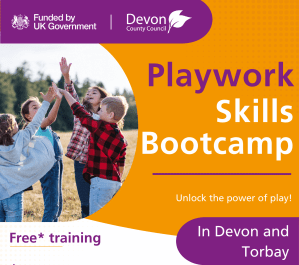
Playwork training Following on from our work with Devon County Council to develop playwork training for HAF providers, The Playwork Foundation have recently developed playwork training to accompany a pilot Playwork Skills Bootcamp currently being run in Devon and Torbay.
“Democracy is made in the playgrounds” – just one of the many quotable moments from a Westminster Hall debate last week. Brought to our attention by Jackie Boldon at Playwork in Progress, this was part of an hour-long debate secured by Tom Hayes, Labour MP for Bournemouth East, in partnership with Play England.
With Play England CEO, Eugene Minogue, in attendance, Tom expanded his opening statements with two key asks:
A new national Play Strategy for England; and
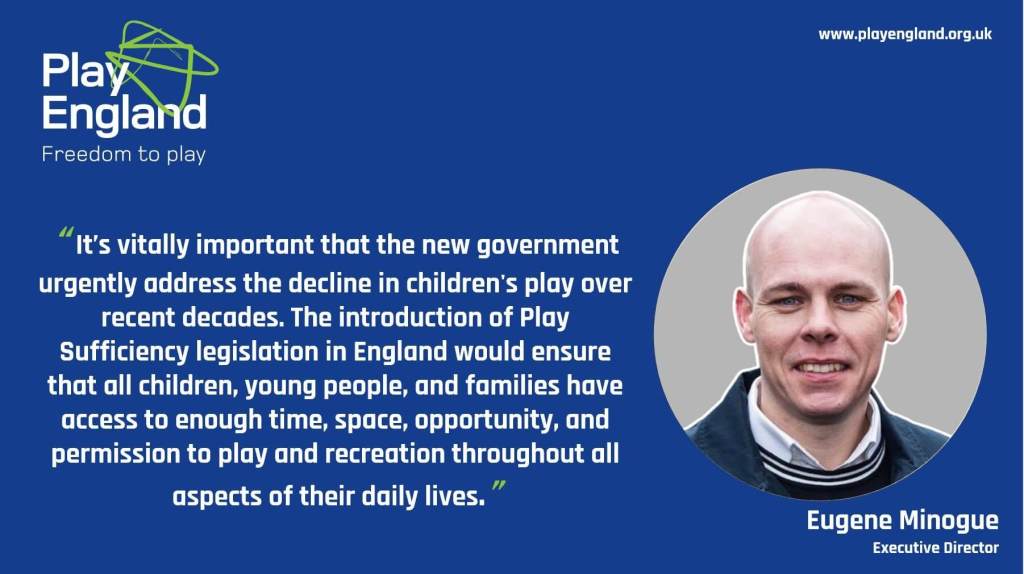
Play sufficiency legislation.
The Play England website details further success as a result of the debate in the securing of a meeting with the Parliamentary Under-Secretary of State (Local Growth and Building Safety), Alex Norris MP.
I look forward to meeting with the Minister to build on today’s debate and take forward the bold policy changes needed to give children their childhood back – Eugene Minogue, Play England, CEO
This is the latest in a long-standing campaign by Play England aimed at the new Labour Government in Westminster. In July last year, they published an open letter outlining the first steps of change that prioritised the importance of play, to which they received a response (albeit a little lacklustre) in September 2024 from the Ministry of Housing Communities & Local Government in England:
Play England is calling on supporters to help keep up the momentum by contacting their local Members of Parliament at Westminster. While play sufficiency legislation already exists in Wales and Scotland, supporters in these countries can still encourage their Westminster MPs to advocate for play and inspire their colleagues in England to take action.
Read the full debate on Hansard (official publisher of parliamentary transcripts).
To find out who you can contact, visit WriteToThem and enter your postcode.
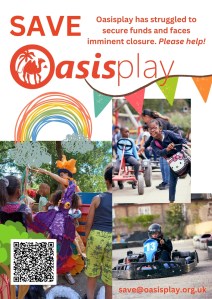
According to a post on Instagram, a community meeting is being held tonight at Stockwell Adventure Playground to discuss the future of Oasisplay.
On the Oasisplay website, it explains how, due to the closure of funding bodies and diminishing donations, Oasisplay is facing “a huge deficit” this financial year – going so far as to say that, without substantial fundraising, they will be forced to “close with immediate effect”.
“We feel confident that with the support of the community Oasisplay will survive the current situation. Please help by spreading the word and link to our fundraising page”
Further information from the JustGiving fundraising page:
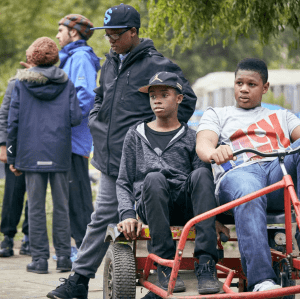
Oasisplay describes its four sites as “a Nature Garden, a youth led Go Kart Track and two amazing Adventure Playgrounds, catering for children from birth to 18 years of age, or 25 years for disabled people” and how the organisation has been a part of the local community for 50 years.
According to the JustGiving page, each year they provide over 2000 hours of free and inclusive environmental play sessions, playwork provision on their adventure playgrounds, karting and mechanics sessions, holiday playschemes, day trips, community events, educational sessions and youth leadership opportunities.
In addition to these core provisions, Oasisplay also host a weekly food hub at each of their sites, distribute free tickets to local attractions and events to support local families, offer volunteering opportunities, and host activity sessions for schools.
At the time of publishing, £38,200 had been raised equating to 25% of their £150,000 goal
Like most open-access playwork provision, their services are open to all those who wish to use them. However, many referrals come from local authority and other multi-agency groups such as social services, youth offending teams, schools and other community organisations. This may be part of the reason why their services are in higher demand than ever.
Whilst many similar organisations and provisions have been lost in recent years, the impacts of the COVID-19 pandemic and cost-of-living crisis continue to significantly affect the both the financial and health status of their community. .
Unfortunately Oasisplay has not been immune to the tough economic climate and we too have had to scale back significantly in the last 2 months, despite intense need. We are determined that this is a temporary measure and with your support we will not only be able to save Oasis from complete closure, but also bring back all of the services that we have recently cut.
£10 will pay for 1 child to attend an After School Club at the playground
£50 will pay for 3 children to attend a Saturday Club at the playground
£100 will pay for petrol and spare parts for 2 weeks of Karting sessions at the Kart Track
£150 will pay for an under-5’s Forest School Foragers session at the Nature Garden
£250 will pay for a kart maintenance and mechanics session for young people at the Kart Track
With their goal set at £150,000, what exactly will that funding be put towards?
£60,000 will fill their shortfall for the current financial year, keeping their gates open until April 2025.
£100,000 will keep sites open until August 2025 for the paying groups and projects for which additional funding can be secured.
£150,000 would allow Oasisplay to reinstate some of their free services until August 2025 and provide time to find further funding.
We are making a robust financial plan for the future, including significant cost cutting measures. We continue to explore all possible funding options and are in talks with Lambeth Council about how they may be able to help us to keep this vital service open.
Play Wales have announced a series of 4 webinars that will explore Play Sufficiency Duty in Wales. Though part of further research into the Welsh legislation and implementation, the webinars will also explore the adoption and campaign for similar play sufficiency measures in other parts of the UK.
What is Play Sufficiency?
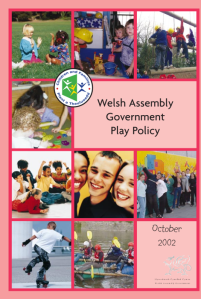
The Welsh Government’s journey to play sufficiency began in 2002, when on the 22nd October, the government unveiled its Play Policy. This policy outlined how play:
has contributed to human development;
is intrinsically motivated and an imperative;
has significantly contributed to the evolution and development of our species;
is how children learn about the world;
is freely chosen, personally-directed and intrinsically motivated;
is not necessitated upon an external goal or reward; and,
is a fundamental and integral part of health development for both the child but also wider society.
The policy also stated that play is so critical to all children’s physical, social, mental, emotional, and creative skills development, that society should seek every opportunity to support it and create environments that foster it. Furthermore, decision-making at all levels of government should consider the impact of their decisions on children’s opportunities to play.
Fast-forward, and the Children and Families Measure 2010 established Wales as the first country in the world to legislate for children’s play. Specifically, Chapter 2, Section 11 of the Measure set out a duty on all local authorities in Wales to “assess the sufficiency of play opportunities in its area for children in accordance with regulations” – something which would become more commonly known as the Play Sufficiency Duty.
The first part of the Duty commenced in November 2012 and all local authorities in Wales submitted their first Play Sufficiency Assessments in March 2013. These examined:
Demographics of each area
Open space and potential play space
Dedicated play provision
Recreational provision
Other factors that promote play opportunities (e.g. traffic, transport, planning etc)
In July 2014, the second part of the Duty commenced which required (as far as is reasonable and practical) local authorities to secure sufficient play opportunities for children in each county, having regard to their previously submitted Play Sufficiency Assessment.
To coincide with Section 11 being fully implemented, statutory guidance – ‘Wales: A Play Friendly Country’ – was issued by Welsh Ministers to local authorities on how to assess for sufficient play opportunities, and how to secure sufficient play opportunities.
Through the Planning Act 2019, Scotland similarly introduced a duty for local authorities in Scotland to undertake Play Sufficiency Assessments as part of Local Place Plans (also introduced by the legislation). And, in England, Leeds recently became the first city to voluntarily undertake Play Sufficiency Assessments led by Active Leeds through a project funded by Sport England: Get Set Leeds Local (GSLL). Play Sufficiency was also the key ask in Play England’s manifesto for the 2024 UK General Election.
The Play Wales webinars are split into 4 distinct sessions that explore the scale of play sufficiency – from the macro of the duty as a mechanism to strive towards play-friendly places, to the micro of play sufficiency at the community level. Though each webinar can stand alone, attending all four will give a more thorough insight (so make sure you book a ticket for each event!). All sessions are 12:30 – 2pm. Dates and links below:
I find that people fall into one of two camps: Those who know and care about NOS and those who are blissfully (and contently) unaware of them! If you are in the first camp, then we have some exciting news for you (if you’re in the second camp… sorry!).
Play Wales has recently published a second information sheet about the review of the National Occupational Standards (NOS) for playwork which has been taking place over the summer and anticipated to run into 2025:
The update outlines the work that has taken place this summer as well as what is expected to happen next as the review progresses. One of the headlines is the establishment of a Writing Group who will:
ensure the new playwork NOS the requirements set by the UK Standards and Framework Panel, the UK NOS Consortium and the Playwork NOS Scoping Review (2023).
Name
Location
Caroline Kerr
Northern Ireland
Martin King-Sheard
Wales
Dianne Larrington
England
Kay Maxwell
Scotland
Karen Sharp (Chair)
Scotland
Sarah Turton
Wales
Meynell Walter
England
Mike Wragg
England
Membership of the Writing Group
Recruitment to the Playwork NOS Advisory Group is ongoing, with expertise in the areas of higher education, qualifications and awarding bodies, further education delivery, open-access playwork and/or out-of-school childcare being sought. Interested parties are invited to email a CV and covering letter to nosreview@play.wales.
If you’re not able to volunteer for the Advisory Group, you will have the opportunity to feedback on the NOS during a wider public consultation expected to take place in the summer of 2025.

















 The Playwork Foundation