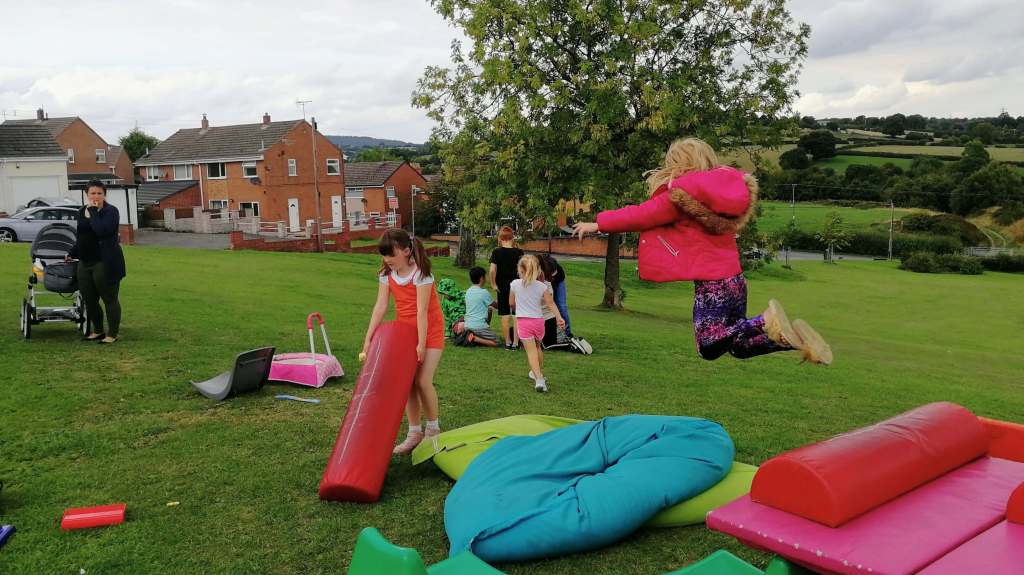
“Play sufficiency” refers to the concept of assessing – and ideally ensuring – that children have access to adequate opportunities to play.
Wales became the first country in the world to enshrine children’s right to play in law through the Children and Families (Wales) Measure 2010. This ground-breaking legislation triggered a ripple effect, inspiring similar initiatives in other countries and regions, which we aim to gather briefly here for you to explore on these pages in (roughly) chronological order.
This is under construction, so please excuse the messiness! But, we don’t want to wait for it to be polished and ready before we let people in. So, please, look around, and let us know if you think there’s something missing or wrong.
Wales
The journey to a Play Sufficiency Duty in Wales began with the then-Welsh Assembly Government announced its Play Policy during a plenary session of the Third Assembly (2003 – 2007) on 22nd October 2002.
The Minister for Health and Social Services at the time, Jane Hutt, described the decision to implement a Play Policy as:
“…an explicit demonstration of the importance that the Welsh Assembly Government places on the value of play in childhood and the importance of children in our society”
The Play Policy emphasised the profound role of play in human development, describing it as “intrinsically motivated” and “essential”. It highlighted how play had been fundamental to the evolution and growth of our species, serving as a cornerstone of how children learn about and engage with the world.
In the policy, characteristics of play are defined as “freely chosen, personally directed, and intrinsically motivated,” without the need for external goals or rewards. Play is portrayed as a fundamental and integral part of healthy development for both children and wider society.
It further states that the physical, social, and cognitive development gained exclusively through play are so critical that it is imperative that governments support play, create environments that foster play that enable it, and carefully consider the impacts of their decisions on children’s ability to play.
The Policy also reinforces the importance of children having access to “the broadest range of environments and play opportunities,” warning that the denial or insufficient provision of such access can lead to inhibited or constrained development.
The 2002 Play Policy was followed by ‘Play in Wales: The Assembly Government’s Play Policy Implementation Plan’ in 2006. The United Nations Convention on the Rights of the Child (UNCRC) was also adopted as the basis for policy-making in Wales by the Welsh Government in 2004.
Then, in 2010, the Children and Families (Wales) Measure 2010 achieved statutory affirmation making Wales the first country in the world to enact legislation to support children’s play.
Specifically, Section 11 places a duty on all local authorities to assess and secure sufficient play opportunities for children in their areas. This includes considering the needs of children with disabilities and ensuring that play opportunities are accessible and inclusive.
“…using ‘secure’ rather than ‘provide’ ensures that partnership approach. [It] also means that it doesn’t negate all providers in Wales from seeking funding from other sources for opportunities for play, for funding for play provision, because the word secure doesn’t place it as a statutory requirement”
Ruth Conway,
Deputy Director of the Early Years Childcare and Play Division, Welsh Government
However, this duty did not come into force until November 2012 when the The Play Sufficiency Assessment (Wales) Regulations 2012 were introduced. These Regulations guide local authorities on assessing play opportunities for children. They specify:
- What to include in the assessment (Regulation 3)
- Who should be consulted, such as specific individuals and groups (Regulation 4)
- The need for an action plan as part of the assessment (Regulation 5).
- How often assessments should be conducted (Regulation 6).
- How to publish the results (Regulations 7 and 8).
Broadly, the Play Sufficiency Assessments must consider nine areas:
| Matter A | Population. |
| Matter B | Providing for diverse needs. |
| Matter C | Space available for children to play (including: open spaces, outdoor unstaffed designated play spaces, and playing fields). |
| Matter D | Supervised provision (including: playwork provision and structured recreational activities). |
| Matter E | Charges for play provision. |
| Matter F | Access to space and provision, including road safety measures, transport, information and publicity. |
| Matter G | Securing and developing the play workforce. |
| Matter H | Community engagement and participation. |
| Matter I | Play within all relevant policy and implementation agendas. |
The first of these assessments were completed by local authorities in 2013, and take place every 3 years.
For more information and resources on the Play Sufficiency Assessment process, click here.
Statutory guidance to support local authorities to fulfil their new duties was issued in 2014, entitled ‘Wales – a Play Friendly Country‘. This provided a national definition of what constitutes a ‘rich play environment‘:
A rich play environment is one which is flexible, adaptable, varied and interesting. It maximises the potential for socialising, creativity, resourcefulness, challenge, and choice. It is a trusted public space where children feel free to play in their own way, in their own time, on their own terms.
The guidance also defined ‘quality play provision‘ nationally. Outlining quality play provision as offering all children the opportunity to freely interact with or experience the following:
| Other children | of different ages and abilities with a choice to play alone or with others, to negotiate, co-operate, fall out, and resolve conflict. |
| The natural world | weather, trees, plants, insects, animals, mud. |
| Loose parts | natural and man-made materials that can be manipulated, moved and adapted, built and demolished. |
| The four elements | earth, air, fire and water. |
| Challenge and uncertainty | graduated opportunities for risk taking; both on a physical and emotional level. |
| Changing identity | role play and dressing up. |
| Movement | running, jumping, climbing, balancing, rolling, swinging, sliding and spinning. |
| Rough and tumble | play fighting. |
| The senses | sounds, tastes, textures, smells and sights. |
The guidance was refreshed and updated in January 2025:
For insights into the origins of Play Sufficiency in Wales, you can watch Introducing Play Sufficiency – Why and How (21/01/25) – the first in a series of webinars, curated by Dr Wendy Russell (University of Gloucestershire) and Mike Barclay and Ben Tawil (Ludicology), with support from Play Wales.
The webinar also discusses Play Sufficiency’s inclusion into the UNCRC General Comment 17 on article 31, with Mike Greenaway (Director, Play Wales), Theresa Casey (then-President of the International Play Association) and Keith Towler (then-Children’s Commissioner for Wales), and a discussion about Play Sufficiency as an organising principle with Mike Barclay and Ben Tawil (Ludicology).
Under construction. Please check back for further information coming soon! Below are some of the links we hope to utilise in future writing:
Scotland
The journey to play sufficiency legislation in Scotland begins in 2006 when Play Scotland commissioned research to gather baseline information on how local authorities approached children’s play. 27 of the 32 local authorities responded to a survey that asked some key questions about support, policy and planning for play in the absence of any statutory duty for play, including:
- Is Play a priority for your Local Authority (e.g., in your Corporate Planning Integrated Children’s Service Plan)?
- Do you have a Play Policy?
- Do you have a Play Strategy?
- Do you have a Physical Activity Strategy and if so does it include children?
- In 2005/06 Financial year how much money will be spent on direct play provision?
- Can you estimate how much money is spent per child per week on Outdoor Play?
- How many After School Clubs, Community Buildings, Leisure Centres, Soft Play Centres are free at the point of entry?
- How many Outdoor Facilities (i.e., playgrounds, playing fields, open space sites) do you have?
- How many Strategic Play Development Officers do you employ?
- What CPD opportunities do you provide annually?
- Are you holding a Playday Event on 2 August 2006?
The following year, in 2007, a report by John McKendrick (above) was published which analysed the survey responses which highlighted just how differently each local authority was planning for and prioritising play.
Key findings included:
- Play as a priority: Whilst 68% of local authorities said they considered play a priority, only 22% of respondents indicated their authority had a specific play policy, and just 31% had a formal play strategy.
- Financial investment: The survey estimated at least £7.8 million was spent on direct play provision in 2005/06, but inconsistencies in how spending was reported (e.g., playground costs) made comparisons difficult, including variations in per-child expenditure.
- Facilities: The report documented at least 4,156 playgrounds in Scotland, with striking regional differences in the number of children per playground – for example, rural areas tended to have better ratios than major cities.
- Workforce development: Only 41% of local authorities employed a dedicated Strategic Play Development Officer, while 59% provided career development or CPD opportunities for playwork staff.
- Playday: Only 22% of authorities reported to be hosting a Playday event in 2006.
Whilst the report acknowledged its limitations – such as inconsistencies in interpretation, financial reporting, and incomplete responses – it nonetheless highlighted that play was regarded as important within Scottish local authorities. However, the approach to play was often fragmented and sector-specific, emphasising the need for a more cohesive, corporate strategy to guarantee effective provision across all regions.
Beyond these general policy considerations, the report identified five key recommendations:
- National Play Policy & Statutory Duty
A National Play Policy, backed by a statutory obligation and ring-fenced funding, should be established to ensure all children have access to adequate play opportunities. - Community Planning & Local Focus
Play should be central to Community Planning Partnerships, requiring them to develop and implement a Play Strategy to create safe, engaging, and accessible play environments. - Comprehensive Play Space Records
Standardised national and local records of playgrounds, playing fields, and other play spaces should be maintained to improve planning and equitable access. - Staff Development & Strategic Leadership
Local authorities must commit to playwork qualifications and continuous professional development for all staff involved in play, ensuring each authority has a designated strategic play champion. - Inclusive Play Access
Authorities should develop inclusive play strategies that address affordability, ensuring equitable access to after-school clubs, leisure centres, and community buildings, particularly for children from low-income households.
 The Playwork Foundation