
On Tuesday 13th May 2025, Play England will unveil its new 10-year strategy, It All Starts with Play!, at the House of Commons. The launch will coincide with the announcement of a new All-Party Parliamentary Group (APPG) on Play during a special event in the Terrace Pavilion, overlooking the River Thames.
Hosted by Labour MP for Bournemouth East, Tom Hayes, the event will bring together politicians, sector leaders, and advocates of children’s right to play. Alongside formal remarks, the event also teases the opportunity to “play and connect with key voices shaping the future of play in policy, planning, and public life”.
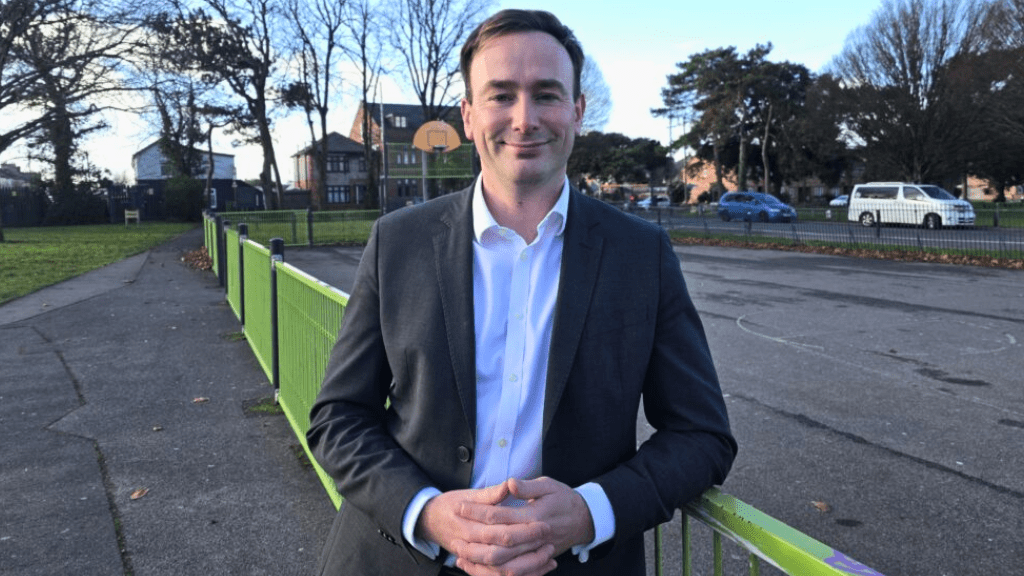
Tom Hayes MP may be fresh in your memories from January this year when he successfully tabled Westminster’s longest debate on play in 17 years – and, notably, the first debate on play in 8 years!
His motion focused on the provision of playgrounds by local authorities in England, during which he outlined two pivotal proposals:
1. That the Play Strategy for England be “dusted off… to better spend the money already in the system”.
2. Introduce Play Sufficiency Duty legislation for England, bringing it in line with Wales and Scotland, proposing the Planning and Infrastructure Bill as the perfect opportunity to do so.
These proposals were key tenets of the 2024 Play England Manifesto, making it unsurprising that Hayes was joined by Eugene Minogue, CEO of Play England, at the Palace of Westminster.
So, could the launch of It All Starts with Play! be the pivotal moment for play that playworkers in England have been waiting for?
It certainly prompts reflection on the challenges both Play England and the wider playwork sector in England have faced since the 2010 UK General Election.
The National Play Strategy, introduced by Ed Balls and Andy Burnham in 2008, represented a landmark commitment to children’s play in England, backed by £235 million to create thousands of play spaces and adventure playgrounds. However, the strategy was abandoned by the Cameron-Clegg Coalition just two years later, signalling the beginning of a sharp decline of play provision and policy across England.
With no national commitment to play, local authorities and other play providers have grappled with fragmented funding and ever-dwindling resources.
This absence of a cohesive strategy and government funding has also left the sector drawing on piecemeal funding and more corporate and private sponsorship, sometimes leading to a distortion of the role of play and playwork to comply the agendas of such funding streams.
That is why when graphics of the event sponsors accompanied the invitation to the Westminster event, some playwork advocates raised concerns about what such financial backing signalled for the future of play in England. So much so, that on sharing the news over the weekend, one commentator challenged me to “follow the money”.
PLEASE NOTE: In the original article (posted 30/04/25), it incorrectly asserted that the following organisations were sponsors of Play England. It has since been clarified that these are the sponsors of the event at Westminster, not Play England as an organisation. Our apologies for this misrepresentation.
Before I do so, it is important to note that it has been made clear by Play England that these sponsors have had no role in shaping the new 10-year strategy, which has been developed independently through the year-long process of consultation and engagement throughout 2024.
So, who are they?

- The Association of Play Industries (API) – trade association for providers of indoor and outdoor playground equipment and safety surfacing.
- Playscheme – bespoke playground equipment specialists who design, manufacture, install and maintain fixed playground equipment.
- Wicksteed – outdoor playground equipment manufacturer.
- Sutcliffe Play – employee-owned playground equipment manufacture and design.

- Play Innovation – provider of outdoor play, sports equipment and Multi Use Games Areas (MUGA)
- Notts Sport – owners of ChildsPlay who specialise in the design and supply of artificial turf carpets for fixed equipment playgrounds
- PlayNation – a publication by NationMedia in partnership with Play England, promoting play and physical activity for children & young people, and a publishing partner for the strategy itself
- Passport 365 – sports industry management software
- SAPCA – trade association for the sports and play construction industry
After closer inspection, I think it was a fair challenge to pose! But, is it tantamount to an orchestrated conspiracy or simply pragmatic promotion?
On the one hand, these organisations do not seem nefarious in their own field. They can bring expertise, resources, and innovation to the table when considering – like Tom Hayes’ debate did – the future of fixed equipment playgrounds in England. Their financial support also enables Play England to launch their new strategy on a scale befitting of such a prestigious venue. By doing so, the strategy is given an elevated platform and brings key players together more effectively and with intention.
On the other hand, it’s reasonable to question whether such alignments risk prioritising expensive, prescriptive, equipment-focused solutions to spatial injustice in children’s play more broadly – at the expense of rich play, dynamic environments curated by playworkers when it comes to policy-making.
In that model, jet-washable synthetic surfacing marginalises the mud and mums community-driven initiatives that form our heritage of adventure playgrounds and playschemes. At the same time, childhood itself risks being seen through a purely utilitarian lens, where play is not valued for its own sake but as a tool to ensure “active children become active adults”, as Mark Hardy, API Chair, framed it in the video above.
Or can both things be true? That ethically-sourced and inclusive fixed equipment playgrounds are championed, whilst the profits from such pioneering are used to fund play advocacy to secure the sector after more than two decades of neglect. That lucrative, purchasable forms of play “pay their way” by offsetting their dilution of the play spaces valued by playworkers, enabling organisations like Play England to shape policy in ways that align with principled play advocacy.

The challenge lies in balancing the benefits of sponsorship with the need to safeguard the ethos of play for play’s sake – distinct from physical activity or sport. By advocating for robust legislation and community-led initiatives, Play England has the opportunity to reclaim the narrative. Defending and strengthening the playwork perspective of play will be crucial amid what some fear is the growing influence of play equipment and sports industries.
That being said, the progress secured by Eugene and the Play England Trustees is a testament to immense passion and sustained perseverance – no doubt, like many in the sector, often unpaid and under intense scrutiny. As this next chapter unfolds, The Playwork Foundation will remain a critical friend and honest broker, advocating for the playwork principles and children’s right to play to remain central in future policy and practice.
I, for one, remain eager to see what the strategy holds. And, if certain reassurances are anything to go by, we (to borrow the Royal ‘we’) might just be pleasantly surprised!
Those wishing to attend the event on Tuesday 13th May should RSVP by Monday 6th May 2025 using the link in the email. Applicants are advised that spaces are limited and subject to confirmation.
This article was written by Siôn Edwards, the current Chair of The Playwork Foundation. They reflect his personal views and not necessarily those of The Playwork Foundation as a whole.

 The Playwork Foundation