Play Wales have announced a series of 4 webinars that will explore Play Sufficiency Duty in Wales. Though part of further research into the Welsh legislation and implementation, the webinars will also explore the adoption and campaign for similar play sufficiency measures in other parts of the UK.
What is Play Sufficiency?
The Welsh Government’s journey to play sufficiency began in 2002, when on the 22nd October, the government unveiled its Play Policy. This policy outlined how play:
- has contributed to human development;
- is intrinsically motivated and an imperative;
- has significantly contributed to the evolution and development of our species;
- is how children learn about the world;
- is freely chosen, personally-directed and intrinsically motivated;
- is not necessitated upon an external goal or reward; and,
- is a fundamental and integral part of health development for both the child but also wider society.
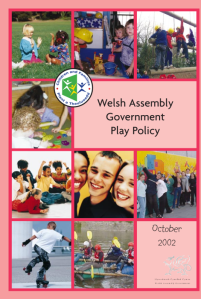
The policy also stated that play is so critical to all children’s physical, social, mental, emotional, and creative skills development, that society should seek every opportunity to support it and create environments that foster it. Furthermore, decision-making at all levels of government should consider the impact of their decisions on children’s opportunities to play.
Fast-forward, and the Children and Families Measure 2010 established Wales as the first country in the world to legislate for children’s play. Specifically, Chapter 2, Section 11 of the Measure set out a duty on all local authorities in Wales to “assess the sufficiency of play opportunities in its area for children in accordance with regulations” – something which would become more commonly known as the Play Sufficiency Duty.
The first part of the Duty commenced in November 2012 and all local authorities in Wales submitted their first Play Sufficiency Assessments in March 2013. These examined:
- Demographics of each area
- Open space and potential play space
- Dedicated play provision
- Recreational provision
- Other factors that promote play opportunities (e.g. traffic, transport, planning etc)

In July 2014, the second part of the Duty commenced which required (as far as is reasonable and practical) local authorities to secure sufficient play opportunities for children in each county, having regard to their previously submitted Play Sufficiency Assessment.
To coincide with Section 11 being fully implemented, statutory guidance – ‘Wales: A Play Friendly Country’ – was issued by Welsh Ministers to local authorities on how to assess for sufficient play opportunities, and how to secure sufficient play opportunities.

Through the Planning Act 2019, Scotland similarly introduced a duty for local authorities in Scotland to undertake Play Sufficiency Assessments as part of Local Place Plans (also introduced by the legislation). And, in England, Leeds recently became the first city to voluntarily undertake Play Sufficiency Assessments led by Active Leeds through a project funded by
Sport England: Get Set Leeds Local (GSLL). Play Sufficiency was also the key ask in Play England’s manifesto for the 2024 UK General Election.

The Play Wales webinars are split into 4 distinct sessions that explore the scale of play sufficiency – from the macro of the duty as a mechanism to strive towards play-friendly places, to the micro of play sufficiency at the community level. Though each webinar can stand alone, attending all four will give a more thorough insight (so make sure you book a ticket for each event!). All sessions are 12:30 – 2pm. Dates and links below:

 The Playwork Foundation