This article was originally published July 2016 and has been updated to better reflect the UK context.
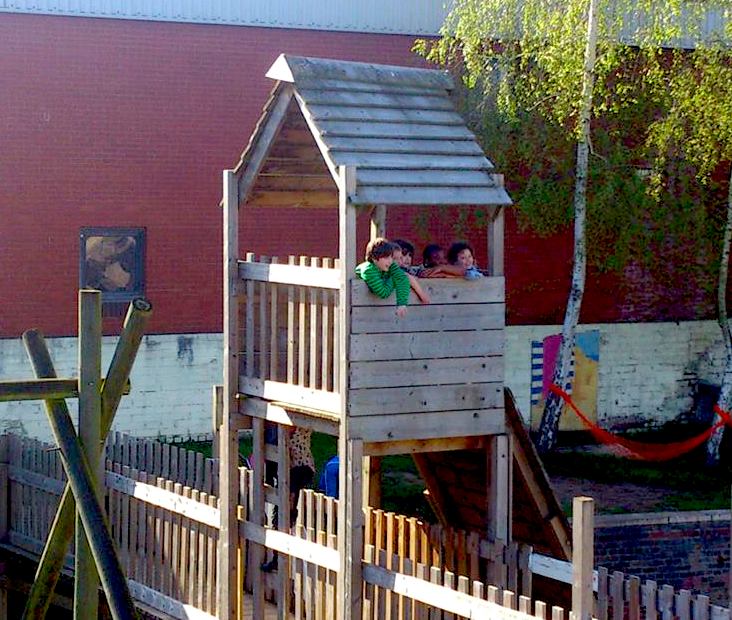
Playwork is an essential component of adventure playgrounds, a form of staffed provision renowned the world over as offering children the best opportunities to play within a dedicated, managed setting. Most adventure playgrounds are situated in areas of high density, limited open space, multiple deprivation, or a combination of all three. They offer children who are often otherwise seriously disadvantaged, enriched play opportunities within a safe, stimulating environment and an empowering, supportive community.
On-going austerity, cuts to public services and the generally unprotected nature of play provision is nevertheless leading to the closure of many of Britain’s existing adventure playgrounds. This article sets out some of the reasons why such action is bad policy, bad economics and bad for children and families; why retaining adventure playgrounds is a good use of public resources.
1. A false economy in the short-term …
The primary reason for the threat to adventure playgrounds is that local authorities need to cut costs in the face of decreasing budgets. But does closing adventure playgrounds really save money? Even in the short-term, staffed adventure playgrounds have been shown to be excellent value. The homemade equipment, use of recycled materials and the self-servicing maintenance of traditional adventure playgrounds means they require almost no capital expenditure after the initial building is in place.
Some local authorities are replacing them with fixed equipment playgrounds to the tune of up to £600,000 per playground in order to make savings in staff and running costs of less than £80,000 p.a. But fixed equipment playgrounds require regular maintenance, safety inspections, repairs and upgrading – even without the vandalism and misuse to which they are often subject (especially where they have replaced much loved staffed playgrounds). All of these costs come from council budgets, whereas the equivalent costs on staffed adventure playgrounds are minimal or covered by additional fundraising.
2. A false economy in the long-term
In the long-term, the social impact of adventure playgrounds – on children’s future life chances as well as on the opportunities for staff and volunteers in the community – has been found to deliver economic benefits to the degree that ‘every £1 invested in an adventure playground generates an estimated £1.32 in social benefits’ over a 20-year period, and every £1 invested in qualified playwork staff generates an estimated £200 in social benefits over the same period. As the research states, ‘stopping investment in adventure playgrounds … with qualified personnel would result in more costs than are saved’ (Matrix, 2010).
3. Adventure playgrounds have an important role in the lives of local children, their families and communities
Most adventure playgrounds are unique, the only such facilities in their area. They are free at the point of access and open when families most need them, offering invaluable opportunities to children and young people otherwise deprived of safe places to play. But they are not just places to play: because they are staffed, they are also self-contained communities, places of social safety and support; important resources not only for children but also for their hard-pressed families and communities (Beunderman, 2010).
4. Space for children to play is vital for their health
Recent research (Gill, 2014) has found empirical evidence that ‘play initiatives lead to improvements in children’s physical and mental health and well-being, and are linked to a range of other cognitive and social developmental benefits … Supervised out-of-school (play) provision’ in particular is ‘linked to increases in levels of physical activity and in children’s levels of well-being’.
5. Playing also improves other outcomes for children
It has been established since the introduction of the Every Child Matters policy framework in 2003-4 that enjoying informal play and recreation has a vital role in supporting children’s development, enhancing their learning, improving their physical fitness and cultivating the all-important resilience and adaptability that leads to improved outcomes.
Because they are generally situated in areas of high deprivation and used by children potentially at most risk, adventure playgrounds contribute significantly to local authorities plans to meet their responsibilities for vulnerable children and families: ensuring they are healthy and safe; narrowing the gap between those children who do well and those who need extra support to thrive; and supporting their improved resilience (Lester and Russell, 2008)
6. Responsibilities to children under UK legislation
The Children Act 2004 places a duty on local authorities in England to ‘make arrangements … with a view to improving the well-being of children in the authority’s area so far as relating to physical and mental health and emotional well-being; protection from harm and neglect; education, training and recreation; the contribution made by them to society; and their social and economic well-being’. This duty has been specifically interpreted by the Westminster government to include adequate provision for children’s informal play and recreation out of school.
In Wales, Section 28 of the Children Act 2004 imposes a duty on local authorities and other bodies such as the local police body, local health boards, NHS Trusts, probation boards and youth offending teams to ensure that their functions are discharged having regard to the need to safeguard and promote the welfare of children. In 2004, the Welsh Government also formally adopted the UNCR as the basis of policy making relating to children and young people. Later in 2011, children’s rights were enshrined in Welsh law under the Rights of Children and Young Persons (Wales) Measure 2011 which places a duty on Ministers to have due regard to the UNCRC when developing or reviewing legislation and policy – this made Wales the first UK nation to make such significant legislative arrangements to ensure the centrality of children’s rights. This means that Ministers must give the appropriate weight to the requirements of the UNCRC, balancing them against all the other factors that are relevant to the decision in question – Children’s Rights Impact Assessments are undertaken by Ministers to ensure due regard and compliance. Section 11 of the measure also places a duty on Local Authorities to assess the sufficiency of play opportunities in their areas for children in accordance with regulations – the Play Sufficiency Duty made Wales the first country in the world to legislate for children’s play. To have regard to these Play Sufficiency Assessments, a Local Authority must secure sufficient play opportunities in its area for children, so far as reasonably practicable.
In Scotland, steps are being taken to ensure that children enjoy their rights in accordance to the UNCRC. On 16 March 2021, the Scottish Parliament unanimously passed the United Nations Convention on the Rights of the Child (Incorporation) (Scotland) Bill – a landmark piece of legislation that aims to incorporate the UNCRC into Scottish law to the maximum extent of the Scottish Parliament’s powers – signalling a revolution in children’s rights in Scotland. Unfortunately, on 6 October 2021, the UK Supreme Court judgment on the Bill found 3 provisions to be outwith the legislative competence of the Scottish Parliament. While the judgment means that the Bill could not receive Royal Assent in its current form, the majority of work in relation to implementation of the UNCRC can proceed and is continuing. Child Rights and Wellbeing Impact Assessments (CRWIA) are part of an action plan to help children and young people experience their rights and to ensure that policies and legislation in Scotland protect and promote the rights and wellbeing of children and young people. The Scottish Government has stated it remains committed to the incorporation of the UNCRC to the maximum extent possible and to go through the Reconsideration Stage as soon as practicable.
The UNCRC has not yet been incorporated into domestic Northern Ireland law however a number of other policy and legislative vehicles can be used to realise children’s rights in Northern Ireland. The first of these is the Children’s Services Co-operation Act (Northern Ireland) 2015 (CSCA) which aims to improve the well-being of children and young people in a manner which realises their rights. It places obligations on Departments / Agencies to cooperate with each other in order to contribute to the improvement of outcomes for children and young people. The Act also places a statutory obligation on the Northern Ireland Executive to adopt a Children and Young People’s Strategy, the responsibility for the development and implementation of which lies with the Department of Education of Northern Ireland. There have been considerable delays in the implementation of both the CSCA and the strategy, mostly due to the lack of a Northern Ireland Executive for 3 years.
7. Obligations under international law
The United Nations (UN) Convention on the Rights of the Child (1989), to which the UK is a signatory, protects children’s right to play which is enshrined in Article 31. In 2013 the UN issued a General Comment on this article, stating that play ‘is fundamental to the quality of childhood, to children’s entitlement to optimum development, to the promotion of resilience and to the realisation of other rights’. It says that article 31 places governments under an obligation to undertake whatever action may be necessary:
‘to make available all necessary services, provision and opportunities aimed at facilitating the full enjoyment of children’s rights (to play and leisure) and that even where there are problems arising from limited resources, there is an obligation to strive to ensure the widest possible enjoyment of the relevant rights under the prevailing circumstances.’
‘As such, no regressive measures in relation to the rights under article 31 are permitted. Should any such deliberate measure be taken, the (authority) would have to prove that it has carefully considered all the alternatives, including giving due weight to children’s expressed views on the issue, and that the decision was justified bearing in mind all other rights provided for in the Convention’. (CRC, 2013)
In the 2016, the CRC reported directly on the UK’s record under article 31, expressing concern about ‘the withdrawal of a play policy in England and underfunding of play’ across the UK.
8. Doing more for children’s play has cross-party support
The All Party Parliamentary Group (APPG) on a Fit and Healthy Childhood co-chaired by Baroness Floella Benjamin (Lib Dem) and Steve McCabe MP (Lab), issued a report in 2016 which recognises the vital role of play provision in combating obesity and other health issues. It calls for ‘a new legal duty on public health bodies to work with schools and local government [in England] to ensure that all children have access to suitable play opportunities, within close proximity to their home and at school’. It also advocates a new statutory duty on local authorities in England to provide for play as part of a national strategy.
In March 2022, the APPG also hosted an open meeting which focussed on play “Misunderstanding the value of play – How to educate policy makers”. Speakers included Prof Vivian Hill from the British Psychological Society; Prof Paul Ramchandani and Dr Christine O’Farrelly from PEDAL (Play in Education, Development and Learning) at Cambridge University and Michael Follett (Outdoor Play and Learning).
It is clear that the consensus on the importance of public policy on children’s play, which saw a £390m national commitment to play in England from 2006-10, has not dissipated, only the capacity, in the short-term, to fund it from UK Government finances. But the long-term cost of rising levels of obesity caused by sedentary childhoods and increasing levels of poor mental health is bringing even this into question as a false economy; there are growing prospects of a return to a bold national vision for a country where children are supported to play freely in their local neighbourhoods by an ambitious, crosscutting government policy, such as the Play Sufficiency Duty now in place in Wales.
9. Adventure Playgrounds can secure community assets for future generations
In the London Boroughs of Islington, Hackney and Lambeth for example, local authorities and their partners have each taken measures to protect and sustain their adventure playgrounds, with Islington taking the bold step of placing each of its 12 sites under a ‘deed of dedication’ that protects them in perpetuity for children’s play.
10. Once gone, they will be lost forever
If these sites are either closed for redevelopment or turned into unstaffed, fixed equipment play areas, these invaluable facilities will be lost forever, diminishing the lives and life chances of local children. Closing adventure playgrounds, most of which have evolved over generations since the 60s and 70s, is to trash one of the UK’s great grass-roots cultural legacies; a community tradition famed the world over and which has been emulated from New York to Iraq. Far from being ‘the best place in the world to grow up’ (DCSF, 2008), childhoods will continue to shrink and the country will be diminished.
Download a briefing paper based on this article, to use in local campaigns.
References and useful resources
All Party Parliamentary Group (APPG) on a fit and Healthy Childhood, London, 2014, Healthy Patterns for Healthy Families: Removing the Hurdles to a Healthy Family, London: APPG
Beunderman, J, 2010, People make play, London: Demos / Play England
Committee on the Rights of the Child, 2016, Concluding observations on the fifth periodic report of the United Kingdom of Great Britain and Northern Ireland. Geneva: CRC
Department for Children, Schools and Families (DCSE), 2007, The children’s plan: Building brighter futures, London: The Stationery Store
Dodd, H F and Lester, K, J, 2022 “Adventurous Play as a Mechanism for Reducing Risk for Childhood Anxiety: A Conceptual Model” in Clinical Child and Family Psychology Review Available at: https://link.springer.com/article/10.1007/s10567-020-00338-w
Dodd, H, F, Nesbit, R, J and FitzGibbon, L, 2022 “Child’s Play: Examining the Association Between Time Spent Playing and Child Mental Health” in Child Psychiatry & Human Development Available at: https://link.springer.com/article/10.1007/s10578-022-01363-2
Dodd, H. F. FitzGibbon, L. Watson, B. E. and Nesbit, R. J., 2022 “Children’s Play and Independent Mobility in 2020: Results from the British Children’s Play Survey” in International Journal of Environmental Research and Public Health, available at https://www.mdpi.com/1660-4601/18/8/4334
Gill, T, 2014, The Play Return, London: Children’s Play Policy Forum
Godfrey, L, 2022, Play England Report into the State of Adventure Playgrounds in England available at: https://www.playengland.org.uk/newsblog/interview-with-anita-grant-for-modern-mindset-with-adam-cox-erae3-d2xj8
Matrix Evidence, 2010, An economic evaluation of play provision: Final report, London: Play England
Nesbit, R. J. Bagnall, C. L. Harvey, K. and Dodd, H. F. 2022 Perceived Barriers and Facilitators of Adventurous Play in Schools: A Qualitative Systematic Review” in Children, Available at https://www.mdpi.com/2227-9067/8/8/681
Weale, S (2022) “Adventurous play boosts children’s mental health, study finds”, The Guardian, available at: https://www.theguardian.com/society/2022/may/20/adventurous-play-boosts-childrens-mental-health-study-finds
 The Playwork Foundation
Reblogged this on Play and Other Things….
LikeLike
Good Blog
LikeLike